
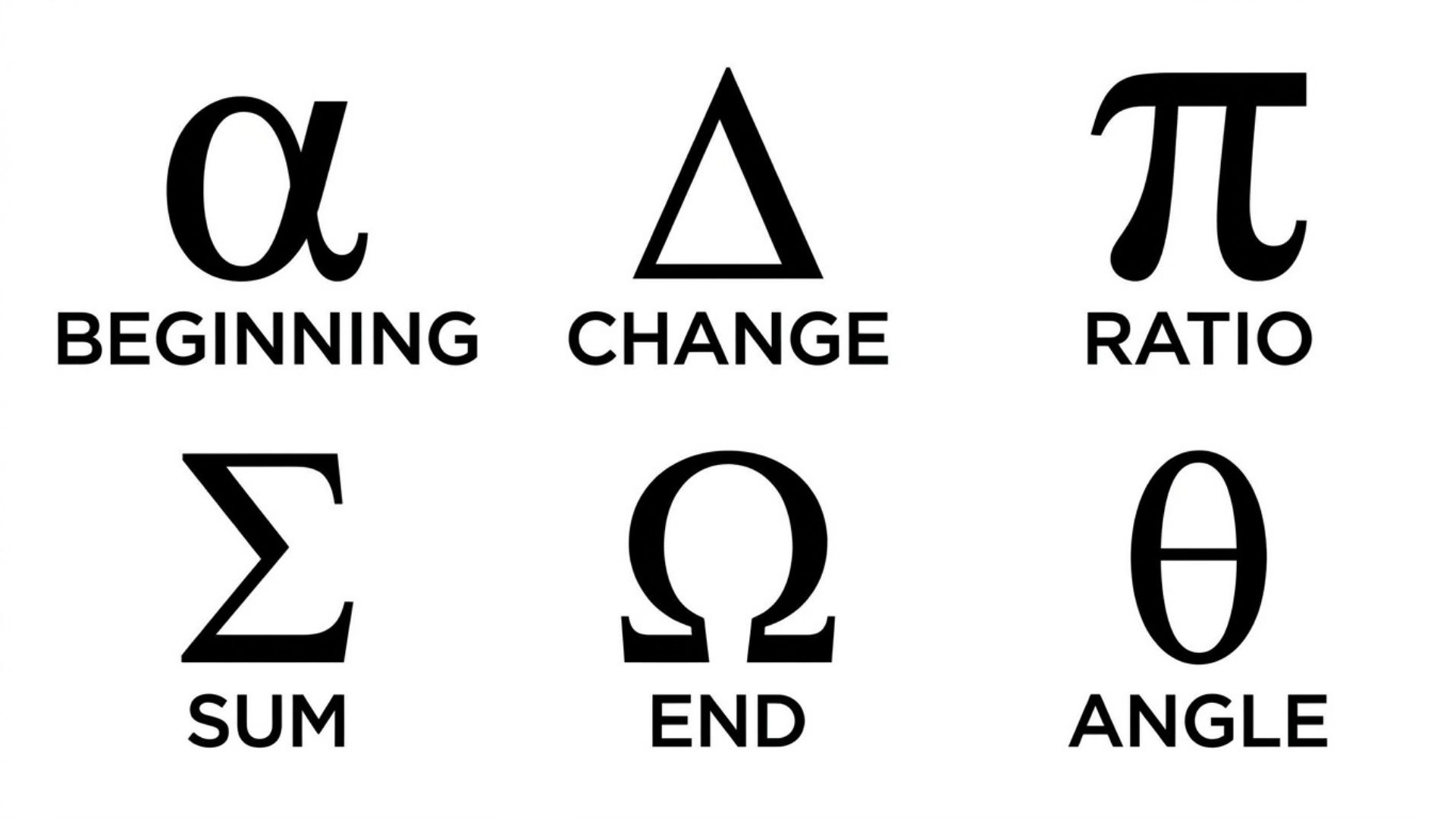
Greek symbols are letters from the Greek alphabet that are widely used in mathematics, physics, statistics, engineering, astronomy, chemistry, and other fields. Some are also familiar outside science, such as π (pi), Δ (delta), Σ (sigma), and Ω (omega).
The Greek alphabet has 24 standard letters, beginning with alpha and ending with omega. Each letter has an uppercase and lowercase form, although some lowercase letters also have special variants. In scientific and mathematical writing, a Greek letter can have different meanings depending on the subject and the formula in which it appears.
For example, μ (mu) may represent a population mean in statistics, while λ (lambda) may represent wavelength in physics. Similarly, σ (sigma) is commonly used for standard deviation in statistics but can represent other quantities in physics and mathematics.
This guide explains the Greek symbols, their names, common meanings, pronunciation, scientific uses, and the easiest ways to identify them.
Greek Symbols at a Glance
Quick Greek Symbols Reference Table
| Letter | Uppercase | Lowercase | Name | Common Uses |
| Alpha | Α | α | Alpha | Angle, coefficient, significance level |
| Beta | Β | β | Beta | Coefficient, beta particle, angle |
| Gamma | Γ | γ | Gamma | Gamma radiation, angle, mathematical functions |
| Delta | Δ | δ | Delta | Change, difference, small variation |
| Epsilon | Ε | ε | Epsilon | Small quantity, error, mathematical limits |
| Zeta | Ζ | ζ | Zeta | Mathematical functions, variables |
| Eta | Η | η | Eta | Efficiency, variables |
| Theta | Θ | θ | Theta | Angle, temperature, parameters |
| Iota | Ι | ι | Iota | Variables, mathematical notation |
| Kappa | Κ | κ | Kappa | Curvature, constants, variables |
| Lambda | Λ | λ | Lambda | Wavelength, eigenvalue, decay constant |
| Mu | Μ | μ | Mu | Mean, coefficient of friction, micro |
| Nu | Ν | ν | Nu | Frequency, viscosity, variables |
| Xi | Ξ | ξ | Xi | Mathematical variables, random variables |
| Omicron | Ο | ο | Omicron | Greek letter, variables |
| Pi | Π | π | Pi | Circle constant, product notation |
| Rho | Ρ | ρ | Rho | Density, correlation, resistivity |
| Sigma | Σ | σ | Sigma | Summation, standard deviation, stress |
| Tau | Τ | τ | Tau | Torque, time constant, shear stress |
| Upsilon | Υ | υ | Upsilon | Variables, physics notation |
| Phi | Φ | φ | Phi | Angle, phase, golden ratio in some contexts |
| Chi | Χ | χ | Chi | Chi-square statistics, variables |
| Psi | Ψ | ψ | Psi | Wave functions, variables |
| Omega | Ω | ω | Omega | Ohm, angular frequency, variables |
These meanings are common examples rather than universal definitions. Mathematical notation is context-dependent, and Unicode’s mathematical character documentation also records Greek letter variants that can have distinct mathematical semantics.
What Do Greek Symbols Mean?
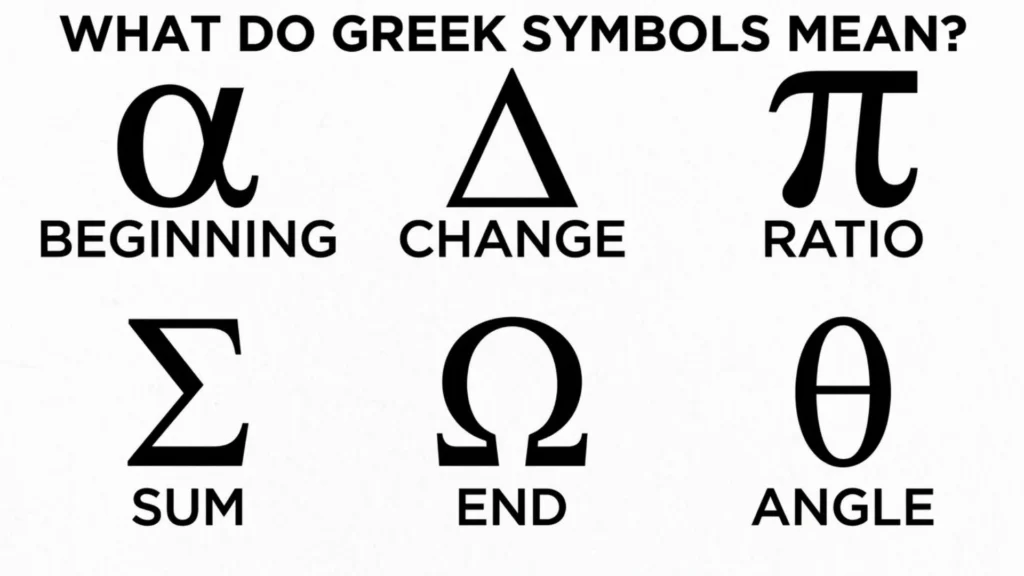
A Greek symbol has two related identities.
First, it is a letter of the Greek alphabet. For example, π is the Greek letter pi.
Second, it may be used as a symbol in a particular field. In mathematics, π is the familiar circle constant. In another context, a Greek letter may represent an angle, coefficient, parameter, physical quantity, or statistical value.
This means you should not assume that every Greek letter has one fixed scientific meaning.
The best way to determine a symbol’s meaning is to look at:
- The subject being studied.
- The formula around the symbol.
- Whether the symbol is uppercase or lowercase.
- The definition given by the author, textbook, or instructor.
The 24 Greek Letters and Their Symbols
Alpha — Α α
Alpha is the first letter of the Greek alphabet.
The lowercase symbol α is commonly used in mathematics and science for quantities such as angles, coefficients, parameters, and significance levels in statistics.
In physics, alpha can also appear in the name of alpha particles and in various formulas.
Example:
α = 30°
Here, α represents an angle.
The uppercase form Α looks similar to the Latin letter A.
Beta — Β β
Beta is the second Greek letter.
The lowercase β is frequently used for coefficients, parameters, angles, and statistical quantities. In physics, beta is also associated with beta particles and beta radiation.
For example:
y = α + βx
Here, β can represent the coefficient of x.
The uppercase Β resembles the Latin letter B, but it is a Greek character.
Gamma — Γ γ
Gamma is the third Greek letter.
The lowercase γ appears in mathematics and physics for angles, constants, and specialized quantities. Gamma is also strongly associated with gamma radiation.
The uppercase Γ has a distinctive shape and is sometimes used in mathematics for functions and other structures.
For example:
γ = 90°
could use γ as an angle when the surrounding context defines it that way.
Delta — Δ δ
Delta is the fourth Greek letter and is one of the most recognizable scientific symbols.
The uppercase Δ commonly represents a change or difference.
For example:
Δx = x₂ − x₁
means the change in x between two values.
The lowercase δ can represent a small change, variation, or a specialized mathematical or scientific quantity.
Delta is particularly useful because the uppercase and lowercase forms can have noticeably different conventional uses.
Epsilon — Ε ε
Epsilon is the fifth Greek letter.
The lowercase ε commonly appears in mathematics to represent a small positive quantity, particularly in discussions involving limits and proofs. It can also represent an error or other parameter depending on the subject.
For example:
|x − a| < ε
uses ε as a small positive quantity.
The uppercase Ε looks like the Latin E.
Zeta — Ζ ζ
Zeta is the sixth Greek letter.
The lowercase ζ appears in mathematical notation and in the names of several mathematical functions.
One famous example is the Riemann zeta function, commonly written as:
ζ(s)
Zeta is less commonly encountered by beginners than symbols such as π, α, Δ, or σ, but it remains an important Greek letter in advanced mathematics.
Eta — Η η
Eta is the seventh Greek letter.
The lowercase η can represent different quantities in scientific and engineering formulas. One common use is as a symbol for efficiency.
For example:
η = useful output / total input
may describe efficiency when that notation is defined for the particular problem.
The uppercase Η looks similar to the Latin H.
Theta — Θ θ
Theta is the eighth Greek letter.
The lowercase θ is one of the most common Greek symbols in mathematics and is frequently used to represent an angle.
For example:
θ = 45°
In physics and engineering, θ can also represent a parameter or another quantity.
The uppercase Θ is also important in mathematics and computer science, where it can appear in asymptotic notation such as Θ(n).
Iota — Ι ι
Iota is the ninth Greek letter.
The lowercase ι is used mainly as a variable or specialized mathematical symbol.
It is not as common in elementary scientific formulas as π, α, β, or θ.
The uppercase Ι looks almost identical to the Latin capital I, which can make it difficult to distinguish in some fonts.
Kappa — Κ κ
Kappa is the tenth Greek letter.
The lowercase κ is used in mathematics, statistics, physics, and other technical fields for different parameters and constants.
For example, κ may represent curvature or another coefficient depending on the subject.
The uppercase Κ resembles the Latin K.
Lambda — Λ λ
Lambda is the eleventh Greek letter.
The lowercase λ is particularly important in physics because it commonly represents wavelength.
A familiar relationship is:
λ = v/f
where λ represents wavelength, v represents wave speed, and f represents frequency.
Lambda is also used in mathematics for eigenvalues and in computer science for concepts related to lambda calculus and anonymous functions.
The uppercase Λ appears in other mathematical and scientific notation.
Mu — Μ μ
Mu is the twelfth Greek letter.
The lowercase μ has many important uses.
In statistics, μ commonly represents a population mean.
In physics, μ may represent a coefficient of friction, permeability, or another physical quantity depending on context.
The symbol μ is also associated with the SI prefix micro-, meaning one millionth, when used as a unit prefix.
For example:
1 μm = 0.000001 m
The uppercase Μ looks like the Latin M.
Nu — Ν ν
Nu is the thirteenth Greek letter.
The lowercase ν is used for different quantities in physics, mathematics, and engineering.
In some physics contexts, ν represents frequency.
It can also be used for other parameters, so the surrounding formula should always be checked.
The uppercase Ν looks like the Latin N.
Xi — Ξ ξ
Xi is the fourteenth Greek letter.
The lowercase ξ is used as a mathematical variable and can appear in probability, statistics, mathematics, and physics.
The uppercase Ξ has a distinctive three-horizontal-line shape.
Xi is not usually one of the first Greek symbols beginners learn, but it is useful when reading advanced mathematical notation.
Omicron — Ο ο
Omicron is the fifteenth Greek letter.
Its uppercase and lowercase forms are:
Ο ο
Omicron is less common as a distinctive mathematical symbol because its lowercase form resembles the Latin o and its uppercase form resembles O.
It can still appear as a variable or Greek letter in specialized notation.
Pi — Π π
Pi is the sixteenth Greek letter and one of the world’s best-known mathematical symbols.
The lowercase π represents the ratio of a circle’s circumference to its diameter.
Its approximate value is:
π ≈ 3.14159
A common formula is:
A = πr²
where A is the area of a circle and r is its radius.
The uppercase Π is also used in mathematics, especially for product notation, where it can represent the multiplication of a sequence of terms.
Rho — Ρ ρ
Rho is the seventeenth Greek letter.
The lowercase ρ has several scientific uses.
In physics, it commonly represents density:
ρ = mass / volume
In statistics, ρ can represent a population correlation coefficient in some notation systems.
The uppercase Ρ looks like the Latin capital P, but it is the Greek letter rho.
The uppercase Σ commonly represents summation.
For example:
Σxᵢ
indicates that a collection of x values is being added according to the notation.
The lowercase σ commonly represents standard deviation in statistics, although it can represent other quantities in different fields. MathWorld notes that sigma has several mathematical uses and that σ is commonly used for standard deviation.
Greek writing also uses ς, called final sigma, in particular word positions. Unicode separately identifies the final sigma character.
Tau — Τ τ
Tau is the nineteenth Greek letter.
The lowercase τ can represent torque, a time constant, or other quantities in physics and engineering.
For example, in some physical systems:
τ
may describe a characteristic time or time constant.
The exact meaning depends on the formula.
The uppercase Τ resembles the Latin T.
Upsilon — Υ υ
Upsilon is the twentieth Greek letter.
The lowercase υ is used as a variable in scientific and mathematical notation.
It is less common in basic formulas than symbols such as π, α, θ, or λ.
The uppercase Υ resembles the Latin Y but is a Greek letter.
Phi — Φ φ
Phi is the twenty-first Greek letter.
The lowercase φ is commonly used for angles, phase, and other quantities in mathematics and physics.
Phi is also associated with the golden ratio in some mathematical contexts, although notation and conventions can vary.
The uppercase Φ can represent other specialized quantities, including physical and mathematical parameters.
Some mathematical systems also distinguish variant phi forms. Unicode documents these Greek mathematical variants separately.
Chi — Χ χ
Chi is the twenty-second Greek letter.
The lowercase χ is particularly familiar in statistics through chi-square notation.
For example:
χ²
is read as “chi-squared.”
Chi-square methods are used in statistics for various hypothesis-testing and goodness-of-fit applications.
The uppercase Χ resembles the Latin X, but it is a Greek character.
Psi — Ψ ψ
Psi is the twenty-third Greek letter.
The lowercase ψ is widely recognized in physics, particularly quantum mechanics, where it can represent a wave function.
It can also appear as a variable in mathematics and other technical subjects.
The uppercase Ψ is used in other scientific and mathematical contexts.
Omega — Ω ω
Omega is the twenty-fourth and final Greek letter.
The uppercase Ω is especially familiar in electrical engineering because it is the symbol for the ohm, the SI derived unit of electrical resistance.
The lowercase ω is commonly used for angular frequency in physics:
ω = 2πf
where f is ordinary frequency.
Omega can also have specialized mathematical meanings depending on the field.
Greek Symbols in Mathematics
Pi and Circle Calculations
The symbol π is one of the most important Greek symbols in mathematics.
It appears in formulas involving circles, including:
C = 2πr
and:
A = πr²
Here, π connects the radius of a circle with its circumference and area.
Sigma and Summation
The uppercase symbol Σ is used to represent summation.
For example:
Σᵢxᵢ
indicates that values represented by xᵢ are being added across the relevant index range.
Sigma allows a long addition process to be written compactly.
Delta and Change
The uppercase Δ is often used to indicate a change or difference.
For example:
Δy = y₂ − y₁
means the change in y between two values.
This convention appears in mathematics, physics, economics, and many other quantitative subjects.
Theta and Angles
The symbol θ is frequently used to represent an angle.
For example:
sin θ
means the sine of angle θ.
You will commonly see theta in trigonometry, geometry, physics, and engineering.
Epsilon and Small Quantities
The symbol ε often represents a small positive quantity in mathematical proofs and limit arguments.
It allows mathematicians to express ideas involving arbitrarily small tolerances or distances.
For example:
|x − a| < ε
can describe a requirement that x be within ε of a.
Greek Symbols in Physics
Alpha, Beta, and Gamma
Physics uses several Greek letters to identify particles, radiation, parameters, and physical quantities.
Alpha, beta, and gamma are particularly recognizable because of alpha, beta, and gamma radiation.
However, a Greek letter’s use in a physics equation may be completely different from its use in nuclear physics.
Lambda and Wavelength
In wave physics, λ commonly represents wavelength.
A common relationship is:
λ = v/f
where:
- λ = wavelength
- v = wave speed
- f = frequency
This is one of the most recognizable scientific uses of lambda.
Mu, Rho, Sigma, and Tau
Several Greek symbols are frequently used for physical quantities:
- μ can represent friction-related or electromagnetic quantities.
- ρ can represent density.
- σ can represent stress in mechanics or another physical quantity.
- τ can represent torque or a time constant.
The correct meaning must be determined from the subject and equation.
Omega and Angular Frequency
The lowercase ω is widely used for angular frequency.
A common relationship is:
ω = 2πf
where ω is angular frequency and f is frequency.
The uppercase Ω has a very different familiar scientific role as the symbol for electrical resistance measured in ohms.
Greek Symbols in Statistics
Alpha and Significance
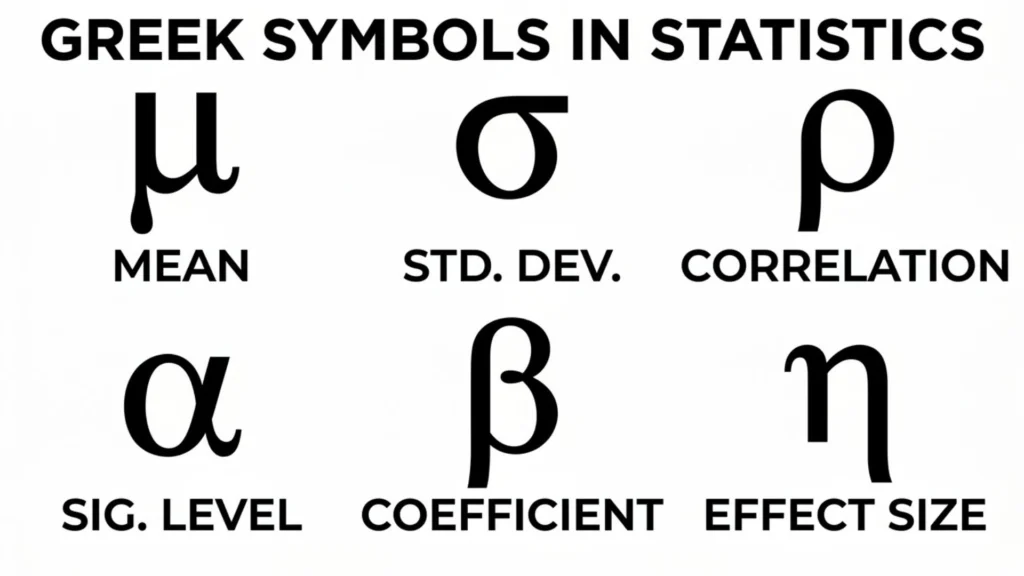
In statistics, α commonly represents a significance level.
For example, a statistical test might use:
α = 0.05
The significance level is part of the framework used to evaluate statistical evidence.
Mu and Population Mean
The symbol μ is commonly used for a population mean.
For example, a population parameter may be represented as:
μ = population mean
This is different from x̄, which is commonly used for a sample mean.
Sigma and Standard Deviation
The lowercase σ commonly represents the population standard deviation.
Standard deviation describes the spread of values around a mean.
The important point is that sigma’s meaning comes from its statistical context. In another field, σ may represent something entirely different. MathWorld also notes that sigma can have several meanings beyond standard deviation.
Rho and Correlation
The lowercase ρ can represent a population correlation coefficient.
Correlation measures the strength and direction of a relationship between variables.
The exact notation can vary, so the statistical context should always be checked.
Chi-Squared
The symbol χ² is commonly used in statistics for chi-square methods and distributions.
For example, chi-square tests can be used for categorical data and goodness-of-fit questions.
This is one reason χ is particularly recognizable to statistics students.
Greek Symbols in Engineering
Stress and Strain Symbols
Engineering formulas use Greek letters extensively.
For example:
- σ may represent stress.
- ε may represent strain.
- τ may represent shear stress.
- ρ may represent density.
- μ may represent a friction coefficient.
These meanings are not universal. Engineering textbooks generally define the symbols used in each formula or discipline.
Electrical and Mechanical Symbols
Greek symbols are also common in electrical and mechanical engineering.
Examples include:
- Ω for ohm
- ω for angular frequency
- τ for time constants or torque
- η for efficiency
- μ for permeability or other physical parameters
The same letter can therefore appear in multiple engineering disciplines with different meanings.
Uppercase vs Lowercase Greek Symbols
Common Uppercase Symbols
Some uppercase Greek letters have especially recognizable mathematical or scientific uses:
- Δ — change or difference
- Σ — summation
- Π — product notation
- Ω — ohm in electrical notation
- Θ — theta; also used in mathematical notation
- Λ — lambda in uppercase form
- Φ — phi in uppercase form
Uppercase and lowercase forms should not automatically be treated as interchangeable.
Common Lowercase Symbols
Some highly recognizable lowercase forms include:
- α — alpha
- β — beta
- γ — gamma
- δ — delta
- θ — theta
- λ — lambda
- μ — mu
- π — pi
- ρ — rho
- σ — sigma
- τ — tau
- φ — phi
- χ — chi
- ψ — psi
- ω — omega
Why Case Matters
Changing the case can change the conventional meaning.
For example:
Σ commonly indicates summation, while σ commonly represents standard deviation in statistics.
Similarly:
Π can indicate product notation, while π is the circle constant.
This is why identifying whether a symbol is uppercase or lowercase is an important first step when reading a formula.
Greek Symbols You Can Copy and Paste
Uppercase Greek Symbols
Here is a convenient uppercase Greek alphabet:
Α Β Γ Δ Ε Ζ Η Θ Ι Κ Λ Μ Ν Ξ Ο Π Ρ Σ Τ Υ Φ Χ Ψ Ω
Lowercase Greek Symbols
Here is the lowercase Greek alphabet:
α β γ δ ε ζ η θ ι κ λ μ ν ξ ο π ρ σ τ υ φ χ ψ ω
Common Scientific Symbols
Frequently used Greek symbols include:
α β γ Δ δ θ λ μ π ρ Σ σ τ φ χ ψ Ω ω
You can copy these directly when you need them in notes, documents, messages, or educational material.
Some mathematical environments also use special Greek glyph variants, such as different forms of theta, phi, pi, epsilon, rho, and kappa. Unicode explicitly records several such variants because mathematical documents can use different glyph forms with different semantics.
Greek Symbols That Look Like Latin Letters
Common Visual Confusions
Some Greek letters look very similar to English letters.
Examples include:
| Greek Symbol | Greek Name | Similar Latin Letter |
| Α | Alpha | A |
| Β | Beta | B |
| Ε | Epsilon | E |
| Η | Eta | H |
| Ι | Iota | I |
| Κ | Kappa | K |
| Μ | Mu | M |
| Ν | Nu | N |
| Ο | Omicron | O |
| Ρ | Rho | P |
| Τ | Tau | T |
| Χ | Chi | X |
| Υ | Upsilon | Y |
This can be confusing when reading formulas because a Greek symbol may visually resemble an English letter while representing a completely different character.
Greek vs Latin Letters
For example:
P is the Latin letter P.
Ρ is the Greek letter rho.
Likewise:
X is the Latin letter X.
Χ is the Greek letter chi.
They may look almost identical in some fonts, but they are different characters.
This distinction matters when typing symbols into documents, code, mathematical software, or search boxes.
How to Identify the Meaning of a Greek Symbol
Check the Context
The same Greek letter can mean different things in different subjects.
For example, μ could mean:
- population mean in statistics
- coefficient of friction in mechanics
- permeability in electromagnetism
- micro- as a unit prefix
Therefore, the letter alone may not provide enough information.
Look at the Formula
Look at the symbols immediately around the Greek letter.
For example:
λ = v/f
strongly suggests that λ is wavelength.
Likewise:
σ
inside a statistics problem may suggest standard deviation.
Identify the Subject
Ask what subject you are studying.
If the topic is:
- statistics → μ and σ may have statistical meanings
- physics → λ may mean wavelength
- geometry → θ may mean an angle
- electrical engineering → Ω may indicate ohms
- calculus → ε may appear in limit definitions
- mathematics → Σ may indicate summation
The subject often provides the strongest clue.
Check the Definition
When reading a textbook, research paper, or formula sheet, look for a symbol definition.
For example:
Let μ denote the population mean.
Once the author defines μ, that definition takes priority for that particular problem.
Never assume that the most famous meaning of a Greek letter must be the meaning intended by the author.
Greek Symbols in Common Formulas
Mathematics Example
Consider:
A = πr²
Here:
- A = area
- π = pi
- r = radius
Pi is the Greek symbol connecting the radius to the area of a circle.
Physics Example
Consider:
λ = v/f
Here:
- λ = wavelength
- v = wave speed
- f = frequency
Lambda is being used as a wavelength symbol.
Statistics Example
Consider:
z = (x − μ) / σ
In a common standardized-score setting:
- x = observed value
- μ = population mean
- σ = population standard deviation
- z = standardized value
This example demonstrates why understanding the subject is important. The same Greek symbol can have another meaning in another discipline.
Frequently Asked Questions About Greek Symbols and Meanings
How many Greek symbols are there?
The standard Greek alphabet contains 24 letters, from alpha to omega. Each standard letter has an uppercase and lowercase form, although Greek also contains additional historical letters and variant symbols beyond the standard modern alphabet.
What are the 24 Greek letters?
The 24 letters are alpha, beta, gamma, delta, epsilon, zeta, eta, theta, iota, kappa, lambda, mu, nu, xi, omicron, pi, rho, sigma, tau, upsilon, phi, chi, psi, and omega.
What does α mean?
Alpha (α) can represent an angle, coefficient, parameter, statistical significance level, or other quantity depending on the field.
What does β mean?
Beta (β) is used for coefficients, parameters, angles, and various scientific quantities. It is also associated with beta particles in physics.
What does Δ mean?
Delta (Δ) commonly represents a change or difference. For example, Δx can mean the change in x.
What does π mean?
Pi (π) is the mathematical constant representing the ratio of a circle’s circumference to its diameter. It is approximately 3.14159.
What does μ mean?
Mu (μ) has several common meanings. In statistics, it often represents a population mean. In physics and engineering, it can represent other quantities such as a coefficient of friction or permeability.
What does σ mean?
Sigma (σ) commonly represents population standard deviation in statistics. It also has other meanings in mathematics, physics, and engineering.
What does λ mean?
Lambda (λ) commonly represents wavelength in physics. It is also used for eigenvalues, decay constants, and other mathematical or computer-science concepts.
What does Ω mean?
Omega (Ω) is commonly used as the symbol for the ohm, the SI unit of electrical resistance. The lowercase ω is commonly used for angular frequency.
Can I copy and paste Greek symbols?
Yes. You can copy symbols such as α β γ Δ θ λ μ π Σ σ φ Ω ω directly into documents, notes, messages, and other applications.
Why are Greek letters used in mathematics and science?
Greek letters provide a convenient set of symbols that can be assigned to variables, constants, parameters, angles, physical quantities, and mathematical operations. Their use also helps distinguish different quantities from ordinary Latin-letter variables.
Do Greek symbols have different meanings?
Yes. A Greek letter can have several meanings depending on the field and the formula. For example, σ can represent standard deviation in statistics but stress in some engineering contexts.
Are Greek symbols the same as Greek letters?
Not exactly. A Greek letter is part of the Greek alphabet. When that letter is used in a mathematical, scientific, engineering, or other specialized context, it functions as a symbol with a particular meaning.
What is the difference between uppercase and lowercase Greek symbols?
Uppercase and lowercase Greek letters are different forms of the same alphabetic letter, but they may have different conventional uses in mathematics and science. For example, Σ commonly represents summation while σ commonly represents standard deviation.
Conclusion
Greek symbols are much more than a collection of unusual characters. They are the 24 letters of the Greek alphabet used in a wide range of mathematical, scientific, statistical, engineering, and technical notation.
Some symbols have become especially familiar: π for the circle constant, Σ for summation, Δ for change, θ for angles, λ for wavelength, μ for a population mean in statistics, σ for standard deviation, and Ω for electrical resistance. However, these meanings are not universal. The subject, formula, uppercase or lowercase form, and author’s definitions all help determine what a Greek symbol means.
If you are trying to identify an unfamiliar symbol, first find its Greek letter name, then check its case and the context in which it appears. This simple approach makes even complicated formulas much easier to understand.

Elliot Kensington
Elliot Kensington is a storyteller at heart, always fascinated by the hidden corners of human imagination. From a young age, he found comfort in books and the worlds they created, inspiring him to craft tales that blend emotion, suspense, and wonder. His writing journey began with short stories that captured fleeting moments of life, and over time, evolved into novels that explore both the extraordinary and the everyday. Elliot believes that every story holds a piece of the soul, and his mission is to connect readers to those moments that linger long after the last page. When he’s not writing, he enjoys exploring nature, capturing moments through photography, and seeking inspiration in the little things.
Books by Elliot Kensington:
-
Shadows of Tomorrow
-
The Whispering Path