
Logic symbols are special signs used to represent logical relationships between statements, conditions, and ideas. They make complex reasoning easier to write, read, and analyze in mathematics, computer science, philosophy, programming, and digital electronics.
Common examples include ¬ for NOT, ∧ for AND, ∨ for OR, → for implication, and ↔ for “if and only if.” Other symbols such as ∀ and ∃ are used to express statements about all or some members of a group.
If you are trying to identify a logic symbol, understand what it means, learn how to read a logical expression, or copy a symbol for your own work, this guide provides a practical reference.
Logic Symbols at a Glance
Quick Reference Chart
| Symbol | Name | Meaning | Read As | Example |
| ¬ | Negation | Reverses a truth value | not | ¬P |
| ∧ | Conjunction | Both statements must be true | and | P ∧ Q |
| ∨ | Disjunction | At least one statement is true | or | P ∨ Q |
| ⊕ | Exclusive OR | Exactly one statement is true | XOR | P ⊕ Q |
| → | Implication | One statement implies another | if…then | P → Q |
| ↔ | Biconditional | Both statements have the same truth value | if and only if | P ↔ Q |
| ∀ | Universal quantifier | Applies to every member | for all | ∀x P(x) |
| ∃ | Existential quantifier | Applies to at least one member | there exists | ∃x P(x) |
| ∄ | Non-existence | No member satisfies a condition | there does not exist | ∄x P(x) |
| ⊤ | Truth | Always true | true | P ∨ ¬P |
| ⊥ | Falsity | Always false | false | P ∧ ¬P |
| ≡ | Logical equivalence | Expressions have the same logical value | logically equivalent to | P ≡ Q |
| ⊨ | Semantic consequence | A statement follows logically from another | entails | P ⊨ Q |
| ⊢ | Syntactic derivation | A statement can be formally derived | proves | P ⊢ Q |
The exact notation can vary between textbooks, courses, programming languages, and branches of logic. However, the symbols above are among the most widely encountered forms.
The Seven Basic Logic Symbols
For beginners, the most important symbols to learn first are:
- ¬ — NOT
- ∧ — AND
- ∨ — OR
- ⊕ — XOR
- → — implication
- ↔ — biconditional
- ∀ / ∃ — quantifiers
The first five are especially common in propositional logic and Boolean reasoning. University mathematics courses commonly introduce NOT, AND, and OR with truth tables and then move to implication and related logical relationships.
Basic Logic Symbols
¬ Negation
The symbol ¬ means NOT or negation.
It changes a statement from true to false or from false to true.
For example:
P: The door is open.
Then:
¬P: The door is not open.
The truth relationship is simple:
| P | ¬P |
| True | False |
| False | True |
Negation is useful when you need to express the opposite of a proposition.
You may also see other notation for negation, such as ~P or !P in particular contexts. The exact notation depends on the system being used.
∧ Conjunction
The symbol ∧ means AND.
The expression:
P ∧ Q
means that P and Q are both true.
For example:
- P = I finished my homework.
- Q = I submitted my homework.
Then:
P ∧ Q
means:
“I finished my homework and submitted it.”
A conjunction is true only when both parts are true.
| P | Q | P ∧ Q |
| F | F | F |
| F | T | F |
| T | F | F |
| T | T | T |
∨ Disjunction
The symbol ∨ means OR.
The expression:
P ∨ Q
means that P is true, Q is true, or both are true.
This point is important because mathematical and formal logic normally treats OR as inclusive OR. In other words, both conditions can be true at the same time.
For example:
P: I will study mathematics.
Q: I will study science.
Then:
P ∨ Q
means that at least one of these statements is true.
| P | Q | P ∨ Q |
| F | F | F |
| F | T | T |
| T | F | T |
| T | T | T |
⊕ Exclusive OR
The symbol ⊕ commonly represents exclusive OR, or XOR.
Unlike ordinary OR, XOR is true when exactly one of the two statements is true.
| P | Q | P ⊕ Q |
| F | F | F |
| F | T | T |
| T | F | T |
| T | T | F |
For example, suppose a question says:
“You may choose tea or coffee, but not both.”
That is an XOR-style condition.
The easiest way to remember it is:
OR = one or both
XOR = one, but not both
→ Implication
The symbol → represents implication, often read as:
- if P, then Q
- P implies Q
- P leads to Q, in a formal logical sense
The expression:
P → Q
says that whenever P is true, Q must also be true.
For example:
P: A number is divisible by 4.
Q: The number is even.
Then:
P → Q
is true because every number divisible by 4 is even.
The truth table is:
| P | Q | P → Q |
| F | F | T |
| F | T | T |
| T | F | F |
| T | T | T |
The most important row to remember is T → F = F.
It is also important not to automatically interpret mathematical implication as a statement of cause and effect. Formal implication describes a logical condition, not necessarily a real-world causal relationship.
↔ Biconditional
The symbol ↔ means biconditional.
It is commonly read as:
- if and only if
- iff
- P if and only if Q
The expression:
P ↔ Q
is true when P and Q have the same truth value.
| P | Q | P ↔ Q |
| F | F | T |
| F | T | F |
| T | F | F |
| T | T | T |
For example:
P: A shape is a square.
Q: The shape is a four-sided figure with four equal sides and four right angles.
When the statements are being used with the appropriate definitions, the relationship can be expressed using an “if and only if” relationship.
Logic Quantifier Symbols
Quantifiers are especially important in predicate logic. Instead of talking about one particular statement, they allow us to make claims about members of a group or domain.
∀ Universal Quantifier
The symbol ∀ means for all, for every, or for each.
For example:
∀x P(x)
can be read as:
“For every x, P(x) is true.”
Suppose:
P(x): x is greater than 0.
Then:
∀x P(x)
would mean that every x in the stated domain is greater than 0.
The domain matters. A statement that is true for all positive integers may not be true for all real numbers.
∃ Existential Quantifier
The symbol ∃ means there exists or there is at least one.
For example:
∃x P(x)
means:
“There is at least one x for which P(x) is true.”
If P(x) means “x is an even number,” then:
∃x P(x)
is true if the domain contains at least one even number.
∄ Non-Existence Symbol
The symbol ∄ is commonly used to mean there does not exist.
For example:
∄x P(x)
means that there is no x satisfying P(x).
This can also be expressed using negation and the existential quantifier:
¬∃x P(x)
The exact notation used may depend on the textbook or formal system.
Negated Quantifiers
Quantifiers become particularly interesting when negation is involved.
Two important relationships are:
¬∀x P(x)
and
¬∃x P(x)
In classical logic, these correspond to:
¬∀x P(x) ↔ ∃x ¬P(x)
and:
¬∃x P(x) ↔ ∀x ¬P(x)
In plain English:
- “Not everything has property P” means “there is at least one thing that does not have property P.”
- “There does not exist anything with property P” means “everything does not have property P.”
These distinctions are important in mathematics, computer science, and formal proofs.
Logic Truth Symbols
⊤ True
The symbol ⊤ is commonly used to represent truth or a proposition that is always true.
For example:
P ∨ ¬P
is a standard form that is always true in classical propositional logic.
It may therefore be described as a tautological expression.
⊥ False
The symbol ⊥ commonly represents falsehood or a proposition that is always false.
For example:
P ∧ ¬P
cannot be true when P has only one truth value at a time, so it represents a contradiction.
Tautology and Contradiction
A tautology is a logical expression that is true under every possible assignment of truth values.
A contradiction is false under every possible assignment.
For example:
P ∨ ¬P
is a tautology.
P ∧ ¬P
is a contradiction.
A statement that is true in some situations and false in others is often called contingent.
These concepts are important when checking whether logical arguments or formulas work in every possible case.
Logic Equivalence and Consequence Symbols
≡ Logical Equivalence
The symbol ≡ is often used to indicate logical equivalence, although notation can vary by context.
Two expressions are logically equivalent when they have the same truth value for every possible assignment.
For example:
¬(P ∧ Q) ≡ (¬P ∨ ¬Q)
expresses one of De Morgan’s laws in a common notation.
Logical equivalence can be checked by constructing truth tables and comparing the final columns.
⊨ Semantic Consequence
The symbol ⊨ is commonly associated with semantic entailment.
An expression such as:
P ⊨ Q
means, roughly, that whenever P is true under the relevant interpretation, Q is also true.
This is different from simply saying that Q happens to be true.
The distinction becomes especially useful in formal logic, where mathematicians and computer scientists separate what follows from the meaning of statements from what can be derived through a formal proof system.
⊢ Formal Derivation
The symbol ⊢ is commonly used for syntactic derivation or formal provability.
An expression such as:
P ⊢ Q
can mean that Q can be formally derived from P according to a particular proof system.
This creates an important distinction:
- ⊨ concerns semantic consequence.
- ⊢ concerns formal derivation.
The two ideas are closely related, but they are not simply interchangeable symbols.
Logic Symbols and Truth Tables
Truth tables provide a systematic way to show how logical expressions behave for every possible combination of truth values. They are widely used for propositional logic and Boolean reasoning.
AND Truth Table
For P ∧ Q, the result is true only when both inputs are true.
| P | Q | P ∧ Q |
| F | F | F |
| F | T | F |
| T | F | F |
| T | T | T |
OR Truth Table
For P ∨ Q, the result is true when at least one input is true.
| P | Q | P ∨ Q |
| F | F | F |
| F | T | T |
| T | F | T |
| T | T | T |
NOT Truth Table
NOT has only one input.
| P | ¬P |
| F | T |
| T | F |
Implication Truth Table
For P → Q, the only false case is when P is true and Q is false.
| P | Q | P → Q |
| F | F | T |
| F | T | T |
| T | F | F |
| T | T | T |
Biconditional Truth Table
For P ↔ Q, the result is true when both statements have the same truth value.
| P | Q | P ↔ Q |
| F | F | T |
| F | T | F |
| T | F | F |
| T | T | T |
Complete Basic Logic Table
| P | Q | ¬P | P ∧ Q | P ∨ Q | P ⊕ Q | P → Q | P ↔ Q |
| F | F | T | F | F | F | T | T |
| F | T | T | F | T | T | T | F |
| T | F | F | F | T | T | F | F |
| T | T | F | T | T | F | T | T |
This table is useful as a quick reference when studying propositional or Boolean logic. Standard truth tables for these operators show the same relationships.
Logic Symbols in Mathematics
Propositional Logic
Propositional logic deals with statements that can be assigned a truth value.
For example:
P: 5 is greater than 3.
Q: 10 is an even number.
Both statements are true, so:
P ∧ Q
is true.
You can combine propositions using logical connectives such as:
- ¬
- ∧
- ∨
- →
- ↔
- ⊕
These symbols allow mathematical arguments to be written in a compact form.
Predicate Logic
Predicate logic extends basic propositional logic by introducing variables and quantifiers.
For example:
P(x): x is greater than 10
can be combined with:
∀x
or:
∃x
to make statements about an entire domain or about at least one member of that domain.
Predicate logic is commonly used for mathematical definitions, formal proofs, computer science, and the study of logical systems.
Mathematical Proofs
Logic symbols appear throughout mathematical proofs.
For example:
P → Q
can express a conditional relationship.
P ↔ Q
can express an “if and only if” relationship.
¬P
can express the negation of an assumption.
∴
is sometimes used to mean “therefore,” although it is better viewed as a reasoning or proof notation rather than a basic logical connective.
Logical notation helps mathematicians describe assumptions, conclusions, equivalences, and relationships precisely.
Logic Symbols in Computer Science
Boolean Operators
Computer science frequently uses Boolean logic to represent conditions that are either true or false.
The basic relationships are closely connected to logical AND, OR, and NOT:
- AND
- OR
- NOT
- XOR
For example, a program might check whether:
age ≥ 18 AND hasID = true
before allowing an action.
The mathematical symbols may not be the exact characters used in source code, but the underlying logical ideas are closely related.
Programming Equivalents
Programming syntax varies by language, so there is no single universal programming symbol for every logical operation.
Common C-style equivalents include:
| Logic Concept | Mathematical Symbol | Common Programming Form | ||
| NOT | ¬ | ! | ||
| AND | ∧ | && | ||
| OR | ∨ | ` | ` | |
| XOR | ⊕ | ^ in many Boolean/bitwise contexts | ||
| Equality | = or related notation | == in many languages |
Python, for example, commonly uses words such as:
- not
- and
- or
rather than the C-style operators.
The important lesson is that logic symbols and programming operators express related ideas, but their exact syntax depends on the language and context.
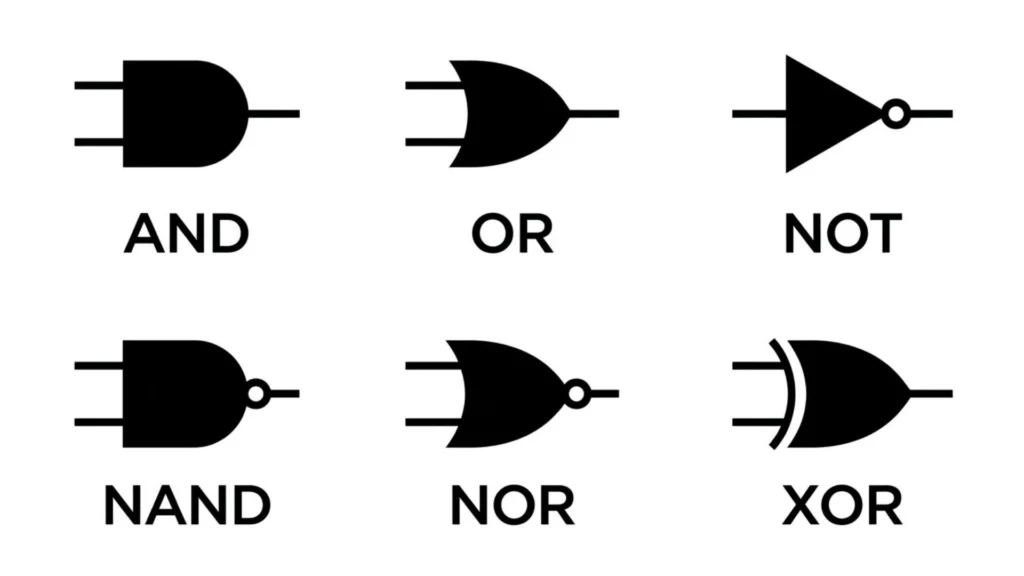
Digital Logic Gates
Logic symbols are also connected to digital electronics.
Basic logic gates include:
- AND
- OR
- NOT
- XOR
- NAND
- NOR
- XNOR
A digital circuit can use these gates to process binary inputs represented by 0 and 1.
For example, an AND gate produces an output of 1 only when both inputs are 1. This corresponds closely to the truth behavior of logical conjunction.
Logic Symbols vs Similar Mathematical Symbols
= vs ≡
The symbol = normally means equality.
For example:
2 + 3 = 5
The symbol ≡ can have different meanings depending on the field. In logic, it may indicate logical equivalence; in other mathematical contexts, it can indicate an identity or another special relationship.
Therefore, do not assume that = and ≡ are interchangeable in every situation.
→ vs ⇒
The symbols → and ⇒ can look similar in meaning, but their use varies by textbook and context.
→ is commonly used for implication or a conditional statement.
⇒ is also widely used to mean “implies” or “therefore follows,” particularly in mathematical writing.
Always check the notation used by your course, textbook, or instructor.
↔ vs ⇔
Similarly, ↔ commonly represents a biconditional.
⇔ is often used in mathematical writing to mean “if and only if” or “is equivalent to.”
They can be used similarly in some contexts, but they should not automatically be treated as identical in every formal system.
∨ vs ⊕
This is one of the most common beginner mistakes.
P ∨ Q is true when P is true, Q is true, or both are true.
P ⊕ Q is true only when exactly one of them is true.
Remember:
∨ = one or both
⊕ = exactly one
⊨ vs ⊢
These symbols represent two different ideas:
⊨ → semantic consequence
⊢ → formal derivation or provability
A simple way to remember the distinction is:
- ⊨ asks what follows based on meaning or interpretation.
- ⊢ asks what can be derived using a formal proof system.
These distinctions become more important as you move from beginner logic into formal logic and theoretical computer science.
Logic Symbols You Can Copy and Paste
Basic Operators
You can copy these commonly used logic symbols:
¬ ∧ ∨ ⊕ → ↔
Other useful symbols include:
⊤ ⊥ ≡ ⊨ ⊢
Quantifiers
Common quantifier symbols include:
∀ ∃ ∄
You can combine them with variables:
∀x
∃x
∀x P(x)
∃x P(x)
Truth and Proof Symbols
Useful symbols for more advanced work include:
⊤ — true
⊥ — false
≡ — logical equivalence in many contexts
⊨ — entails
⊢ — proves/derives
∴ — therefore
∵ — because
Remember that notation can vary between authors and disciplines. A symbol copied from a reference should always be interpreted according to the notation defined in the document where it appears.
How to Read Logic Expressions
Simple Expressions
Start by identifying the main operator.
For example:
P ∧ Q
Read it as:
“P and Q.”
For:
¬P
read:
“Not P.”
For:
P ∨ Q
read:
“P or Q.”
For:
P → Q
read:
“If P, then Q.”
For:
P ↔ Q
read:
“P if and only if Q.”
Compound Expressions
Consider:
¬P ∧ Q
This means that P is false and Q is true.
Parentheses can make complicated expressions easier to understand.
For example:
(P ∧ Q) → R
can be read as:
“If P and Q are both true, then R follows.”
When several logical operators appear together, learn the conventions used by your particular course or notation system rather than relying only on visual order.
Quantified Expressions
Consider:
∀x P(x)
Read:
“For every x, P of x.”
Now consider:
∃x P(x)
Read:
“There exists an x such that P of x is true.”
The domain is important because the same formula can have different truth values when the set of possible x values changes.
How to Memorize Logic Symbols
Easy Memory Tricks
A few simple associations can make logic symbols easier to remember.
¬ = NOT
Think of the symbol as placing a logical “no” over the statement.
∧ = AND
Think of the upward-pointing shape as joining two statements together.
∨ = OR
Think of it as a branching choice between alternatives.
⊕ = XOR
Remember the extra circle or special form as a clue that it is different from ordinary OR.
→ = implication
Think of the arrow as pointing from the condition toward its consequence.
↔ = biconditional
The double direction suggests that the relationship works both ways.
∀ = all
Remember the upside-down A as standing for “all.”
∃ = exists
The backward-looking E can help you associate it with “exists.”
Common Beginner Mistakes
One common mistake is treating OR as automatically meaning “one but not both.” In formal mathematical logic, ∨ is normally inclusive, so both statements may be true.
Another mistake is assuming:
P → Q
means:
Q → P
It does not. Implication is directional. If P implies Q, that does not automatically mean Q implies P.
Other common errors include:
- confusing ∨ with ⊕
- confusing → with ↔
- forgetting that ¬ reverses a truth value
- ignoring the domain of a quantified statement
- treating mathematical implication as ordinary cause and effect
- assuming every textbook uses exactly the same notation
- confusing semantic consequence with formal derivation
Logic Symbols Practice Quiz
Questions
1. What does ¬P mean?
A. P and Q
B. Not P
C. P or Q
D. P implies Q
2. When is P ∧ Q true?
A. When P is true only
B. When Q is true only
C. When both P and Q are true
D. When both are false
3. What does P ∨ Q normally mean in mathematical logic?
A. Exactly one is true
B. At least one is true
C. Both must be false
D. P must imply Q
4. What does ⊕ usually represent?
A. AND
B. NOT
C. XOR
D. Implication
5. What does ∀ mean?
A. There exists
B. Not equal
C. For all
D. Therefore
6. What is the only false case for P → Q?
A. P = F, Q = F
B. P = F, Q = T
C. P = T, Q = F
D. P = T, Q = T
7. What does P ↔ Q indicate?
A. P and Q have the same truth value
B. P is always false
C. P is always true
D. P is unrelated to Q
Answers
- B — Not P
- C — Both P and Q are true
- B — At least one is true
- C — XOR
- C — For all
- C — P is true and Q is false
- A — P and Q have the same truth value
Frequently Asked Questions About Logic Symbols
What are the basic logic symbols?
The most common basic logic symbols are ¬, ∧, ∨, →, and ↔. XOR, written ⊕, is also important, especially in Boolean logic and computer science.
What does ∧ mean in logic?
∧ means AND or conjunction. The expression P ∧ Q is true only when both P and Q are true.
What does ∨ mean in logic?
∨ means OR or disjunction. In formal mathematical logic, it normally means that P is true, Q is true, or both are true.
What does ¬ mean?
¬ means NOT or negation. It changes a statement’s truth value: a true statement becomes false, and a false statement becomes true.
What do ∀ and ∃ mean?
∀ means for all or for every, while ∃ means there exists or at least one exists. They are important symbols in predicate logic.
What is the difference between OR and XOR?
Ordinary OR, ∨, is true when at least one statement is true, including the case where both are true. XOR, ⊕, is true only when exactly one statement is true.
What is the difference between → and ↔?
→ represents implication: if P is true, Q must be true.
↔ represents a biconditional: P and Q have the same truth value, commonly expressed as “P if and only if Q.”
What is the difference between ⊨ and ⊢?
⊨ generally represents semantic consequence, while ⊢ generally represents formal derivation or provability within a proof system. This distinction is important in formal logic.
Can I copy and paste logic symbols?
Yes. Common logic symbols such as ¬ ∧ ∨ ⊕ → ↔ ∀ ∃ ∄ ⊤ ⊥ ≡ ⊨ ⊢ can be copied and pasted. However, make sure the symbol has the intended meaning in the context where you use it.
Why are logic symbols important?
Logic symbols provide a compact way to express relationships between statements. They are used in mathematics, formal reasoning, computer science, programming, digital electronics, and many areas where precise conditions need to be communicated.
Conclusion
Logic symbols turn complicated relationships between statements into concise mathematical expressions. The most useful symbols to learn first are ¬ for NOT, ∧ for AND, ∨ for OR, ⊕ for XOR, → for implication, and ↔ for biconditional. Quantifiers such as ∀ and ∃ become especially important when you move into predicate logic.
The key to learning these symbols is not simply memorizing their names. Practice reading them in complete expressions and use truth tables to see exactly when each expression is true or false. Also remember that notation can differ between textbooks and fields, so always follow the definitions given in your particular course or system.
Once you understand the basic operators, you can move comfortably into truth tables, mathematical proofs, Boolean logic, programming conditions, digital circuits, and more advanced formal logic. The goal is to understand what each symbol does and how it changes the meaning of the complete expression.

Elliot Kensington
Elliot Kensington is a storyteller at heart, always fascinated by the hidden corners of human imagination. From a young age, he found comfort in books and the worlds they created, inspiring him to craft tales that blend emotion, suspense, and wonder. His writing journey began with short stories that captured fleeting moments of life, and over time, evolved into novels that explore both the extraordinary and the everyday. Elliot believes that every story holds a piece of the soul, and his mission is to connect readers to those moments that linger long after the last page. When he’s not writing, he enjoys exploring nature, capturing moments through photography, and seeking inspiration in the little things.
Books by Elliot Kensington:
-
Shadows of Tomorrow
-
The Whispering Path