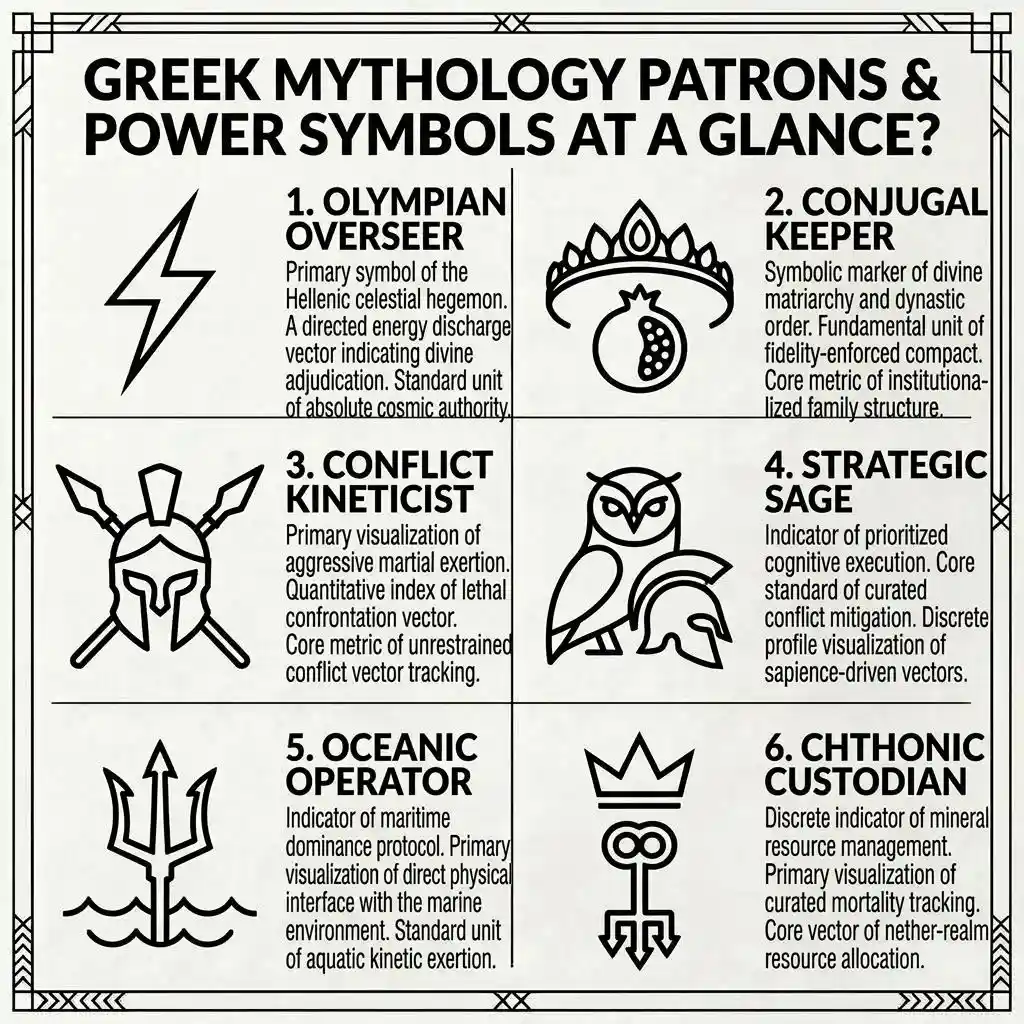
Greek mythology is filled with recognizable animals, weapons, plants, objects, creatures, and divine attributes. When people search for Greek mythology symbols, they are often looking for more than a simple list.
They want to know what a symbol represents, which god or goddess it belongs to, where it comes from, and what it may mean today.
Some associations are strongly established in ancient Greek art and literature. For example, Zeus is commonly identified by his thunderbolt, Poseidon by his trident, Athena by the owl and other attributes, and Apollo by the lyre and laurel. Other meanings found online are modern interpretations rather than fixed beliefs held by all ancient Greeks.
This guide explores major Greek mythology symbols and meanings, including gods and goddesses, animals, mythological creatures, weapons, plants, flowers, heroes, and famous objects. It also explains the difference between ancient symbolism and modern meanings, making it easier to understand which associations have historical roots and which developed later.
What Are Greek Mythology Symbols? (Quick Answer)
Greek mythology symbols are recognizable objects, animals, plants, weapons, creatures, and visual attributes associated with gods, goddesses, heroes, myths, and mythological stories.
Some of the best-known examples include:
- Thunderbolt: Associated with Zeus
- Owl: Associated with Athena
- Trident: Associated with Poseidon
- Peacock: Associated with Hera
- Dove: Associated with Aphrodite
- Lyre: Associated with Apollo
- Bow: Associated with Artemis
- Winged sandals: Associated with Hermes
- Grapevine and ivy: Associated with Dionysus
- Grain: Associated with Demeter
- Laurel: Associated with Apollo
- Pomegranate: Closely connected with the Persephone myth
- Medusa’s head: Associated with the Gorgon and protective imagery
- Pegasus: Famous winged horse from Greek mythology
- Golden Fleece: Important object in the story of Jason and the Argonauts
The word “symbol” can be used broadly. In ancient Greek art, many of these were more precisely attributes that helped viewers recognize a particular deity or mythological figure.
Greek Mythology Symbols at a Glance
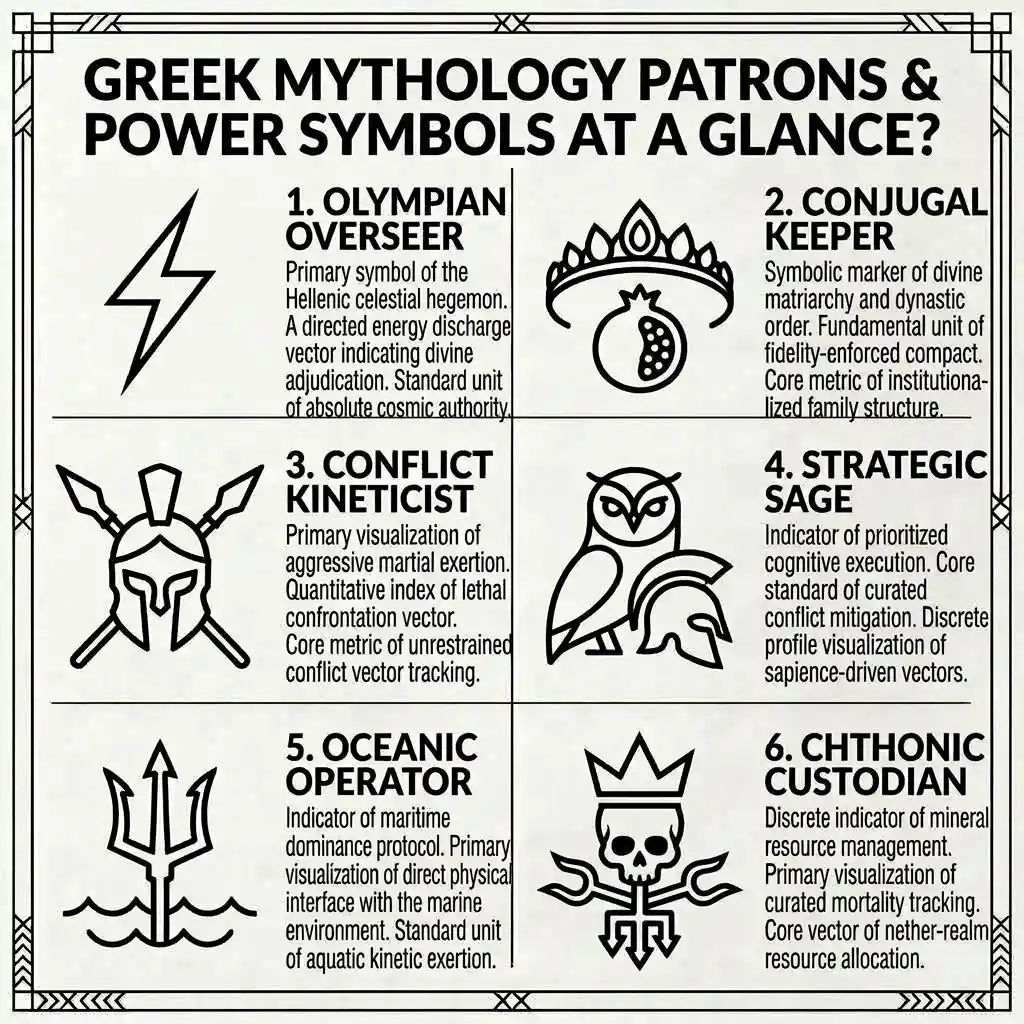
A quick reference can make it easier to identify the most recognizable symbols before exploring their individual stories.
Most Famous Greek Mythology Symbols
| Symbol | Associated Figure | Type | Common Association |
| ⚡ Thunderbolt | Zeus | Divine weapon | Sky and divine authority |
| 🦉 Owl | Athena | Animal | Wisdom and Athena |
| 🔱 Trident | Poseidon | Weapon | Sea and earthquakes |
| 🦚 Peacock | Hera | Animal | Hera and royal imagery |
| 🕊️ Dove | Aphrodite | Animal | Love and beauty |
| 🎵 Lyre | Apollo | Instrument | Music and poetry |
| 🏹 Bow | Artemis | Weapon | Hunting and wilderness |
| 🪽 Winged sandals | Hermes | Object | Travel and messages |
| 🍇 Grapevine | Dionysus | Plant | Wine and Dionysian worship |
| 🌾 Grain | Demeter | Plant | Agriculture and harvest |
| 🌿 Laurel | Apollo | Plant | Apollo and victory traditions |
| 🫒 Olive tree | Athena | Plant | Athena and Athens |
| 🍎 Golden apple | Aphrodite/Greek myths | Object | Mythic conflict and desire |
| 🐍 Snake | Various figures | Animal | Different meanings by myth |
| 🪽 Pegasus | Greek mythology | Creature | Heroic adventure and divine mythology |
| 🐕 Cerberus | Hades/Underworld | Creature | Guardian of the underworld |
| 👹 Gorgoneion | Medusa/Gorgons | Protective image | Protection and apotropaic imagery |
| 🥇 Golden Fleece | Jason and Argonauts | Mythic object | Quest and adventure |
These associations should be understood in context. A symbol can have more than one meaning, and not every modern interpretation reflects a belief documented in ancient Greece.
Symbols, Attributes, and Mythological Objects
A useful distinction is between an attribute and a general symbolic meaning.
An attribute is an object or feature that helps identify a mythological figure. For example, the trident helps viewers recognize Poseidon in ancient art.
A symbolic interpretation goes a step further and asks what that object represents. Someone today may interpret the trident as power or control over the sea.
Greek Gods and Their Symbols
The gods and goddesses of Greek mythology are the most familiar source of mythological symbols. Ancient artists often used recognizable attributes to make a deity identifiable.
Zeus
Main symbols and attributes: Thunderbolt, eagle, oak, scepter, throne.
The thunderbolt is his most recognizable attribute.
In modern symbolism, Zeus’s thunderbolt is often interpreted as a representation of power, authority, strength, and divine force. These modern meanings should be distinguished from the specific religious and mythological context of Zeus.
Hera
Main symbols and attributes: Peacock, crown, scepter, pomegranate.
The peacock became strongly associated with Hera in Greek and later classical artistic traditions. The bird’s impressive appearance also made it suitable for representing majesty.
Her crown and scepter reinforce her status as queen of the gods.
Poseidon
Main symbols and attributes: Trident, horse, dolphin, bull.
The trident is his best-known attribute. In artistic representations, it helps identify Poseidon even when the surrounding story is not immediately obvious.
Today, the trident is often interpreted as a symbol of strength, authority, the ocean, or control over natural forces.
Hades
Main symbols and attributes: Helm of invisibility, Cerberus, cypress, bident.
Hades rules the realm of the dead in Greek mythology.
Unlike some modern portrayals, Hades should not simply be reduced to a “god of evil.” His mythological role is connected with the underworld and the dead.
Cerberus, the multi-headed guardian dog, is one of the most recognizable creatures associated with his realm.
The helm of invisibility is another important mythological object connected with Hades.
Athena
Main symbols and attributes: Owl, olive tree, aegis, helmet, spear, shield.
Athena is associated with wisdom, strategic warfare, crafts, and the city of Athens.
The owl is perhaps her most famous animal attribute. The olive tree is also closely connected with Athena and the mythic traditions surrounding Athens.
Her armor, helmet, spear, and aegis are important visual identifiers.
The modern phrase “owl equals wisdom” is a simplified interpretation, but the owl’s association with Athena has deep roots in Greek visual culture.
Apollo
Main symbols and attributes: Lyre, bow, laurel, sun-related imagery in later traditions.
Apollo is connected with music, poetry, prophecy, healing, and several other areas of Greek religious and mythological tradition.
The lyre is one of his clearest attributes and reflects his connection with music.
The laurel is strongly associated with Apollo, particularly through the story of Daphne and the later use of the laurel wreath.
Artemis
Main symbols and attributes: Bow, arrows, deer, hunting dog, cypress.
Artemis is associated with hunting, wilderness, animals, and the protection of young life.
Her bow and arrows are among her most recognizable attributes.
The deer is another important animal associated with Artemis.
Modern interpretations often connect Artemis’s imagery with independence, wilderness, protection, and feminine strength, although these are broader contemporary readings rather than a single ancient definition.
Ares
Main symbols and attributes: Spear, shield, sword, helmet, armor.
Ares represents the violent and destructive aspects of warfare in Greek mythology.
His weapons and armor are therefore central to his visual identity.
Ares’s spear and shield can be interpreted in a straightforward mythological context as military attributes. Modern audiences may additionally associate them with courage, combat, conflict, or strength.
Aphrodite
Main symbols and attributes: Dove, rose, shell, myrtle, swan.
Aphrodite is the goddess most closely associated with love, beauty, desire, and sexual attraction.
The dove, rose, and myrtle are among the plants and animals connected with her.
The shell is especially familiar from later artistic representations of her birth from the sea.
Aphrodite’s imagery is therefore frequently used today for themes involving love, beauty, romance, and femininity.
Hermes
Main symbols and attributes: Winged sandals, herald’s staff, winged helmet in later representations, tortoise.
Hermes is associated with communication, travel, boundaries, trade, and his role as a messenger.
His winged sandals are one of his most recognizable attributes.
The caduceus, or herald’s staff, is also associated with Hermes. It is important not to confuse this with the Rod of Asclepius, which has a different connection with healing and medicine.
Demeter
Main symbols and attributes: Grain, wheat, torch, poppy, cornucopia.
Demeter is closely connected with agriculture, grain, fertility of the earth, and the harvest.
Wheat and grain are particularly important because agriculture is central to her mythology.
Her story involving Persephone also connects Demeter with the seasonal cycle and the loss and return of her daughter.
Hephaestus
Main symbols and attributes: Hammer, anvil, tongs, forge, fire.
Hephaestus is the divine craftsman and smith.
His hammer and anvil immediately identify him with metalworking and craftsmanship.
Modern interpretations can connect his imagery with creativity, construction, persistence, and skilled work.
Dionysus
Main symbols and attributes: Grapevine, ivy, thyrsus, drinking vessel, leopard.
Dionysus is associated with wine, theater, celebration, altered states, and religious ecstasy.
The grapevine is one of his most recognizable attributes.
The thyrsus, a staff often decorated with vegetation, is another distinctive piece of Dionysian imagery.
Hestia
Main symbols and attributes: Hearth, fire, home, household.
Hestia is associated with the hearth and domestic life.
Unlike gods whose identities are easily represented by weapons or animals, Hestia’s most important symbolic association is the hearth fire.
It can represent the center of household life and communal continuity in modern interpretations.
Greek Mythology Symbols for Wisdom, Love, Strength & Protection
The most recognizable wisdom-related imagery includes:
- Athena
- Owl
- Olive tree
- Athena’s helmet and strategic attributes
The owl of Athena is especially famous because of its long-standing association with the goddess.
Modern uses of owl imagery often expand this association into a general symbol of knowledge and wisdom.
Greek Mythology Symbols for Love
Love-related Greek mythology symbols include:
- Aphrodite
- Eros
- Dove
- Rose
- Myrtle
- Shell
- Golden apple in particular mythological contexts
Aphrodite is the central figure in this group.
Eros, the personification or god associated with desire and love, also has an important place in Greek mythology.
Greek Mythology Symbols for Strength
Possible strength-related imagery includes:
- Zeus’s thunderbolt
- Heracles’s club
- Nemean lion
- Ares’s weapons
- Athena’s armor
- Poseidon’s trident
These symbols do not form one official ancient Greek “strength symbol.” Their modern association with strength comes from the power, stories, or attributes connected with the figures.
Greek Mythology Symbols for Protection
Protection-related imagery includes:
- Aegis
- Gorgoneion
- Athena’s shield
- Protective representations of Medusa or the Gorgon face
The Gorgoneion, the face or head of a Gorgon, is particularly important because Gorgon imagery could serve an apotropaic, or protective, purpose in ancient Greek art.
Greek Mythology Symbols for Victory
Victory can be connected with:
- Nike
- Laurel wreath
- Athena
- Heracles
- Greek heroic victories
The laurel wreath later became strongly associated with achievement and victory, while Nike personifies victory in Greek mythology.
Greek Mythology Symbols for Transformation
Transformation is a major theme in Greek myths.
Examples include:
- Persephone
- Daphne
- Narcissus
- Cygnus and other transformation myths
- Phoenix in later Greek and broader traditions
Greek mythology contains many stories in which gods, humans, and other beings are transformed into animals, plants, stars, or other forms.
Greek Mythology Symbols for Death and the Underworld
Common imagery includes:
- Hades
- Cerberus
- Persephone
- Styx
- Charon
- Pomegranate
- Cypress
- Underworld
These symbols should not all be reduced to “death symbols.” For example, the pomegranate has a specific role in the Persephone myth and can be interpreted through themes of the underworld, separation, seasonal change, fertility, and return.
Greek Mythology Animals and Creature Symbols
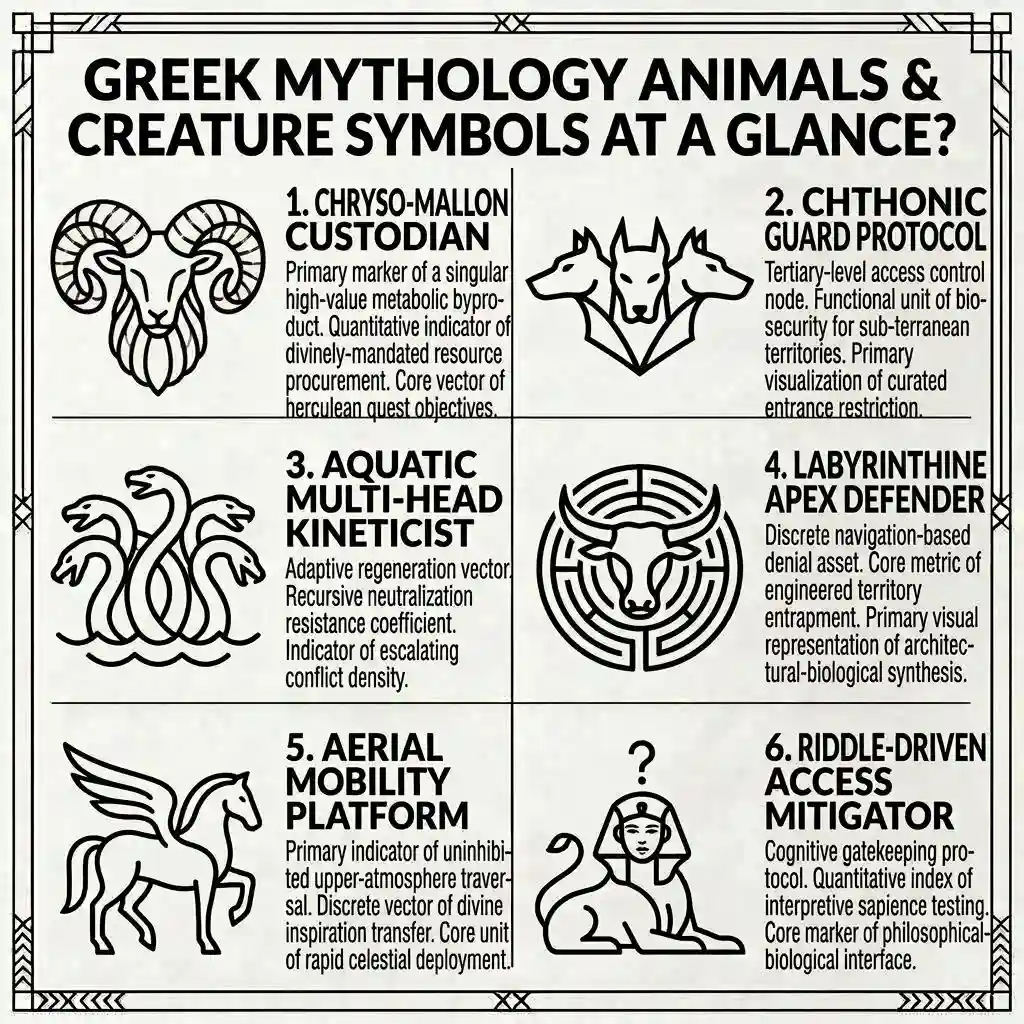
Animals and mythological creatures play major roles throughout Greek mythology.
Owl
The owl is strongly associated with Athena.
It is one of the most recognizable animal attributes in Greek mythology and ancient Greek art.
Today, owl imagery is widely interpreted as wisdom, intelligence, observation, and knowledge.
Eagle
The eagle is strongly associated with Zeus.
Its connection with the sky and Zeus’s divine authority has made it one of the most recognizable birds in Greek mythology.
Modern symbolism may also connect the eagle with strength, freedom, leadership, and vision.
Peacock
The peacock is associated with Hera.
Its impressive appearance fits the goddess’s royal status in later artistic traditions.
Modern interpretations often emphasize beauty, dignity, pride, and majesty.
Dove
The dove is associated with Aphrodite.
It is commonly connected with love and beauty in modern symbolism as well.
However, the dove also has meanings in other cultures and traditions, so it should not be treated as exclusively Greek.
Dolphin
Dolphins appear in several Greek myths and are connected with the sea.
They can also be associated with Poseidon and other maritime stories.
Modern interpretations often connect dolphins with the ocean, friendship, guidance, and protection.
Horse
Horses have a particularly rich place in Greek mythology.
Poseidon has strong connections with horses, while Pegasus is the most famous supernatural horse.
Horses can therefore appear in stories involving gods, heroes, sea mythology, and divine creatures.
Snake
Snakes appear throughout Greek mythology and can have very different meanings.
- Healing
- Danger
- Transformation
- The earth
- Guardianship
- Divine or supernatural forces
This is why saying “the Greek snake symbol always means X” would be misleading.
Pegasus
Pegasus is the famous winged horse associated with the hero Bellerophon and the world of Greek myth.
Today, Pegasus is commonly interpreted as a symbol of freedom, imagination, inspiration, adventure, and reaching beyond ordinary limits.
These modern meanings are broader interpretations of the creature’s mythological story.
Cerberus
Cerberus is the guardian dog of the underworld.
His role is closely connected with preventing the dead from leaving and the living from entering the realm of the dead.
Cerberus is therefore more accurately understood through his mythological function than through a single modern symbolic meaning.
Medusa and the Gorgons
Medusa is one of the most famous figures in Greek mythology.
Her snake-covered head became known as the Gorgoneion when used as an image.
Gorgon imagery appeared in ancient Greek art and could serve a protective purpose by presenting a frightening face intended to ward off harm.
Modern interpretations of Medusa can include protection, resilience, survival, feminine power, or transformation. These modern meanings should not automatically be projected backward onto all ancient representations.
Minotaur
The Minotaur is a creature with a human body and bull’s head, associated with the labyrinth of Crete.
The story connects the creature with Theseus, Ariadne, and King Minos.
Modern interpretations often use the Minotaur to represent fear, inner conflict, isolation, or a difficult challenge, but these are interpretive readings rather than one fixed ancient definition.
Phoenix
The phoenix is a famous mythical bird associated with renewal and return.
Although the phoenix appears in ancient Greek literary tradition, its history is broader than Greek mythology alone.
Modern audiences commonly interpret the phoenix as:
- Rebirth
- Renewal
- Transformation
- Recovery
- Starting again
It is therefore better to describe it as a figure with a broader ancient cultural history rather than an exclusively Greek invention.
Greek Mythology Animals and Creature Symbols
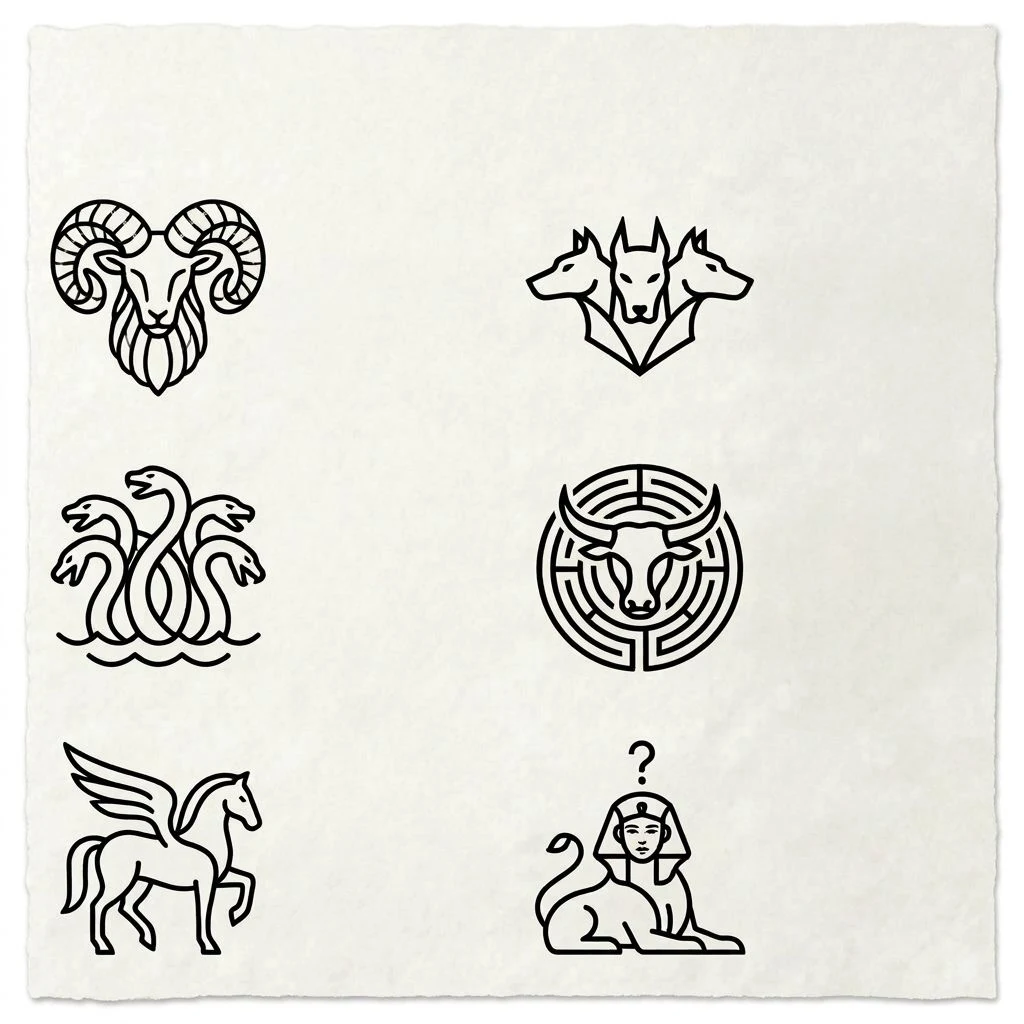
Weapons and objects are among the easiest symbols to recognize because they are often visually distinctive.
Zeus’s Thunderbolt
The thunderbolt is Zeus’s signature divine weapon.
It is strongly connected with his authority over the sky and his role as a powerful Olympian deity.
Modern symbolic uses often connect it with:
- Power
- Authority
- Strength
- Divine force
- Sudden energy
Poseidon’s Trident
Poseidon’s trident is perhaps the second most recognizable divine weapon after Zeus’s thunderbolt.
Its primary mythological association is with Poseidon and his control over the sea and other domains connected with him.
Today, it is frequently used as a symbol of ocean power and strength.
Athena’s Aegis
The aegis is a protective object associated particularly with Athena in Greek mythology and art.
It is sometimes represented as a shield or protective garment and may bear the head of a Gorgon.
Because of this imagery, the aegis is often interpreted in connection with protection, divine power, and defense.
Bow and Arrows
The bow and arrows are strongly associated with Artemis and Apollo.
Artemis’s bow reflects her role as a huntress.
Apollo is also depicted with a bow and can be associated with archery in Greek mythology.
The same basic object can therefore have different mythological meanings depending on the figure.
Lyre
The lyre is strongly associated with Apollo.
It represents his connection with music and poetic culture.
The lyre is one of the clearest examples of an ordinary object becoming an important visual attribute of a deity.
Winged Sandals
Winged sandals are associated with Hermes and his role as a swift messenger and traveler.
Modern interpretations often connect them with:
- Speed
- Travel
- Freedom
- Communication
- Movement
Caduceus
The caduceus is the staff associated with Hermes.
It is important to distinguish it from the Rod of Asclepius, which has a different mythological and medical association.
This distinction matters because the caduceus is often incorrectly presented as the original Greek symbol of medicine.
Golden Fleece
The Golden Fleece is a central object in the story of Jason and the Argonauts.
Jason’s journey to obtain it forms one of the best-known heroic quests in Greek mythology.
Modern interpretations can connect the Golden Fleece with:
- Adventure
- Ambition
- Quest
- Achievement
- Leadership
- The search for something difficult to obtain
Labyrinth
The labyrinth is associated with the Minotaur story and the mythology of Crete.
Its modern symbolism often includes:
- Complexity
- Confusion
- Inner journey
- Challenge
- Finding a way through difficulty
However, the ancient mythological context should come first.
Greek Mythology Plants, Flowers & Nature Symbols
Nature is deeply connected with Greek myths, especially through stories of transformation.
Olive Tree
The olive tree is strongly associated with Athena and the mythic contest between Athena and Poseidon for the patronage of Athens.
The olive became extremely important to Greek society, making the tree both a cultural and mythological symbol.
Modern symbolism often connects it with peace, wisdom, prosperity, and endurance.
Laurel
Laurel is strongly associated with Apollo.
Its connection comes especially from the story of Daphne, who is transformed into a laurel tree.
The laurel wreath later became associated with achievement and victory.
Rose
The rose is commonly associated with Aphrodite and themes of love and beauty.
Because roses also have meanings in many other cultures, the flower should not be treated as exclusively Greek.
Ivy
Ivy is strongly associated with Dionysus.
Its evergreen nature and presence in Dionysian imagery make it a recognizable plant attribute.
It can be used today to evoke Dionysus, wine, celebration, and wildness.
Grapevine
The grapevine is one of Dionysus’s clearest attributes.
It reflects the importance of grapes and wine in Dionysian mythology and religious practice.
Modern uses often connect grapevine imagery with celebration, pleasure, abundance, and creativity.
Pomegranate
The pomegranate is central to the story of Persephone.
Because Persephone eats pomegranate seeds in the underworld story, the fruit becomes connected with her relationship to Hades and the cycle between the underworld and the world above.
Modern interpretations can include:
- Transformation
- Fertility
- Cycles
- Separation
- Return
- Life and death
The exact interpretation depends on context.
Grain and Wheat
Grain and wheat are strongly associated with Demeter.
They reflect agriculture, food, harvest, and the fertility of cultivated land.
The Demeter-Persephone mythology also connects agriculture with seasonal change.
Greek Mythology Symbols of Famous Heroes
Greek mythology includes many heroic figures whose objects and attributes have become recognizable symbols.
Heracles
Heracles, known in Roman mythology as Hercules, is commonly represented with:
- Club
- Lion skin
- Bow
- Physical strength
The Nemean lion’s skin is especially recognizable.
Modern interpretations often use Heracles imagery to represent strength, courage, endurance, and overcoming difficult challenges.
Perseus
His mythological equipment includes:
- Curved sword
- Reflective shield
- Winged sandals
- Cap or helm associated with invisibility
- Medusa’s head
His story is therefore rich in symbols connected with courage, strategy, protection, and heroic achievement.
Theseus
Theseus is best known for defeating the Minotaur.
Important elements of his story include:
- Sword
- Labyrinth
- Ariadne’s thread
- Minotaur
- Athens
The thread of Ariadne has become a popular modern metaphor for finding a way through a complicated problem.
Achilles
Achilles is one of the best-known heroes of the Trojan War tradition.
His recognizable mythology includes:
- Armor
- Spear
- Shield
- Trojan War
- His vulnerable heel in later tradition
Modern uses often interpret Achilles imagery through courage, heroism, vulnerability, and the tension between strength and weakness.
Odysseus
Odysseus is famous for his intelligence, resourcefulness, and long journey home after the Trojan War.
His story is connected with:
- The bow
- The voyage
- The sea
- Ithaca
- The Trojan Horse
Modern symbolism often uses Odysseus to represent perseverance, intelligence, travel, and the journey home.
Jason
Jason is the hero of the Argonaut expedition.
His most famous symbol is the Golden Fleece, which represents the central goal of his quest.
His story also connects him with the Argo, Medea, and the Argonauts.
Greek Mythology Symbols in Ancient Art
Symbols become easier to understand when readers know where ancient Greeks actually used them.
Vase Paintings
Greek pottery provides some of the most valuable surviving visual evidence for mythology.
Artists depicted gods, heroes, creatures, battles, and mythological stories on vessels used in everyday and ceremonial settings.
Attributes helped viewers identify characters within complex scenes.
Sculptures
Sculpture frequently used attributes to distinguish gods.
A trident, helmet, owl, bow, or other object could help viewers recognize a particular figure.
Coins
Ancient Greek coins sometimes featured gods, goddesses, animals, plants, and other images connected with local cities and religious traditions.
These images could communicate civic identity as well as religious associations.
Temples and Religious Objects
Mythological and religious imagery also appeared in temples and sacred objects.
The meaning of an image depended on its location, deity, story, and religious context.
This is important because the same animal or object could have different meanings in different settings.
Ancient Greek Meanings vs. Modern Symbolism
One of the most important parts of understanding Greek mythology symbols is recognizing that modern symbolism is not always the same as ancient symbolism.
What Ancient Evidence Shows
Ancient evidence comes from sources such as:
- Mythological literature
- Vase paintings
- Sculptures
- Coins
- Temple decoration
- Inscriptions
- Religious objects
For example, ancient art can show Athena with recognizable attributes such as armor, a helmet, spear, aegis, and owl imagery.
Common Modern Interpretations
Modern readers often assign broader meanings to ancient symbols.
For example:
| Symbol | Traditional Mythological Association | Common Modern Interpretation |
| Owl | Athena | Wisdom |
| Thunderbolt | Zeus | Power |
| Trident | Poseidon | Strength and sea |
| Laurel | Apollo | Victory and achievement |
| Olive | Athena | Peace and wisdom |
| Dove | Aphrodite | Love |
| Phoenix | Mythic bird | Rebirth |
| Pomegranate | Persephone story | Transformation and cycles |
| Pegasus | Mythological winged horse | Freedom and imagination |
| Medusa | Gorgon imagery | Protection, resilience, empowerment |
The modern interpretation can be meaningful without being described as the only meaning held in ancient Greece.
Why Meanings Can Change
Symbols change meaning because cultures reinterpret older stories.
A symbol can move from:
Myth → religious art → classical art → literature → modern art → tattoos and popular culture.
Each stage can add new associations.
That is why a modern tattoo meaning should not automatically be presented as an ancient Greek belief.
Greek Mythology Symbols for Tattoos
Greek mythology provides a large collection of tattoo imagery.
Greek God Tattoos
Popular choices include:
- Zeus
- Athena
- Poseidon
- Apollo
- Artemis
- Aphrodite
- Hades
- Hermes
A tattoo can use either the deity itself or a recognizable attribute such as a thunderbolt, owl, trident, bow, or lyre.
Medusa Tattoos
Medusa tattoos are especially popular because her image is visually distinctive.
Modern wearers may associate Medusa with:
- Protection
- Survival
- Resilience
- Transformation
- Personal strength
These meanings are modern interpretations and should not automatically be described as the universal meaning of Medusa in ancient Greece.
Athena Tattoos
Athena tattoos commonly use:
- Owl
- Helmet
- Spear
- Shield
- Aegis
- Olive branch or tree
They may be chosen to express themes such as wisdom, strategy, courage, or strength.
Persephone Tattoos
Persephone-inspired tattoos may feature:
- Pomegranate
- Flowers
- Crown
- Underworld imagery
- Seasonal plants
Modern interpretations often focus on transformation, duality, personal growth, and cycles of change.
Zeus and Poseidon Tattoos
A Zeus tattoo may feature a thunderbolt, eagle, clouds, or other divine imagery.
A Poseidon tattoo may feature a trident, waves, horses, or sea imagery.
Choosing a Historically Informed Symbol
If historical accuracy matters, research the association before getting a tattoo.
Ask:
- Is the symbol actually connected with the figure?
- Does the association appear in ancient art or literature?
- Is the meaning ancient or primarily modern?
- Has the symbol been changed by later popular culture?
- Is another symbol being incorrectly attributed to Greek mythology?
This approach helps avoid common mythology-related misconceptions.
Greek Mythology Symbols vs. Greek Cultural Symbols
Not every symbol associated with Greece is a symbol from Greek mythology.
Greek Key
The Greek key, also called the meander pattern, is strongly associated with Greek art and design.
It is important culturally and historically, but it should not automatically be described as a symbol belonging to a particular Greek god or myth.
Greek Alphabet
The Greek alphabet is a writing system rather than a mythology symbol.
Individual Greek letters may appear in mythology, mathematics, science, or modern design, but the alphabet itself is not a list of mythological symbols.
Olive Branch
The olive branch has broad cultural meanings, including peace, and has connections with ancient Greek culture and mythology.
Its connection with Athena and the olive tree makes it relevant to Greek mythology, but it also has a much wider cultural history.
Laurel Wreath
The laurel wreath has strong connections with Apollo and the story of Daphne.
It later became a broader symbol of victory, achievement, and honor.
Why Context Matters
A Greek-looking image is not automatically a Greek mythology symbol.
To identify it accurately, ask:
- Is it connected to a god?
- Is it part of a known myth?
- Is it an attribute?
- Is it a decorative pattern?
- Is it a later cultural symbol?
- Is its popular meaning modern?
This simple check can prevent many inaccurate interpretations.
How to Identify a Greek Mythology Symbol
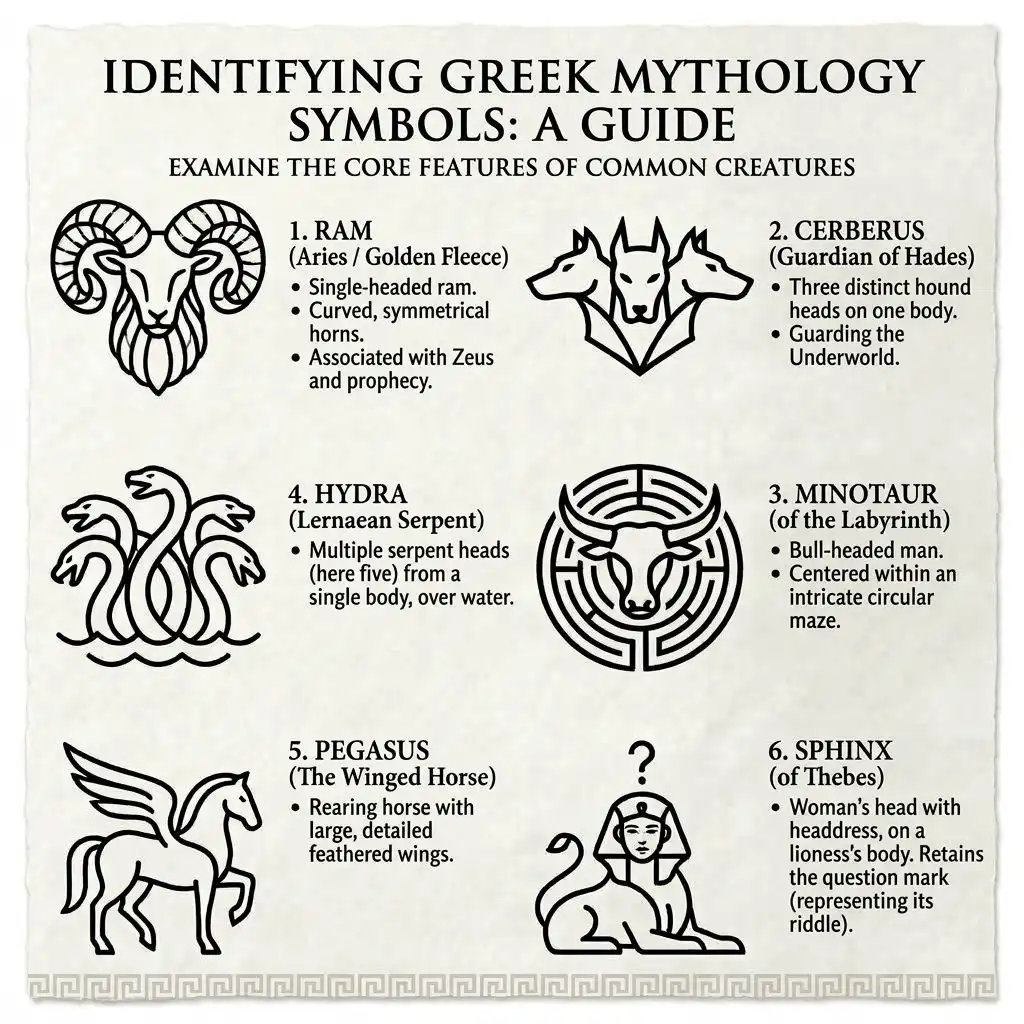
When you find an unfamiliar Greek symbol, use its surrounding context to identify it.
Identify the Figure
First ask whether the image shows a recognizable god, goddess, hero, or creature.
A helmet and spear may suggest Athena, but context is still necessary.
Identify the Attribute
Look for distinctive objects.
For example:
- Trident → Poseidon
- Thunderbolt → Zeus
- Owl → Athena
- Lyre → Apollo
- Bow → Artemis
- Winged sandals → Hermes
- Grapevine → Dionysus
These associations can help identify a figure in ancient art.
Check the Myth
The Golden Fleece, Ariadne’s thread, Medusa’s head, and the pomegranate are good examples.
Check Ancient Art
If historical accuracy matters, compare the symbol with surviving ancient representations.
Look at:
- Vase paintings
- Sculptures
- Coins
- Reliefs
- Inscriptions
- Museum collections
Separate History From Interpretation
Finally, ask whether a claimed meaning is:
Ancient evidence,
later classical interpretation, or
modern symbolism.
This is especially important when researching tattoo meanings and social-media symbolism.
Greek Mythology Symbols for Beginners
Greek mythology can seem overwhelming because there are hundreds of characters, stories, and attributes.
Which Symbols Should You Learn First?
Start with the easiest associations:
- Zeus → Thunderbolt
- Athena → Owl
- Poseidon → Trident
- Hera → Peacock
- Aphrodite → Dove
- Apollo → Lyre
- Artemis → Bow
- Hermes → Winged sandals
- Demeter → Grain
- Dionysus → Grapevine
- Hephaestus → Hammer
- Hades → Cerberus
Once you know these, it becomes much easier to recognize Greek mythological figures in art.
Easy Ways to Remember Them
Try grouping symbols by category.
Sky: Zeus and thunderbolt
Sea: Poseidon and trident
Wisdom: Athena and owl
Love: Aphrodite and dove
Music: Apollo and lyre
Hunting: Artemis and bow
Messages and travel: Hermes and winged sandals
Harvest: Demeter and grain
Wine: Dionysus and grapevine
Craftsmanship: Hephaestus and hammer
Frequently Asked Questions About Greek Mythology Symbols
What are the most famous Greek mythology symbols?
Some of the most recognizable are Zeus’s thunderbolt, Athena’s owl, Poseidon’s trident, Hera’s peacock, Aphrodite’s dove, Apollo’s lyre, Artemis’s bow, Hermes’s winged sandals, Dionysus’s grapevine, Medusa’s Gorgon head, Pegasus, and the Golden Fleece.
What is the symbol of Zeus?
Zeus is most famously associated with the thunderbolt. The eagle, oak, scepter, and throne are also important attributes associated with him.
What is Athena’s symbol?
Her helmet, spear, shield, and aegis are also important attributes.
What does the owl symbolize in Greek mythology?
The owl is strongly associated with Athena. In modern usage, it is commonly interpreted as a symbol of wisdom and knowledge.
What is Poseidon’s symbol?
Poseidon’s best-known symbol is the trident. Horses, dolphins, and bulls are also associated with him in Greek mythology.
What Greek mythology symbol represents love?
Aphrodite, Eros, the dove, rose, and myrtle are among the imagery associated with love and desire in Greek mythology.
What Greek mythology symbol represents strength?
There is no single official Greek mythology symbol for strength. Zeus’s thunderbolt, Heracles’s club, the Nemean lion, Ares’s weapons, and Poseidon’s trident can all be interpreted through themes of strength or power.
What does Medusa symbolize?
In ancient Greek contexts, Gorgon imagery could have a protective or apotropaic function. Modern interpretations of Medusa often include protection, resilience, transformation, and empowerment.
What does Persephone symbolize?
Persephone’s mythology is associated with the underworld, seasonal change, separation, return, and the pomegranate. Modern interpretations often emphasize transformation and personal growth.
What does the pomegranate symbolize in Greek mythology?
The pomegranate is closely connected with the Persephone myth because of the seeds she eats in the underworld. Its modern interpretations can include fertility, transformation, cycles, separation, and return.
What does the phoenix symbolize?
The phoenix is commonly interpreted today as a symbol of rebirth, renewal, and transformation.
What is the Greek mythology symbol for wisdom?
The owl has a strong connection with Athena in ancient Greek visual culture.
What is the Greek mythology symbol for protection?
The aegis and Gorgon imagery are important examples. Gorgon faces could serve an apotropaic or protective purpose in ancient Greek art.
What are Greek mythology symbols for tattoos?
Popular choices include Athena’s owl, Medusa, Zeus’s thunderbolt, Poseidon’s trident, Persephone’s pomegranate, Pegasus, Apollo’s lyre, and Artemis’s bow.
Is the Greek key a Greek mythology symbol?
The Greek key or meander is an important Greek artistic and decorative pattern, but it is not automatically a symbol belonging to a particular mythological deity.
Is the caduceus a Greek medical symbol?
The caduceus is associated with Hermes and his role as messenger and herald. It should be distinguished from the Rod of Asclepius, which has a more direct connection with healing and medicine.
Are modern Greek mythology symbol meanings historically accurate?
Not always. Some modern meanings are based on ancient stories or artistic associations, while others developed through later literature, popular culture, spirituality, or tattoo culture.
Conclusion
Thunderbolts, tridents, owls, peacocks, doves, lyres, bows, grapevines, olive trees, laurel, pomegranates, mythological creatures, heroic weapons, and legendary objects all contribute to the visual language of Greek mythology.
The most important step is to consider context. An ancient attribute connected with a god is not necessarily the same thing as a modern symbolic meaning. Athena’s owl can identify the goddess in ancient art while also representing wisdom to modern audiences. Medusa can have a history of protective imagery while modern tattoo culture gives her additional meanings.
Understanding this difference makes Greek mythology symbols much easier to research and interpret. Whether you are studying ancient art, learning about Greek gods, researching a tattoo, or simply curious about the meaning of a mythological image, the best approach is to start with the original mythological association and then consider how later cultures have reinterpreted it.

Clara Miles
Hello! I’m Clara, a lifelong dreamer who finds magic in everyday moments. Writing has always been my way of exploring the world and understanding the people around me. I love creating stories that make readers laugh, cry, and reflect on life’s little surprises. When I’m not writing, you can usually find me sipping coffee at a cozy café or wandering through nature with a notebook in hand. My journey as an author is fueled by curiosity, imagination, and a love for connecting with my readers. Every story I write is a piece of my heart, and I hope it inspires yours too.
Books:
-
Whispers of the Heart
-
Shadows and Sunlight