Coat of arms symbols have been used for centuries to identify people, families, institutions, communities, and places. A shield covered with animals, plants, colors, crosses, weapons, or other figures may look decorative, but heraldry has its own visual language and terminology.
When people search for coat of arms symbols, they often want to know what a lion, eagle, crown, sword, rose, fleur-de-lis, or particular color means. Others want to understand the parts of a coat of arms, find a family coat of arms, or discover whether a crest connected to their surname actually belongs to their family.
One important point comes first: there is no universal rule saying that every heraldic color or animal has one fixed meaning. In many cases, the original reason for choosing a particular charge or color is unknown unless the designer or historical record explains it. Some arms also use visual wordplay, known as canting arms, where an image relates to the bearer’s name.
This guide explains the most common coat of arms symbols in simple language while also showing how to read heraldic designs more accurately.
What Are Coat of Arms Symbols?
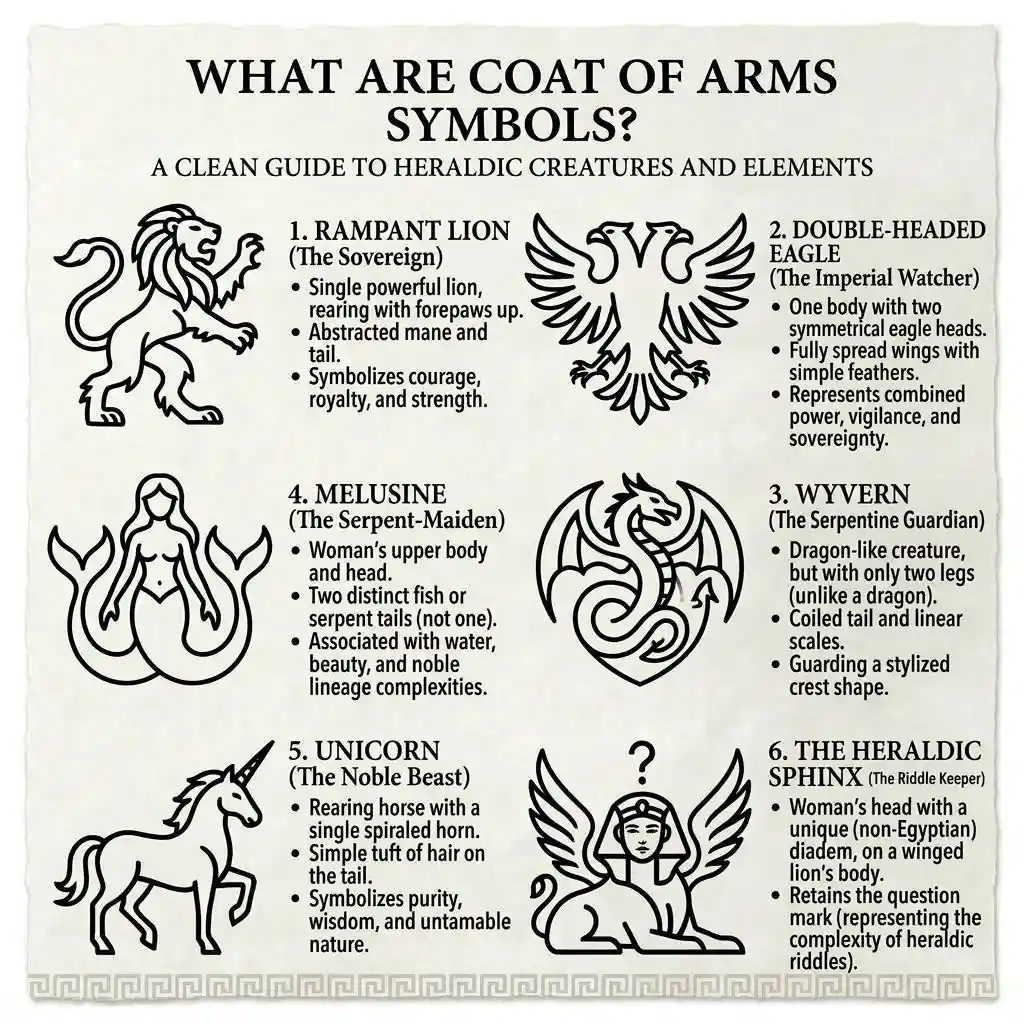
A coat of arms is a heraldic design used to identify a particular bearer. The central part is the shield, which carries the colors and symbols that form the arms. Other elements, such as a helmet, crest, mantling, supporters, and motto, may be added to create a fuller heraldic achievement.
What Is a Heraldic Charge?
A charge is a figure placed on a heraldic shield. Charges can include animals, birds, plants, weapons, buildings, stars, crosses, mythical creatures, and many other objects.
For example, a lion placed on a shield is a charge. An eagle, rose, sword, castle, or fleur-de-lis can also function as a charge.
The charge may have a historical association with the bearer, a place, a family story, a political connection, a religious reference, or even a pun on the bearer’s name. Because of this variety, it is safer to say that a symbol is associated with an idea rather than claiming that it always has one exact meaning.
What Is Heraldry?
Heraldry is the system and tradition surrounding coats of arms and related emblems. It developed in medieval Europe and eventually became a broader form of personal, institutional, civic, and corporate identity.
A coat of arms is therefore more than a decorative picture. It is an identifying design with rules and traditions governing its description, inheritance, display, and use.
Parts of a Coat of Arms
A complete heraldic display can contain several different elements. Not every coat of arms includes every part.
Shield
The shield is the central part of a coat of arms.
It carries the main tinctures, divisions, and charges. The shield is the essential part of the arms; surrounding elements can be added or omitted according to the heraldic tradition and the bearer.
When someone refers to the “arms” of a person or institution, the shield is usually the first part to examine.
Helmet
A helmet may appear above the shield.
Its design can vary according to the heraldic tradition, status, and type of arms. The helmet helps form the visual structure of a complete achievement.
Crest
The crest is the figure positioned above the helmet, normally resting on a wreath or torse.
This distinction is important because people often call an entire coat of arms a “crest.” In technical heraldry, however, the crest is only one part of the larger display.
Wreath and Mantling
The wreath, also called a torse in many contexts, is the twisted band associated with the crest.
Mantling is the decorative cloth flowing from the helmet. It developed from practical medieval equipment associated with protecting the helmet from the sun and became a conventional heraldic decoration.
Supporters
Supporters are figures placed on either side of the shield.
They may be animals, birds, humans, mythical creatures, or other figures, depending on the heraldic tradition and particular grant or usage.
Supporters are not automatically included on every coat of arms. Their use can have specific historical or institutional rules.
Motto
A motto is a short phrase associated with the bearer.
It may express an ideal, family tradition, religious idea, place identity, historical event, or personal principle. It does not necessarily provide a literal translation of every symbol on the shield.
Mottoes can appear in different languages and are often displayed on a scroll below or around the arms.
Compartment
A compartment is the base on which supporters may stand.
It can represent ground, landscape, or another setting and is not required for every heraldic achievement.
Coat of Arms Colors and Tinctures
Colors in heraldry are called tinctures. Traditional heraldic language uses special names for many of them.
Metals: Gold and Silver
The two principal heraldic metals are:
- Or — gold or yellow
- Argent — silver or white
These are called metals because they represent gold and silver in heraldic terminology.
Red, Blue, Black, Green, and Purple
Common heraldic colors include:
- Gules — red
- Azure — blue
- Sable — black
- Vert — green
- Purpure — purple
These technical names are useful when reading a formal heraldic description, known as a blazon.
What Do Heraldic Colors Mean?
You may often see popular lists claiming:
- Red means courage
- Blue means loyalty
- Green means hope
- Black means wisdom or mourning
- Gold means wealth
- Purple means royalty
These can be useful traditional or modern associations, but they should not automatically be treated as the historical reason a specific coat of arms uses that color.
The American Heraldry Society specifically notes that the original meanings of colors and charges often cannot be known unless the designer left evidence explaining the choices.
The Rule of Tincture
One of the important principles of traditional heraldic design is the rule of tincture.
In simple terms, heraldry generally seeks strong contrast between metals and colors. A metal charge is normally not placed directly on a metal field, while a colored charge is normally not placed directly on another color.
This contrast makes the design easier to recognize from a distance.
Common Animal Symbols on Coats of Arms
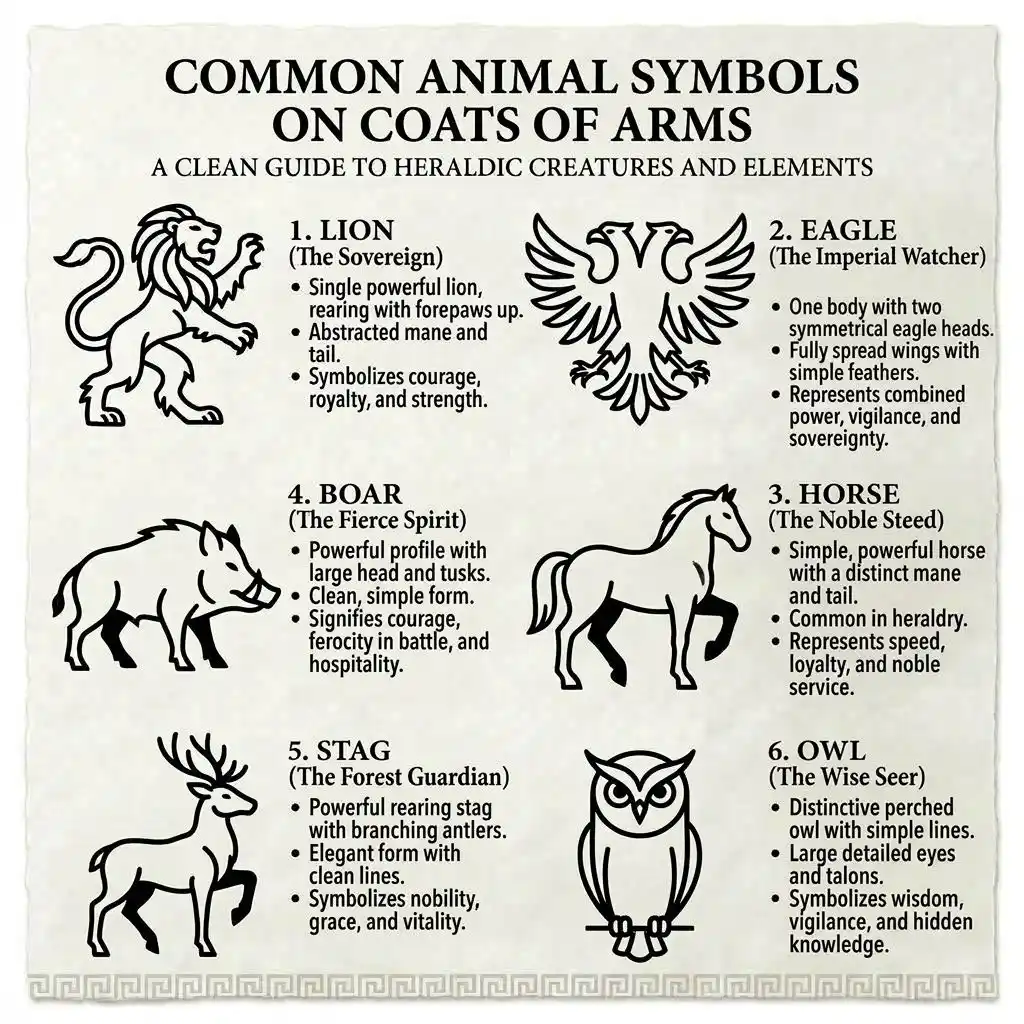
Animals are among the most recognizable heraldic charges.
Lion
The lion is one of the most famous figures in heraldry.
It is often associated in modern explanations with:
- Courage
- Strength
- Nobility
- Authority
- Bravery
Lions can appear in many different poses, including rampant, where the animal is shown standing on one hind leg with its forelegs raised.
However, a lion on a particular coat of arms does not automatically prove that the original bearer intended “courage” as its meaning. It may have been inherited, selected for another reason, connected with a name or place, or chosen for a specific historical purpose.
Eagle
The eagle is another important heraldic bird.
It is often associated today with:
- Power
- Authority
- Vision
- Leadership
- Sovereignty
Eagles have also been important in imperial, national, civic, and institutional heraldry.
Their meaning therefore depends heavily on the specific heraldic tradition.
Bear
The bear can appear as a charge in European and later heraldic traditions.
Modern interpretations often connect it with:
- Strength
- Endurance
- Courage
- Determination
But these should be treated as common associations rather than universal historical definitions.
Wolf
The wolf may be used to evoke qualities such as:
- Determination
- Independence
- Wilderness
- Persistence
Its significance can also be connected with a particular family, locality, story, or visual pun.
Stag or Deer
A stag or deer is often associated in modern heraldic explanations with:
- Hunting
- Nature
- Nobility
- Gentleness
- Wilderness
The animal can also have a specific local or family connection.
Horse
Horses may suggest:
- Speed
- Travel
- Readiness
- Military traditions
- Strength
As with other animals, the actual reason for its inclusion should be established from the history of the particular arms.
Boar
The boar is a recognizable heraldic animal and is often interpreted through ideas such as:
- Courage
- Ferocity
- Determination
- Strength
Its appearance may also relate to hunting or a particular family tradition.
Dog
Dogs can be associated with:
- Loyalty
- Faithfulness
- Vigilance
- Companionship
Different breeds and poses may have different heraldic descriptions.
Dragon
The dragon is one of the best-known mythical creatures in heraldry.
It can be associated with:
- Power
- Protection
- Courage
- Warrior traditions
The red dragon of Wales is a particularly recognizable example of dragon imagery connected with national identity.
Griffin
The griffin combines features traditionally associated with an eagle and a lion.
Because of this combination, modern interpretations often connect the griffin with:
- Strength
- Courage
- Guardianship
- Nobility
The griffin’s historical use should still be understood in its particular heraldic context.
Common Plant and Flower Symbols
Plants and flowers can also appear as heraldic charges.
Fleur-de-Lis
The fleur-de-lis is one of the most recognizable symbols associated with French heraldic and royal history.
It has also appeared in many other places and institutions, so it should not be treated as exclusively French in every context.
Its modern associations can include:
- Royalty
- Heritage
- Nobility
- Faith
- French identity
The meaning depends on where and how the symbol is used.
Rose
The rose has an important place in English heraldic history and is widely recognized in British culture.
Modern readers may associate it with:
- Love
- Beauty
- Honor
- England
- Family heritage
The famous Tudor rose is a historical example of how a flower can become connected with dynastic identity.
Thistle
The thistle is strongly associated with Scotland.
It can therefore represent:
- Scottish identity
- Heritage
- Resilience
- National tradition
Its significance is particularly strong in Scottish cultural and heraldic contexts.
Oak
The oak tree can be used to suggest ideas such as:
- Strength
- Endurance
- Stability
- Longevity
It may also represent a place, landscape, family tradition, or historical association.
Wheat and Grain
Wheat and grain are natural choices for heraldic designs connected with:
- Agriculture
- Harvest
- Prosperity
- Rural identity
- Farming
A municipality or family connected with agricultural land may use such imagery for a very specific reason.
Lily
Lily imagery can appear in heraldic and religious contexts.
Depending on the design and setting, it may be associated with:
- Purity
- Faith
- Beauty
- Religious tradition
The exact significance should be determined from the particular arms rather than assumed from a generic symbol list.
Common Objects and Weapons in Heraldry
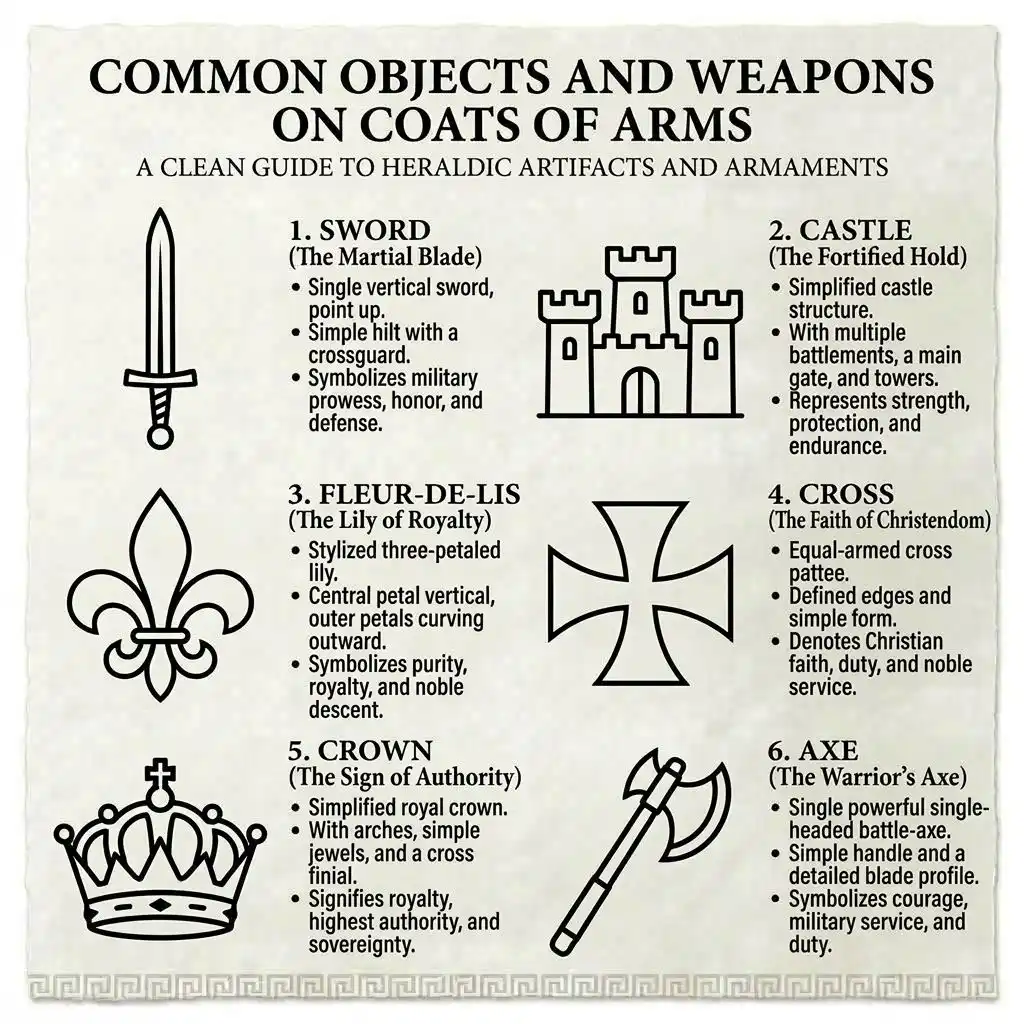
Objects can communicate occupation, location, history, military service, or personal identity.
Sword
A sword may be interpreted through:
- Military service
- Courage
- Defense
- Authority
- Warfare
It can also be a specific reference to a historical person or event.
Crown
A crown is strongly connected with:
- Royalty
- Authority
- Rank
- Sovereignty
However, different crowns can have different forms and heraldic meanings.
A crown appearing on a coat of arms does not automatically mean that the bearer was personally a monarch.
Castle
A castle or fortified tower can evoke:
- Defense
- Security
- Strength
- A fortified place
- Local history
In civic heraldry, a castle may represent an actual historic building or fortified settlement.
Key
A key may be associated with:
- Authority
- Guardianship
- Access
- Responsibility
It may also have a religious or institutional meaning.
Anchor
An anchor is especially suitable for maritime imagery.
Modern interpretations include:
- Stability
- Safety
- Hope
- Seafaring
- Maritime identity
A specific coat of arms may use it because the bearer or community has a direct connection with the sea.
Book
A book can appear in heraldic designs connected with:
- Learning
- Education
- Scholarship
- Law
- Religion
Universities and educational institutions may use books as part of their visual identity.
Ship
A ship can represent:
- Travel
- Exploration
- Trade
- Maritime history
- A coastal community
Its actual significance may be very specific to the bearer or place.
Hammer
A hammer may be connected with:
- Craftsmanship
- Industry
- Metalworking
- Engineering
- Labor
A town known for manufacturing or a family associated with a craft might use such imagery.
Common Heraldic Shapes and Charges
Heraldry also uses geometric figures that beginners may not immediately recognize.
Cross
The cross is one of the most common heraldic figures.
It may have religious, historical, military, institutional, or regional associations.
The exact form of the cross matters because different cross designs have different names and histories.
Chevron
A chevron is a V-shaped heraldic figure.
It is one of the classic ordinaries used in heraldic design.
Popular interpretations sometimes associate it with protection, building, or service, but the specific historical reason for a chevron on a particular shield should not be assumed.
Fess
A fess is a horizontal band across the shield.
It is a basic heraldic ordinary and is often one of the first technical terms beginners encounter.
Bend
A bend is a diagonal band running across the shield.
Its exact orientation and description are part of heraldic blazon.
Pale
A pale is a vertical band positioned down the center of the shield.
Like the fess and bend, it is primarily a formal heraldic element rather than a symbol that automatically carries one universal message.
Saltire
A saltire is an X-shaped heraldic figure.
The best-known example is the saltire appearing on the flag associated with Scotland.
Stars and Roundels
Stars and circular figures can appear as charges.
Their significance varies widely according to the particular arms.
This is another reason not to use a simple dictionary in which every shape is assigned one guaranteed meaning.
What Do Coat of Arms Symbols Mean?
The meaning of a coat of arms is best understood by considering the whole design, not one symbol in isolation.
Symbols of Strength
Modern readers often associate these heraldic images with strength:
- Lion
- Bear
- Eagle
- Dragon
- Sword
- Castle
- Oak
The combination of several charges may create a stronger theme, but the original designer’s intention may be different.
Symbols of Courage
Commonly interpreted courage-related imagery includes:
- Lion
- Sword
- Dragon
- Warrior figures
- Shield
These associations are especially common in modern explanations of heraldry.
Symbols of Loyalty
Some animals and objects are commonly associated with loyalty or faithfulness.
The dog is a familiar example.
A motto may also communicate loyalty more directly than an individual charge.
Symbols of Protection
Protective imagery may include:
- Shield
- Castle
- Tower
- Guardian animals
- Dragon
- Sword
A protective interpretation can be particularly appropriate when the design has a clear defensive or military context.
Symbols of Royalty
Royal or sovereign associations may include:
- Crown
- Lion
- Eagle
- Scepter
- Fleur-de-lis
However, these symbols can appear outside royal contexts as well.
Symbols of Wisdom and Learning
Modern interpretations may connect the following with learning:
- Book
- Lamp or torch
- Owl
- Open pages
- University symbols
The actual meaning of any one charge depends on the particular arms.
How to Read a Coat of Arms
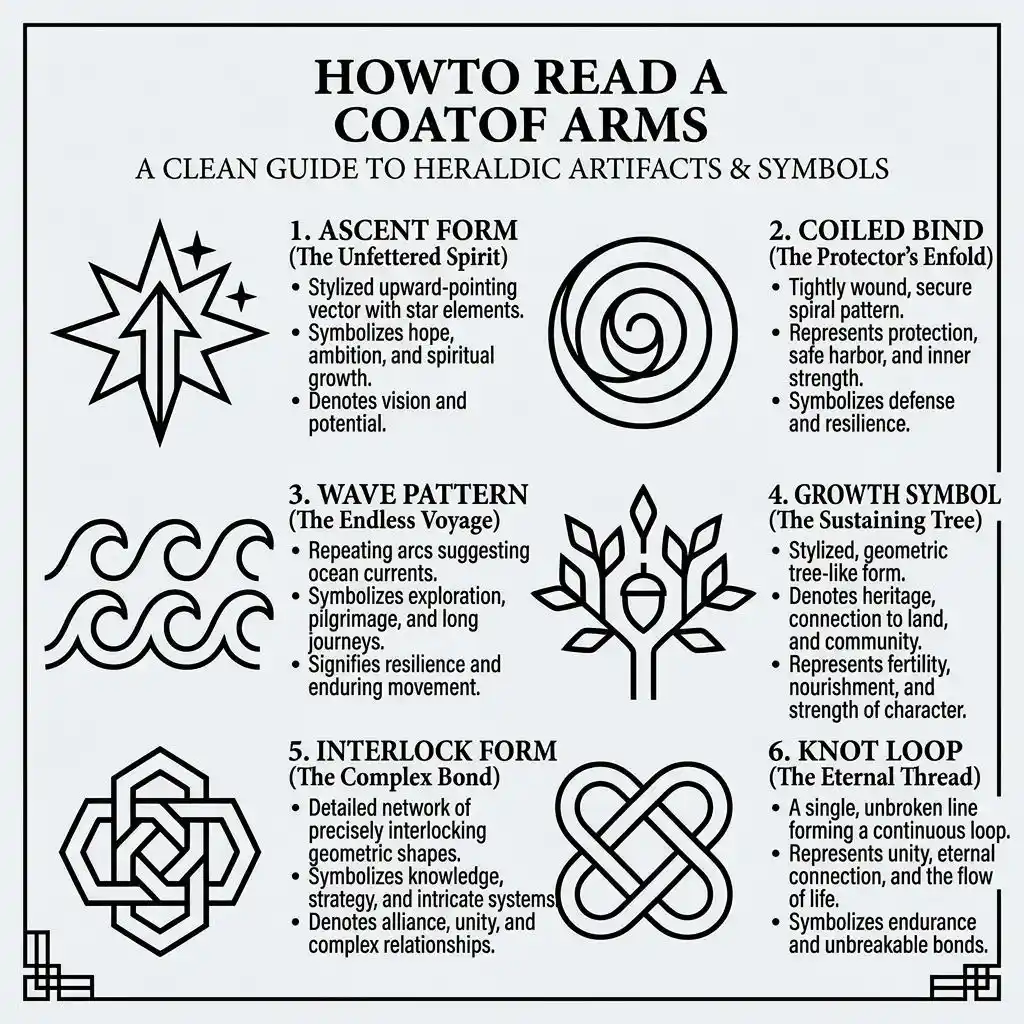
You do not need to be a heraldry expert to begin reading a coat of arms.
Identify the Shield
Start with the central shield.
Ask:
- What color is the field?
- Is the shield divided?
- Are there multiple sections?
- What charges appear on it?
The shield contains the primary visual information.
Identify the Tinctures
Next, identify the colors.
Look for:
- Or
- Argent
- Gules
- Azure
- Sable
- Vert
- Purpure
Learning these terms makes formal heraldic descriptions much easier to understand.
Find the Charges
Identify the objects, animals, plants, and figures on the shield.
For example, you might find:
A lion + crown + three stars
Do not immediately assign a generic meaning to each one. First determine whether the combination relates to a known person, family, institution, place, or historical event.
Understand Dexter and Sinister
Heraldry uses the terms dexter and sinister from the perspective of the bearer of the shield.
- Dexter means the bearer’s right.
- Sinister means the bearer’s left.
Because you are looking at the front of the shield, these directions appear reversed from the viewer’s perspective.
This distinction is important when reading a formal blazon.
Identify the Crest
Look above the helmet.
The figure there is the crest, not the entire coat of arms.
This is one of the most common terminology mistakes made by people who are new to heraldry.
Read the Motto
The motto may provide a clue about the values, history, or identity associated with the arms.
However, it should not necessarily be treated as a literal explanation of every charge.
Understand the Blazon
A blazon is the formal written description of heraldic arms.
It allows a heraldic design to be described precisely in words.
For example, a simple description such as “Azure, a chevron Argent” means a blue shield bearing a silver or white chevron.
Once you learn basic blazon vocabulary, written descriptions become much easier to decode.
Coat of Arms vs Family Crest
The terms coat of arms and family crest are often mixed together in everyday speech, but they are not technically identical.
What Is a Crest?
The crest is the figure placed above the helmet.
It is one part of a larger heraldic achievement.
A person may therefore have a coat of arms that includes a crest, but calling the entire shield a “crest” is technically inaccurate.
Why “Family Crest” Can Be Misleading
The phrase “family crest” is widely used commercially, especially in products marketed around surnames.
Historically, however, heraldic arms are generally connected with specific bearers and their recognized descendants rather than automatically belonging to every person who has the same surname.
| Term | Meaning |
| Coat of arms | Heraldic arms centered on the shield |
| Shield | Central surface carrying the arms |
| Crest | Figure above the helmet |
| Supporters | Figures placed beside the shield |
| Motto | Short phrase associated with the arms |
| Achievement | Complete heraldic display |
Does Every Surname Have a Coat of Arms?
No, sharing a surname does not by itself establish a right to a particular coat of arms.
How Surname Heraldry Really Works
A coat of arms is generally associated with a particular armiger rather than automatically with everyone who has the same family name.
Historical heraldic systems vary, and some traditions have had different approaches to inheritance. But the basic point remains important: a surname alone is not proof that a particular coat of arms belongs to you.
For example, historical armorial records can contain multiple different coats of arms associated with different people sharing the same surname.
How to Research Your Family’s Heraldic History
If you want to determine whether you have a genuine connection to a particular coat of arms, begin with genealogy.
A useful process is:
- Record your parents and grandparents.
- Work backward through documented generations.
- Identify the specific ancestor who is claimed to have borne the arms.
- Find reliable evidence that this person actually bore those arms.
- Establish your descent from that individual.
- Check the heraldic rules applicable to the country and period involved.
The American Heraldry Society recommends objective genealogical research rather than relying only on surname matches or commercial certificates.
Coat of Arms vs Logo and Other Symbols
Modern logos and coats of arms can sometimes look similar, especially when a logo uses a shield.
Heraldry vs Modern Logos
A modern logo is generally created as a visual identity for a company, organization, product, or project.
A coat of arms belongs to a different heraldic tradition and has its own vocabulary and conventions.
A shield-shaped graphic is therefore not automatically a coat of arms.
Heraldic Symbols vs Cultural Symbols
Some symbols can belong to several categories at once.
For example, a rose can be:
- A flower
- A cultural symbol
- A national or regional emblem
- A heraldic charge
- A decorative design
Context determines which interpretation is appropriate.
Famous Heraldic Symbols and Their History
Certain symbols have become especially recognizable because of their historical use.
Fleur-de-Lis
The fleur-de-lis is strongly associated with French royal and heraldic history.
It also appears in many other places, so its presence does not automatically identify a French coat of arms.
Lion
Lions appear frequently in heraldic designs across Europe and beyond.
They are especially recognizable because of their bold appearance and long history in royal, civic, and personal heraldry.
Eagle
Eagles have been used in many heraldic and national traditions.
They can communicate identity at a national, imperial, civic, or personal level depending on the design.
Dragon
Dragon imagery is particularly notable in Welsh heraldic and national symbolism.
The creature’s dramatic appearance has also made it popular in fantasy, literature, and modern graphic design.
Rose
The rose is strongly associated with English history and became particularly notable through the Tudor rose.
Its use shows how a flower can become part of a broader political and dynastic story.
Crown
Crowns appear in many heraldic contexts.
Their form and position can matter because different crowns can relate to different ranks, offices, institutions, or traditions.
Historical Meanings vs Modern Interpretations
This distinction is essential when researching coat of arms symbols.
What Historical Evidence Can Tell Us
Historical evidence can include:
- Heraldic grants
- Armorial records
- Genealogical documents
- Seals
- Coins
- Manuscripts
- Official registers
- Historical descriptions
- Contemporary artwork
These sources can help identify who bore the arms and how the design was used.
However, they do not always explain why every color or charge was selected.
Why Symbol Meanings Change
A symbol can acquire new meanings over time.
A lion may have been selected for a family-specific reason, while later audiences interpret it as courage.
A rose may identify a dynasty, while modern readers see it primarily as beauty or love.
A castle may refer to a specific place, while someone today interprets it simply as protection.
The modern interpretation can be interesting, but it should not be confused with documented historical intent.
Common Heraldry Myths
Several misconceptions appear repeatedly.
Myth: Every color has one exact meaning.
Reality: The original reason for a color may be unknown unless historical evidence explains it.
Myth: Every surname has one family coat of arms.
Reality: A surname can be shared by many unrelated people, and different arms can belong to different bearers of the same name.
Myth: The crest and coat of arms are the same thing.
Reality: The crest is one component positioned above the helmet, while the shield carries the principal arms.
Myth: Only aristocrats could ever have heraldic arms.
Reality: Heraldic use expanded beyond knights and nobles and has also included civic, institutional, and other forms of identity.
Myth: A commercial surname certificate proves ancestry.
Reality: A surname match alone does not establish descent from the historical bearer of particular arms. Genealogical evidence is needed.
Frequently Asked Questions About Coat of Arms Symbols
What do coat of arms symbols mean?
Coat of arms symbols can identify people, families, institutions, places, occupations, historical events, or other associations. There is no universal rule that every charge has one fixed meaning. The historical reason for a particular symbol may only be known when records explain it.
What does a lion mean on a coat of arms?
A lion is commonly associated today with courage, strength, bravery, authority, and nobility. However, the specific reason a lion appears on particular arms may be different or unknown.
What does an eagle symbolize in heraldry?
An eagle is often associated with power, authority, vision, sovereignty, and leadership. Its meaning depends on the particular heraldic tradition and design.
What do colors mean on a coat of arms?
Heraldic colors are called tinctures. Common tinctures include red, blue, black, green, purple, gold, and silver. Popular symbolic meanings exist, but the original reason for a particular color cannot always be established.
What does red mean in heraldry?
Red, or gules, is often given modern associations such as courage, strength, and bravery. These associations should not automatically be treated as the documented reason for every use of red.
What does blue mean in heraldry?
Blue, or azure, is often associated in modern explanations with loyalty, truth, or justice. The historical meaning of blue on a specific coat of arms may be different or undocumented.
What is the difference between a crest and a coat of arms?
A coat of arms centers on the shield and may form part of a larger achievement. The crest is the figure positioned above the helmet. Therefore, the crest is only one component of a complete heraldic display.
Does every family have a coat of arms?
No. Not every family has a coat of arms, and having the same surname as someone who historically bore arms does not automatically give you a right to use those arms.
Can I find my family coat of arms by surname?
A surname search can help locate historical records, but it cannot by itself prove that a particular coat of arms belongs to your family. You need genealogical evidence connecting you to the specific armiger who bore the arms.
What is a heraldic charge?
A charge is a figure placed on a shield. Animals, plants, weapons, buildings, stars, crosses, and mythical creatures can all appear as charges.
What are tinctures in heraldry?
Tinctures are the colors and metals used in heraldic designs. The principal traditional terms include Or, Argent, Gules, Azure, Sable, Vert, and Purpure.
What is a blazon?
A blazon is the formal written description of a coat of arms. It uses specialized heraldic vocabulary to describe the shield and its components.
What do dexter and sinister mean?
Dexter refers to the bearer’s right side, while sinister refers to the bearer’s left side. When you look at a shield from the front, these directions appear reversed.
What is an achievement of arms?
An achievement is a complete heraldic display that can include the shield, helmet, crest, wreath, mantling, supporters, compartment, and motto. Not every achievement contains all these elements.
Are coat of arms symbols universal?
No. Heraldic traditions differ by country, period, and institution. The same animal or object can have different associations in different contexts.
How can I tell if a coat of arms is authentic?
Start by identifying the claimed bearer and the country or heraldic authority involved. Then look for reliable historical or official records and establish whether there is a documented connection between the arms and the person or institution being discussed.
Conclusion
Coat of arms symbols form a detailed visual language built from shields, colors, animals, plants, objects, geometric figures, mottoes, and other heraldic elements. A lion may be commonly associated with courage, an eagle with authority, a rose with heritage, and a crown with royalty, but these popular meanings should not automatically be treated as the original explanation for every heraldic design.
The most reliable way to understand a coat of arms is to examine the complete design and its historical context. Learn the difference between a shield and crest, understand charges and tinctures, recognize the basic parts of an achievement, and use the blazon when a precise description is needed.
If you are researching a supposed family coat of arms, remember that a surname alone does not establish ownership or ancestry. Genuine heraldic research requires a connection to a particular bearer and appropriate genealogical evidence.
Once you understand these principles, coat of arms symbols become much more than attractive pictures. They become clues that can help explain identity, history, geography, institutions, and the traditions surrounding heraldry.

Clara Miles
Hello! I’m Clara, a lifelong dreamer who finds magic in everyday moments. Writing has always been my way of exploring the world and understanding the people around me. I love creating stories that make readers laugh, cry, and reflect on life’s little surprises. When I’m not writing, you can usually find me sipping coffee at a cozy café or wandering through nature with a notebook in hand. My journey as an author is fueled by curiosity, imagination, and a love for connecting with my readers. Every story I write is a piece of my heart, and I hope it inspires yours too.
Books:
-
Whispers of the Heart
-
Shadows and Sunlight