
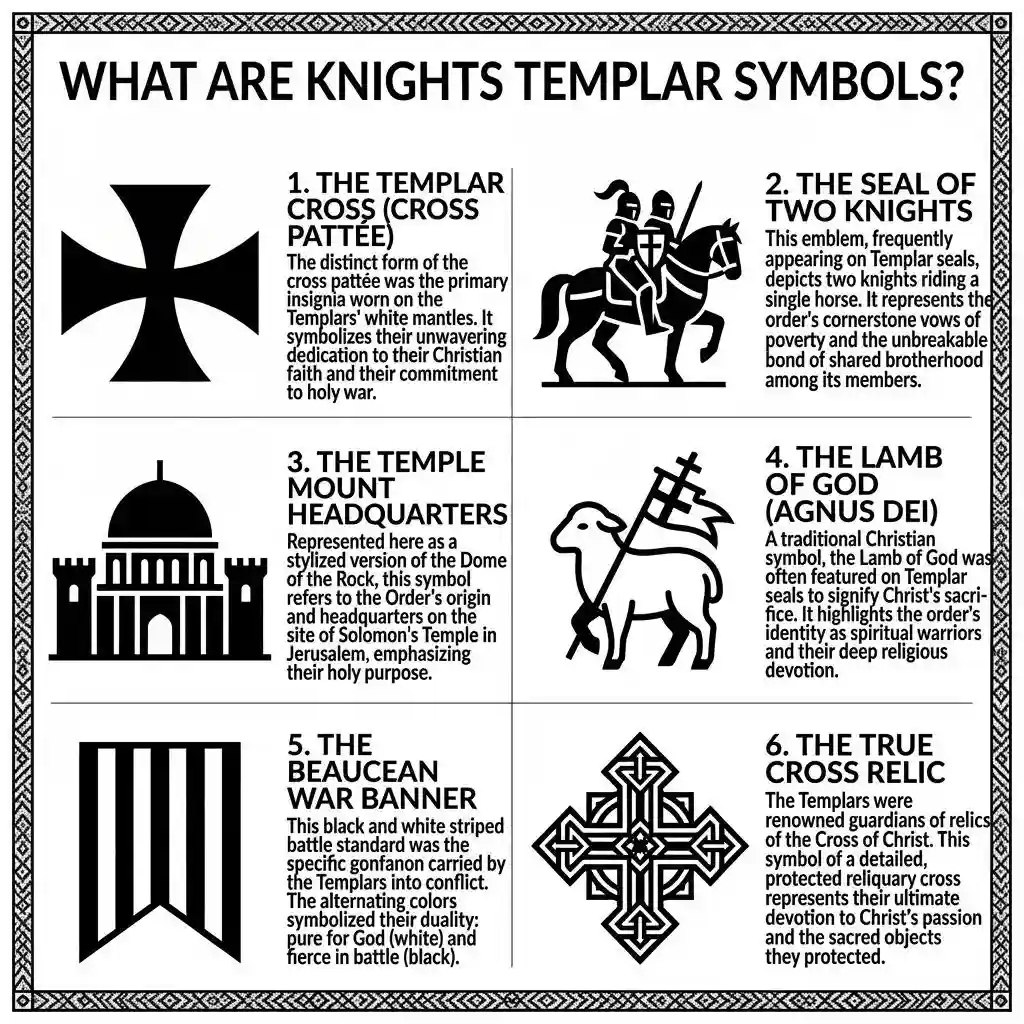
The Knights Templar symbols remain fascinating because they connect medieval religion, military life, heraldry, banners, seals, and the history of the Crusades. The red cross, black-and-white Beauséant banner, two knights riding one horse, and other images are frequently associated with the Order of the Temple.
At the same time, modern websites and popular culture have added many images and meanings that are not necessarily supported by medieval evidence. Baphomet, skull and crossbones, secret-society imagery, and various modern Templar designs are often discussed alongside genuine historical symbols.
Understanding the difference between documented medieval imagery and later interpretation makes the subject much clearer. This guide explores the best-known Knights Templar symbols, what they represented or were used for, where they appeared, and why some of their supposed meanings remain uncertain.
What Were the Knights Templar?
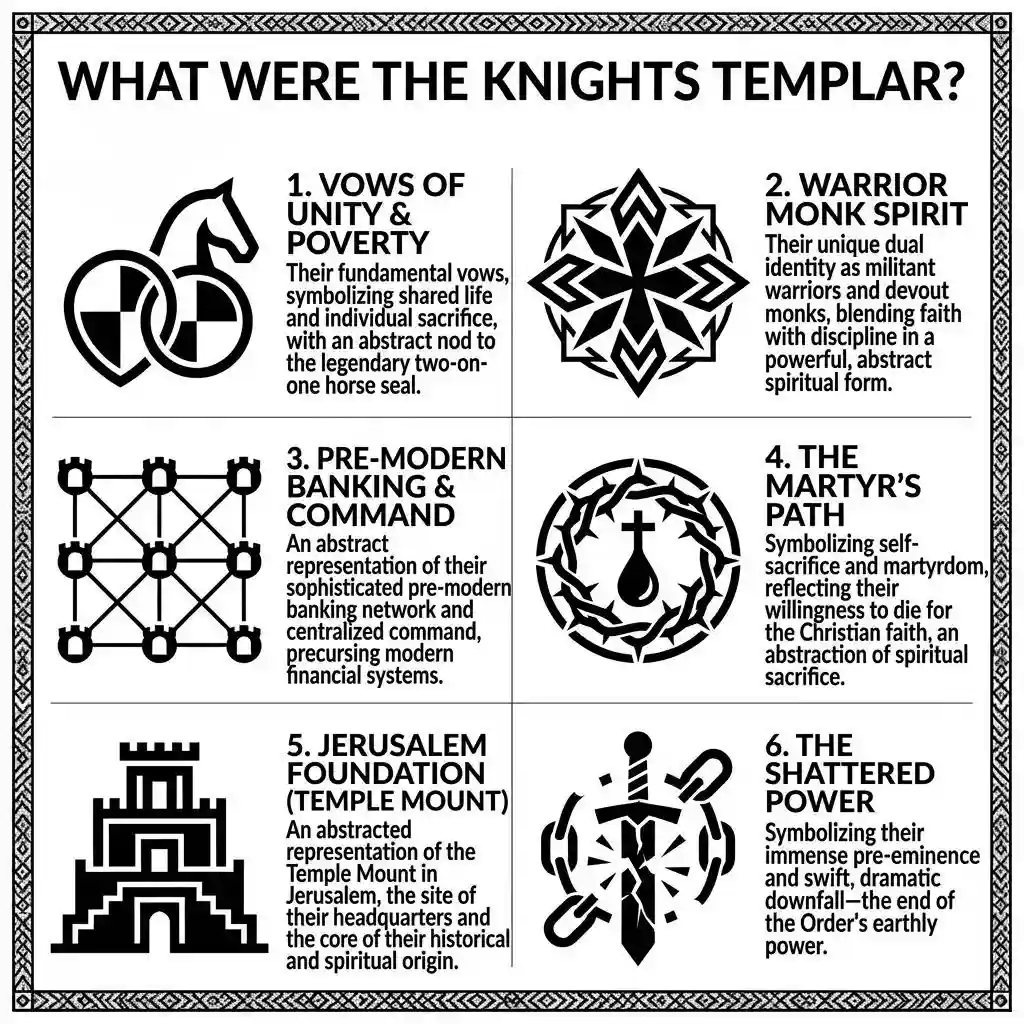
The Knights Templar were a medieval religious and military order formed in the early twelfth century. Their original name was associated with the Poor Fellow-Soldiers of Christ and of the Temple of Solomon.
The Order developed in the context of the Crusades and became an important institution with military, religious, administrative, and financial responsibilities.
The Origins of the Order
The Templars emerged in the early 1100s in the Kingdom of Jerusalem. Their initial purpose was connected with protecting pilgrims traveling in the Holy Land.
The Order eventually expanded far beyond a small group of knights. It developed a network of properties, commanderies, personnel, and supporters across Europe and the eastern Mediterranean.
Why the Templars Used Symbols
Symbols served practical purposes in medieval society.
A banner could identify a military unit. A seal could authenticate a document. A cross could communicate Christian identity. Clothing could distinguish members of a religious order.
Therefore, not every Templar symbol should be understood as a secret code.
Some imagery had an obvious institutional or religious function.
Symbols as Religious and Military Identity
The Templars combined two identities that may seem unusual to modern readers: they were a religious order and a military organization.
Their visual identity consequently included Christian imagery, clothing associated with religious life, military banners, seals, and heraldic devices.
Understanding this background helps explain why the cross and banner were so important.
Knights Templar Symbols and Meanings: Quick Reference
The following table provides a simple introduction to major symbols and images associated with the Templars.
| Symbol or Image | What It Is | Historical Association | Common Interpretation |
| Red cross | Christian cross used by Templars | Strongly associated with the Order | Christian faith and crusading identity |
| Beauséant | Black-and-white banner | Templar military banner | Order identity and battlefield recognition |
| Two knights on one horse | Image found on Templar seals | Historically documented | Often linked with poverty or brotherhood |
| Agnus Dei | Lamb of God imagery | Appears in Templar seal traditions | Christian religious symbolism |
| Temple imagery | Architectural imagery on some seals | Connected with the Order’s name | Association with the Temple |
| White mantle | Religious clothing | Associated with Templar knights | Religious identity and status |
| Baphomet | Figure mentioned in trial accusations | Connected to accusations against Templars | Later mystery and controversy |
| Skull and crossbones | Skull imagery later associated with Templars | Historical connection is uncertain | Later legend and popular symbolism |
The final column should not be treated as a universal dictionary. Some meanings are well supported, while others are interpretations that developed over time.
The Red Templar Cross
The red cross is probably the most recognizable symbol associated with the Knights Templar.
It appeared as part of the Order’s visual identity and expressed its Christian character.
What the Templar Cross Looks Like
Modern illustrations often show a red cross with flared ends, commonly described as a cross pattée.
Historical representations can vary, however, and the term “Templar cross” should not be treated as though there was one perfectly standardized graphic logo.
The important feature is the association between the Order and a red Christian cross.
Meaning and Religious Context
The cross was fundamentally a Christian symbol.
For the Templars, its presence reflected their religious identity and their role within the crusading world.
The color red is also strongly associated with the Templar cross in surviving descriptions and later representations.
Rather than interpreting the cross as a secret mystical code, it is more historically useful to understand it as part of the Order’s Christian and military identity.
Where the Cross Appeared
Templar crosses could be associated with:
- Clothing
- Shields
- Banners
- Seals
- Buildings
- Manuscript illustrations
- Other representations of members of the Order
The exact form could differ depending on the object, artist, period, and source.
Templar Cross vs. Other Medieval Crosses
The cross was not exclusive to the Templars.
Christian crosses were used throughout medieval Europe and the eastern Mediterranean. Other military and religious orders also used cross imagery.
Therefore, seeing a cross pattée on a medieval object does not automatically prove that the object belonged to the Knights Templar.
The Beauséant Banner
The Beauséant, also spelled Baucent or Beausant in different sources, is one of the most distinctive symbols associated with the Templars.
It is generally described as a black-and-white banner.
What Was the Beauséant?
The Beauséant served as an important banner of the Templar Order.
A military banner had an obvious practical role: it helped members recognize their group during the confusion of battle.
For a medieval military organization, maintaining a visible standard could be essential.
What Did the Black and White Colors Mean?
Different explanations have been offered for the colors.
Medieval writer Jacques de Vitry described the Templar banner using a contrast between black and white and connected this contrast with the Order’s relationship to friends and enemies.
Modern explanations sometimes reduce the colors to simple ideas such as good and evil. That interpretation should not automatically be treated as the complete historical meaning.
The medieval evidence is more valuable than a modern symbolic formula.
How Was the Banner Used?
The banner was particularly important in military settings.
A standard could provide a rallying point for troops and help maintain formation.
The Beauséant therefore had both symbolic and practical importance.
Is Every Black-and-White Templar Flag Authentic?
No.
Modern reproductions can differ substantially from medieval representations.
Flags sold today as “Templar banners” may be historical reconstructions, artistic interpretations, or completely modern designs.
If authenticity matters, the design should be compared with medieval evidence rather than judged by how popular it is online.
The Two Knights on One Horse
One of the most famous Templar images appears on seals showing two mounted figures sharing a single horse.
This image has generated considerable discussion.
The Famous Templar Seal
The two-riders image is associated with the early Templar seal tradition.
It became one of the most recognizable visual representations connected with the Order.
The image is historically important because it appears in a genuine administrative context rather than only in modern artwork.
The Poverty Interpretation
One traditional interpretation connects the two riders and one horse with the Templars’ early vow of poverty.
The idea is straightforward: two knights sharing one horse could visually communicate a lack of individual wealth.
This interpretation is frequently repeated, but readers should understand that the precise original intention of the seal is not completely certain.
Other Interpretations of the Seal
The image has also been interpreted in relation to:
- Brotherhood
- Shared resources
- Military cooperation
- The Order’s early history
- The contrast between individual knights and a collective institution
Because the original creators did not leave a modern explanatory caption, it is safer to distinguish documented imagery from later explanations.
Knights Templar Seals and Their Symbols
Seals were important administrative tools in medieval institutions.
They could help authenticate documents and identify the authority behind them.
Why Medieval Orders Used Seals
A seal was not necessarily a “secret symbol.”
It was a practical method of authentication and institutional identification.
The Templars, like other medieval institutions, used seals in administrative and legal contexts.
Two Knights Seal
The two-knights image is particularly famous because of its unusual composition.
Two figures share one horse, making the image immediately recognizable.
Its exact symbolic message is debated, but its association with the Templars is historically significant.
Temple Imagery on Templar Seals
Some Templar seals contain architectural imagery associated with the Temple.
This relates naturally to the Order’s name and its connection with the Temple of Solomon tradition.
Modern writers sometimes use such imagery as evidence for elaborate theories about secret chambers or hidden knowledge.
The historical existence of Temple-related imagery does not, by itself, prove those later claims.
Agnus Dei
The Agnus Dei, or Lamb of God, is an important Christian image that also appears in Templar-related seal traditions.
It depicts a lamb associated with Christian symbolism, often carrying or accompanied by a cross or banner.
The image is not uniquely Templar. It belongs to a much wider Christian artistic tradition.
Its presence in a Templar context therefore demonstrates the Order’s use of established Christian imagery rather than necessarily revealing a secret Templar code.
The White Mantle and Templar Clothing
The white mantle is another visual feature strongly associated with the Knights Templar.
White Mantle
Templar knights are commonly represented wearing white mantles.
The white clothing helped distinguish the Order and reflected its religious character.
Medieval clothing was not merely decorative. Clothing could communicate religious membership, social identity, and institutional status.
Red Cross on the Mantle
The red cross became an important identifying feature associated with the Templar mantle.
This combination—white clothing with a red cross—is now one of the clearest visual representations of a Templar knight.
Modern illustrations often exaggerate uniformity, however. Historical clothing could vary depending on period, role, status, and artistic representation.
Clothing as Institutional Identity
The Templars were a religious order, so their clothing was part of their institutional identity.
The combination of religious dress and military equipment visually communicated that the wearer belonged to a specialized organization.
Knights Templar Religious Symbols
The Templars’ symbols should be understood within medieval Christianity.
Christian Cross
The cross was central to Christian identity and therefore naturally important to a Christian military order.
The Templars’ use of a red cross should be understood within this broader religious context.
Agnus Dei
The Lamb of God was another Christian image associated with Templar seal traditions.
Its meaning comes primarily from Christian theology rather than from a secret Templar belief system.
Temple of Solomon Imagery
The Order’s name referred to the Temple of Solomon.
Consequently, Temple-related imagery could function as an institutional reference.
This historical association should not automatically be expanded into claims that the Templars possessed secret knowledge or hidden artifacts connected with Solomon’s Temple.
Religious Meaning and Medieval Context
The Templars operated in a medieval Christian society where religious symbols were deeply integrated into public and institutional life.
A cross, lamb, church, biblical reference, or sacred building could communicate religious identity without having an additional hidden meaning.
Templar Symbols and Medieval Heraldry
Heraldry provides another way to understand Templar imagery.
Cross Pattée
A cross pattée has arms that broaden toward their ends.
Modern illustrations frequently use this form for Templar imagery.
However, cross pattée designs existed outside the Templar Order as well.
The shape alone is therefore not enough to establish Templar ownership.
Banners and Shields
Medieval military organizations needed ways to identify themselves.
Banners and shields could display crosses, colors, heraldic imagery, or other identifying features.
For the Templars, these objects combined practical military identification with religious identity.
Heraldic Identification
A symbol becomes easier to identify historically when it is studied together with:
- The object on which it appears
- The date
- The location
- The associated person or institution
- The surrounding imagery
- Documentary evidence
This is more reliable than identifying an emblem from its shape alone.
Symbols Commonly Attributed to the Knights Templar
Several controversial symbols are frequently connected with the Templars.
Some connections come from historical evidence, while others became popular much later.
Baphomet
Baphomet is one of the most controversial names associated with the Templars.
During the Templar trials that began in 1307, accusations concerning an alleged figure called Baphomet appeared in the proceedings.
However, this does not establish that Baphomet was an official Templar symbol.
Modern depictions of Baphomet, especially the familiar horned figure, developed much later and should not simply be projected backward onto the medieval Templars.
Skull and Crossbones
The skull and crossbones is another image frequently described as a Templar symbol.
There are stories connecting it with Templar legends, graves, and later maritime traditions.
However, the evidence does not justify treating the skull and crossbones as an unquestioned official emblem of the medieval Knights Templar.
Modern Templar merchandise may use the design, but modern usage is different from medieval documentation.
Five-Pointed Star
Five-pointed stars existed in many cultures and periods.
A pentagram or five-pointed star should therefore not automatically be called a Templar symbol simply because it appears alongside Templar-inspired artwork.
If such a design is claimed to be Templar, its specific historical source should be identified.
Inverted Cross
The inverted cross is also sometimes included in modern lists of Templar symbols.
Its meaning has varied across Christian and later cultural contexts.
There is no good reason to treat every inverted cross as evidence of Templar symbolism.
Context matters.
Knights Templar Symbols vs. Modern Myths
The Templars became the subject of many legends after the medieval Order disappeared.
Medieval Evidence
Historical evidence for Templar symbolism includes:
- Seals
- Documents
- Medieval descriptions
- Clothing
- Banners
- Religious imagery
- Archaeological remains
- Contemporary or near-contemporary accounts
These sources should form the foundation of an article about genuine Templar symbols.
Later Legends
After the Order’s suppression, stories about the Templars continued to develop.
Later writers connected the Templars with hidden treasure, secret knowledge, lost relics, mysterious societies, and other subjects.
Some stories became so popular that they are now difficult to separate from the historical image of the Templars.
Conspiracy Theories
Modern conspiracy theories sometimes claim that the Templars survived secretly or controlled later organizations.
These claims belong to the history of Templar mythology rather than being treated as established medieval facts.
A responsible article should clearly identify them as later claims.
Knights Templar Symbols and Freemasonry
The relationship between the medieval Templars and modern Freemasonry is frequently misunderstood.
Medieval Templars
The medieval Knights Templar were a religious-military order that was suppressed in the early fourteenth century.
Their institutional history belongs to the medieval period.
Modern Masonic Knights Templar
Modern Masonic organizations use Templar-related names and imagery in certain fraternal traditions.
They are not simply the medieval Order continuing unchanged through the centuries.
Modern organizations can draw inspiration from medieval Templar history without establishing direct institutional continuity.
Why the Two Are Often Confused
The confusion comes partly from the continued popularity of Templar names, crosses, knightly imagery, and medieval themes.
When researching a symbol, always determine whether the source is discussing:
- The medieval Knights Templar
- Later European traditions
- Masonic organizations
- Modern historical societies
- Popular culture
The same symbol can have different meanings in each setting.
Knights Templar Symbols in Popular Culture
The Templars have become major figures in books, movies, television, games, and historical fiction.
Books and Movies
Fiction often combines authentic medieval details with invented stories.
A film may show a particular Templar emblem because it looks visually impressive rather than because it is historically documented.
Video Games
Games frequently use Templar crosses, banners, armor, secret chambers, and conspiracies to create dramatic narratives.
These can be entertaining, but they should not be treated as historical sources.
Modern Merchandise
Templar imagery appears on:
- Jewelry
- Clothing
- Flags
- Wall art
- Posters
- Coins
- Replica shields
- Decorative crosses
Some products reproduce historical designs, while others combine medieval and modern imagery.
How Pop Culture Changes Historical Imagery
Once an image becomes familiar, people may assume it has always been part of the historical tradition.
This is why checking primary or institutional evidence is important when authenticity matters.
Knights Templar Symbols in Tattoos
Templar-inspired tattoos are popular because crosses, knights, shields, swords, and banners create visually distinctive designs.
Templar Cross Tattoos
A red cross or cross pattée may be used to represent interest in medieval history, Christianity, military traditions, or the Templar legend.
The meaning chosen by the person receiving the tattoo can be personal.
Knight and Sword Designs
A knight, sword, shield, or armored figure may communicate ideas such as courage, discipline, defense, or medieval identity.
These meanings are often modern personal interpretations rather than direct translations of a documented Templar symbol.
Modern Symbolic Meanings
Someone may choose Templar imagery to express:
- Interest in medieval history
- Religious identity
- Personal courage
- Brotherhood
- Discipline
- Military heritage
- Fascination with the Crusades
- Connection with medieval art
These modern meanings should be distinguished from what a medieval Templar actually intended.
Historical Accuracy and Cultural Context
If historical accuracy matters, research the design before using it.
A tattoo described as “ancient Templar symbolism” may actually be a modern combination of several unrelated medieval images.
How to Identify an Authentic Templar Symbol
Identifying genuine Templar imagery requires more than recognizing a familiar cross.
Check the Historical Source
Look for evidence from:
- Medieval manuscripts
- Seals
- Charters
- Archaeological artifacts
- Contemporary chronicles
- Museum collections
- Academic research
A website that gives a symbolic meaning without identifying its source deserves additional scrutiny.
Check the Date
Determine when the image was created.
A design from the nineteenth century cannot automatically be used as evidence for what the Templars used in the twelfth century.
Likewise, a twentieth-century tattoo design cannot prove a medieval tradition.
Identify the Original Context
Ask where the symbol appeared.
Was it on:
- A seal?
- A banner?
- A manuscript?
- A tomb?
- A building?
- A shield?
- Clothing?
- A modern product?
Context can completely change how an image should be interpreted.
Separate Evidence From Interpretation
A useful rule is:
Documented image does not always mean documented meaning.
We may know that a particular symbol appeared on a Templar seal while still being uncertain about exactly what its designer intended it to communicate.
This distinction is especially important when reading about the two-knights seal and controversial symbols.
Templar Symbols vs. Other Medieval Crosses
Crosses associated with different military and religious traditions are often confused.
Templar Cross vs. Maltese Cross
The Maltese cross is strongly associated with the Knights Hospitaller and later traditions connected with the Order of Malta.
It should not automatically be called a Templar cross.
Templar Cross vs. Jerusalem Cross
The Jerusalem cross has its own history within the Christian and Crusader world.
Its association with Jerusalem does not make it an exclusive Templar emblem.
Templar Cross vs. Generic Cross Pattée
A cross pattée is a shape rather than proof of institutional ownership.
Different groups could use visually similar cross forms.
To identify a Templar symbol confidently, examine the complete historical context.
Knights Templar Symbols for Beginners
The topic can seem complicated because medieval symbolism, religion, heraldry, and later legends are often mixed together.
Symbols to Learn First
Beginners can start with:
- Red Templar cross
- Beauséant banner
- Two knights on one horse
- Templar seals
- Agnus Dei
- White mantle
- Temple imagery
- Baphomet as a later controversial association
The first seven help explain documented Templar visual culture, while Baphomet helps explain the difference between medieval evidence and later accusations and interpretations.
Easy Way to Remember Them
Think of the major symbols by function:
- Cross → Christian identity
- Banner → military identification
- Seal → institutional authentication
- Two knights → famous Templar seal imagery
- Mantle → religious and institutional identity
- Agnus Dei → Christian imagery
- Temple imagery → connection with the Order’s name
This method is easier than memorizing long lists of unsupported symbolic meanings.
How to Research Templar Imagery
When researching a symbol, use the following process:
Identify → Date → Locate → Compare → Verify
First identify the image. Then determine its date and location. Find the original object or documentary reference if possible. Compare it with other historical examples, and finally verify the interpretation using reliable historical sources.
Frequently Asked Questions About Knights Templar Symbols
What is the main symbol of the Knights Templar?
The red cross is the most widely recognized symbol associated with the Knights Templar. It reflected the Order’s Christian identity and became an important part of its visual representation.
What does the Templar red cross mean?
The red cross primarily reflects the Christian identity of the Order and its role within the medieval crusading world. It should not automatically be interpreted as a secret or occult symbol.
What is the Beauséant banner?
The Beauséant was a black-and-white banner associated with the Knights Templar. It served as an important military standard and part of the Order’s identity.
What does the two knights on one horse mean?
The image of two knights sharing one horse appears in Templar seal traditions. It has traditionally been connected with the Order’s poverty, while other interpretations relate it to brotherhood or shared resources. Its precise original meaning is not certain.
What did the Knights Templar seal look like?
The Templars used multiple seals. One famous image shows two mounted figures sharing one horse, while other seals contain different religious or architectural imagery.
Was Baphomet a Knights Templar symbol?
Baphomet was mentioned in accusations made during the trials of the Templars, but this does not establish that it was an official Templar symbol. The familiar horned figure associated with Baphomet today developed much later.
Did the Templars use skull and crossbones?
The skull and crossbones is often associated with Templar legends and modern Templar imagery, but it should not be treated as an unquestionably documented official emblem of the medieval Order.
Are Templar symbols connected to Freemasonry?
Modern Masonic Knights Templar traditions use medieval Templar themes and imagery, but modern organizations should not automatically be described as the medieval Order continuing unchanged.
What is the difference between a Templar cross and a Maltese cross?
The Templar cross is associated with the Knights Templar, while the Maltese cross is strongly associated with the Knights Hospitaller and later Order of Malta traditions. Similar-looking cross designs can have different institutional histories.
Are modern Templar symbols historically accurate?
Some modern designs are based on genuine medieval imagery, while others are reconstructions or later inventions. Checking the original date, object, and historical source is the best way to determine authenticity.
What do Templar symbols mean in tattoos?
Modern tattoo meanings are usually personal. A person may use a Templar cross, knight, sword, or banner to represent faith, courage, history, discipline, or another personal idea. Those meanings should not automatically be presented as medieval definitions.
Did the Knights Templar have secret symbols?
The Templars certainly used recognizable institutional imagery, seals, banners, crosses, and religious symbols. Claims about an extensive secret symbolic system should be distinguished from documented medieval evidence.
Conclusion
The Knights Templar symbols that can be connected most clearly with historical evidence include the red cross, Beauséant banner, Templar seals, two knights sharing one horse, white mantle, and Christian imagery such as the Agnus Dei. These symbols helped communicate religious identity, institutional membership, military organization, and administrative authority.
Other images, including Baphomet, skull and crossbones, occult designs, and elaborate secret-society imagery, require much greater caution. Some come from medieval accusations, later legends, or modern interpretations rather than clear evidence that they were official Templar symbols.
The best way to understand Templar symbolism is to look beyond a simple list of meanings. Consider the date, source, object, historical context, and level of evidence behind each claim. That approach reveals a much more interesting picture of the Knights Templar while keeping medieval history separate from the myths that developed around the Order centuries later.

Clara Miles
Hello! I’m Clara, a lifelong dreamer who finds magic in everyday moments. Writing has always been my way of exploring the world and understanding the people around me. I love creating stories that make readers laugh, cry, and reflect on life’s little surprises. When I’m not writing, you can usually find me sipping coffee at a cozy café or wandering through nature with a notebook in hand. My journey as an author is fueled by curiosity, imagination, and a love for connecting with my readers. Every story I write is a piece of my heart, and I hope it inspires yours too.
Books:
-
Whispers of the Heart
-
Shadows and Sunlight