The ancient Inca world is remembered for its remarkable architecture, textiles, religious traditions, and close relationship with the natural environment. Today, people search for Inca symbols to understand the meanings behind the sun, animals, geometric designs, sacred objects, and other forms of visual expression connected with the Inca or Andean world.
However, understanding these symbols is not always as simple as assigning one meaning to one shape. Some symbols and religious associations are well documented, while other meanings commonly found online come from modern interpretations. It is also important to remember that the Inca Empire was part of a much older Andean cultural history.
This guide explains important Inca symbols and meanings in a simple way. It also explores religious symbolism, animals, textiles, khipu, the Chakana, architecture, tattoos, and the difference between historically documented meanings and modern uses.
What Are Inca Symbols?
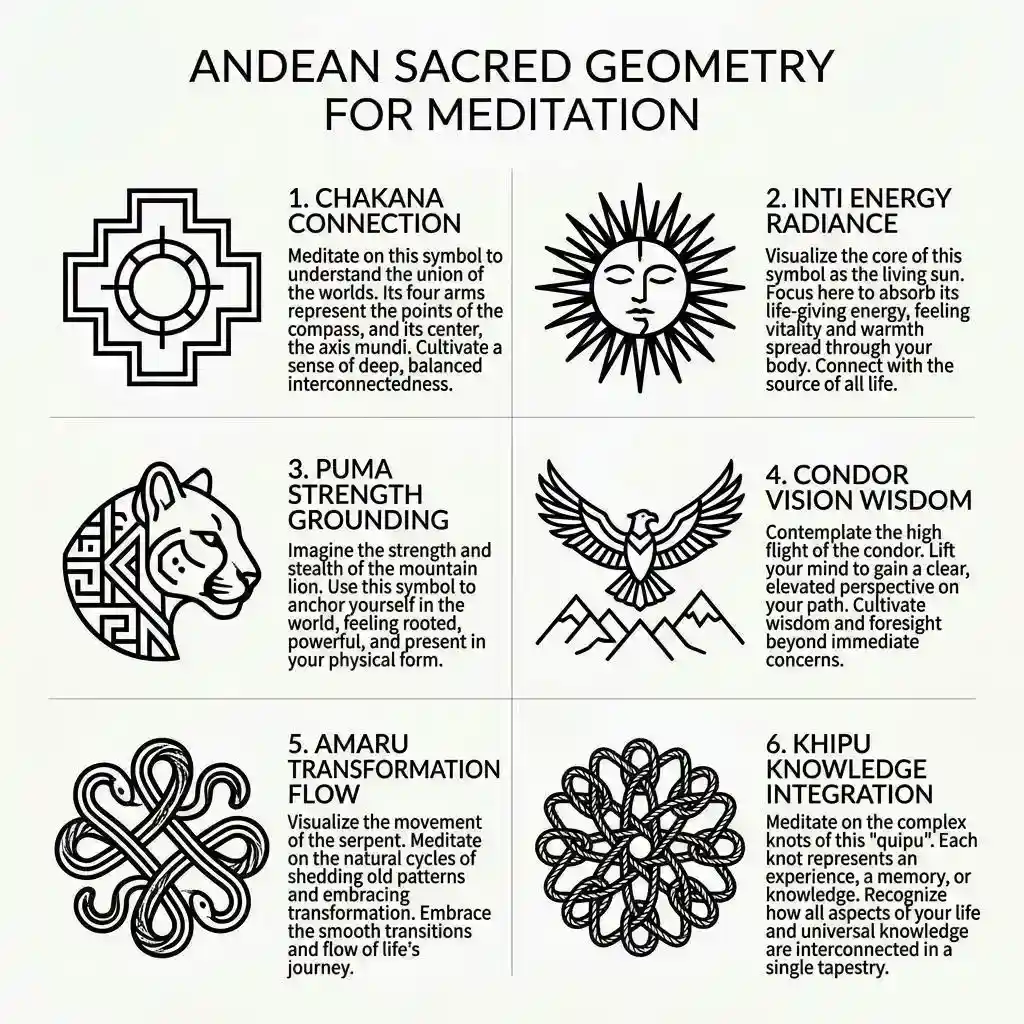
Inca symbols can refer to visual designs, sacred imagery, animals, objects, textile patterns, and systems of communication associated with the Inca world. Some were connected with religion, social status, political authority, nature, or daily life.
The word “Inca” is also sometimes used broadly for ancient Andean culture. Historically, however, the Inca or Inka were the ruling civilization of a large empire centered in the Andes. Their traditions developed within a region that already had a long history of different cultures.
Why Did the Incas Use Symbols?
Visual communication was important in Inca society. Designs could appear on textiles, pottery, buildings, ceremonial objects, and other materials.
Symbols and visual motifs could help communicate identity, status, religious ideas, political relationships, or cultural traditions. Their meaning often depended on where a design appeared and how it was used.
This is why an individual shape should not always be given one universal meaning.
Inca Symbols vs. General Andean Symbols
Not every symbol associated with Peru or the Andes originated with the Inca.
The Andes had developed sophisticated cultures long before the rise of the Inca Empire. Earlier civilizations and societies contributed to the artistic and religious traditions that later existed under Inca rule.
When researching a particular design, it is therefore useful to ask whether it is:
- Specifically associated with the Inca period
- From an earlier Andean culture
- A design that continued across different periods
- A modern interpretation of an ancient motif
- A contemporary design inspired by Andean history
This distinction makes the study of Inca symbols more accurate.
Why Can Inca Symbol Meanings Be Difficult to Determine?
Ancient symbols rarely come with a modern-style explanation attached to them. Archaeologists and historians often have to study an object’s location, material, artistic style, historical period, and relationship to other evidence.
A geometric pattern on a textile, for example, may have social meaning, but its exact meaning cannot always be translated into one simple English word.
For this reason, responsible explanations should separate documented evidence from interpretation.
Inca Symbols and Meanings: Quick Reference
The following concepts are among the most useful starting points when learning about Inca symbolism.
| Symbol or Concept | General Association | Historical Context |
| Inti and the Sun | Solar power and religious importance | Closely connected with Inca religion |
| Condor | Sacred bird and highland symbolism | Important in Andean religious imagery |
| Puma | Animal imagery and power | Important in Inca and broader Andean traditions |
| Serpent | Religious and natural-world associations | Appears in Andean symbolic traditions |
| Toqapu | Geometric textile designs | Associated with elite Inca textiles |
| Khipu/Quipu | Recording and communication | Used to store and organize information |
| Chakana | Andean cross-shaped design | Modern interpretations vary and require context |
| Huaca | Sacred place or object | Important to Andean religious traditions |
| Inca textiles | Identity, status, and social information | Central to Inca visual culture |
| Sacred landscape | Mountains, places, and natural features | Important within Andean religious life |
These categories should be understood in their historical contexts rather than treated as a fixed dictionary in which every design has only one meaning.
Important Inca Religious Symbols
Religion was deeply connected with Inca political and social life. The Inca religious world included deities, sacred places, ancestors, natural forces, and ritual practices.
Inti and the Sun
Inti was the Inca sun deity and is one of the most recognizable religious associations connected with the Inca Empire.
The sun was especially important to the Inca ruling tradition. Solar imagery therefore became closely associated with imperial religion and authority.
Modern images of an Inca sun often show a circular face surrounded by rays. Such artwork can be inspired by historical traditions, but modern decorative versions should not automatically be assumed to reproduce a single standardized ancient Inca symbol.
The importance of Inti is much more historically secure than the claim that one particular modern sun drawing was the universal Inca sun symbol.
Viracocha
Viracocha, also spelled Wiraqocha or Viracocha, is an important deity in accounts of Andean religion.
He is often described in historical sources as a creator or powerful supernatural being. Accounts of Andean religion developed through different historical periods, and descriptions recorded after the Spanish conquest must be considered within their colonial context.
For this reason, Viracocha is better understood as part of a complex religious tradition rather than represented by one simple icon.
Pachamama
Pachamama is widely associated with earth, fertility, agriculture, and the natural environment in Andean traditions.
The concept has continued to hold cultural importance in the Andes beyond the Inca period. It should therefore not be presented as a symbol belonging exclusively to the Inca Empire.
Modern references to Pachamama often connect her with nature, nourishment, farming, and respect for the earth.
Mama Quilla
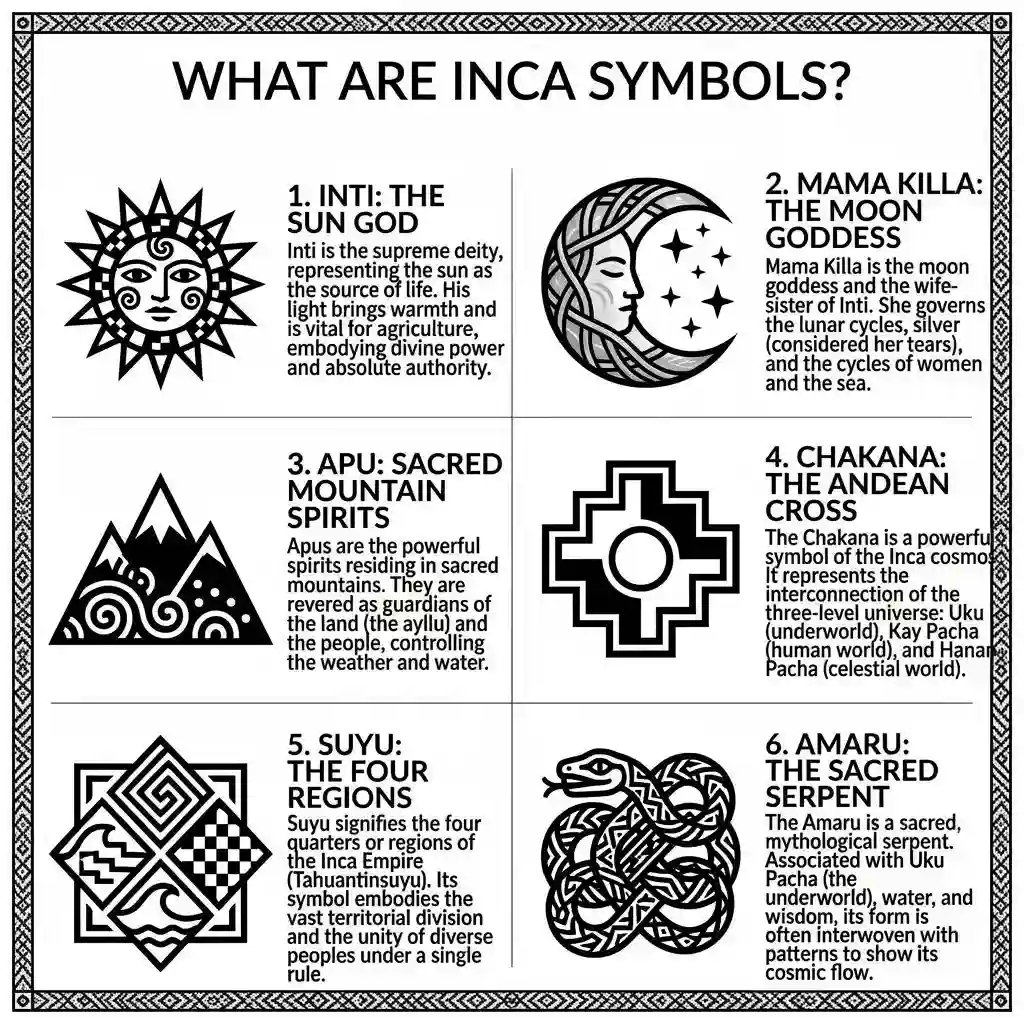
Mama Quilla is traditionally identified as a moon deity associated with the Inca religious world.
The moon had an important place within Andean understandings of time and the natural environment. References to Mama Quilla are particularly useful when explaining how celestial bodies were incorporated into religious traditions.
Illapa
For an agricultural society, weather had enormous practical importance. Rain and seasonal conditions directly affected crops and survival, making weather-related religious beliefs significant.
Rather than treating Illapa as a simple “weather symbol,” it is more useful to understand the deity within the broader relationship between religion, agriculture, and natural forces.
Huacas and Sacred Places
A huaca or wak’a could refer to a sacred being, place, object, or feature within Andean religious traditions.
A sacred mountain, spring, stone, shrine, or other location could have religious significance.
The landscape itself could be part of the religious world.
Inca Animal Symbols and Meanings
Animals were important within Andean environments and belief systems. Their symbolic importance varied according to context.
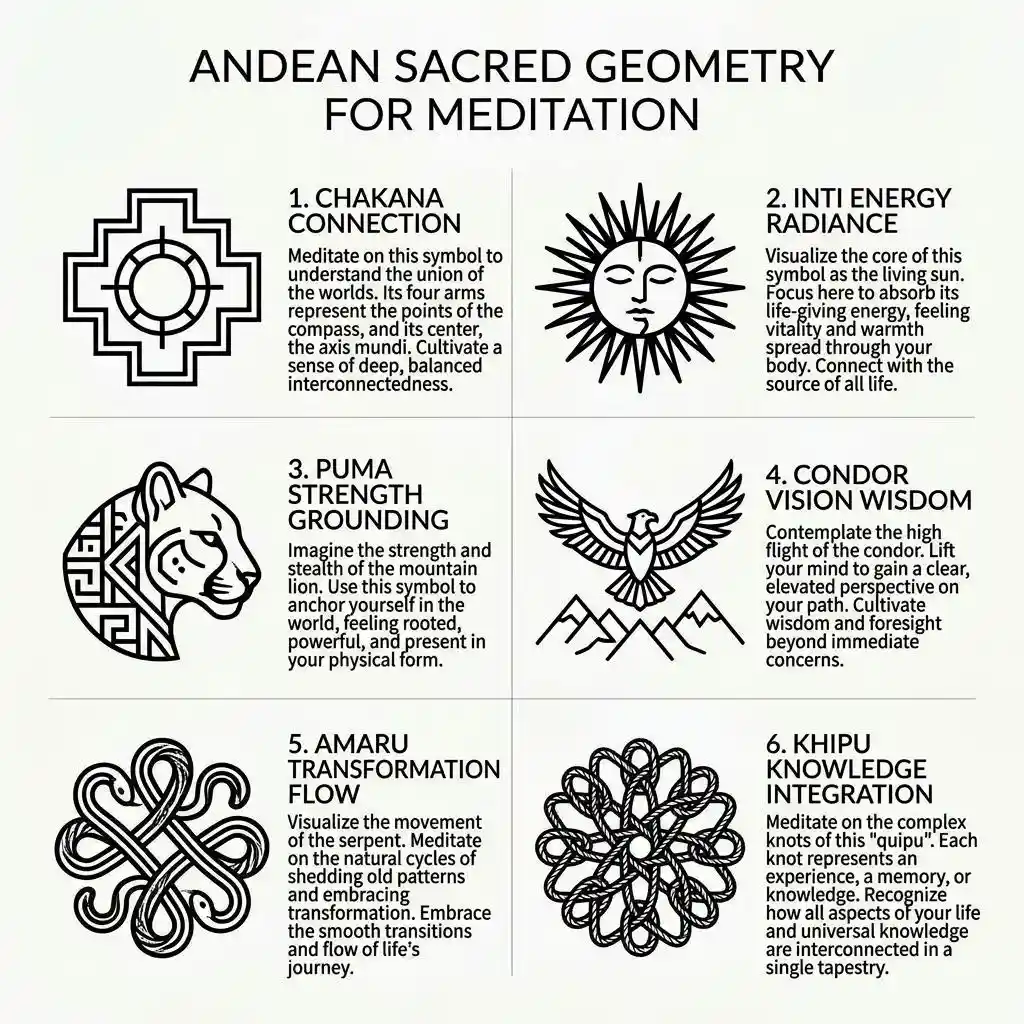
Three animals are particularly common in modern discussions of Inca symbolism: the condor, puma, and serpent.
Condor
The condor is one of the most recognizable birds of the Andes.
Because it flies high above the mountains, the condor became associated with the upper world in many modern explanations of Andean symbolism. It also appears in broader Andean religious and artistic traditions.
However, the popular statement that the condor universally and exclusively “represented heaven” should be treated carefully. Symbolic meaning can vary according to historical and cultural context.
Today, the condor is frequently used as a symbol of the Andes, freedom, elevation, and connection with the mountain environment.
Puma
The puma was an important animal in the Andean environment and appears in discussions of Inca art, architecture, and symbolism.
The animal is often associated with strength, power, and the earthly world in modern interpretations.
Cusco is famously described in some traditions as having been planned in the form of a puma. Whether every detail of that interpretation can be historically established is more complicated than the popular version suggests, but the puma remains strongly associated with Inca and Cusco imagery.
Serpent
The serpent is another important animal in Andean symbolic traditions.
Modern explanations frequently connect the serpent with the lower or inner world, transformation, and the earth. Such interpretations are often linked to the concept of different levels of existence in Andean cosmology.
However, meanings attributed to serpent imagery can vary by period and context. It is better to describe these interpretations as associations rather than claiming that every serpent design had exactly the same meaning.
Other Animals in the Inca World
The Andean environment contained many animals that could have practical, artistic, or religious importance.
These included:
- Llamas
- Alpacas
- Vicuna
- Birds
- Felines
- Frogs
- Fish
- Various insects and smaller animals
Llamas and alpacas were particularly important for transportation, wool, food, and textiles.
Inca Textile Symbols
Textiles are one of the most important areas for understanding Inca visual culture.
Clothing could communicate information about identity, rank, political relationships, and social position. Fine textiles were valuable objects and could have ceremonial and political importance.
Toqapu
Toqapu refers to distinctive geometric designs associated especially with Inca textiles.
These designs often appear as small geometric compartments arranged in organized patterns. They can include squares, rectangles, lines, and other repeated forms.
Toqapu is especially important because it demonstrates that geometric designs in Inca textiles were not necessarily simple decoration.
Some researchers have explored whether particular toqapu designs carried specific meanings or information. However, the interpretation of individual designs remains an area where readers should distinguish scholarly evidence from popular claims.
Geometric Patterns
Geometric patterns were common in Andean textile traditions.
Repeated shapes could be used to create visually complex garments and objects. Their organization, color, placement, and relationship to the rest of a textile could contribute to the object’s meaning.
It is therefore risky to create a universal dictionary saying that every triangle, square, or zigzag always had one specific meaning.
Checkerboard Designs
Checkerboard and contrasting geometric patterns are strongly associated with Inca textiles and imperial visual culture.
Some garments with distinctive patterns were connected with social and political identity.
The important lesson is that a pattern’s meaning may come from the complete textile rather than from one isolated shape.
Clothing and Social Status
Clothing was more than personal decoration in Inca society.
Fine garments could communicate status and social position. Some textiles were extremely labor-intensive and required skilled production.
This means an Inca textile symbol should often be considered together with:
- The garment itself
- The quality of the material
- The design
- The colors
- The wearer
- The setting
- The historical period
This contextual approach is more accurate than assigning a single meaning to an isolated motif.
Khipu or Quipu: The Inca Knot System
One of the most fascinating parts of Inca communication is the khipu, also commonly spelled quipu.
A khipu is made from cords and knots arranged in organized ways. These objects were used to record and communicate information.
What Is a Khipu?
A khipu consists of a main cord with additional cords attached to it. Knots and other characteristics of the cords could encode information.
Khipu are especially important because the Inca did not leave behind a conventional alphabetic writing system like the one used by many modern societies.
What Did Khipu Record?
Khipu were used for administrative purposes, including information connected with populations, goods, labor, and other forms of organization.
Their complexity shows that information could be carefully structured without using a conventional alphabet.
Researchers continue to study khipu to understand the full range of information they may have contained.
Were Khipu Symbols or Writing?
This question has no simple answer.
Khipu were certainly information-recording systems, but researchers continue to investigate exactly how their different features communicated information and whether some khipu contained forms of narrative or non-numerical information.
It is therefore more accurate to call khipu a sophisticated recording and communication system than to simply describe them as an “Inca alphabet.”
Why Khipu Matter Today
Khipu demonstrate that communication does not have to look like a modern written page.
They also provide an important reminder that Inca civilization developed sophisticated methods for managing information across a large empire.
Inca Cross and Chakana
The Chakana, often called the Andean cross, is one of the most recognizable designs associated with the Andes today.
It is frequently included in modern discussions of Inca symbols, spirituality, and tattoos.
What Is the Chakana?
The Chakana is a stepped cross-like geometric form found in Andean visual traditions.
Modern interpretations often connect its levels and structure with concepts such as the organization of the cosmos or different realms of existence. Modern explanations do not always have the same evidentiary status as interpretations based on archaeological material.
Historical Evidence and Modern Interpretation
When reading about the Chakana, it is useful to separate three things:
- The historical existence of stepped and cross-like Andean designs.
- Interpretations of their meaning in specific archaeological contexts.
- Modern spiritual and cultural explanations.
These categories may overlap, but they should not automatically be treated as identical.
Inca Symbols in Architecture and Art
Inca symbolism was not limited to small objects.
Architecture, stonework, textiles, ceremonial spaces, and relationships with the landscape could all communicate cultural and religious ideas.
Machu Picchu
Machu Picchu is one of the best-known surviving Inca sites.
Its buildings, terraces, stonework, water systems, and relationship with the surrounding mountains provide important evidence for understanding Inca architecture and the environment.
However, it would be inaccurate to treat every unusual stone formation at Machu Picchu as a hidden symbol.
Some features had practical purposes, while others may have had ceremonial or religious significance.
Cusco and Inca Architecture
Cusco was the political and cultural center of the Inca Empire.
Inca architecture used carefully fitted stonework, planned spaces, and monumental construction. Buildings and urban organization could express political power as well as practical needs.
Sacred Landscapes
Mountains and other natural features could hold religious importance in Andean societies.
This is one reason Inca symbolism should be studied as part of a larger relationship among people, religion, nature, and place.
Inca Symbols for Strength, Protection, and Spiritual Meaning
Modern readers often search for Inca symbols that represent specific ideas such as strength, protection, love, fertility, or good fortune.
These searches are understandable, but they require careful interpretation.
Symbols Associated With Strength
Animal imagery, elite clothing, architecture, and imperial objects could also communicate authority and status.
However, a modern statement such as “this exact shape was the ancient Inca symbol for strength” should not be accepted without evidence.
Symbols Associated With Protection
People today may choose Andean-inspired designs as personal symbols of protection.
A design can have personal spiritual meaning today without having possessed that exact meaning in the Inca period.
Nature and Fertility
Consequently, modern interpretations of Inca-inspired symbols often focus on nature, fertility, abundance, and balance.
The safest historical approach is to explain the specific religious or environmental association rather than assigning a universal meaning to every visual design.
Modern Spiritual Interpretations
Modern websites, artists, tattoo designers, and spiritual communities sometimes give detailed meanings to Inca-inspired symbols.
Some of these interpretations may be inspired by genuine Andean concepts, while others may combine different traditions or reflect modern beliefs.
Readers should therefore ask whether a meaning is:
- Historically documented
- A scholarly interpretation
- A modern cultural interpretation
- A personal meaning
- A commercial description
This distinction makes the information much more reliable.
Inca Symbols in Tattoos and Modern Culture
Inca-inspired tattoos have become popular because geometric patterns, animals, sun imagery, and stepped designs can create distinctive artwork.
However, choosing a tattoo based on ancient symbolism deserves some research.
Popular Inca-Inspired Tattoo Designs
Common designs include:
- Condors
- Pumas
- Serpents
- Sun imagery
- Geometric patterns
- Chakana-inspired designs
- Textile-inspired motifs
- Mountain imagery
- Khipu-inspired designs
Not every modern tattoo is an authentic reproduction of an archaeological symbol.
Modern Tattoo Meanings
A person may choose a puma to express strength, a condor to express freedom, or a mountain design to represent connection with nature.
These can be personal meanings.
Cultural Respect
Using ancient cultural imagery thoughtfully means understanding where it came from.
Before choosing an Inca-inspired design, consider:
- Its historical origin
- Whether it is genuinely Inca or broadly Andean
- Whether the meaning is documented
- Whether a modern interpretation has been added
- Whether the design is being presented respectfully
This approach can help prevent accidental misinformation or cultural misrepresentation.
Inca Symbols vs. Aztec and Maya Symbols
They were not the same culture.
Inca Symbols
The Inca civilization developed in the Andes, with its political center at Cusco. Its visual traditions included textiles, geometric designs, sacred imagery, architecture, and khipu.
Aztec Symbols
The Aztec or Mexica civilization developed in central Mexico. Its religious and artistic traditions included different deities, calendrical systems, animals, and symbols.
Understanding these differences is important when researching ancient symbols.
How to Identify an Authentic Inca Symbol
Not every design labeled “Inca” online is historically authentic.
If you find a symbol on a website, tattoo page, clothing item, or social media post, investigate its origin before accepting the stated meaning.
Check the Historical Period
A symbol may come from:
- Pre-Inca Andean culture
- Inca imperial period
- Colonial-era art
- Later Indigenous traditions
- Modern Peruvian or Andean design
The date matters.
Check the Artifact or Source
A reliable explanation should ideally identify the type of historical evidence behind the claim.
Ask:
- Is there a known artifact?
- Is it held by a museum?
- Where was it discovered?
- What period does it belong to?
- Has its meaning been studied?
Distinguish Inka From Earlier Andean Cultures
A design found in Peru is not automatically an Inca design.
The Andes were home to many civilizations and communities before, during, and after the Inca Empire.
A historically responsible article should identify the culture and period whenever the evidence allows.
Separate Evidence From Modern Interpretation
One of the easiest ways to improve your understanding is to ask:
“Do we know this, or do we interpret this?”
Both pieces of information can be valuable, but they should not be presented as equally certain.
Inca Symbols by Category
Organizing symbols by category makes them easier for beginners to understand.
Religious Symbols
Religious symbolism can include:
- Inti
- Viracocha
- Mama Quilla
- Illapa
- Pachamama in broader Andean tradition
- Huacas
- Sacred landscapes
Animal Symbols
Important animal imagery includes:
- Condor
- Puma
- Serpent
- Llama
- Alpaca
- Other Andean animals
Textile Symbols
Textile-related visual traditions include:
- Toqapu
- Geometric patterns
- Checkerboard designs
- Repeated motifs
- Status-related garment designs
Communication and Record Systems
Khipu belongs in its own category because it functioned as a sophisticated information-recording system rather than simply decorative symbolism.
Yes. Inca and broader Andean-inspired imagery continues to appear in contemporary art, textiles, jewelry, tourism, fashion, tattoos, education, and cultural heritage work.
However, modern use can have meanings that differ from ancient meanings.
Contemporary Andean Art
Modern artists may draw on ancient geometric designs, animals, textiles, and architecture while creating entirely new works.
This does not necessarily make the modern artwork historically inaccurate. It simply means that it belongs to a different period.
Jewelry and Fashion
Sun designs, stepped crosses, animal figures, and geometric textile patterns are frequently used in modern products.
When these products are described as “ancient Inca symbols,” however, buyers should check whether the historical claim is supported.
Museums and Cultural Heritage
Museums play an important role in preserving and explaining Inca and Andean artifacts.
Museum collections can provide a much stronger starting point for research than anonymous websites because objects can often be studied alongside information about their material, period, location, and cultural context.
Inca Symbols for Beginners
If you are new to the subject, you do not need to memorize dozens of designs.
Start with a small group of major concepts.
Which Symbols Should Beginners Learn First?
A useful starting list is:
- Inti and the sun
- Condor
- Puma
- Serpent
- Toqapu
- Khipu
- Chakana
- Huaca
- Inca textiles
- Sacred landscapes
Learning these concepts gives you a foundation for understanding many other discussions of Inca symbolism.
Easy Ways to Remember Them
Instead of memorizing isolated meanings, connect each concept with its context.
For example:
- Inti → sun and religion
- Condor → Andean bird and sacred associations
- Puma → animal imagery and power
- Serpent → Andean religious symbolism
- Toqapu → geometric textiles
- Khipu → knots and information
- Huaca → sacred place or object
Remember that these short associations are learning aids, not complete historical definitions.
How to Research an Inca Symbol
When you encounter an unfamiliar symbol, use this simple process:
Identify → Date → Locate → Compare → Verify
First identify the design. Then determine its historical period and geographical origin. Compare it with documented artifacts, and finally verify the proposed meaning through reliable historical or museum sources.
This method is much safer than accepting a symbolic meaning simply because it appears on several websites.
Frequently Asked Questions About Inca Symbols
What are the most famous Inca symbols?
Some of the best-known concepts associated with Inca symbolism include Inti and solar imagery, the condor, puma, serpent, toqapu textile designs, khipu, and the Chakana. Their historical meanings and interpretations vary by context.
What did Inca symbols mean?
Inca symbols and visual motifs could relate to religion, nature, social status, political authority, identity, communication, and cultural traditions. Not every symbol has one universally established meaning.
What is the Inca sun symbol?
The sun and the deity Inti were highly important within Inca religion and imperial traditions. Modern “Inca sun” designs are often inspired by this association, but not every modern sun illustration should be treated as an exact historical Inca emblem.
What does the Inca cross mean?
The Chakana, or Andean cross, is a stepped cross-like design associated with Andean visual traditions. Many modern interpretations connect it with cosmology and different levels of existence, but specific historical meanings should be considered in context.
What animals were important to the Incas?
The condor, puma, and serpent are especially prominent in modern discussions of Inca and Andean symbolism. Llamas, alpacas, and other animals were also extremely important to everyday Andean life and economy.
What is a khipu or quipu?
A khipu, also spelled quipu, is a system of cords and knots used to record and organize information. Khipu demonstrate the sophisticated ways the Inca could manage information without relying on an alphabetic writing system.
Did the Incas have a written language?
The Inca did not use an alphabetic writing system in the same way as modern English or Spanish. They used khipu for recording information, while other forms of visual communication existed through textiles, objects, architecture, and imagery.
What did Inca textile symbols mean?
Inca textiles could communicate information related to identity, social status, political relationships, and cultural traditions. Toqapu and other geometric designs are particularly important, but the exact meaning of individual motifs should not be assumed without evidence.
Are Inca symbols still used today?
Yes. Inca and Andean-inspired imagery is used in contemporary art, textiles, jewelry, tattoos, fashion, tourism, and cultural heritage. Modern uses can have meanings that differ from those documented for the ancient Inca period.
Are modern Inca tattoo meanings historically accurate?
Not always. A tattoo may use an authentic ancient motif but give it a modern personal meaning. Before calling a tattoo meaning “ancient Inca,” it is useful to verify whether historical evidence actually supports that interpretation.
What is the difference between Inca and Aztec symbols?
The Inca and Aztec were different civilizations from different regions of the Americas. Inca culture developed in the Andes, while the Aztec or Mexica civilization developed in central Mexico. Their religious traditions, writing or recording systems, art, and symbolism were different.
Are all Peruvian symbols Inca symbols?
No. Peru has a very long history that includes many cultures before, during, and after the Inca Empire. A symbol found in Peru may belong to an earlier Andean culture, a later tradition, or a modern design.
Conclusion
Inca symbols provide a fascinating way to explore the religion, art, textiles, animals, communication systems, and worldview of the Inca and wider Andean world. Important subjects include Inti and the sun, sacred animals, toqapu textiles, khipu, sacred places, architecture, and the Chakana.
The most important point is to consider historical context. Not every geometric design has one proven meaning, and not every modern “Inca symbol” is an authentic Inca artifact.
By separating documented history from later interpretation, readers can appreciate Inca symbolism without turning a complex culture into a simple list of symbols and meanings.

Clara Miles
Hello! I’m Clara, a lifelong dreamer who finds magic in everyday moments. Writing has always been my way of exploring the world and understanding the people around me. I love creating stories that make readers laugh, cry, and reflect on life’s little surprises. When I’m not writing, you can usually find me sipping coffee at a cozy café or wandering through nature with a notebook in hand. My journey as an author is fueled by curiosity, imagination, and a love for connecting with my readers. Every story I write is a piece of my heart, and I hope it inspires yours too.
Books:
-
Whispers of the Heart
-
Shadows and Sunlight