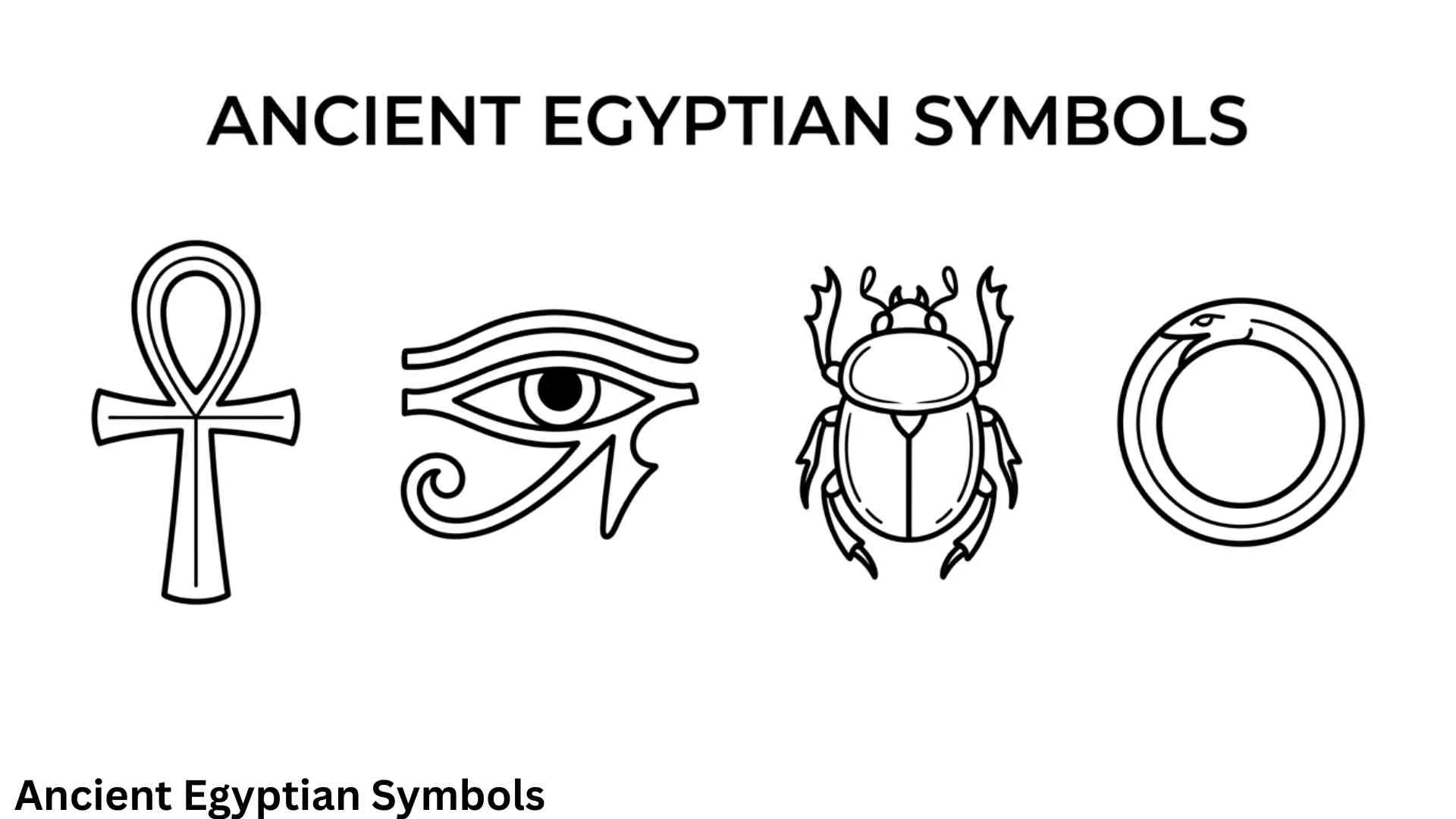
Ancient Egyptian symbols are powerful visual signs used by the people of ancient Egypt to represent ideas, beliefs, gods, protection, and daily life.
In short, ancient Egyptian symbols helped Egyptians communicate spiritual meanings, record knowledge, and express their deep beliefs about life, death, and the afterlife.
These symbols still fascinate historians, students, and artists today because of their mystery and beauty.
What Are Ancient Egyptian Symbols?
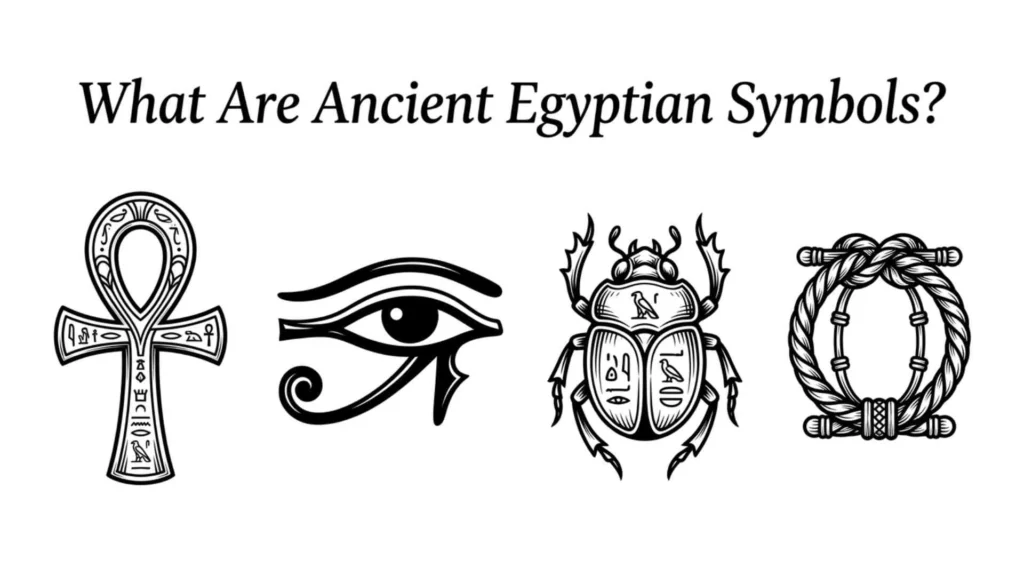
Ancient Egyptian symbols are visual images used in writing, religion, art, and daily life in ancient Egypt. These symbols carried meanings related to:
- Life and death
- Protection
- Power
- Wisdom
- The afterlife
- Nature and the universe
They were often carved into:
- Temple walls
- Tombs
- Jewelry
- Amulets
- Papyrus scrolls
Unlike modern letters, many Egyptian symbols represented ideas or objects, not just sounds.
The Historical Origins of Ancient Egyptian Symbols
Ancient Egyptian symbols date back more than 5,000 years to one of the world’s earliest civilizations.
Early Development of Egyptian Symbolism
The earliest symbols appeared in hieroglyphic writing, one of the oldest writing systems.
Hieroglyphs included:
- Pictures of animals
- Objects from daily life
- Natural elements like water and sun
These symbols allowed Egyptians to record:
- Laws
- Religious texts
- Historical events
- Trade records
Role of Religion in Symbol Development
Religion played a major role in shaping Egyptian symbols.
Egyptians believed:
- Life continued after death
- Gods controlled nature
- Symbols carried magical power
Because of this, symbols were used in rituals, tomb decorations, and protective charms.
Why Ancient Egyptian Symbols Were Important
Ancient Egyptian symbols were more than decoration—they had powerful meanings.
Key Reasons They Were Important
- Helped people communicate ideas
- Protected individuals from danger
- Represented gods and spiritual beliefs
- Preserved knowledge and history
- Guided souls in the afterlife
These symbols shaped everyday life and religious practices.
The Most Famous Ancient Egyptian Symbols
Many symbols from ancient Egypt remain widely recognized today.
The Ankh Symbol
The Ankh is one of the most famous ancient Egyptian symbols.
Meaning of the Ankh
- Symbol of life
- Eternal life
- Immortality
It is often called the “Key of Life.”
Where It Was Used
- Held by gods in temple carvings
- Worn as jewelry
- Placed in tombs
Egyptians believed the Ankh protected life both on earth and in the afterlife.
The Eye of Horus
The Eye of Horus is another powerful symbol.
Meaning of the Eye of Horus
- Protection
- Healing
- Royal power
Historical Story
According to legend, Horus lost his eye in battle. The eye was later restored, making it a symbol of healing and restoration.
Uses
- Amulets for protection
- Decorations on boats
- Tomb carvings
Sailors believed it protected them during journeys.
The Eye of Ra
Similar to the Eye of Horus, the Eye of Ra symbolized power.
Meaning
- Protection
- Strength
- Solar energy
It was often linked to the sun god Ra.
The Scarab Beetle
The scarab beetle is one of the most fascinating Egyptian symbols.
Meaning of the Scarab
- Rebirth
- Transformation
- Renewal
Natural Inspiration
Egyptians observed scarab beetles rolling balls of dung, which they associated with the movement of the sun across the sky.
Uses
- Amulets
- Jewelry
- Tomb decorations
The scarab symbolized the cycle of life.
The Djed Pillar
The Djed pillar symbol represented stability.
Meaning
- Strength
- Stability
- Endurance
It was often linked to the backbone of the god Osiris.
Uses
- Protective amulets
- Temple carvings
People believed it provided support and strength.
The Was Scepter
The Was scepter symbol represented authority.
Meaning
- Power
- Control
- Leadership
Uses
- Held by gods and rulers
- Shown in royal artwork
It symbolized divine authority.
The Lotus Flower
The lotus flower symbolized beauty and rebirth.
Meaning
- Creation
- Purity
- Renewal
Cultural Importance
The lotus closes at night and opens in daylight, symbolizing rebirth.
It became a powerful symbol of life’s cycles.
The Feather of Ma’at
This symbol represented truth and justice.
Meaning
- Balance
- Truth
- Moral order
Mythological Role
In the afterlife, a person’s heart was weighed against the feather to judge their life.
The Cartouche
A cartouche is an oval shape used to enclose names.
Meaning
- Protection of royal names
- Authority
- Identity
Pharaohs’ names were written inside cartouches.
Hieroglyphic Symbols and Writing
Ancient Egyptian symbols formed part of hieroglyphic writing.
Types of Hieroglyphic Symbols
- Phonetic symbols (represent sounds)
- Ideograms (represent ideas)
- Determinatives (clarify meaning)
This complex system allowed Egyptians to record detailed information.
Ancient Egyptian Symbols in Religion
Religion heavily influenced Egyptian symbolism.
Symbols of the Gods
Each god had specific symbols.
Examples:
- Sun disk for Ra
- Crocodile symbol for Sobek
- Falcon symbol for Horus
These symbols helped people recognize gods in art.
Symbols Used in Rituals
Priests used symbols during religious ceremonies.
Examples:
- Amulets for protection
- Sacred objects during offerings
Symbols were believed to hold spiritual power.
Ancient Egyptian Symbols in Daily Life
Symbols were not limited to temples—they were part of everyday life.
Jewelry and Amulets
Many Egyptians wore symbolic jewelry.
Common items included:
- Scarab pendants
- Eye amulets
- Protective charms
These items were believed to keep evil away.
Architecture and Buildings
Symbols decorated:
- Temples
- Palaces
- Tombs
Carvings told stories and protected structures.
Clothing and Personal Items
Symbols appeared on:
- Clothing patterns
- Household objects
- Tools
They added meaning to ordinary items.
Practical Applications of Ancient Egyptian Symbols
Ancient Egyptian symbols had many practical uses.
Communication and Record Keeping
Symbols helped Egyptians document:
- Trade transactions
- Laws
- Agriculture
This supported organized society.
Protection and Safety
Amulets were worn for protection.
People believed symbols could:
- Prevent illness
- Guard against danger
- Bring good luck
Medical and Healing Practices
Some symbols were believed to have healing powers.
Doctors used:
- Symbolic charms
- Ritual markings
These practices combined medicine and spirituality.
Ancient Egyptian Symbols in Tombs and the Afterlife
Egyptians strongly believed in life after death.
Tomb Decorations
Symbols were painted inside tombs to guide the dead.
Common symbols included:
- Ankh
- Scarab
- Feather of Ma’at
They helped souls find their way.
Burial Objects
Burial items often contained symbols.
Examples:
- Amulets placed inside bandages
- Coffin decorations
These symbols protected the deceased.
Impact of Ancient Egyptian Symbols on Modern Society
Ancient Egyptian symbols continue to influence modern culture.
Influence on Art and Design
Modern artists use Egyptian symbols in:
- Jewelry design
- Tattoos
- Home décor
Their beauty makes them popular today.
Use in Education
Students study these symbols to understand ancient civilizations.
This helps:
- Learn history
- Develop research skills
- Understand ancient cultures
Tourism and Cultural Heritage
Ancient Egyptian symbols attract millions of visitors to historical sites.
This supports:
- Tourism industries
- Preservation efforts
- Cultural pride
Benefits of Studying Ancient Egyptian Symbols
Learning about these symbols offers many advantages.
Educational Benefits
- Improves historical knowledge
- Enhances critical thinking
- Builds cultural awareness
Cultural Benefits
- Encourages respect for ancient traditions
- Preserves heritage
- Promotes global understanding
Creative Benefits
Symbols inspire:
- Art
- Fashion
- Literature
They fuel imagination.
Interesting Facts About Ancient Egyptian Symbols
Here are some fascinating facts:
- Hieroglyphs remained undeciphered for centuries until modern discoveries.
- Many symbols were believed to have magical power.
- Some amulets were worn from birth to death.
- Certain symbols appeared only in royal tombs.
Legends and Stories Behind Ancient Egyptian Symbols
Ancient myths often explained symbol meanings.
The Legend of Osiris and the Djed Pillar
The Djed pillar symbol is linked to the god Osiris.
Legend says:
After Osiris was defeated, his backbone became the symbol of stability.
This story gave the Djed pillar deep spiritual meaning.
The Story of the Eye of Horus
In mythology, Horus fought his rival and lost his eye.
The eye was restored, symbolizing healing and restoration.
This story made the Eye of Horus a protective symbol.
Ancient Egyptian Symbols in Modern Popular Culture
Today, Egyptian symbols appear in:
- Movies
- Video games
- Books
- Museum exhibits
These symbols continue to inspire storytelling.
Challenges in Understanding Ancient Egyptian Symbols
Researchers still face challenges.
Common Challenges
- Decoding ancient meanings
- Interpreting damaged inscriptions
- Translating symbolic language
Despite this, ongoing research continues to reveal new discoveries.
Frequently Asked Questions (FAQs)
1. What are ancient Egyptian symbols?
Ancient Egyptian symbols are visual signs used in writing, religion, and art to represent ideas, gods, and beliefs.
2. What is the most famous ancient Egyptian symbol?
The Ankh is considered one of the most famous symbols, representing life and eternal life.
3. Were ancient Egyptian symbols used only for religion?
No, they were also used in daily life, trade records, art, and communication.
4. Why did Egyptians use symbols in tombs?
They believed symbols protected the dead and guided their souls in the afterlife.
5. Are ancient Egyptian symbols still used today?
Yes, they are widely used in education, art, fashion, and cultural studies.
Conclusion
Ancient Egyptian symbols remain among the most fascinating elements of human history. These powerful visual signs helped ancient Egyptians communicate ideas, express spiritual beliefs, protect their communities, and preserve their knowledge for future generations. From the Ankh symbol of life to the protective Eye of Horus, each symbol carried deep meaning and practical value. Today, these symbols continue to inspire artists, historians, students, and travelers, connecting modern society to one of the world’s most remarkable civilizations. By studying ancient Egyptian symbols, we gain valuable insights into culture, history, creativity, and the enduring human desire to understand life and the afterlife.

Isaac Wellington
I’ve always been fascinated by the hidden stories in everyday life and the power of words to change how we see the world. Writing, for me, isn’t just a profession—it’s a way to explore human emotions, mysteries, and the unexpected twists of life. Over the years, I’ve dedicated myself to creating stories that linger in your mind long after the last page. When I’m not writing, you’ll usually find me wandering through old libraries or sketching ideas in a notebook. I believe every story has a heartbeat, and I aim to capture that rhythm in my work. Join me on a journey where imagination meets reality, and the ordinary becomes extraordinary.
Books:
-
Shadows of the Forgotten
-
Whispers Through Time