
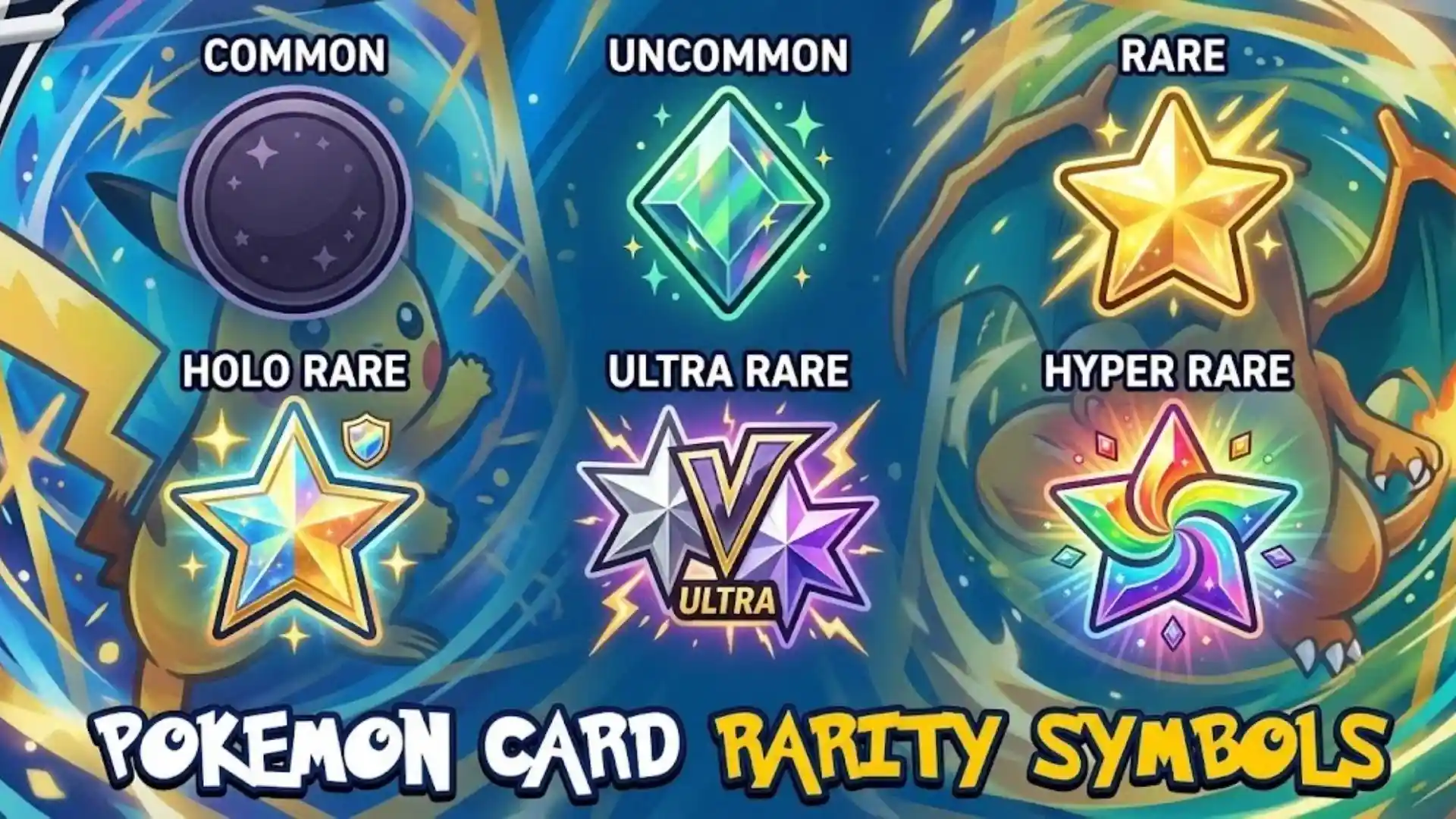
Japanese Pokémon cards use a distinctive rarity classification system that helps collectors identify common cards, special illustrations, and premium collectibles. If you’ve ever spotted AR, SAR, SR, or RR beside a card number, understanding these abbreviations can make collecting much easier.
The Japanese Pokemon Card Rarity Symbols also help you distinguish modern cards from older releases. Some vintage cards use circles, diamonds, and stars, while newer cards usually display letter-based codes. Each marking belongs to a particular rarity system, so the card’s release era matters.
This guide explains the main Japanese Pokemon card rarity symbols, what each abbreviation means, and how to read card numbers correctly. You’ll also learn the differences between AR, SAR, SR, and CHR, how Japanese rarities compare with English cards, and why rarity alone doesn’t determine a card’s value.
Japanese Pokemon Card Rarity Chart
The quickest way to identify a Japanese Pokémon card is to check its printed rarity code. The following Japanese Pokemon card rarity chart covers widely encountered modern categories and several important historical rarities.
| Rarity symbol | Full name | General meaning |
| C | Common | Standard common card |
| U | Uncommon | Standard uncommon card |
| R | Rare | Standard rare category |
| RR | Double Rare | Higher rarity used for Pokémon ex and certain earlier card types |
| RRR | Triple Rare | Historical category associated with certain VMAX and VSTAR cards |
| AR | Art Rare | Illustration-focused card category |
| SR | Super Rare | High-rarity category that includes full-art cards |
| SAR | Special Art Rare | Special illustration-focused category |
| UR | Ultra Rare | Gold-themed rarity in relevant Japanese releases |
| HR | Hyper Rare | Historical rarity associated with rainbow-themed cards |
| CHR | Character Rare | Pokémon illustrated with a human character |
| CSR | Character Super Rare | Higher-rarity character-themed category |
| K | Radiant Pokémon | Special rarity used for Radiant Pokémon |
| A | Amazing Rare | Historical category for Amazing Pokémon |
| S | Shiny Rare | Shiny Pokémon rarity used in relevant releases |
| SSR | Shiny Super Rare | Higher-rarity shiny Pokémon category in relevant releases |
| MUR | Mega Ultra Rare | Rarity category introduced in the Mega Evolution era |
| MA | Mega Attack Rare | Special Mega Evolution-era rarity category |
| BWR | Black White Rare | Special rarity associated with selected Black and White-themed cards |
Important: This chart combines multiple release eras. Not every Japanese expansion contains every rarity. The official Japanese card database lists current and selected rarity filters, including C, U, R, RR, AR, SR, SAR, UR, MUR, MA, and BWR. Check the exact expansion before identifying an unfamiliar code. Official Japanese Pokémon Card Database.
Older cards may display circle (●), diamond (◆), and star (★) symbols instead of letter codes. These markings belong to an earlier system and shouldn’t be confused with the rarity codes printed on modern Japanese cards.
What Do Japanese Pokemon Card Rarity Symbols Mean?
A rarity symbol identifies a card’s classification within its particular release. It gives collectors a useful starting point when sorting cards, checking set lists, and comparing different printings.
However, a rarity code doesn’t tell you everything about a card. It doesn’t independently confirm authenticity, market value, condition, or exact pull probability.
How to Find the Rarity Symbol on a Japanese Pokemon Card
On most modern Japanese Pokémon cards, the rarity code appears along the bottom edge, near the collector number. The precise layout can vary with the card design and release era.
When identifying a card, examine three details together:
- Rarity marking: The letter code, such as AR, SAR, or SR.
- Collector number: The individual card number within its expansion.
- Set identifier: The code or release information that helps identify the expansion.
For example, a card marked 087/081 SAR has a collector number that exceeds the set’s listed total. The SAR designation identifies its rarity category, while the number helps locate the specific card.
Don’t confuse the rarity marking with the small regulation mark, such as a letter used to indicate tournament-format legality. That mark serves a different purpose.
What Do the Circle, Diamond, and Star Symbols Mean?
Older Japanese Pokémon cards used three familiar rarity symbols. These markings are especially useful when identifying vintage cards and early releases.
●
Circle — Common
The filled circle indicates a common card in the older rarity system. These cards were generally among the more frequently encountered cards in an expansion.
◆
Diamond — Uncommon
The filled diamond marks an uncommon card. It represents a different classification from the circle-marked common cards.
★
Star — Rare
The star marks a rare card in the older system. Depending on the release, the card may feature a holographic finish.
These symbols are useful for recognizing older cards, but they aren’t a universal rarity scale for every Pokémon card ever printed. Modern Japanese expansions rely primarily on letter-based abbreviations.
Why Japanese Pokemon Cards Use Letter Abbreviations
Japanese cards transitioned to letter-based rarity markings beginning with the Black Collection and White Collection releases in December 2010. Later expansions introduced additional codes as the game added new card types and collecting categories.
The modern system includes basic classifications such as C, U, and R alongside special categories such as AR and SAR. These abbreviations make it easier to identify a card’s assigned rarity without relying entirely on artwork or foil treatment.
The key is to identify the release era before interpreting the symbol. A code used in one generation may be absent from another, and historical categories don’t necessarily form part of today’s standard rarity lineup.
Japanese Pokemon Card Rarity Abbreviations Explained

Understanding the Japanese Pokemon card rarity abbreviations is the foundation of accurate card identification. Although some categories share similar artwork or foil finishes, their official rarity codes distinguish them.
C — Common
C stands for Common. It identifies a standard common card in Japanese expansions that use the modern letter-based system.
Common cards often include basic Pokémon, supporting cards, and other regular set entries. They usually don’t have the elaborate full-card illustrations associated with AR or SAR cards.
However, common doesn’t mean useless or unwanted. A common Pokémon may be important for a competitive deck, while an older card may attract collectors because of its artwork, condition, or historical significance.
U — Uncommon
U stands for Uncommon. It identifies a card in the uncommon category, which generally sits above common in the basic rarity classification.
Uncommon cards can include Pokémon, Trainer cards, and other gameplay pieces. Their rarity marking doesn’t indicate how effective they are in a deck.
For example, an uncommon Trainer card might be essential to a competitive strategy even though it has no premium illustration. Gameplay usefulness and collectible rarity are separate considerations.
R — Rare
R stands for Rare. It marks a standard rare card in the relevant Japanese rarity system.
Depending on the expansion, an R card may feature a holographic illustration or other finishing details. However, you shouldn’t assume every card marked R has the same visual treatment across different generations.
R also doesn’t mean the card is necessarily expensive. A widely available rare card featuring a less-demanded Pokémon may cost less than an AR card with popular artwork.
RR — Double Rare
RR stands for Double Rare. In modern Japanese expansions, this category commonly includes regular-art Pokémon ex cards.
The code helps distinguish these cards from standard rare cards and more elaborate illustration-focused rarities. However, the precise card types associated with RR depend on the generation.
Older releases may use RR for other card families, including certain Pokémon V cards. Always check the expansion rather than assuming every RR card belongs to the same mechanic.
RRR — Triple Rare
RRR stands for Triple Rare. This code appeared in the Sword & Shield era and was associated with particular higher-rarity Pokémon VMAX and VSTAR cards.
RRR is especially relevant to collectors who buy older Japanese booster boxes or collect cards from that generation. It shouldn’t be presented as a standard category in every current expansion.
If you find an RRR card, check its set and card type before comparing it with a modern RR card. The abbreviations look related, but they don’t necessarily indicate identical rarity structures across different eras.
AR — Art Rare
AR stands for Art Rare. It identifies cards whose illustrations play a central role in their presentation.
An AR card often features a Pokémon within a broader scene rather than a conventional, isolated character portrait. The artwork may depict the Pokémon interacting with its surroundings, exploring a location, or appearing alongside other characters.
AR became a major part of the modern Japanese rarity system with the VSTAR Universe release in December 2022. The corresponding English category is generally called Illustration Rare in the relevant modern sets.
AR cards appeal to collectors who enjoy artwork as much as competitive play. A card’s popularity still depends on its character, illustration, availability, and condition.
SR — Super Rare
SR stands for Super Rare. In relevant Japanese expansions, this category includes full-art Pokémon and Trainer cards.
Full-art cards extend their artwork across more of the card surface than conventional designs. Depending on the release, SR cards may feature textured foil, metallic effects, or other distinctive finishes.
Supporter cards can be particularly appealing to collectors because they showcase recognizable human characters. Still, not every SR card features a Trainer, and appearance alone cannot establish its rarity.
In corresponding modern English releases, Japanese SR cards commonly align with the English Ultra Rare category. This is one reason collectors should compare official rarity classifications rather than translating abbreviations literally.
SAR — Special Art Rare
SAR stands for Special Art Rare. It identifies a special illustration-focused rarity that became prominent with modern Japanese expansions beginning in late 2022.
SAR cards often feature elaborate scenes, expressive character artwork, and distinctive textured finishes. Their illustrations may show Pokémon in dramatic environments or portray Trainers in more personal, detailed settings.
Collectors frequently pursue SAR cards as chase cards, meaning cards they especially want to find in booster packs. However, SAR doesn’t guarantee a high resale price or a particular pull rate.
The corresponding rarity in relevant modern English sets is generally called Special Illustration Rare, abbreviated SIR. Although the Japanese and English names differ, the categories commonly correspond.
UR — Ultra Rare
UR stands for Ultra Rare in the Japanese rarity system. In relevant modern releases, it commonly identifies gold-themed cards.
Gold finishes and distinctive surface treatments make these cards visually different from many AR and SAR cards. Their exact appearance depends on the expansion and the card’s design.
Here’s an important terminology trap: Japanese UR doesn’t mean the same thing as English Ultra Rare in the modern Scarlet & Violet-era comparison. Japanese UR commonly corresponds to English Hyper Rare, while Japanese SR commonly corresponds to English Ultra Rare.
Always use the original Japanese rarity code and the exact card listing when identifying a printing.
HR — Hyper Rare
HR stands for Hyper Rare in historical Japanese rarity systems. It appeared in earlier release eras, including sets associated with rainbow-themed cards.
HR is important when researching older Japanese collections because its use differs from the modern Japanese UR category. Collectors should avoid treating the two abbreviations as interchangeable.
The English rarity terminology also changed across generations. For accurate comparisons, check the specific card and its corresponding English release rather than relying on the abbreviation alone.
CHR — Character Rare
CHR stands for Character Rare. This category is associated with cards that illustrate a Pokémon alongside a human character.
The artwork often creates a visual relationship between the character and the Pokémon. A card might show a Trainer interacting with a partner Pokémon or depict a scene that adds personality to the illustration.
CHR is especially relevant to collectors of Japanese Sword & Shield-era cards and certain special expansions. It isn’t a universal rarity category used in every modern set.
Because CHR cards emphasize character relationships, collectors may value them for their illustrations even when another category has a higher general rarity classification.
CSR — Character Super Rare
CSR stands for Character Super Rare. It belongs to the historical family of character-focused Japanese rarities.
CSR cards generally use more elaborate designs than the CHR category. They are associated with selected Sword & Shield-era releases and often combine Pokémon and Trainer themes with premium card treatments.
The important distinction is historical context. CHR and CSR remain useful labels when identifying older Japanese cards, but you shouldn’t expect them in every modern booster box.
Other Japanese Pokemon Card Rarity Codes
Several additional codes appear in particular Japanese releases. They are worth recognizing if you collect across multiple generations.
| Code | Meaning | Where it matters |
| K | Radiant Pokémon rarity | Selected Sword & Shield-era releases |
| A | Amazing Rare | Historical Amazing Pokémon cards |
| S | Shiny Rare | Selected shiny-focused expansions |
| SSR | Shiny Super Rare | Certain shiny Pokémon releases |
| MUR | Mega Ultra Rare | Mega Evolution-era releases |
| MA | Mega Attack Rare | Selected Mega Evolution-era releases |
| BWR | Black White Rare | Selected Black and White-themed cards |
These categories aren’t all part of one universal ladder. Some belong to special products or historical generations, while others appear in newer releases. Confirm an unfamiliar code through the official Japanese card database or a reliable set checklist.
AR vs SAR vs SR vs CHR: What’s the Difference?
The differences between AR, SAR, SR, and CHR become clearer when you compare their names, artwork styles, and release histories.
| Feature | AR | SAR | SR | CHR |
| Full name | Art Rare | Special Art Rare | Super Rare | Character Rare |
| Main focus | Illustration-led artwork | Special illustration treatment | High-rarity classification | Pokémon and human character artwork |
| Visual presentation | Often a broad, scene-based illustration | Often elaborate, premium full-art artwork | Varies by card and release | Character-centered illustration |
| Typical context | Modern Japanese expansions | Modern Japanese expansions | Multiple release generations | Selected historical expansions |
| English comparison | Illustration Rare | Special Illustration Rare | Often Ultra Rare in corresponding modern releases | No universal one-to-one equivalent |
AR vs SAR
The main difference is the rarity designation and the specific card’s artwork classification.
AR cards emphasize illustration-led designs that can show a Pokémon in a detailed setting. SAR cards occupy a separate special illustration category and often attract considerable collector interest.
However, SAR doesn’t automatically mean more valuable than AR. A highly sought-after AR featuring a popular Pokémon can cost more than a less-demanded SAR.
SAR vs SR
SAR and SR are different Japanese rarity categories, even when both cards use full-art designs.
SR cards include a range of high-rarity designs, including full-art Pokémon and Trainer cards. SAR cards belong to the special illustration category and often feature more elaborate scene-based artwork.
Their visual differences aren’t absolute rules. The printed rarity code and set checklist provide stronger evidence than appearance alone.
CHR vs AR
CHR emphasizes a Pokémon’s relationship with a human character. AR identifies the Art Rare category and isn’t defined by the presence of a Trainer.
An AR illustration can include several Pokémon or a detailed environment. A CHR illustration typically highlights the connection between a Pokémon and a character.
Because CHR belongs to particular historical releases, compare the exact set before deciding whether a card belongs to CHR or another illustration category.
CHR vs CSR
Both categories emphasize Pokémon and human character themes. CSR represents Character Super Rare, while CHR means Character Rare.
They belong to the historical Japanese rarity landscape, particularly selected Sword & Shield-era expansions. The codes help distinguish the official categories even when two cards share similar artwork themes.
How Japanese Pokemon Card Numbering Works
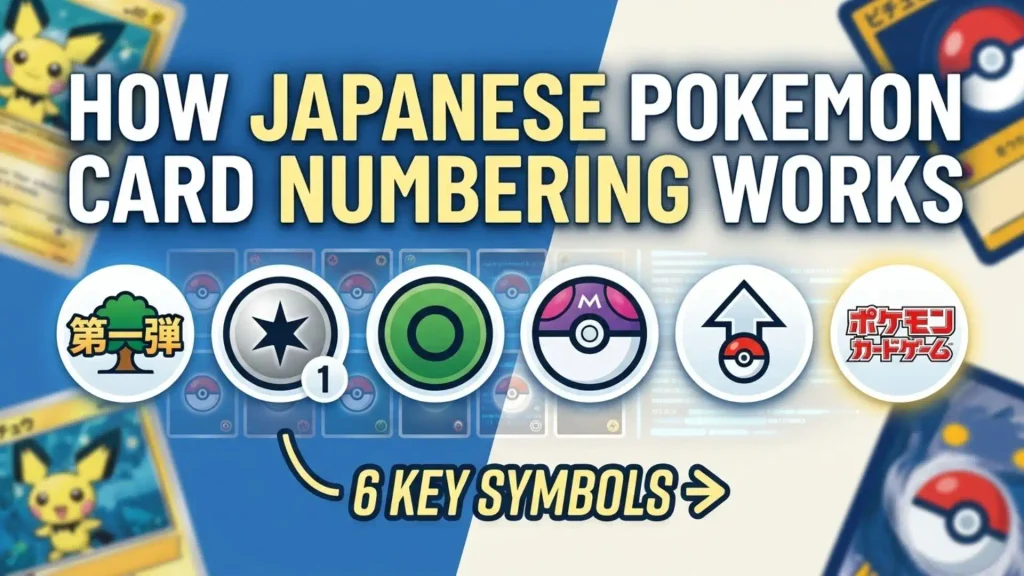
Rarity codes become more useful when you understand the Japanese Pokemon card numbering system. The collector number identifies the card within a particular expansion, while the rarity code identifies its classification.
How to Read a Japanese Pokemon Card Number
A typical collector number follows this format:
Card number / listed set total
For example:
- 001/070 identifies card 1 in a set with a listed total of 70.
- 070/070 identifies card 70 in that numbered set.
- 071/070 indicates a card numbered beyond the listed total.
These examples explain the numbering format rather than identify specific cards. To identify an actual printing, match the number with its set name or expansion code.
What Does a Pokemon Card Number Above the Set Total Mean?
A number above the listed set total commonly indicates a card outside the expansion’s main numbered sequence. Collectors often describe these as secret rares or extra-numbered cards, depending on the set and its conventions.
For example, 071/066 has a first number larger than the second. That pattern suggests the card belongs to an additional numbered section.
However, the number alone doesn’t establish the exact rarity. Check the printed code and expansion checklist to confirm whether the card is AR, SR, SAR, UR, or another category.
A higher collector number also doesn’t automatically make a card valuable. Demand, supply, artwork, condition, and the specific Pokémon all influence the market.
Japanese Pokemon Set Codes Explained
Japanese expansions use set identifiers that help collectors identify a release.
Examples include:
- sv2a: Pokémon Card 151.
- s12a: VSTAR Universe.
- SM-series codes: Identifiers associated with the Sun & Moon era.
- SV-series codes: Identifiers associated with the Scarlet & Violet era.
These codes aren’t rarity symbols. Instead, they help connect a card to its expansion, release history, and official checklist.
When checking a card, combine its set identifier, collector number, and rarity code. Together, those details provide a much stronger identification than any one marking alone.
How to Verify a Card’s Set and Rarity
Use this simple process when identifying an unfamiliar Japanese card:
- Find the printed rarity code near the card number.
- Record the collector number exactly as shown.
- Identify the expansion or set code.
- Search the official Japanese card database or a trusted set checklist.
- Compare the artwork, card type, and other printed details with the reference.
This approach is particularly useful when buying Japanese singles online. Sellers sometimes use broad labels such as “rare,” “full art,” or “secret rare” without specifying the exact category.
Japanese Pokemon Card Rarity vs English Pokemon Card Rarity
Japanese and English Pokémon cards share the same broader game, but their rarity terminology and card classifications aren’t identical. This can confuse collectors who buy cards in both languages.
Japanese cards typically display letter-based codes such as AR, SAR, SR, and UR. English cards use their own rarity names and, depending on the release era, different printed symbols.
The safest approach is to identify the original Japanese card first, then check its corresponding English release when one exists.
Japanese AR vs English Illustration Rare
Japanese Art Rare (AR) cards commonly correspond to English Illustration Rare cards in modern releases.
Both categories emphasize artwork that extends beyond the conventional card illustration. The design may show a Pokémon in its habitat, interacting with other characters, or appearing in a detailed scene.
Although the categories commonly correspond, don’t assume every Japanese AR card has an English counterpart. Japanese sets can contain exclusive cards or distribute cards differently across international releases.
Japanese SAR vs English Special Illustration Rare
Japanese Special Art Rare (SAR) commonly corresponds to English Special Illustration Rare (SIR).
Both classifications identify special illustration-focused cards in their respective modern rarity systems. Their artwork often attracts collectors who want distinctive designs rather than cards selected purely for competitive play.
When comparing prices, make sure both listings refer to the same Pokémon, artwork, card version, and condition. Two cards with similar names can have different values if their printings differ.
Japanese SR vs English Ultra Rare
This is one of the most important differences to remember.
In corresponding modern releases, Japanese Super Rare (SR) commonly maps to English Ultra Rare. The English naming doesn’t use the same abbreviation as the Japanese version.
For example, a Japanese SR Supporter card may correspond to an English Ultra Rare Supporter card. The artwork and card design can differ slightly between languages or releases, so verify the exact printing.
Japanese UR vs English Hyper Rare
Japanese Ultra Rare (UR) commonly corresponds to English Hyper Rare in relevant modern sets.
Gold-themed cards are a useful visual clue, but the rarity code and official checklist should confirm the category. Older Japanese HR cards add another layer of complexity because historical rarity labels don’t always match modern terminology.
Remember: Japanese UR and English Ultra Rare aren’t interchangeable terms. Check the actual Japanese code instead of translating the abbreviation literally.
How Rare Are Japanese Pokemon Cards?
The printed rarity classification gives you a useful starting point, but it doesn’t reveal the full odds of pulling a card from a pack.
A card’s actual availability depends on the expansion, product type, pack collation, and distribution of individual rarities. Special sets may also use different pack structures from regular expansions.
Do Higher Rarity Codes Mean Lower Pull Rates?
Generally, premium rarity categories are less frequently encountered than basic cards within the relevant product. However, the relationship isn’t a universal mathematical scale.
An SAR may be harder to pull than an AR in a particular expansion, but you shouldn’t assume the same exact odds apply to every set. Even cards within one category can have different market availability.
The Pokémon Company doesn’t publish universal pull-rate guarantees covering every Japanese expansion and rarity. Community opening data can offer clues, but results from a limited sample shouldn’t be treated as official odds.
Japanese Pokemon Booster Box Pull Rates
A booster box contains sealed booster packs from a particular product. Its contents depend on that product’s collation and release-specific rules.
Before buying a box, check whether it belongs to a regular expansion, a special set, or another product line. These products may have different pack counts, card selections, and rarity distributions.
Keep three points in mind:
- A booster box doesn’t guarantee a particular SAR or other chase card unless the product explicitly states a guarantee.
- Pull-rate estimates from collectors are observations, not promises about your box.
- A box that contains one desirable rarity doesn’t necessarily contain the specific card you want.
If you want one exact AR, SAR, or SR, buying the individual card may be more predictable than opening random packs.
Are SAR Cards Rarer Than AR Cards?
SAR cards often occupy a more premium collector category than AR cards in modern Japanese expansions. Their special illustrations and relative availability help explain their popularity.
Still, rarity labels don’t translate into identical pull odds across all releases. Check set-specific evidence before claiming that one category is a fixed number of times rarer than another.
An AR card may also command a higher price when its character or artwork attracts stronger demand. Scarcity matters, but collector interest matters too.
Does Pokemon Card Rarity Determine Value?
No. Rarity and market value are related, but they aren’t the same thing.
A card’s price can depend on several factors:
- Character popularity: Iconic Pokémon and well-known Trainers may attract more buyers.
- Artwork: Distinctive illustrations can increase collector interest.
- Condition: Scratches, whitening, dents, and poor centering can reduce value.
- Supply: The number of available copies affects competition among buyers.
- Demand: Collector trends and competitive play can change interest.
- Printing: Special editions, promos, and language differences can affect desirability.
For example, an AR card featuring a popular Pokémon may sell for more than a less-demanded SAR. Always compare recent sales for the exact card and language rather than assuming a rarity code establishes its price.
How to Check Japanese Pokemon Card Authenticity
Rarity symbols can help you identify a card, but they cannot prove authenticity by themselves. Counterfeit cards may copy legitimate rarity codes, collector numbers, and artwork.
If you’re buying an expensive Japanese single, verify several details before paying.
Check the Rarity Code and Collector Number
Search for the exact collector number and rarity code in a trusted card checklist. Confirm that the artwork, card type, and expansion match the listing.
A mismatch deserves further investigation. However, unusual numbering doesn’t automatically prove that a card is fake because legitimate cards can have special numbering or release-specific features.
Inspect Artwork and Foil Quality
Examine high-resolution photographs for printing problems, unusual textures, inconsistent fonts, and suspicious surface finishes.
Look at the card as a whole rather than relying on a single test. Authentic cards can vary in appearance across releases, while counterfeit products can imitate some genuine visual features.
Useful checks include:
- Comparing the card with a verified reference image.
- Inspecting the print quality and fine artwork details.
- Checking the foil pattern against the exact printing.
- Reviewing the seller’s photographs of the front and back.
- Looking for dents, scratches, peeling, and other condition issues.
Compare the Card With a Verified Reference
The official Japanese Pokémon card database is a useful starting point for checking listed cards and rarity classifications.
Compare the exact set, card number, rarity, and artwork. If a listing provides too little information to confirm the printing, ask the seller for clearer photographs before buying.
When Does Professional Grading Help?
Professional grading services assess a card’s condition and may provide authentication as part of their process. PSA (Professional Sports Authenticator) is one established service used by Pokémon card collectors.
Grading can make sense for valuable cards when authentication, condition assessment, and resale considerations justify the cost. It isn’t necessary for every rare card, and a high rarity code doesn’t guarantee a high grade.
Raw cards can be perfectly suitable for personal collections. Focus on the card’s condition, authenticity, and your collecting goals before deciding whether to submit it for grading.
How to Buy and Protect Japanese Pokemon Cards
Once you understand the Japanese Pokemon card rarity system, you can make better decisions when buying singles, opening booster boxes, or organizing a collection.
Buying Japanese Pokemon Card Singles
Buying individual cards makes sense when you want a specific Pokémon, illustration, or rarity. You can choose the exact card instead of hoping to pull it from a random pack.
Before purchasing, check these details:
- The exact card name and collector number.
- The rarity code and expansion.
- The card’s language and printing.
- The seller’s reputation and return policy.
- The condition of the card’s front, back, and edges.
- The total cost, including shipping and any applicable import fees.
When buying from overseas sellers, review shipping protection and tracking options. International shipping can add costs and create extra handling risks, particularly for expensive cards.
Booster Boxes vs Individual Cards
Both approaches have advantages, depending on what you want from collecting.
| Buying method | Main advantage | Main drawback |
| Booster boxes | Pack-opening experience and random discoveries | You may not pull your desired card |
| Individual singles | You choose the exact card | Popular cards may cost more upfront |
| Bulk lots | Convenient for building a collection | Lots may contain duplicates or unwanted cards |
| Graded cards | Professionally assessed condition and authentication | Grading premiums can increase the price |
If you’re chasing one specific SAR, compare the cost of buying that card directly with the cost of opening packs. Random pulls can be exciting, but they aren’t a reliable way to obtain a particular card.
How to Store AR, SAR, and Other Rare Cards
Proper storage helps protect your cards from avoidable damage. Textured surfaces and holographic finishes can suffer from scratches, pressure, and careless handling.
Follow these basic practices:
- Use card sleeves: Place valuable cards in clean, appropriately sized sleeves.
- Add rigid protection: Use suitable toploaders or card savers when extra protection is needed.
- Store cards securely: Choose binders or storage boxes that prevent bending and excessive movement.
- Avoid sunlight: Prolonged exposure can fade artwork and damage cards.
- Control moisture: Keep your collection in a cool, dry environment with stable conditions.
- Handle cards carefully: Avoid touching foil surfaces unnecessarily or forcing cards into tight sleeves.
You don’t need expensive equipment to protect every card. Start with clean sleeves and safe storage, then invest in additional protection for your most valuable pieces.
Frequently Asked Questions About Japanese Pokemon Card Rarity Symbols
What Do Japanese Pokemon Card Rarity Symbols Mean?
Japanese Pokémon card rarity symbols identify a card’s classification within its particular release. Modern cards commonly use letter codes such as C, U, R, RR, AR, SR, SAR, and UR. Older cards may use circle, diamond, and star symbols. The exact system depends on the card’s release era.
What Does SAR Mean on a Japanese Pokemon Card?
SAR stands for Special Art Rare. It identifies a special illustration-focused rarity used in modern Japanese Pokémon expansions. These cards often feature elaborate artwork and textured finishes. SAR cards commonly correspond to English Special Illustration Rare cards in relevant modern releases.
What Does AR Mean on a Japanese Pokemon Card?
AR stands for Art Rare. It identifies an illustration-focused rarity that commonly features detailed scenes and distinctive artwork. In corresponding modern English releases, AR cards generally align with Illustration Rare cards.
What Does SR Mean on a Japanese Pokemon Card?
SR stands for Super Rare. The category includes high-rarity cards such as full-art Pokémon and Trainer cards in relevant releases. Japanese SR cards commonly correspond to English Ultra Rare cards in modern sets, although exact comparisons depend on the printing and era.
What Does CHR Mean on a Japanese Pokemon Card?
CHR stands for Character Rare. It identifies cards featuring Pokémon alongside human characters in character-focused illustrations. The category is associated with selected historical Japanese expansions, particularly from the Sword & Shield era.
Why Does My Japanese Pokemon Card Number Exceed the Set Total?
A number such as 071/066 indicates that the card’s collector number exceeds the set’s listed total. This often signals an additional or secret-numbered card. Check the exact expansion and printed rarity code to confirm the card’s classification.
Are Japanese Pokemon Cards Rarer Than English Cards?
Not automatically. Japanese and English releases can have different card selections, product structures, and rarity classifications. Compare the exact card, release, and availability rather than assuming one language is always rarer.
Does a Higher Rarity Symbol Mean a Pokemon Card Is Worth More?
No. Rarity can influence collector interest, but price also depends on character popularity, artwork, condition, supply, and demand. A desirable AR card can sometimes sell for more than a less-demanded SAR. Check recent sales for the exact card before estimating its value.
Conclusion: How to Identify Japanese Pokemon Card Rarity
Understanding Japanese Pokemon Card Rarity Symbols becomes much easier when you know where to look and what each code means. Start by checking the printed rarity marking near the collector number, then confirm the card’s set and release era.
Remember the main distinctions: AR means Art Rare, SAR means Special Art Rare, SR means Super Rare, and CHR means Character Rare. Older cards may use circle, diamond, and star symbols instead of modern letter codes.
Most importantly, don’t judge a card by its rarity marking alone. Verify the exact printing, inspect its condition, and consider collector demand before buying or estimating its value.
With these steps, you’ll be better prepared to identify Japanese Pokémon cards, compare rarities across languages, and build a collection with confidence.

Elliot Kensington
Elliot Kensington is a storyteller at heart, always fascinated by the hidden corners of human imagination. From a young age, he found comfort in books and the worlds they created, inspiring him to craft tales that blend emotion, suspense, and wonder. His writing journey began with short stories that captured fleeting moments of life, and over time, evolved into novels that explore both the extraordinary and the everyday. Elliot believes that every story holds a piece of the soul, and his mission is to connect readers to those moments that linger long after the last page. When he’s not writing, he enjoys exploring nature, capturing moments through photography, and seeking inspiration in the little things.
Books by Elliot Kensington:
-
Shadows of Tomorrow
-
The Whispering Path