Family connects your past, present, and future. It shapes your identity, carries your traditions, and gives you people to lean on when life gets difficult. That’s why many people choose a Celtic symbol for family to express love, loyalty, unity, and a lasting connection with their relatives.
Celtic-inspired designs offer several meaningful ways to express these relationships. The Trinity Knot, for example, features interlocking loops that people often associate with family unity.
The Celtic Tree of Life offers another interpretation, with roots suggesting ancestry and branches representing future generations. Other designs, including the Triskelion, Dara Knot, and Serch Bythol, carry their own popular associations.
However, there’s an important historical detail to understand. No single ancient Celtic design has been universally established as the official symbol for family. Many family-related meanings attached to these patterns reflect modern interpretations of older artistic traditions.
Understanding that distinction helps you choose a design that feels meaningful without confusing modern symbolism with documented history.
What Is the Celtic Symbol for Family?
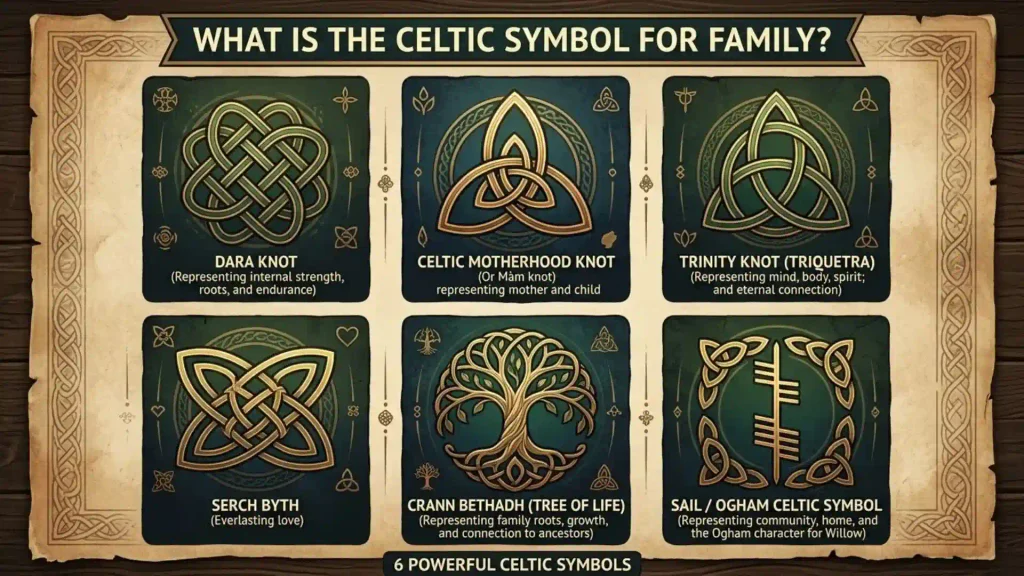
The Celtic symbol for family most commonly sought today is the Trinity Knot, also called the Triquetra. Its three interlocking loops create a continuous design that lends itself naturally to ideas about unity, connection, and enduring relationships.
People often interpret its three parts as a father, mother, and child. Others connect them with siblings, three generations, or different parts of a family that remain connected. These interpretations can make the design especially meaningful for jewelry, artwork, and family tattoos.
The Celtic Tree of Life is another popular choice. Its roots and branches provide a clear visual metaphor for family heritage, shared ancestry, and growth across generations.
Other designs express different aspects of family life:
- Trinity Knot: Unity, interconnectedness, and lasting bonds.
- Celtic Tree of Life: Family roots, ancestry, growth, and continuity.
- Triskelion: Movement, life’s cycles, and personal growth.
- Dara Knot: Strength, resilience, and family foundations in modern interpretations.
- Serch Bythol: Enduring love and close relationships.
- Celtic-inspired interlaced knots: Connection, loyalty, and togetherness.
- Celtic Cross: Christian faith, cultural heritage, and shared family traditions.
The best choice depends on what you want the design to communicate. If family unity matters most, the Trinity Knot may suit you. If you want to honor your ancestors, a Tree of Life design may express that idea more clearly.
Remember: A symbol’s modern meaning can be sincere and valuable even when historians cannot confirm that ancient Celts used it for the same purpose.
Celtic Symbols That Represent Family and Their Meanings
Several Celtic and Celtic-inspired designs can express family relationships. Each has a different appearance, cultural background, and range of interpretations.
Trinity Knot: A Celtic Family Knot for Unity
<AsyncImage query=”traditional Celtic Trinity Knot triquetra black ink interlaced three loops isolated white background” aspectRatio=”5:4″ width=”100%”/>
The Trinity Knot, known as the Triquetra, is one of the most recognizable designs associated with Celtic art. Its three connected loops form a balanced pattern with no obvious beginning or end.
That continuous structure makes it a natural choice for representing relationships that endure. Today, many people use the Trinity Knot as a Celtic family knot, connecting its three sections with parents and children or three closely connected family members.
Its meaning isn’t limited to family, however. Depending on the context, people also associate it with eternity, spiritual unity, and the number three.
Trinity Knot family meaning
The Trinity Knot’s threefold symbolism allows several interpretations:
- Parents and children: Three loops can represent a parent-child family unit.
- Family unity: Interconnected lines suggest relationships that remain linked.
- Generational bonds: The three parts can represent grandparents, parents, and children.
- Lasting love: The continuous pattern can symbolize enduring affection.
- Spiritual meaning: In Christian contexts, the Triquetra has been used in connection with the Trinity.
These are interpretations rather than one fixed historical definition. The symbol’s meaning can change according to the person, tradition, or setting.
The Triquetra appears in medieval Insular art, including Christian manuscripts and decorative objects. Its presence in historical artwork doesn’t establish that it originally meant father, mother, and child.
Nevertheless, the design remains a thoughtful choice for people who want a compact visual expression of family connection.
Who should choose the Trinity Knot?
Choose this design if you want a simple, recognizable pattern that communicates unity without requiring a large or elaborate image.
It works well for:
- Matching family tattoos.
- Pendants and necklaces.
- Rings and bracelets.
- Memorial jewelry.
- Personalized gifts for parents or children.
For a family tattoo, you can keep the traditional pattern or personalize it with initials, a date, or a small additional motif. Just remember that those additions create a personal interpretation rather than a historically established Celtic convention.
Celtic Tree of Life: A Symbol of Family Roots and Generations
<AsyncImage query=”Celtic Tree of Life circular interlaced roots and branches traditional Celtic knotwork illustration” aspectRatio=”5:4″ width=”100%”/>
The Celtic Tree of Life is especially appealing to people who want to honor their ancestry. Its familiar design places a tree inside a circular arrangement, often showing the roots and branches interwoven into a continuous pattern.
The image offers an easy way to express the relationship between a family’s past and future. Roots connect the tree to the ground, while branches extend outward and create room for new growth.
This makes the Tree of Life a meaningful modern family roots symbol.
Celtic Tree of Life family meaning
Different parts of the tree can suggest different aspects of family life:
- Roots: Ancestors, heritage, and the foundations that shaped your family.
- Trunk: Stability, shared values, and the experiences that hold relatives together.
- Branches: Children, grandchildren, and future generations.
- Leaves: Individual family members and the different paths they follow.
- Circular design: Continuity, connection, and the ongoing nature of life.
For example, someone researching their Irish ancestry might choose a Tree of Life pendant to honor grandparents and great-grandparents. Another person might use the same design to celebrate the growth of a young family.
Both interpretations make sense as personal symbolism.
Trees also held cultural and religious importance in various ancient Celtic societies. However, Celtic-speaking peoples lived across different regions and periods, so their beliefs weren’t identical. The popular circular Tree of Life design should not automatically be treated as one universally documented ancient Celtic emblem.
Why the Tree of Life represents family so well
Unlike a three-loop knot, a tree can accommodate the idea of a large, expanding family. Its branches suggest that people can share the same origins while developing distinct identities.
This makes it suitable for:
- Family reunion artwork.
- Ancestry-themed decorations.
- Memorial pieces honoring several generations.
- Family crest-inspired designs.
- Jewelry celebrating heritage.
- Tattoos featuring names or birth dates.
If your main goal is to represent family heritage, shared ancestry, and the continuation of generations, the Tree of Life may be a better fit than a Trinity Knot.
Triskelion: A Celtic-Inspired Symbol of Life’s Cycles
<AsyncImage query=”ancient triple spiral Triskelion stone carving Newgrange Ireland archaeological symbol” aspectRatio=”5:4″ width=”100%”/>
The Triskelion, also called the triskele, features three curved arms or spirals radiating from a central point. Its name comes from a Greek term associated with three legs, although the design appears in several forms.
Triple-spiral motifs have a long archaeological history in Europe. One famous example appears at Newgrange, a prehistoric passage tomb in County Meath, Ireland, built around 3200 BCE. This monument predates the conventional historical period associated with the ancient Celts by thousands of years.
That timeline matters. The triple spiral is part of Ireland’s ancient archaeological heritage, but its appearance at Newgrange does not prove that it began as a Celtic family symbol.
Triskelion meaning and family symbolism
The design’s turning arms suggest motion rather than stillness. Modern interpretations often connect this movement with life’s cycles, transformation, balance, and continuing development.
For family-related purposes, people may interpret the three spirals as:
- Three generations linked by a shared history.
- The changing stages of family life.
- Individual relatives moving along connected paths.
- Growth, change, and renewal across generations.
- A family’s ability to adapt while preserving its identity.
These interpretations provide a meaningful way to personalize the design. However, there is no universally established historical meaning that identifies the Triskelion specifically as a family emblem.
Triskelion versus Trinity Knot
Although both designs use three-part structures, their appearances differ.
The Trinity Knot relies on interlocking loops, while the Triskelion emphasizes three arms or spirals moving outward from a center. Their histories and cultural associations also differ.
Choose a Triskelion if you prefer a design that suggests movement, change, and the ongoing journey of life. Choose a Trinity Knot if you prefer an interwoven pattern that more directly evokes connection.
Dara Knot: A Modern Celtic Symbol for Strength and Family Roots
<AsyncImage query=”Dara Celtic knot oak root inspired interlaced symmetrical black line symbol white background” aspectRatio=”5:4″ width=”100%”/>
The Dara Knot is commonly presented in modern Celtic-inspired design as a symbol of strength, resilience, and inner stability. Its name is associated with the Irish word doire, meaning an oak grove, and its familiar interpretation draws on the oak tree’s roots.
The oak has strong cultural associations across several European traditions, including those connected with ancient Celtic societies. Its durability and long life made it a fitting image for strength and endurance.
However, the familiar Dara Knot design and its precise modern meaning should not automatically be described as an ancient Celtic family emblem.
Dara Knot family meaning
In contemporary symbolism, the Dara Knot can express the qualities that help families withstand difficult times.
- Strength: The ability to face challenges together.
- Resilience: Recovering after hardship or change.
- Family roots: Remembering the people and traditions that shaped you.
- Stability: Creating a dependable foundation for children and relatives.
- Shared ancestry: Recognizing the connections between generations.
Imagine a family that has experienced migration, financial hardship, or major life changes. A Dara-inspired design could serve as a reminder of the strength that helped them move forward.
The symbol doesn’t guarantee protection or prove a particular ancestry. Its meaning comes from the values and personal history attached to it.
Is the Dara Knot a good family tattoo?
It can be, particularly if strength and perseverance matter more to you than romantic love or a specific family relationship.
A Dara-inspired tattoo may suit someone who wants to honor a parent’s sacrifices, celebrate a family’s resilience, or remember the values passed down through generations.
If historical authenticity is important, research the particular design rather than relying on a product description that labels every Dara Knot ancient.
Serch Bythol: A Celtic-Inspired Symbol of Everlasting Love
<AsyncImage query=”Serch Bythol modern Celtic love knot two interlocking triquetra designs black line illustration white background” aspectRatio=”5:4″ width=”100%”/>
Serch Bythol is a name commonly associated with a modern Celtic-inspired love-knot design made from two connected Trinity Knot forms. The design is often used to express enduring affection, closeness, and commitment.
The name is commonly explained through Welsh-derived or Celtic-language terminology in popular descriptions, but its precise linguistic and historical claims deserve care. It is safest to describe the familiar design as a modern symbol associated with lasting love rather than assume it was a standardized ancient Celtic family emblem.
Serch Bythol symbol meaning
The two connected forms provide an obvious visual metaphor for two lives joined by affection. People often choose the design for romantic relationships, although its broader meaning can extend to other close bonds.
Common modern interpretations include:
- Everlasting love: A relationship that continues through life’s changes.
- Two connected lives: People who support one another while retaining their individuality.
- Commitment: A bond strengthened through trust and shared experiences.
- Family affection: Love between relatives who remain emotionally close.
- Togetherness: A lasting connection between people who matter deeply to each other.
Serch Bythol may appeal to couples, parents and children, or close relatives. The intended relationship depends on the people choosing the design.
Serch Bythol versus the Trinity Knot
The Trinity Knot has three connected loops and is often interpreted as unity or threefold connection. Serch Bythol, in its familiar modern form, combines two Trinity Knot-like shapes to emphasize a bond between two people.
If you want a Celtic symbol for everlasting love, Serch Bythol may suit your goal. If you want a more general symbol for family unity, the Trinity Knot may be more straightforward.
Celtic-Inspired Interlaced Knots: Connection Across Generations
<AsyncImage query=”traditional Insular Celtic interlace knotwork manuscript border continuous woven lines historical decorative pattern” aspectRatio=”5:4″ width=”100%”/>
Not every meaningful Celtic family knot needs a specific modern name. Interlaced knotwork appears throughout historic Insular art, including manuscript decoration, stone sculpture, and metalwork.
These patterns use lines that pass over and under one another, creating intricate designs. Some form closed loops, while others create repeating borders or complex geometric arrangements.
The patterns’ visual qualities make them useful for expressing relationships. Interwoven lines can suggest that individual lives become part of a larger whole without losing their separate identities.
Modern meanings of Celtic knotwork
People commonly interpret continuous interlace patterns through ideas such as:
- Family connection: Relatives remain connected despite distance or change.
- Loyalty: Family members continue to support one another.
- Unity: Different personalities contribute to a shared family identity.
- Continuity: Family stories and traditions pass from one generation to another.
- Belonging: Each person forms part of a larger network of relationships.
These meanings are modern interpretations rather than universal translations of historical Celtic knotwork.
A custom design may incorporate the initials of several relatives, the number of family members, or a meaningful date. Such personalization can make the artwork distinctive, although it doesn’t establish an ancient origin.
When choosing a design, look beyond its commercial label. Ask who created it, whether it copies a historical motif, and which parts reflect modern invention.
Celtic Cross: Family, Faith, and Cultural Heritage
<AsyncImage query=”historic Irish high stone Celtic cross with circular ring medieval Christian monument Ireland” aspectRatio=”5:4″ width=”100%”/>
The Celtic Cross combines a Christian cross with a circular ring around the intersection of its arms. Monumental examples are prominent in Ireland and other parts of the Insular world, where Christian communities developed distinctive forms of religious art.
Unlike the Trinity Knot or Tree of Life, the Celtic Cross has a clear place within Christian visual traditions. Its precise historical development varies by monument and period, so individual examples should be considered in their own archaeological context.
Celtic Cross meaning for family
Modern families may use the Celtic Cross to express:
- Christian faith shared across generations.
- Irish or other Celtic-associated cultural heritage.
- Remembrance of deceased relatives.
- Family traditions connected with worship and community.
- A sense of continuity between ancestors and descendants.
For example, a family might place a Celtic Cross on a memorial plaque to honor a relative whose faith shaped the household. Another might choose a pendant to celebrate Irish Christian heritage.
The symbol doesn’t have one universal family-specific meaning. Its relevance depends on the family’s religious beliefs, history, and personal interpretation.
If faith is central to your family identity, the Celtic Cross may communicate something the other designs cannot express as directly.
Celtic Family Symbols at a Glance
Choosing between different Celtic symbols and their meanings becomes easier when you compare their designs, common interpretations, and historical backgrounds.
| Symbol | Main visual feature | Common modern meaning | Best suited for |
| Trinity Knot | Three interlocking loops | Family unity and lasting bonds | Parents, children, and siblings |
| Celtic Tree of Life | Tree with roots and branches | Ancestry and generational growth | Family heritage and genealogy |
| Triskelion | Three curved arms or spirals | Life’s cycles and personal growth | Families celebrating change and continuity |
| Dara Knot | Modern interlaced knot design | Strength and resilience | Family strength and perseverance |
| Serch Bythol | Two connected Trinity Knot-like forms | Everlasting love and closeness | Couples and close relatives |
| Interlaced Celtic knotwork | Continuous woven lines | Connection and belonging | Matching tattoos and personalized gifts |
| Celtic Cross | Cross surrounded by a ring | Christian faith and heritage | Families with Christian traditions |
Historical note: These designs don’t all have the same historical status. The Trinity Knot and interlace motifs have documented appearances in medieval art. The familiar Dara Knot, Serch Bythol, and circular Tree of Life designs are best approached as modern Celtic-inspired symbols unless a specific historical example can be verified. <text size=”sm”>For context, see
Which Celtic Knot Represents Family Best?
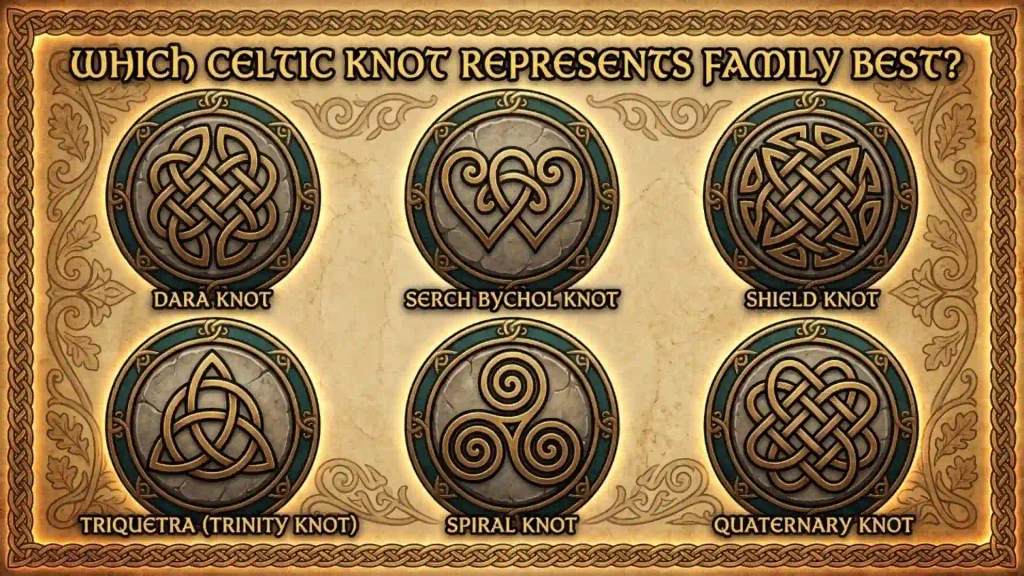
There isn’t one perfect answer for everyone. The right Celtic family symbol depends on the relationship or value you want to celebrate.
Best Celtic Symbol for Family Unity
The Trinity Knot is a strong choice if your main goal is to express togetherness. Its three interlocking loops provide a simple visual metaphor for relatives whose lives remain connected.
You can interpret the loops as parents and children, siblings, or three generations. However, no historical rule requires those exact associations.
For a matching family tattoo, each person could use the same design. Alternatively, family members could choose different sizes while keeping the central pattern consistent.
Best Celtic Symbol for Family Roots and Ancestry
The Celtic Tree of Life works well for people who want to honor their ancestors and celebrate the generations that follow them.
Its branching form gives you room to personalize the design with names, dates, or other details. For example, a family might place grandparents’ initials near the roots and children’s initials near the branches.
The symbolism is easy to understand, although the familiar circular knotwork version shouldn’t automatically be described as an ancient Irish emblem.
Best Celtic Symbol for Family Love
If you want a design associated with enduring affection, consider Serch Bythol or the Trinity Knot.
Serch Bythol’s familiar modern design emphasizes two connected forms, making it particularly suitable for a close relationship. The Trinity Knot offers a broader interpretation of unity that can include several relatives.
For a mother-child or father-daughter gift, a personalized knot can express a relationship more clearly than a generic symbol alone.
Best Celtic Symbol for Family Strength
The Dara Knot is a popular modern choice for strength and resilience. Its association with oak roots gives it a natural connection to endurance and a firm foundation.
The Tree of Life can express similar ideas through its sturdy trunk and established roots. Both designs work well for honoring family members who have overcome hardship or supported others through difficult periods.
Best Celtic Symbol for a Family Tattoo
For a family tattoo, consider three practical factors:
- Meaning: Choose a design that reflects the relationship you want to honor.
- Appearance: Select a pattern that remains recognizable at your preferred size.
- Authenticity: Check whether the design is historical, modern, or a contemporary adaptation.
The Trinity Knot suits small, simple tattoos. The Tree of Life offers more room for detail, while the Triskelion creates a bolder spiral design.
Before making a permanent choice, verify the artwork and decide which parts carry personal meaning.
Celtic Symbols for Specific Family Relationships
Family symbols often become more meaningful when they reflect a particular relationship. You can adapt traditional knotwork or choose a modern Celtic-inspired design to honor the people closest to you.
Celtic Symbols for Parents and Children
The Trinity Knot is a popular modern choice for parents and children because its three loops can represent a close family unit.
A parent might choose the symbol to celebrate the arrival of a child. An adult child might wear it to honor both parents or remember a loved one.
Families with more than three members can still use the design. The three loops need not represent three individual people; they can symbolize unity as a whole.
For a more personal touch, add a child’s birth date or initials. These details can make a meaningful keepsake without claiming that the resulting design follows an ancient Celtic tradition.
Celtic Father-Daughter Knot
A Celtic father-daughter knot is generally a modern personalized design rather than a single historically established symbol.
A Trinity Knot, a linked pair of loops, or another interlaced pattern can represent a father’s enduring love for his daughter. Some people add a small heart, initials, or a meaningful date.
The most important consideration is the relationship itself. A design chosen together may carry more personal significance than a pattern selected simply because a seller labels it a traditional father-daughter symbol.
Celtic Symbols for Siblings
Siblings often share childhood memories, family traditions, and experiences that shape their adult lives. Matching Celtic family knots can celebrate that shared history.
Possible approaches include:
- Choosing identical Trinity Knot tattoos.
- Using related knot designs in different sizes.
- Adding initials to a shared interlaced pattern.
- Choosing a Triskelion to reflect growth through different stages of life.
Matching designs don’t need to be identical to communicate connection. Each sibling can personalize the artwork while preserving a shared element.
Celtic Symbols for Generations and Ancestry
The Tree of Life is a natural choice for families celebrating multiple generations. Its roots and branches provide a clear visual link between ancestors, living relatives, and future descendants.
A family can also create a personalized interlace design that includes names or dates. If you want to honor a specific ancestor, pair the symbol with accurate genealogical information.
A symbol can honor your ancestry, but it cannot prove it. Family records, historical documents, and reliable genealogical research provide stronger evidence of heritage than a decorative knot.
Are Celtic Family Knots Historically Authentic?
This question matters because many online descriptions present every popular Celtic design as an ancient symbol with a fixed meaning.
The historical record is more complicated.
Celtic knotwork is a genuine artistic tradition. Interlaced patterns appear in early medieval Insular art, including manuscripts, carved stones, and metalwork. However, historians cannot assign a specific family meaning to every knot simply because the design appears in an old artwork.
What the historical evidence supports
- Insular art: Interlace patterns flourished in medieval Irish and British artistic traditions.
- Book of Kells: This celebrated illustrated Gospel manuscript contains elaborate ornament, interlace, spirals, and decorated initials.
- Christian contexts: Some three-part motifs, including the Triquetra, have associations with Christian symbolism.
- Ancient triple spirals: Triple-spiral motifs appear at prehistoric sites such as Newgrange, long before the conventional period associated with historical Celtic communities.
- Modern interpretations: Many named family knots and their specific meanings became popular through contemporary design, jewelry, tattoos, and cultural revival.
The last point is particularly important. A modern design can use traditional knotwork techniques without being an ancient artifact.
Are all Celtic family symbols ancient?
No. Some underlying motifs have a documented historical record, while other familiar designs are modern creations or adaptations.
The Dara Knot is commonly linked with oak roots and strength, but the familiar named design lacks a well-established ancient provenance. Similarly, the modern Serch Bythol design is widely associated with everlasting love, but its status as an ancient Celtic family symbol isn’t supported by strong historical evidence.
The familiar circular Celtic Tree of Life design also requires caution. Historical Irish traditions included sacred trees, but that doesn’t prove the modern interlaced tree image existed in medieval Ireland as a standardized symbol.
The distinction doesn’t make modern designs meaningless. It simply helps you understand what you’re choosing.
How to Choose the Right Celtic Family Symbol
Choosing a design becomes easier when you begin with your intended meaning rather than its popularity.
Start With the Meaning You Want to Express
Ask yourself what matters most about your family relationship.
- Unity: Consider the Trinity Knot or a continuous interlace pattern.
- Ancestry: Explore Tree of Life designs and symbols inspired by family roots.
- Strength: Consider the modern Dara Knot or a sturdy tree motif.
- Enduring love: Explore Serch Bythol and other modern love-knot designs.
- Faith: Consider the Celtic Cross if Christian heritage is important to you.
- Growth and change: The Triskelion may suit a family celebrating life’s journey.
These associations are useful starting points, not fixed historical definitions.
Consider the Design and Its Practical Use
A detailed knot can look beautiful on a large pendant but become difficult to recognize when reduced to a tiny tattoo.
Before choosing, consider:
- The size and placement of the design.
- Whether the lines will remain clear over time.
- How well the pattern works in jewelry or engraving.
- Whether you want a traditional-looking motif or a personalized design.
- Whether the design will still feel meaningful years from now.
For tattoos, ask an experienced artist to simplify intricate details when necessary. Clear lines usually work better than excessive decoration at very small sizes.
Research the Cultural Background
If you want an authentic Celtic family symbol, investigate the specific design rather than relying on a general marketing label.
Look for museum collections, archaeological references, scholarly publications, or reliable historical resources. Check whether a source identifies an actual artifact, provides a date, and explains the evidence for its interpretation.
If your family has Irish, Scottish, Welsh, or another Celtic-associated heritage, research that specific background too. These cultures share historical connections, but they don’t have identical traditions or symbols.
Finally, choose a design whose meaning you can explain honestly. Personal symbolism is a valid reason to wear a symbol, even when its modern meaning differs from its historical context.
Frequently Asked Questions About Celtic Symbols for Family
What Is the Celtic Symbol for Family?
The Trinity Knot is one of the most popular modern choices for representing family unity. Its three interlocking loops can symbolize connected relationships, while the Tree of Life is often chosen to express ancestry and generational growth. Neither has been established as the single official ancient Celtic family symbol.
What Is the Irish Symbol for Family?
There isn’t one universally recognized ancient Irish symbol specifically designated for family. The Trinity Knot, Tree of Life, and various interlaced designs are commonly used today to express family love, unity, and heritage. Their historical backgrounds and modern interpretations differ.
Does the Trinity Knot Represent Family?
Today, many people interpret the Trinity Knot as a symbol of family unity, particularly through the idea of three connected family members. Historically, Triquetra-like motifs appear in Insular art, including Christian contexts. However, the specific father-mother-child interpretation isn’t a universally established ancient meaning.
What Does the Dara Knot Mean?
The Dara Knot is commonly associated with strength, resilience, oak roots, and stability in modern Celtic-inspired symbolism. Its name connects with oak-related Irish terminology. However, the familiar named design doesn’t have a well-established ancient history as a specific Celtic family emblem.
What Is the Difference Between the Trinity Knot and the Triskelion?
The Trinity Knot features three interlocking loops, while the Triskelion has three curved arms or spirals radiating from a central point. The Trinity Knot often expresses unity in modern interpretations. The Triskelion is commonly associated with movement and life’s cycles, although both symbols have varied interpretations.
Which Celtic Symbol Is Best for a Family Tattoo?
The Trinity Knot works well for a simple family-unity tattoo, while the Tree of Life suits ancestry and generational themes. The Triskelion offers a spiral design, and the Dara Knot is commonly chosen for strength. Select the pattern that best reflects your personal meaning and verify its historical background before describing it as ancient.
Conclusion
The best Celtic symbol for family is the one that reflects the relationships and values you want to honor. The Trinity Knot offers a simple expression of unity, while the Tree of Life connects naturally with ancestry and growth across generations.
The Triskelion can suggest life’s continuing cycles, and the modern Dara Knot is often associated with strength and resilience. Serch Bythol offers another way to express enduring love, while the Celtic Cross may suit families whose identity includes Christian faith.
Each design carries a different visual and cultural background. Some draw on documented historical motifs, while others use traditional artistic elements to express modern ideas.
Before choosing, take time to understand the design and its history. Then select a symbol that genuinely reflects your family’s story.
After all, the strongest family bond isn’t created by a knot’s shape. It’s built through love, trust, shared memories, and the people who continue to show up for one another.

Clara Miles
Hello! I’m Clara, a lifelong dreamer who finds magic in everyday moments. Writing has always been my way of exploring the world and understanding the people around me. I love creating stories that make readers laugh, cry, and reflect on life’s little surprises. When I’m not writing, you can usually find me sipping coffee at a cozy café or wandering through nature with a notebook in hand. My journey as an author is fueled by curiosity, imagination, and a love for connecting with my readers. Every story I write is a piece of my heart, and I hope it inspires yours too.
Books:
-
Whispers of the Heart
-
Shadows and Sunlight