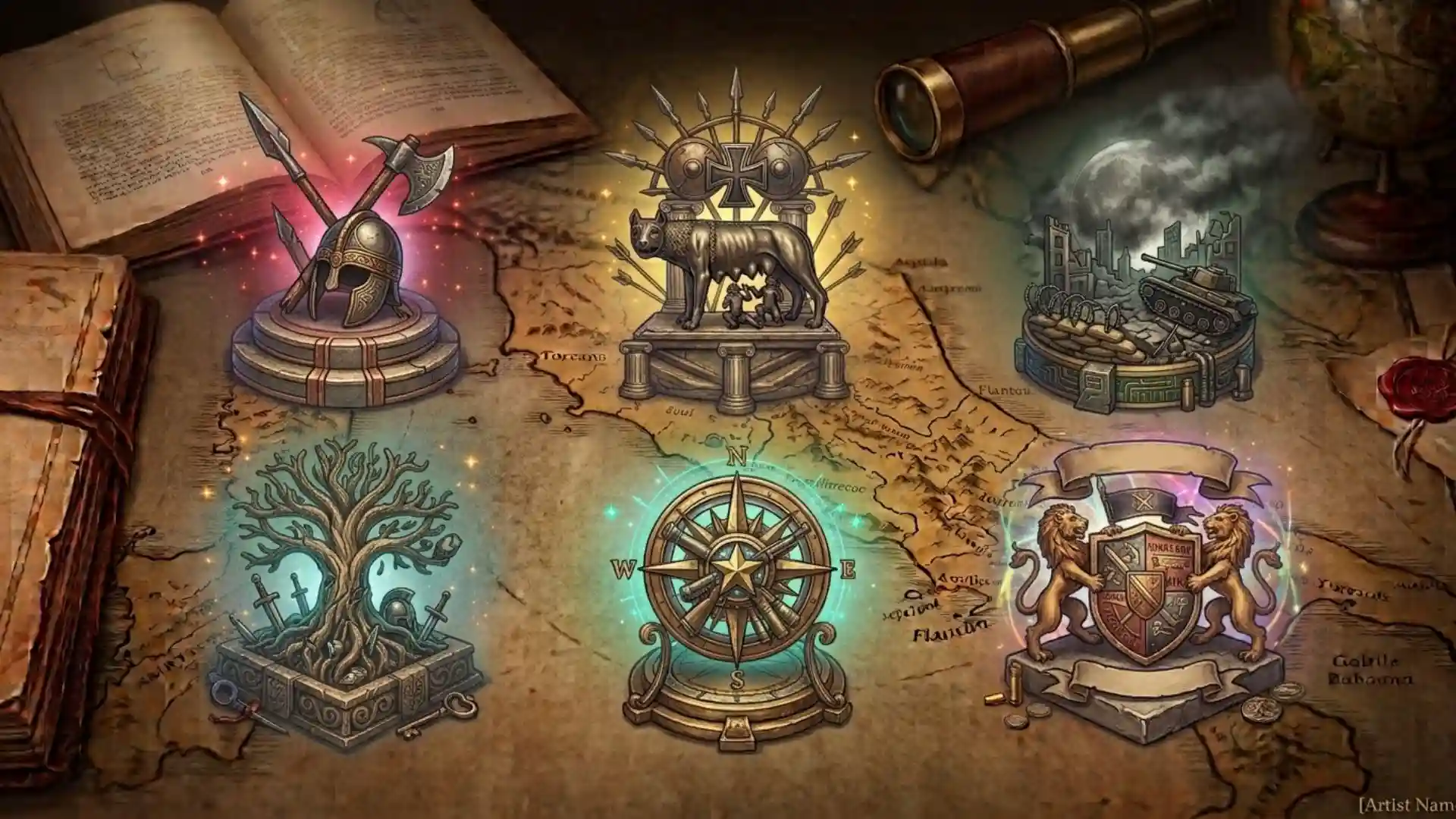
War symbols tell stories that words sometimes struggle to express. A sword can suggest courage or combat, while a white flag may signal surrender or a request for a truce. A dove can communicate peace, and a mushroom cloud can bring nuclear destruction to mind. These images carry different meanings depending on their history, culture, and use.
Understanding war symbols means looking beyond the pictures themselves. Some symbols identify military organizations, while others represent resistance, sacrifice, remembrance, or the desire to end violence. Certain emblems also have specific legal meanings that distinguish them from ordinary illustrations.
In this guide, you’ll discover the meanings of common symbols of war, explore important historical examples, and learn how military, peace, and resistance imagery developed. You’ll also find practical explanations that help you distinguish official military symbols from general pictures associated with warfare.
What Are War Symbols?
War symbols are images, signs, objects, colors, or emblems that communicate ideas associated with armed conflict. They can represent military power, national identity, bravery, destruction, surrender, resistance, or peace.
Some have established historical meanings. Others gain significance through political movements, artistic expression, or personal experiences.
For example, a sword displayed on a military crest may represent tradition and authority. The same sword broken in half might communicate disarmament or the end of a conflict.
War Symbols vs. Military Symbols
Although these terms overlap, they don’t mean exactly the same thing.
- War symbols communicate ideas about conflict, destruction, victory, defeat, resistance, or peace.
- Military symbols identify armed forces, military branches, units, ranks, equipment, or operational information.
- Peace symbols express opposition to violence, reconciliation, disarmament, or a desire for peaceful relations.
- Resistance symbols communicate opposition to authority, occupation, oppression, or a particular political system.
- War illustrations depict scenes or objects associated with warfare without necessarily carrying an established symbolic meaning.
A military badge, for instance, might identify a particular unit rather than symbolize war in general. A dove appearing on an anti-war poster communicates a broader message about peace.
Understanding these differences makes it easier to interpret military iconography accurately.
Why Do People Use Symbols of War?
Symbols communicate complicated ideas quickly. A recognizable image can convey danger, authority, mourning, or hope without requiring a long explanation.
Historically, armies used banners, shields, and distinctive emblems to identify groups on the battlefield. Governments later used military insignia and national flags to communicate allegiance and authority.
Artists, activists, and memorial designers use similar visual language for different purposes.
Common reasons people use war symbolism include:
- Identification: Recognizing military units, armed forces, or national affiliations.
- Communication: Showing danger, surrender, military activity, or evacuation.
- Remembrance: Honoring people who died during war or military service.
- Protest: Expressing opposition to war, nuclear weapons, or military occupation.
- Recognition: Celebrating service, courage, or military achievements.
- Education: Explaining historical battles, military equipment, and the consequences of conflict.
The surrounding context matters. A weapon on a recruiting poster may emphasize military strength, while the same weapon on an anti-war poster may highlight violence and suffering.
Common War Symbols and Their Meanings
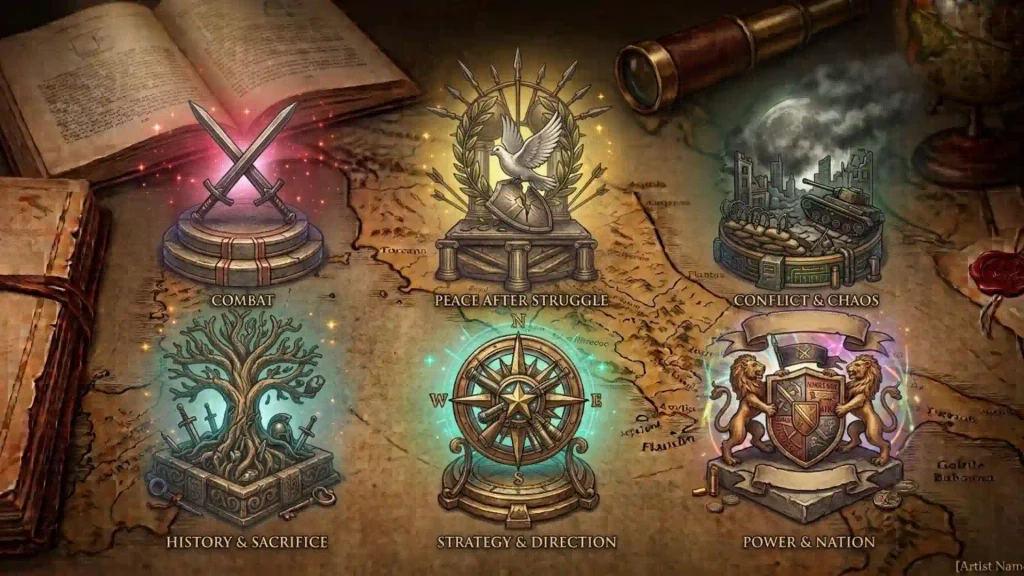
Many familiar images appear in military history, political artwork, memorials, and popular culture. However, their meanings can change according to their setting.
Sword: Combat, Authority, and Honor
The sword is one of the oldest recognizable symbols of war. For centuries, warriors, rulers, and military leaders used swords as weapons and as visible signs of status.
In symbolic imagery, a sword commonly represents:
- Combat and armed conflict.
- Military authority and leadership.
- Courage, discipline, and honor.
- Justice, judgment, or the defense of an ideal.
- Protection against a perceived threat.
Swords also appear in coats of arms, official insignia, monuments, and ceremonial uniforms. Their meaning depends on how artists present them.
A raised sword might suggest readiness for battle. A sword held upright may communicate authority or honor. A sheathed sword can suggest restraint, while a broken sword often represents defeat or the abandonment of violence.
Crossed swords frequently appear in military-themed artwork and insignia. They can suggest combat readiness or a martial tradition, although the exact meaning depends on the organization displaying them.
Gun and Rifle: Armed Conflict and Military Power
Guns and rifles are among the most recognizable images associated with modern warfare. They can represent armed force, military service, self-defense, oppression, or resistance.
A gun symbol often communicates the presence or threat of violence. A rifle carried by a soldier may indicate military duty, while a firearm pointed toward a person can suggest intimidation or aggression.
The same image may carry very different meanings in different settings.
For example, a memorial depicting a fallen soldier beside a rifle might emphasize service and sacrifice. An anti-war illustration showing a rifle surrounded by broken objects might focus on destruction.
Common firearm imagery includes:
- Handguns and pistols.
- Rifles and assault rifles.
- Sniper rifles.
- Bullets and ammunition.
- Crossed firearms in military-style emblems.
These images are common in war illustrations, video games, editorial cartoons, and military graphics. However, a gun or rifle does not have one universal symbolic meaning.
Bomb and Missile: Destruction and Modern Warfare
Bombs and missiles represent the destructive capabilities of modern armed forces. They appear in news graphics, historical illustrations, political cartoons, and anti-war campaigns.
A conventional bomb may symbolize an aerial attack, sudden destruction, or the threat of violence. A missile can suggest long-range military power, technological warfare, or the possibility of escalation.
The surrounding image helps explain the intended message.
- An aerial bomb falling toward a city may represent the danger faced by civilians.
- A missile launch may illustrate military operations or international tensions.
- An unexploded bomb may communicate a continuing danger after fighting ends.
- A destroyed weapon in a peace poster may symbolize disarmament.
Nuclear weapons require a separate distinction. A nuclear bomb is associated with the potential for catastrophic destruction, radioactive contamination, and long-term humanitarian consequences.
Although bomb and missile graphics are common in military icon sets, they’re usually descriptive illustrations rather than historically established symbols with fixed meanings.
Tank and Armored Vehicle: Ground Warfare
Tanks represent armored ground combat, military strength, and mechanized warfare. Their appearance in photographs and illustrations often signals the movement of troops or the presence of heavy military equipment.
A military tank symbol may communicate:
- Ground warfare and battlefield operations.
- Armored protection and military force.
- Territorial control or military occupation.
- Defense and preparation for combat.
- The industrial technology of modern warfare.
Tanks became especially prominent in twentieth-century warfare. Their widespread use during World War I helped establish armored vehicles as recognizable features of modern battlefields.
Today, tank illustrations appear in military maps, educational diagrams, news coverage, and strategy games. Yet a tank icon on a map may simply identify an armored unit or vehicle location.
It doesn’t automatically symbolize aggression or victory. The interpretation depends on the surrounding message.
Military Helmet: Protection, Service, and Sacrifice
A military helmet can represent the soldiers who wear it, their service, and the risks associated with combat. It also suggests protection because helmets help shield personnel from certain battlefield hazards.
In war-related artwork, a helmet may symbolize:
- Military service and duty.
- Protection against battlefield dangers.
- The identity of a soldier or military unit.
- Courage and sacrifice.
- Loss when shown abandoned or placed on a memorial.
An empty helmet beside a pair of boots can create a strong memorial image. The absence of the soldier encourages viewers to think about death, separation, and the human cost of war.
A helmet can also appear on military badges and historical illustrations. Its meaning changes with the design: a helmet worn by a standing soldier suggests service, while a discarded helmet may communicate loss or defeat.
Crosshair and Target Reticle: Targeting and Threat
A crosshair consists of intersecting lines used to indicate a target’s position. A target reticle is a related aiming graphic found in optical and electronic targeting systems.
These images have practical uses in military equipment, photography, maps, and digital interfaces. In symbolic artwork, they can communicate targeting, surveillance, danger, or precision.
For example, a crosshair placed over a military vehicle may indicate a targeting system in a technical illustration. The same graphic placed over a civilian building in an editorial cartoon may criticize military violence.
Crosshairs also appear in gaming interfaces and security-related graphics. Their presence alone doesn’t establish that an image represents war.
Barbed Wire: Confinement, Separation, and Suffering
Barbed wire is widely associated with restricted movement, guarded boundaries, and confinement. Military forces have used it to protect positions, slow movement, and define restricted areas.
Over time, barbed-wire imagery also became associated with prisons, detention facilities, occupied territories, and wartime suffering.
Its common symbolic meanings include:
- Confinement and restricted freedom.
- Physical and political barriers.
- Separation between communities.
- Oppression and imprisonment.
- The dangers faced by people living through conflict.
In a historical illustration, barbed wire surrounding a military position may depict battlefield defenses. In an artwork about displaced civilians, it may communicate exclusion or restricted movement.
The image becomes especially meaningful when paired with other elements, such as a person reaching through a fence or a family standing outside a restricted area.
Military Medals and Stars: Courage and Recognition
Military medals recognize service, achievement, bravery, or other contributions under an awarding institution’s rules. Their designs often include stars, ribbons, shields, national emblems, or symbolic figures.
A medal can represent honor and recognition, but not every medal carries the same meaning.
An official decoration has a defined history and eligibility criteria. A generic star-shaped badge may simply function as a decorative element in military-themed artwork.
Military awards can symbolize:
- Courage under difficult circumstances.
- Service to a country or organization.
- Distinguished achievement.
- Sacrifice and remembrance.
- Recognition by military or government authorities.
The U.S. Medal of Honor, for example, is the country’s highest military decoration for valor in combat. Its meaning comes from its official status and the acts for which recipients receive it, not merely its visual design.
When interpreting a medal, identify the actual award whenever possible. A star alone doesn’t establish which honor it represents.
Military Symbols and Official Insignia
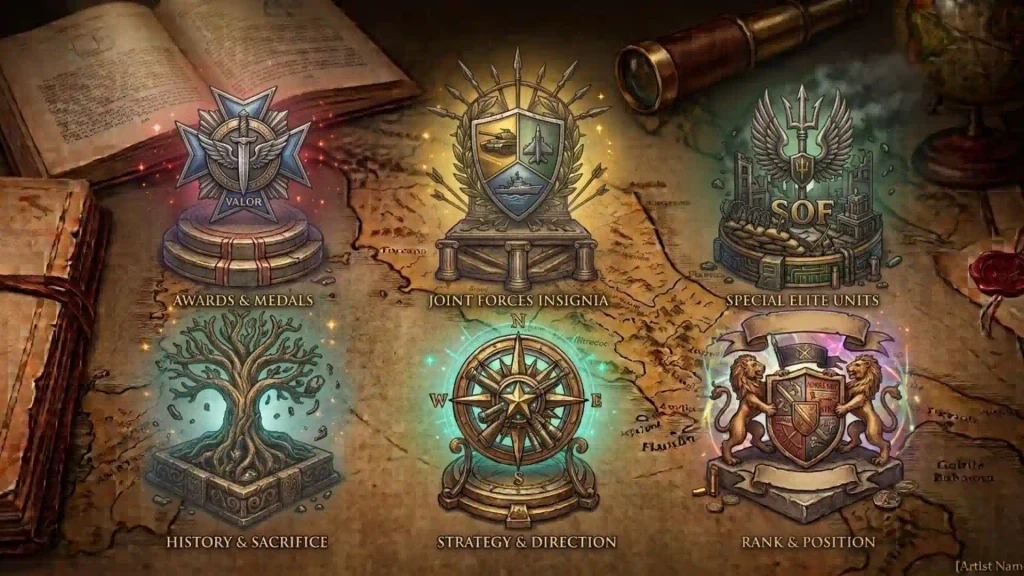
Military insignia communicate identity, affiliation, rank, qualifications, or other information within armed forces. Unlike many general war symbols, official insignia often follow established rules.
Their designs may include animals, stars, shields, weapons, wings, letters, numbers, and national emblems. The same visual element can mean different things in different organizations.
Army, Navy, and Air Force Symbols
Armed forces often use distinct insignia to identify their branches and units.
Army symbols may feature crossed weapons, shields, eagles, or other elements associated with land forces. Naval insignia often incorporate anchors, ships, waves, or maritime imagery. Air-force insignia may include wings, aircraft silhouettes, stars, or national markings.
These are broad design patterns, not universal rules. Each country establishes its own military traditions and official insignia.
A useful distinction is the purpose of the symbol:
- Branch insignia: Identifies a military service or branch.
- Rank insignia: Communicates a service member’s rank.
- Unit insignia: Identifies a particular military formation.
- Qualification badges: Indicate training, specialist skills, or qualifications.
- National markings: Identify an aircraft, vehicle, ship, or other military asset as belonging to a particular country.
A military aircraft’s national marking, for example, helps identify its affiliation. It isn’t necessarily a general symbol of war.
Military Flags, Crests, and Unit Emblems
Flags and crests have helped military groups communicate identity for centuries. Before modern communication systems, recognizable standards could help soldiers identify their own forces during battle.
A military emblem may combine several design elements, each with a particular historical or institutional association.
Common elements include:
- Shields and heraldic shapes.
- Eagles, lions, and other animals.
- Stars, wreaths, and crowns.
- Swords, anchors, or wings.
- National colors and established insignia.
Heraldry developed its own visual conventions, but individual designs require historical context. A lion might represent courage in one coat of arms, while another organization uses it because of a regional or dynastic tradition.
It’s better to identify the actual crest than assign a generic meaning to every element.
Soldier Silhouettes and Military Aircraft
A soldier silhouette is a simplified outline of a person in military clothing or equipment. Designers use these figures in educational diagrams, military infographics, maps, and safety-related graphics.
Similarly, tank, helicopter, fighter aircraft, warship, and drone icons often identify equipment categories.
These are primarily military pictograms. They help people recognize objects quickly, but they don’t always carry deeper symbolic meanings.
A black silhouette of a soldier may represent military personnel in a chart. The same silhouette holding a rifle against a burning skyline may communicate active combat or destruction.
The illustration’s setting determines how viewers interpret it.
Symbols of Victory, Defeat, and Surrender
War symbolism doesn’t focus only on weapons and fighting. Many important images communicate the outcome of conflict or the decision to stop fighting.
Victory Symbols in War
Victory symbols communicate success, achievement, survival, or the end of a military campaign. They can appear on monuments, commemorative medals, national flags, posters, and public celebrations.
A flag raised after a battle may represent control of a location or a military achievement. A memorial dedicated to a victorious campaign may emphasize national pride or collective sacrifice.
Common victory imagery includes:
- Flags raised over a position.
- Victory medals and commemorative badges.
- Laurel wreaths associated with achievement.
- Memorials honoring military campaigns.
- Triumphant figures in historical paintings.
However, victory is rarely experienced in the same way by everyone involved. An image celebrating one side’s success may remind the opposing community of loss or displacement.
Historical interpretation should account for both the event and the people affected by it.
White Flag: Surrender and Truce
The white flag is one of the best-known symbols associated with surrender or a request to communicate with opposing forces.
In armed conflict, its meaning depends on the circumstances. A white flag may signal an intention to surrender, request a truce, or communicate with an opposing side.
It doesn’t automatically mean that a war has ended or that a formal peace treaty exists.
The distinction matters because different stages of conflict require different forms of communication and agreement.
A white flag in a historical painting may depict a surrender. In a political illustration, it might suggest giving up a struggle. In another setting, it could represent a temporary pause rather than a permanent settlement.
A surrender signal and a peace agreement are not the same thing. The former concerns a situation on the ground, while the latter involves an agreement to establish terms between parties.
Broken Weapons and Abandoned Military Equipment
Broken swords, damaged rifles, and abandoned helmets can communicate defeat, disarmament, or the end of fighting.
Artists often use these images to express ideas that go beyond the equipment itself.
A broken sword may represent the rejection of violence. An abandoned rifle might suggest the end of a battle or the loss of a combatant. Weapons gathered in a memorial can symbolize disarmament or the desire to prevent future conflict.
These meanings aren’t fixed. A damaged tank in a battlefield photograph documents destruction, while a deliberately broken weapon in a peace poster makes a symbolic statement.
Context separates the two.
Peace Symbols and Anti-War Imagery
Symbols of peace offer an important contrast to military imagery. They can express reconciliation, nonviolence, disarmament, or hope for a future without armed conflict.
Dove of Peace
The dove of peace is a widely recognized image associated with peace, hope, and reconciliation. Its history includes religious and artistic traditions, while its modern use extends to political campaigns and anti-war movements.
In the biblical story of Noah, a dove returns with an olive leaf, signaling that floodwaters have receded. This account helped establish the dove and olive branch as lasting images of renewal and peace.
Artists and activists later used dove imagery in posters, paintings, and public campaigns.
A dove carrying an olive branch commonly suggests reconciliation. A flock of flying doves may evoke freedom, hope, or peaceful coexistence.
Still, the dove isn’t exclusive to war-related contexts. It can also represent spiritual themes, innocence, or new beginnings.
Peace Sign
The modern peace sign has a specific twentieth-century origin. British artist Gerald Holtom designed it in 1958 for the Campaign for Nuclear Disarmament (CND).
The design combines semaphore signals for the letters N and D, representing nuclear disarmament, inside a circle. The symbol appeared in the British anti-nuclear movement before spreading internationally.
The Nobel Peace Center explains the design’s origins and its later adoption by peace activists in its article, Behind the Peace Symbol.
The peace sign later became associated with broader anti-war activism, civil rights campaigns, and social movements.
Its common meanings include:
- Opposition to nuclear weapons.
- Peaceful protest and nonviolence.
- Disarmament and reconciliation.
- Hope for a world with less violence.
Although people now use it in clothing, jewelry, artwork, and popular culture, its original connection to nuclear disarmament remains an important part of its history.
White Poppy and Remembrance Symbols
The white poppy is associated with remembrance, peace, and opposition to war. In the United Kingdom, the Peace Pledge Union promotes its use as an alternative remembrance symbol.
The red poppy has a different but related history. It became widely associated with remembrance of military personnel who died during the First World War and later conflicts.
The two symbols can express different approaches to remembering war.
| Symbol | Common association | Important context |
| Red poppy | Remembrance of military dead | Widely used in several national remembrance traditions |
| White poppy | Remembrance, peace, and opposition to war | Associated with campaigns promoting peaceful alternatives to conflict |
| Dove | Peace and reconciliation | Draws on religious, artistic, and modern activist traditions |
| Peace sign | Nuclear disarmament and peace activism | Designed in 1958 for the British nuclear disarmament movement |
Neither poppy color has one universal interpretation across every country. Their meanings depend on local traditions and the organizations promoting them.
Olive Branch and Other Peace Motifs
The olive branch has a long association with peace and reconciliation. In ancient Greek traditions, it was connected with peace and victory, and its appearance in later art reinforced those associations.
Today, the olive branch may appear in diplomatic emblems, political artwork, peace campaigns, and ceremonial designs.
Other visual motifs can also communicate peaceful intentions:
- Open hands: Cooperation, nonviolence, or a willingness to communicate.
- White doves: Peace, hope, and reconciliation.
- Broken chains: Freedom from oppression or confinement.
- Handshake: Agreement, cooperation, or reconciliation.
- Green shoots: Renewal and the possibility of rebuilding after conflict.
These motifs are not all exclusively peace symbols. Their meanings depend on their visual presentation and surrounding message.
Resistance, Protest, and Revolution Symbols
Resistance symbols communicate opposition to a political system, military occupation, discrimination, or perceived injustice. Some movements use peaceful symbols, while others use imagery associated with armed struggle.
The distinction matters because a symbol’s meaning can depend heavily on the group displaying it.
Raised Fist: Solidarity and Resistance
The raised fist is a recognizable emblem of solidarity, resistance, and collective action. It has appeared in labor movements, civil rights campaigns, anti-fascist activism, and other political struggles.
Its message often depends on the accompanying colors, slogans, and organizational symbols.
A raised fist on a protest poster may communicate unity and determination. In another context, it might represent a particular political movement or historical event.
The image can also appear in sports and popular culture, where it may express celebration or personal resolve.
A raised fist isn’t inherently a symbol of war. Its relevance to conflict comes from the circumstances in which people use it.
Flags and Emblems of Resistance Movements
Resistance movements often develop distinctive flags, colors, badges, or logos. These designs help supporters communicate shared identity and political goals.
However, symbols linked to resistance can also be contested. One community may view an emblem as a sign of liberation, while another associates it with violence or oppression.
To interpret such symbols responsibly, identify:
- The organization or movement that uses the emblem.
- The period and conflict in which it appeared.
- The political goals associated with it.
- The historical events that shaped public perceptions.
- Whether the symbol has different meanings for opposing communities.
A flag’s colors alone rarely provide enough evidence to establish its meaning. Historical records and reliable sources are more useful than assumptions.
Broken Chains and Liberation Symbols
Broken chains often represent freedom from oppression, forced labor, imprisonment, or political control.
The image communicates a simple idea: something that once restricted movement has been broken.
In war-related artwork, broken chains may represent liberation from occupation or the restoration of political freedom. Human-rights campaigns also use them to communicate emancipation and equal rights.
Other liberation imagery includes open gates, snapped restraints, and people crossing barriers.
These images are broader symbols of freedom. They become specifically connected to war when the surrounding context involves occupation, armed conflict, or wartime imprisonment.
Nuclear War Symbols and Images of Destruction
Nuclear warfare introduced a new visual language into modern conflict. Images of mushroom clouds, atomic explosions, and nuclear warning signs now communicate the risks associated with nuclear technology.
It’s important to distinguish images representing a nuclear explosion from official symbols that identify radiation hazards.
Mushroom Cloud: Nuclear Explosion
The mushroom cloud is one of the most recognizable images associated with nuclear warfare. It forms when a powerful explosion drives hot gases upward, creating a rising column and a cloud-like cap under suitable atmospheric conditions.
Nuclear detonations can produce mushroom clouds, but the shape isn’t exclusive to nuclear explosions. Some large conventional explosions and other intense events can also create similar formations.
The image became especially significant after the atomic bombings of Hiroshima and Nagasaki in August 1945.
Today, mushroom-cloud imagery commonly represents:
- Nuclear destruction and mass casualties.
- The threat of nuclear escalation.
- The long-term consequences of nuclear weapons.
- Anti-nuclear activism and disarmament.
- Public anxiety about catastrophic warfare.
In anti-war artwork, a mushroom cloud may appear over a city to emphasize the threat to civilian life. In historical material, it may document a particular explosion or nuclear test.
The image is emotionally powerful because it links a single visual event with widespread destruction and lasting human consequences.
Radiation Trefoil: Radioactive Hazard
The radiation trefoil is the familiar three-bladed warning symbol used to identify ionizing-radiation hazards.
Unlike a mushroom cloud, the trefoil serves a practical safety purpose. It warns people that radiation may be present in a particular location, on equipment, or in a controlled area.
Its meanings include:
- Radioactive materials or contamination.
- Radiation hazards.
- Restricted access to certain facilities.
- The need for appropriate safety precautions.
The symbol is not, by itself, a sign that a nuclear weapon is present. Radiation hazards can arise in medical, industrial, research, and nuclear-energy settings.
This distinction is important when interpreting nuclear war symbols. A mushroom cloud depicts an explosive event, while the radiation trefoil identifies a hazard.
Nuclear Disarmament and Anti-Nuclear Symbols
Anti-nuclear campaigns often combine the peace sign with images of missiles, bombs, warning signs, or damaged landscapes.
These visual combinations communicate opposition to nuclear weapons and concern about their humanitarian consequences.
The peace sign’s historical connection to nuclear disarmament makes it particularly relevant here. Its use grew beyond the original campaign, but it remains one of the most recognizable symbols associated with peace activism.
Other anti-nuclear images include crossed-out missile silhouettes, hands protecting the Earth, and broken weapon illustrations. These are generally campaign graphics rather than standardized international symbols.
Their central message is often prevention: reducing the risk of nuclear conflict before destruction occurs.
War Symbols in History and Different Cultures
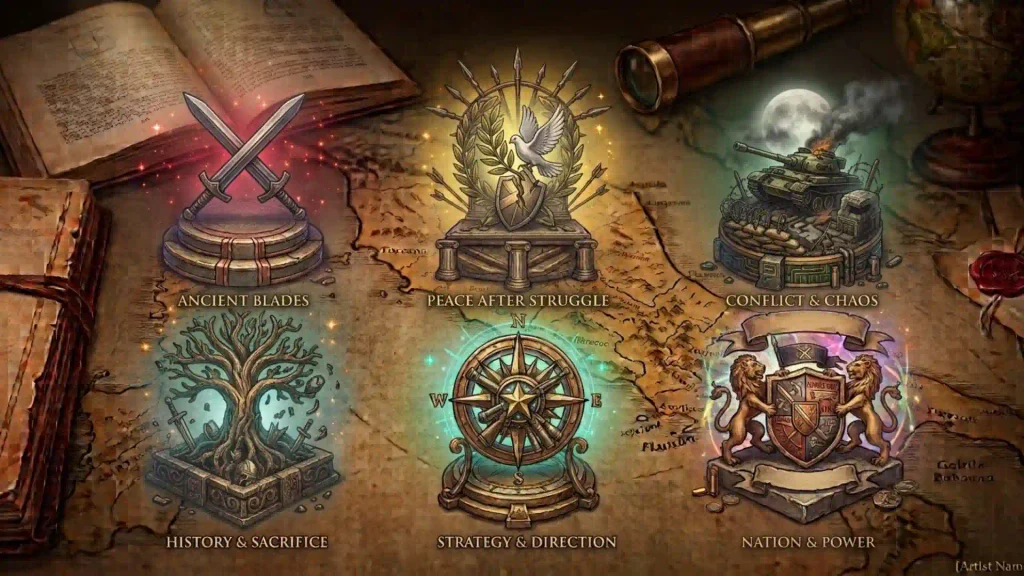
War symbolism changes over time. Ancient standards, medieval heraldry, modern military insignia, and contemporary protest graphics developed under different social and political conditions.
Understanding their origins prevents modern interpretations from being incorrectly applied to historical objects.
Ancient and Medieval War Symbols
Ancient armies used standards, shields, and distinctive emblems to identify leaders and military groups. These visual markers could help soldiers recognize their allies and communicate allegiance.
Medieval warfare placed particular importance on heraldry. Shields, banners, and coats of arms displayed recognizable combinations of colors, animals, shapes, and other designs.
Common historical motifs included:
- Lions: Used in various heraldic traditions and associated with different royal, regional, or noble identities.
- Eagles: Appearing in the emblems of several states, rulers, and military organizations.
- Swords: Associated with combat, authority, and martial status.
- Shields: Used literally for protection and symbolically in heraldry.
- Crossed weapons: Appearing in some military and ceremonial emblems.
These motifs don’t share one universal meaning. A lion in one coat of arms may have a different historical explanation from a lion in another.
Reliable interpretation starts with the specific object, region, and period.
The Tudor Rose and the Wars of the Roses
The Tudor rose is a historical emblem associated with the English Tudor dynasty. Its significance connects to the Wars of the Roses, a series of dynastic conflicts involving rival branches of the English royal family during the fifteenth century.
The House of Lancaster was traditionally associated with a red rose, while the House of York was associated with a white rose.
Henry Tudor’s victory over Richard III at the Battle of Bosworth Field in 1485 helped establish the Tudor dynasty. Henry VII subsequently married Elizabeth of York, connecting the two royal houses.
The Tudor rose combined red and white rose imagery and became associated with the union of Lancaster and York under Tudor rule.
Its historical significance includes:
- Dynastic identity and royal authority.
- The memory of conflict between rival royal houses.
- The political symbolism of reconciliation and union.
- The heritage of the English monarchy.
The Tudor rose is not simply a generic war symbol. It is a specific historical emblem whose meaning comes from English dynastic history.
World War Symbols and Military Remembrance
The two world wars shaped modern military imagery and remembrance traditions. National flags, military badges, service medals, war memorials, and commemorative poppies became important ways to record service and remember the dead.
Different countries developed distinct traditions. Some emphasize military service and national sacrifice, while others place greater emphasis on civilian suffering, peace, or the destruction caused by war.
War memorials may include soldiers, names of the dead, eternal flames, wreaths, or symbolic weapons. Each element can communicate a different aspect of remembrance.
For example, an engraved list of names gives individual recognition to those who died. A wreath may symbolize remembrance, while an empty chair or abandoned helmet can suggest absence and loss.
Historical context matters because the same memorial can carry personal, national, and political meanings simultaneously.
Cultural and Religious Contexts
A symbol may have different meanings across religious traditions, countries, and communities.
A sword can represent justice in one context and violence in another. A bird may symbolize peace, divine presence, freedom, or mourning, depending on the tradition.
Flags and military emblems can also become emotionally charged when they relate to occupation, independence, revolution, or national trauma.
When researching a symbol of war, ask four questions:
- Where did the symbol originate?
- Who used it, and during which period?
- What did it mean to the people who displayed it?
- How do affected communities interpret it today?
These questions help separate documented history from assumptions and modern reinterpretations.
Symbols of War, Mourning, and Humanitarian Crisis
War affects far more than the people carrying weapons. It can separate families, destroy homes, displace communities, and leave lasting grief.
Many symbols associated with war therefore focus on the people affected by conflict rather than military power.
Empty Boots, Helmets, and War Memorials
Empty boots and abandoned helmets can communicate absence, sacrifice, and remembrance.
Military memorials sometimes use equipment, uniforms, or other personal objects to make the human cost of war more visible. An empty pair of boots may represent a missing soldier, while an abandoned helmet may evoke death or the sudden interruption of ordinary life.
These are artistic and commemorative motifs rather than universally standardized symbols.
Their emotional impact comes from what they suggest: someone once occupied that space, but their presence is gone.
Black Ribbons, Mourning, and Grief
Black ribbons commonly communicate mourning, bereavement, or solidarity with people experiencing loss.
Their use extends beyond war. People may wear black ribbons after disasters, attacks, public tragedies, or the death of a respected person.
In wartime contexts, a black ribbon may honor civilians or military personnel who died during conflict. However, mourning traditions vary, and no single color carries the same meaning everywhere.
Other mourning imagery includes candles, wreaths, flowers, memorial walls, and photographs of the deceased.
These images help communities express grief when words alone feel inadequate.
Refugees, Evacuation, and Civilian Displacement
Images of refugees and displaced families communicate the human consequences of armed conflict.
A family carrying bags, a crowded evacuation route, or an abandoned home may represent forced migration and the loss of security. These images often appear in humanitarian reporting, educational material, and advocacy campaigns.
Related concepts include:
- Refugees: People who cross an international border because of persecution, conflict, violence, or other circumstances covered by refugee law.
- Internally displaced people: People forced to leave their homes who remain within their own country’s borders.
- Evacuation: The organized movement of people away from a dangerous area.
- Shelter: A place that provides temporary protection from danger or exposure.
- Humanitarian crisis: A situation in which people face serious threats to life, safety, health, or basic needs.
A child holding a parent’s hand may communicate vulnerability and family separation. A road filled with departing vehicles may illustrate mass displacement.
These are humanitarian images, not necessarily formal symbols. Their meaning comes from the circumstances they depict.
Red Cross, Red Crescent, and Humanitarian Protection
The Red Cross and Red Crescent emblems have a special status in armed conflict. They identify protected medical personnel, facilities, and transports under international humanitarian law when used according to the applicable rules.
The red cross emblem originated in 1864, when governments adopted it as a distinctive sign for medical services during armed conflict. The red crescent was later adopted and formally recognized alongside the red cross. The red crystal became an additional recognized emblem in 2005.
The International Committee of the Red Cross explains their history and use in its official guide, Use of Emblems.
The International Federation of Red Cross and Red Crescent Societies also explains that these emblems serve protective and organizational identification purposes. See its official overview of the emblems.
Their significance includes:
- Identifying protected medical services in armed conflict.
- Helping distinguish authorized humanitarian personnel and facilities.
- Identifying organizations belonging to the International Red Cross and Red Crescent Movement.
- Communicating a commitment to humanitarian assistance.
These emblems are not ordinary decorative graphics. Their use is governed by international humanitarian law and relevant national legislation.
As the ICRC explains, their central meaning is protection. Misuse can undermine the trust and recognition that help safeguard medical and humanitarian work.
War Symbols and Their Meanings at a Glance
The following table summarizes common war symbols and meanings. It distinguishes familiar associations from formal or historically specific uses.
| Symbol or image | Common meaning | Typical context | Important qualification |
| Sword | Combat, authority, honor | Heraldry, military art, monuments | Can also symbolize justice or protection |
| Gun or rifle | Armed force, defense, violence | Military illustrations, political art | Meaning depends on the message |
| Tank | Armored warfare, military power | Maps, news, history | May simply identify a vehicle |
| Military helmet | Protection, service, sacrifice | Memorials, military imagery | An abandoned helmet may suggest loss |
| Barbed wire | Confinement, separation, restriction | Conflict imagery, detention history | Also used for ordinary security |
| White flag | Surrender or request for a truce | Armed conflict | Does not automatically end a war |
| Dove | Peace, hope, reconciliation | Religious art, campaigns | Has additional cultural meanings |
| Peace sign | Nuclear disarmament, peace activism | Protests, artwork | Originated with the CND in 1958 |
| Raised fist | Solidarity, resistance, collective action | Political movements | Associations vary by movement |
| White poppy | Remembrance and peace | Anti-war remembrance campaigns | Not interpreted identically everywhere |
| Mushroom cloud | Nuclear destruction, catastrophic explosion | History, disarmament campaigns | Not every mushroom cloud is nuclear |
| Radiation trefoil | Ionizing-radiation hazard | Safety signs and facilities | Does not specifically mean nuclear war |
| Military medal | Service, valor, achievement | Awards and memorials | Exact meaning depends on the award |
| Broken chains | Liberation and freedom | Political art, human-rights campaigns | A broad freedom motif |
| Red Cross or Red Crescent | Humanitarian protection | Medical services and authorized organizations | Use is governed by law |
This comparison provides a starting point, not a universal dictionary. The meaning of a symbol becomes clearer when you identify its origin, purpose, and surrounding imagery.
How to Interpret War Symbols Correctly
A recognizable image doesn’t always tell the whole story. Before assigning a meaning, examine the symbol’s historical background and how people use it.
Identify the Historical Period and Country
Start by identifying when and where the symbol appeared.
A medieval coat of arms, a twentieth-century military badge, and a modern protest sign belong to different historical settings. Their visual elements may overlap, but their origins and purposes can differ substantially.
For military insignia, identify the country, branch, unit, and approximate date whenever possible.
Separate Official Symbols from Generic Images
Not every military-themed graphic has an official meaning.
A star may be a rank insignia, a decorative feature, or a national emblem. A crosshair may represent a targeting system, while a rifle silhouette may simply identify military personnel in an infographic.
Before calling an image an official symbol, check whether a government, military organization, humanitarian body, or established movement recognizes it as such.
This distinction prevents inaccurate explanations and unsupported claims.
Consider the Surrounding Message
Colors, captions, and nearby objects can change how an image is understood.
A white flag displayed by soldiers may indicate surrender. The same flag in another context might function as part of a larger political or artistic message.
A dove above a battlefield can suggest hope for peace, while a dove beside a memorial may emphasize remembrance.
Look at the whole composition rather than interpreting one object in isolation.
Avoid Universal Claims About Symbolism
Some symbols have widely recognized meanings, but few images communicate exactly the same idea in every culture.
Political movements may adopt historical symbols and give them new meanings. Communities affected by a conflict may interpret an emblem differently from people viewing it from a distance.
For reliable research, consult historical records, official military publications, museums, recognized humanitarian organizations, and reputable academic sources.
When the meaning remains disputed, explain the different interpretations rather than presenting one as universally accepted.
Frequently Asked Questions About War Symbols
What Is the Most Recognizable Symbol of War?
There is no single official symbol that represents every war. Swords, guns, military helmets, tanks, and crossed weapons commonly appear in war-related imagery. However, each has different associations, and some are simply depictions of military equipment rather than established symbols.
What Does a White Flag Mean in War?
A white flag commonly signals surrender or a request to communicate or arrange a truce. Its meaning depends on the circumstances. It does not automatically establish a peace agreement or bring an entire conflict to an end.
What Is the Difference Between War Symbols and Military Symbols?
War symbols communicate ideas about conflict, destruction, victory, sacrifice, resistance, or peace. Military symbols often identify armed forces, ranks, units, equipment, or military activities. Some symbols belong to both categories.
What Symbols Represent Peace After War?
The dove, olive branch, and modern peace sign are widely recognized peace symbols. White poppies and broken weapons can also communicate remembrance, disarmament, or opposition to future conflict. Their exact meanings depend on the traditions and movements using them.
What Does a Raised Fist Symbolize in Wartime Protests?
A raised fist often represents solidarity, resistance, and collective action. In wartime protests, it may express opposition to occupation, government policy, or military violence. Its precise political meaning depends on the movement and historical context.
What Symbols Represent Nuclear War?
Mushroom-cloud imagery commonly represents nuclear explosions and their destructive consequences. The radiation trefoil, by contrast, warns of ionizing-radiation hazards and does not specifically indicate a nuclear weapon. The peace sign also has a historical connection to nuclear disarmament.
What Do Swords and Crossed Weapons Symbolize?
Swords commonly represent combat, authority, honor, justice, or protection. Crossed weapons often suggest military readiness or a martial tradition. Their meanings depend on the emblem, organization, and historical period in which they appear.
Are War Symbols the Same Across Cultures?
No. Some symbols have widely recognized meanings, but cultural and historical context can change their interpretation. A flag, animal, weapon, or color may represent different ideas in different countries or political movements. Researching the specific origin helps avoid misunderstandings.
Conclusion
War symbols communicate much more than the presence of weapons or soldiers. They can represent military identity, courage, destruction, surrender, resistance, mourning, and the hope for peace.
A sword may symbolize combat or honor, while a white flag communicates surrender or a request for a truce. The dove and peace sign offer different expressions of reconciliation and opposition to violence. Meanwhile, official military insignia and humanitarian emblems carry specific meanings that require careful interpretation.
The most reliable way to understand any symbol of war is to examine its history, purpose, and cultural context. When you look beyond the image itself, you gain a clearer understanding of the conflict, values, and human experiences it represents.

Clara Miles
Hello! I’m Clara, a lifelong dreamer who finds magic in everyday moments. Writing has always been my way of exploring the world and understanding the people around me. I love creating stories that make readers laugh, cry, and reflect on life’s little surprises. When I’m not writing, you can usually find me sipping coffee at a cozy café or wandering through nature with a notebook in hand. My journey as an author is fueled by curiosity, imagination, and a love for connecting with my readers. Every story I write is a piece of my heart, and I hope it inspires yours too.
Books:
-
Whispers of the Heart
-
Shadows and Sunlight