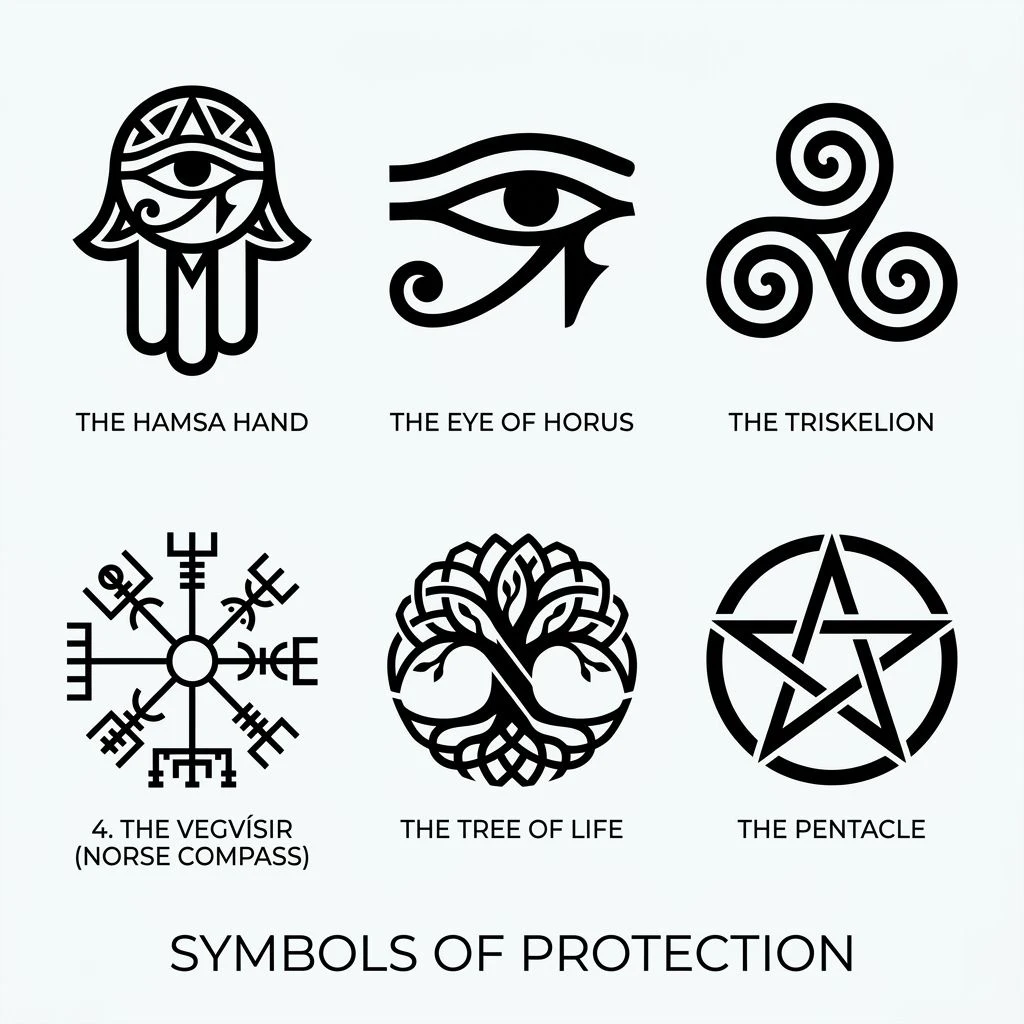
Symbols of protection have appeared in human cultures for thousands of years. People have used eyes, hands, animals, sacred signs, amulets, religious objects, and protective markings to express safety, ward off danger, or seek spiritual care.
Today, symbols of protection can be found on jewelry, tattoos, clothing, artwork, buildings, household objects, and personal belongings. Some are connected with protection from the evil eye, while others represent faith, healing, strength, courage, family, or spiritual security.
Some of the best-known examples include the Hamsa, Nazar or Evil Eye, Eye of Horus, Ankh, Christian cross, Mjölnir, pentacle, protective knots, shields, and guardian animals.
But these symbols do not all mean the same thing. A Hamsa comes from cultural traditions associated with the Middle East and North Africa, while the Eye of Horus belongs to ancient Egyptian religious symbolism. A cross has a different meaning again because it is deeply connected with Christianity.
It is also important to distinguish traditional belief from modern fact. Saying that an ancient community believed an amulet protected its wearer is different from claiming that the object has scientifically proven supernatural powers.
This guide explores the most important symbols of protection, their meanings, cultural backgrounds, modern uses, tattoo ideas, home symbolism, and the differences between symbols, amulets, and talismans.
What Are Symbols of Protection?
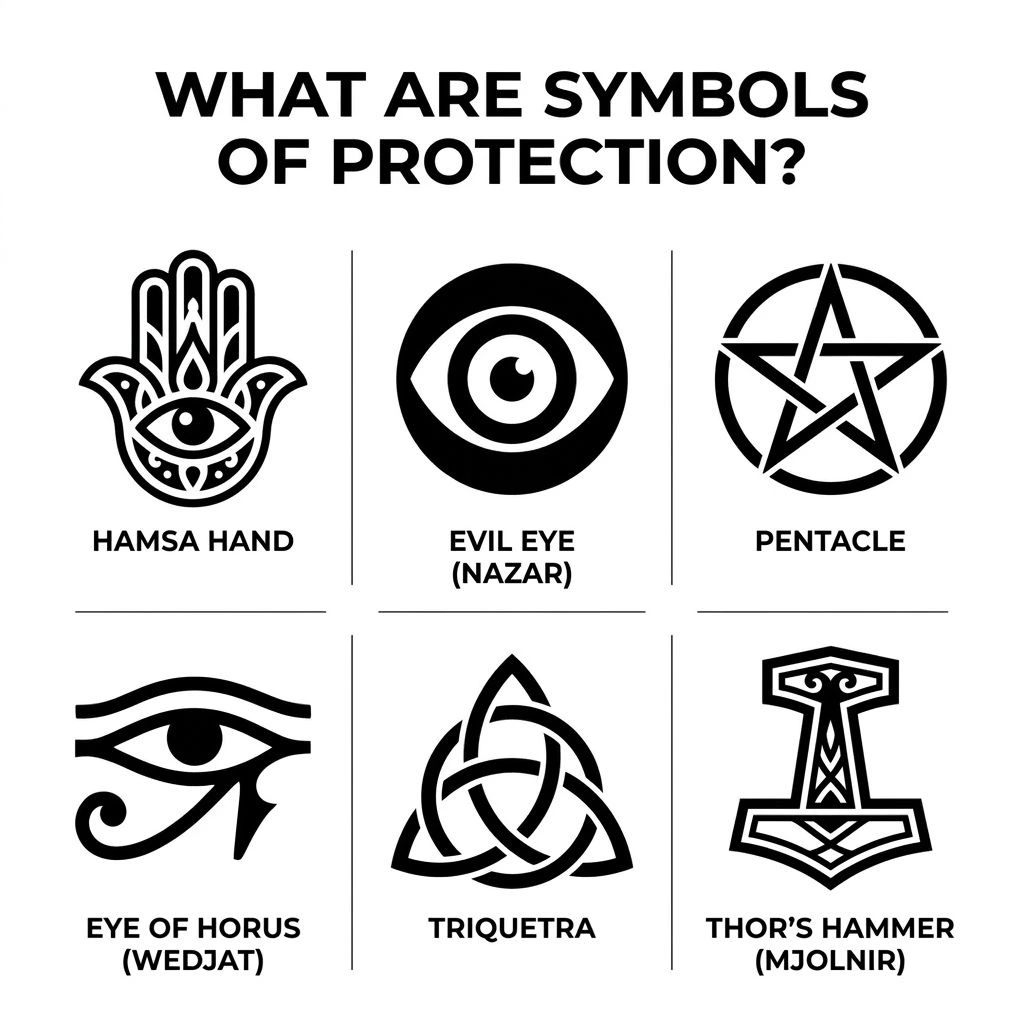
A protection symbol is an image, sign, object, or design traditionally associated with safety, defense, spiritual care, or protection from harm.
Protection can mean different things depending on the culture.
For one person, protection may mean guarding against the evil eye. For another, it may mean divine protection, healing, courage, family safety, or protection during a difficult period.
Historically, protective objects were not always decorative. Ancient Egyptian evidence, for example, includes amulets and inscriptions intended to provide protection and support. The Metropolitan Museum of Art describes ancient Egyptian scarabs carrying signs with positive and protective meanings, including symbols for life and protection.
Protective symbolism can therefore involve:
- Physical safety
- Spiritual protection
- Protection from envy
- Healing and restoration
- Family protection
- Protection of the home
- Courage and strength
- Divine care
- Good fortune
- Protection during important life transitions
Not every symbol has a protective meaning in every culture. Context is essential.
Quick Answer: What Are the Most Common Symbols of Protection?
Some of the most recognizable symbols associated with protection are the Hamsa, Nazar or Evil Eye, Eye of Horus, Ankh, Christian cross, Mjölnir, pentacle, protective knotwork, shield, and guardian animals.
Here is a quick comparison:
| Symbol | Common association | Main context |
| Hamsa | Protection from the evil eye, blessings | Middle Eastern and North African traditions |
| Nazar | Protection from the evil eye | Mediterranean and Middle Eastern traditions |
| Eye of Horus | Protection, healing, regeneration | Ancient Egypt |
| Ankh | Life and continuity | Ancient Egypt |
| Cross | Faith, salvation, divine care | Christianity |
| Mjölnir | Strength and protection | Norse mythology and modern Heathen use |
| Pentacle | Spiritual protection and balance | Various modern esoteric traditions |
| Protective knot | Continuity and connection | Various cultural and artistic traditions |
| Shield | Defense and safety | Broad symbolic use |
| Lion | Courage and guardianship | Many cultural traditions |
| Dragon | Power, guardianship, protection | Varies greatly by culture |
These meanings should be treated as traditional or contextual associations, not universal definitions.
Hamsa: A Major Symbol of Protection
The Hamsa, also called the Khamsa or Hand of Fatima in some contexts, is one of the best-known protective symbols.
It is usually represented as an open hand, sometimes with an eye placed in the center.
The symbol has a long history in the Middle East and North Africa. The British Museum describes hand-shaped amulets from the region as protective objects associated with the “eye of envy,” noting that examples may have been used by Muslim or Jewish communities.
The Hamsa is therefore much more than a modern decorative design.
What Does the Hamsa Mean?
Depending on the cultural and religious context, the Hamsa may be associated with:
- Protection
- Warding off the evil eye
- Blessings
- Good fortune
- Safety
- Family well-being
- Spiritual care
Its meaning can vary between communities, so it is better to describe the Hamsa as a multi-tradition protective symbol rather than assigning it one universal religious definition.
Why Is the Hamsa Associated With Protection?
The open hand itself can be understood as a visual gesture of stopping, guarding, or preventing harm.
In North African examples documented by the British Museum, the Khamsa was specifically connected with protection against the evil eye and bad luck.
Today, Hamsa imagery appears on:
- Necklaces
- Bracelets
- Rings
- Wall decorations
- Clothing
- Artwork
- Tattoos
- Household objects
Evil Eye and Nazar: Protection From Harmful Envy
The evil eye is a belief found in many cultures. It generally involves the idea that a harmful or envious gaze can bring misfortune or harm.
The Nazar is one of the best-known protective forms associated with this tradition, especially in parts of the Mediterranean and Middle East.
It is often represented as a circular blue-and-white eye.
What Does the Evil Eye Symbol Mean?
As a protective symbol, the eye may represent:
- Protection from envy
- Watchfulness
- Awareness
- Safety
- Defense against harmful intentions
- Spiritual guarding
The important distinction is that the evil eye is a belief and cultural tradition, while the Nazar is a physical protective object or design associated with that belief.
Hamsa vs. Evil Eye
These two are closely related in some traditions but are not the same symbol.
The Hamsa is a hand-shaped design.
The Nazar is typically an eye-shaped amulet.
Both can be associated with protection from the evil eye, but their visual forms and cultural histories differ.
Eye of Horus: Ancient Egyptian Protection Symbol
The Eye of Horus, also called the Wedjat, is one of the clearest examples of an ancient symbol with documented protective use.
The Metropolitan Museum of Art describes the Wedjat as the healed eye of Horus and explains that amulets in this form were believed to protect their wearers and transfer regenerative power to them.
The symbol therefore has connections with:
- Protection
- Healing
- Restoration
- Rebirth
- Regeneration
- Wholeness
Ancient Egyptian sources also show that protective amulets were used for both the living and the dead.
Why Is the Eye of Horus Protective?
The mythology surrounding Horus’s injured and restored eye helps explain its protective and healing associations.
The restoration of the eye became connected with ideas of becoming whole again.
This makes the Eye of Horus different from the Nazar even though both use an eye-like design.
Eye of Horus vs. Evil Eye
The two should not be confused.
| Symbol | Historical context | Common association |
| Eye of Horus | Ancient Egypt | Healing, restoration, protection |
| Nazar/Evil Eye | Mediterranean and Middle Eastern traditions | Protection from harmful envy |
| Hamsa | Middle Eastern and North African traditions | Protection and warding off the evil eye |
The similarity in appearance does not mean that they come from the same tradition.
Ankh: Life, Continuity, and Protection
The Ankh is one of the most recognizable symbols from ancient Egypt.
Its shape resembles a cross with a loop at the top, and its hieroglyphic meaning is associated with life.
The Metropolitan Museum identifies the ankh as the Egyptian hieroglyph for “life.”
Because life, health, divine power, and protection were closely connected in ancient Egyptian religious culture, the ankh can appear alongside protective symbolism.
However, it is more accurate to call the Ankh primarily a symbol of life rather than simply a “protection symbol.”
What Does the Ankh Represent?
The Ankh can symbolize:
- Life
- Vitality
- Continuity
- Existence
- Divine life
- Renewal
Ancient Egyptian objects also combine the ankh with other symbols such as the djed and was to express ideas including life, stability, and dominion.
Christian Cross: Faith and Divine Protection
The Christian cross is one of the most important symbols in Christianity.
Its central meaning is connected with the crucifixion and resurrection of Jesus Christ.
For many Christians, wearing or displaying a cross may also express:
- Faith
- Hope
- Salvation
- Divine care
- Trust in God
- Spiritual protection
The protective interpretation should be understood within Christian belief rather than treating the cross as a generic magical charm.
A cross necklace, wall cross, crucifix, or other Christian symbol may therefore function as a visible expression of faith and trust.
Mjölnir: Thor’s Hammer and Protection
Mjölnir is the hammer of Thor, not Odin.
It is relevant to protection symbolism because Thor is strongly associated with strength and defending the divine and human worlds within Norse mythology.
Hammer-shaped pendants are also part of the archaeological record of Viking-Age Scandinavia.
Today, Mjölnir can be used by people interested in:
- Norse mythology
- Thor
- Strength
- Defense
- Modern Heathen religion
- Scandinavian history
The symbol’s modern meaning can vary considerably depending on who is using it and why.
Why Is Mjölnir Associated With Protection?
Thor’s hammer is a weapon and a divine object. In mythology, it is closely associated with Thor’s role as a defender.
For that reason, modern readers often interpret Mjölnir through ideas of:
- Strength
- Courage
- Defense
- Safety
- Protection
It should still be described as a Thor symbol, not an Odin symbol.
Pentagram and Pentacle: Spiritual Protection
The pentagram is a five-pointed star.
A pentacle commonly refers to a pentagram enclosed by a circle.
These symbols have appeared in different historical and cultural settings, so their meanings are not universal.
In some modern esoteric and Neopagan traditions, the pentagram or pentacle may be associated with:
- Protection
- Balance
- Spiritual practice
- The elements
- Harmony
- Personal boundaries
The orientation and context of the symbol can also affect how it is interpreted.
Therefore, it is better to explain the pentacle as a symbol with multiple historical and modern meanings rather than claiming that it has always represented protection.
Triquetra and Protective Knotwork
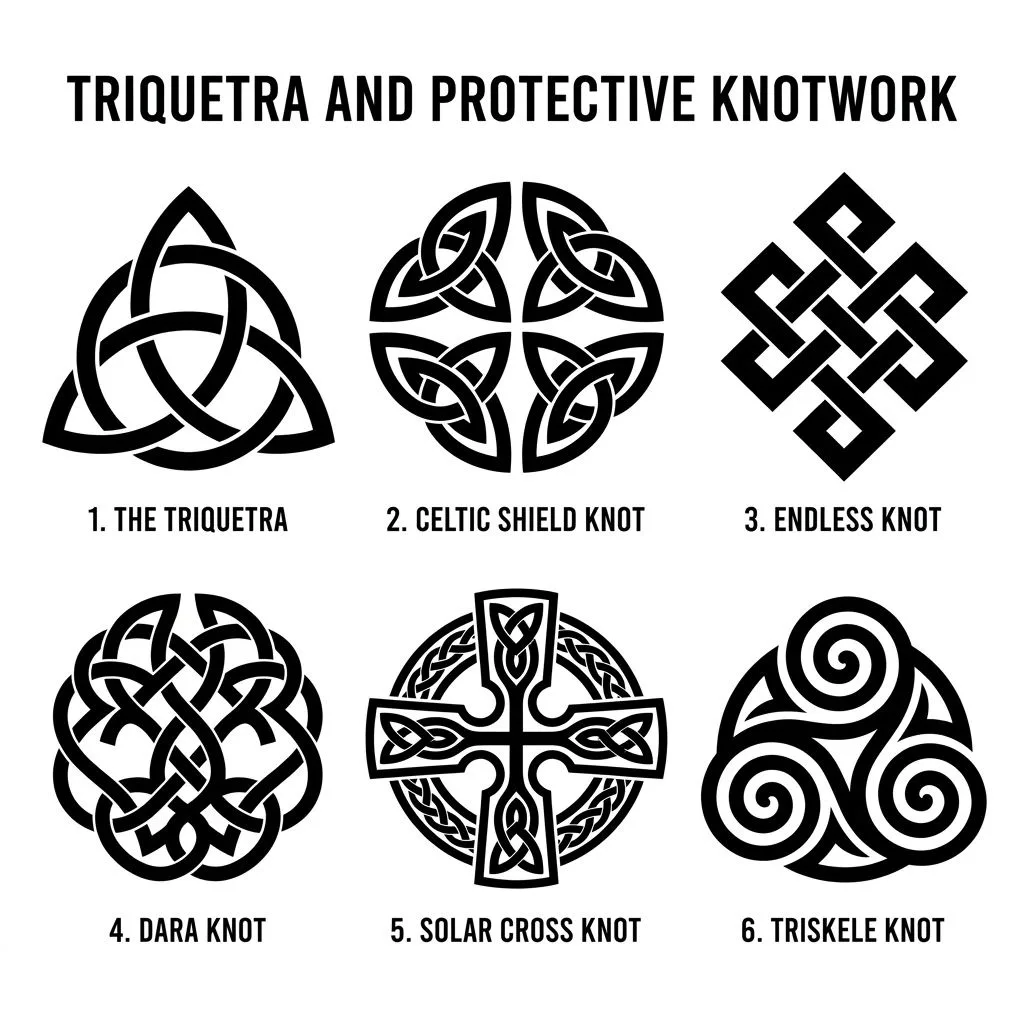
The triquetra is a three-part interwoven design made from continuous lines.
It has appeared in European decorative and religious contexts and is strongly associated with Celtic-inspired modern imagery.
Today, people may interpret the continuous form as representing:
- Unity
- Continuity
- Eternity
- Interconnection
- Spiritual wholeness
Some modern uses also connect it with protection.
However, readers should be careful with claims that every Celtic knot had one exact ancient magical meaning.
Many meanings attached to knotwork today are modern interpretations rather than securely documented explanations for every individual design.
Shield: A Simple Symbol of Protection
The shield is one of the clearest non-religious symbols of protection.
Unlike many esoteric symbols, its meaning is easy to understand visually.
A shield can represent:
- Defense
- Safety
- Security
- Courage
- Boundaries
- Protection of family or community
Because shields were historically used for physical defense, their symbolic connection with protection is straightforward.
Modern logos often use shields to communicate security, trust, defense, or reliability.
A shield can therefore be useful for someone searching for a symbol of protection without a specific religious meaning.
Guardian Animals as Symbols of Protection
Animals have long been used in art and storytelling to express strength, guardianship, and defense.
Their meanings vary widely between cultures.
Lion
The lion commonly represents:
- Courage
- Strength
- Authority
- Leadership
- Guardianship
Lion figures have also been used as architectural guardians.
Dragon
The meaning of the dragon changes dramatically depending on culture.
In some East Asian traditions, dragons may be associated with power, water, prosperity, and beneficial protection.
European dragon traditions can present the creature very differently.
For this reason, it is not accurate to say that every dragon universally symbolizes protection.
Wolf
The wolf can symbolize:
- Loyalty
- Family
- Strength
- Instinct
- Guardianship
- Wildness
Its meaning also depends on the cultural or mythological context.
Bear
The bear can represent:
- Strength
- Courage
- Protection
- Family
- Resilience
A bear image can therefore work as a modern metaphor for a protective parent or guardian.
Ancient Egyptian Symbols of Protection
Ancient Egypt provides some of the clearest archaeological evidence for protective symbolism.
The Eye of Horus, protective hieroglyphs, scarabs, amulets, and other objects were used in contexts involving protection and well-being.
The Metropolitan Museum notes that ancient Egyptian scarabs could carry hieroglyphs selected for positive and protective meanings, including signs for life and protection.
The British Museum likewise explains that ancient Egyptians used symbols and amulets believed to provide protection, power, and good luck.
The Sa Sign
The ancient Egyptian sa sign is associated with protection.
The Metropolitan Museum’s educational material identifies the sa sign as meaning “protection” and describes it as a rolled-up shelter-like form.
This is particularly useful because it demonstrates that ancient Egyptian protective symbolism was much broader than the Eye of Horus alone.
Tyet or Knot of Isis
The Tyet, sometimes called the Knot of Isis, is another Egyptian symbol associated with protection.
The Metropolitan Museum’s educational resources identify it as a protective symbol.
This is an example of why researching individual symbols matters: not every protective design is as famous as the Ankh or Eye of Horus.
Protection Symbols for the Home
Protective symbolism is often associated with entrances, walls, windows, and other boundaries.
A doorway naturally represents a boundary between inside and outside, making it a logical place for protective imagery.
People may display:
- Hamsa decorations
- Nazar charms
- Crosses
- Religious artwork
- Guardian animals
- Shields
- Cultural protective designs
- Sacred inscriptions
Historically, protective objects were also worn or placed in particular locations. Ancient Egyptian evidence includes amuletic papyri intended to keep people safe and well, sometimes enclosed and worn around the neck.
What Is a Good Protection Symbol for a Door?
The answer depends on the tradition.
A person interested in Middle Eastern or North African traditions may choose a Hamsa or related protective design.
A Christian household may choose a cross or religious inscription.
Someone looking for a non-religious visual metaphor might choose a shield, guardian lion, or other protective image.
The important point is that the meaning should come from the tradition or intention behind the symbol, not simply from a generic internet list.
Protection Symbols for Tattoos
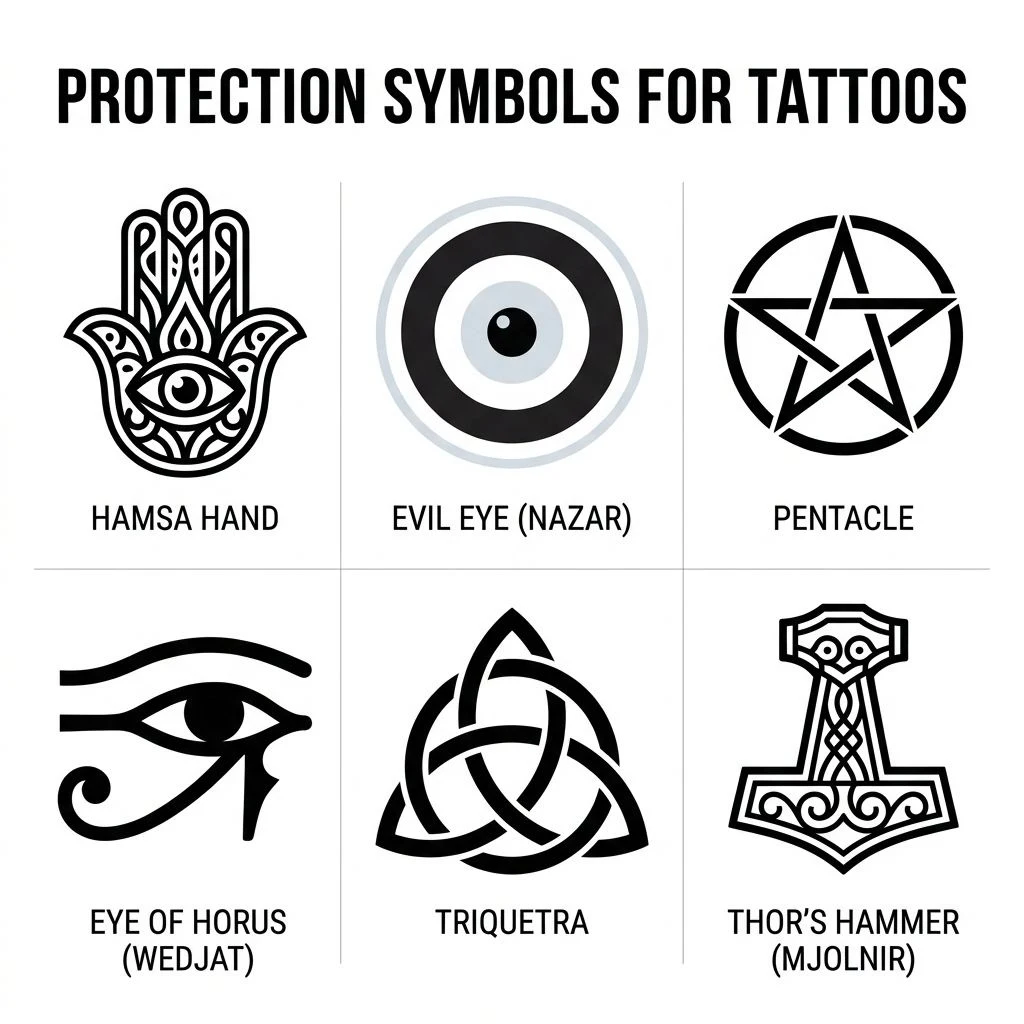
Protection symbols are popular tattoo choices because they can express personal identity, faith, resilience, family, or a desire to remember a particular cultural tradition.
Hamsa Tattoo
A Hamsa tattoo may represent:
- Protection
- Blessings
- Safety
- Protection from the evil eye
Because the Hamsa has cultural and religious significance across multiple communities, learning its history before getting it tattooed is worthwhile.
Evil Eye Tattoo
An Evil Eye or Nazar-inspired tattoo can represent:
- Protection from envy
- Awareness
- Watchfulness
- Spiritual defense
The design can be simple or highly decorative.
Eye of Horus Tattoo
The Eye of Horus is particularly suitable for someone interested in:
- Ancient Egyptian culture
- Protection
- Healing
- Restoration
- Rebirth
Its protective meaning is supported by historical evidence for Wedjat amulets.
Cross Tattoo
A cross tattoo can express:
- Christian faith
- Salvation
- Hope
- Devotion
- Trust in God
Its meaning should be understood through Christianity rather than treating it as merely a general protective charm.
Mjölnir Tattoo
A Mjölnir tattoo can represent:
- Thor
- Norse mythology
- Strength
- Defense
- Modern Heathen identity
Remember that Mjölnir is specifically Thor’s hammer.
Shield Tattoo
A shield tattoo is a straightforward option for someone who wants a non-religious symbol of defense and protection.
It can also be personalized with family symbols, initials, animals, or other imagery.
Protection Symbols by Meaning
Different people want protection for different reasons.
| Desired meaning | Symbols to explore |
| Protection from the evil eye | Hamsa, Nazar |
| Healing and restoration | Eye of Horus |
| Life and continuity | Ankh |
| Christian spiritual protection | Cross |
| Strength and defense | Mjölnir, shield |
| Courage | Lion, bear |
| Family protection | Guardian animals |
| Spiritual balance | Pentacle, depending on tradition |
| Stability | Djed or anchor |
| Watchfulness | Eye imagery |
| Protection of boundaries | Shield, guardian figure |
| Ancient Egyptian protection | Eye of Horus, sa, Tyet |
This kind of purpose-based approach is more useful than simply ranking symbols from “strongest” to “weakest.”
Protection vs. Good Luck, Healing, and Strength
Protection is not exactly the same as good luck or healing.
| Concept | Basic meaning |
| Protection | Guarding against harm |
| Good luck | Favorable fortune or outcomes |
| Healing | Restoration of health or wholeness |
| Strength | Ability to withstand difficulty |
| Guidance | Direction or wisdom |
| Blessing | Favor, grace, or spiritual goodwill |
| Stability | Remaining secure and grounded |
One symbol can have several of these associations.
For example, the ancient Egyptian Wedjat was connected with healing, regeneration, and protection, rather than fitting into only one category.
Likewise, the Hamsa may be connected with both protection and good fortune in different contexts.
Symbol, Amulet, and Talisman: What’s the Difference?
These words are often used interchangeably, but there are useful distinctions.
Symbol
A symbol is an image, sign, or design that communicates an idea.
For example, a shield can symbolize protection even when it is not being used as a physical object.
Amulet
An amulet is generally an object carried or worn because of its protective or beneficial associations.
Ancient Egypt provides many examples of protective amulets, including Wedjat eyes and scarabs.
Talisman
A talisman generally refers to an object believed to carry a particular beneficial, protective, or magical quality.
The terminology varies between academic, historical, religious, and everyday usage.
The key difference is that a symbol communicates meaning, while an amulet or talisman is often treated as an object with a particular protective or beneficial function.
Do Protection Symbols Really Protect You?
This question requires a distinction between belief and evidence.
Many cultures historically believed that particular amulets, symbols, prayers, or objects could protect people from danger, illness, evil, or misfortune.
For example, the Metropolitan Museum explains that ancient Egyptian Wedjat amulets were believed to protect their wearers and transfer regenerative power.
That tells us what people historically believed and practiced.
It does not establish that a symbol has scientifically demonstrated supernatural protective powers.
Today, someone may wear a protection symbol because it:
- Expresses religious faith
- Connects them with family or culture
- Provides personal comfort
- Represents resilience
- Serves as a reminder of a personal value
- Has artistic or historical significance
The meaning can therefore be important even when a supernatural claim cannot be scientifically established.
Protection Symbols by Culture
Protection symbolism becomes easier to understand when grouped by cultural context.
Ancient Egyptian Protection Symbols
Important examples include:
- Eye of Horus
- Sa
- Tyet
- Scarab amulets
- Ankh in life-related contexts
- Protective inscriptions
Ancient Egyptian evidence shows that amulets were used in both everyday life and funerary contexts.
Middle Eastern and North African Protection Symbols
Examples include:
- Hamsa
- Khamsa
- Hand of Fatima
- Nazar and evil-eye traditions
The British Museum documents the use of Khamsa hand amulets against the “eye of envy” in Middle Eastern and North African contexts.
Christian Protection Symbols
Examples can include:
- Cross
- Crucifix
- Saints and devotional imagery
- Religious inscriptions
These symbols should be interpreted within Christian beliefs about faith, salvation, divine care, and devotion.
Norse Protection Symbols
Norse mythology contains many objects and figures associated with strength and defense.
Mjölnir, Thor’s hammer, is particularly recognizable.
It is better described as a Norse religious symbol associated with Thor than as a generic protection charm.
Modern Esoteric Protection Symbols
Some modern spiritual and esoteric traditions use:
- Pentacles
- Protective circles
- Sigils
- Geometric designs
- Symbolic knots
Their meanings can differ significantly between traditions.
Non-Religious Symbols of Protection
Not everyone looking for symbols of protection wants a religious or spiritual design.
Some images communicate protection through ordinary visual language.
Shield
A shield represents defense and safety.
Lock
A lock can represent security, privacy, and keeping something safe.
Fortress
A fortress can symbolize strong boundaries and defense against external threats.
Guardian Animal
A lion, bear, dog, eagle, or other animal can symbolize watchfulness and protection depending on context.
Helmet
A helmet can represent physical defense, preparedness, and safety.
These are symbolic metaphors for protection, rather than necessarily traditional spiritual protection symbols.
How to Choose a Symbol of Protection
The best symbol depends on the meaning you want it to communicate.
If You Want Protection From the Evil Eye
Explore the Hamsa or Nazar and learn about the traditions connected with them.
If You Want Healing and Restoration
The Eye of Horus is especially relevant because ancient Wedjat amulets were associated with healing, regeneration, and protection.
If You Want a Religious Symbol
Choose a symbol that belongs to a religious tradition you follow or meaningfully identify with.
If You Want Strength and Defense
A shield, lion, bear, or Mjölnir may communicate these ideas more directly.
If You Want Family Protection
Consider a guardian animal or a symbol connected with your family’s cultural or religious tradition.
If You Want a Tattoo
Research both the historical meaning and modern associations before permanently choosing the design.
If You Want a Home Symbol
Consider whether you want religious symbolism, cultural symbolism, or a simple visual representation of security.
Cultural Respect When Using Protection Symbols
Protection symbols can belong to living cultures and religions, so context matters.
Before using a symbol, especially as a tattoo, ask:
- Where did it originate?
- Which cultures use it?
- Is it associated with a living religion?
- What did it traditionally mean?
- Does the modern interpretation differ?
- Am I presenting a cultural symbol accurately?
- Does the symbol have additional modern associations?
The Hamsa is a good example of why this matters. Museum sources document its use in Middle Eastern and North African communities and its association with protection from the evil eye.
Similarly, ancient Egyptian protective symbols should be understood within ancient Egyptian religious culture rather than being reduced to modern “magic symbols.”
Respectful use begins with accurate understanding.
Common Mistakes About Protection Symbols
Calling Every Eye Symbol an Evil Eye
The Eye of Horus and Nazar are not the same tradition.
Calling the Ankh a Protection Symbol Only
The Ankh primarily represents life. It can appear in protective contexts, but reducing its meaning to protection loses important Egyptian symbolism.
Saying One Symbol Is Universally the Strongest
There is no objective universal ranking of protective symbols.
Different traditions value different symbols.
Treating Modern Interpretations as Ancient Facts
A modern spiritual interpretation does not automatically prove that ancient people held the same belief.
Calling Every Celtic Knot a Magic Protection Symbol
Knotwork has many historical and artistic uses. Specific meanings should not be invented without evidence.
Confusing Mjölnir With Odin
Mjölnir belongs to Thor.
Treating Religious Symbols as Generic Decorations
A cross, Hamsa, or other sacred symbol can have meanings that go far beyond decoration.
Claiming Supernatural Effects as Scientific Facts
It is more accurate to describe what a tradition believes than to claim that a symbol has scientifically proven supernatural powers.
Frequently Asked Questions
What is the strongest symbol of protection?
There is no universally recognized “strongest” protection symbol. The meaning depends on the culture, religion, and purpose involved. The Hamsa, Nazar, Eye of Horus, cross, shield, and other symbols all have different protective associations.
What symbol represents protection from evil?
The Hamsa and Nazar are strongly associated with protection from the evil eye in Middle Eastern, North African, and related traditions. Religious symbols may also represent protection from evil within particular faith traditions.
What is the ancient Egyptian symbol of protection?
The Eye of Horus or Wedjat is one of the best-known ancient Egyptian protective symbols. Ancient Egyptian sources also include the sa sign and protective amulets.
What symbol protects against the evil eye?
The Hamsa and Nazar are among the best-known symbols associated with protection against the evil eye. Historical museum collections document hand-shaped amulets used for this purpose.
What symbol represents protection and strength?
A shield is a straightforward symbol of defense and protection. Mjölnir, lions, bears, and other guardian imagery can also represent strength and protection depending on cultural context.
What is a good protection symbol for a tattoo?
Common choices include the Hamsa, Nazar, Eye of Horus, cross, Mjölnir, shield, and guardian animals. The best choice depends on the meaning and cultural tradition you want the tattoo to communicate.
What symbol is good for home protection?
A Hamsa, Nazar, cross, religious inscription, guardian animal, or shield can be used as a symbolic representation of protection. The appropriate choice depends on your cultural, religious, or personal context.
What is the difference between Hamsa and Evil Eye?
The Hamsa is a hand-shaped symbol, while the Evil Eye refers to a belief about harmful or envious gazes. The Nazar is a well-known eye-shaped protective amulet associated with that belief.
Is the Eye of Horus the same as the Evil Eye?
No. The Eye of Horus is an ancient Egyptian symbol associated with the god Horus, healing, regeneration, and protection. The evil-eye tradition is much broader and occurs across multiple cultures.
Is the Ankh a symbol of protection?
The Ankh is primarily an ancient Egyptian symbol of life. It can appear in protective contexts, but calling it only a protection symbol gives an incomplete picture of its meaning.
Is Mjölnir a protection symbol?
Mjölnir is primarily Thor’s hammer in Norse mythology. Because Thor is associated with defense and strength, modern users may interpret the hammer as a symbol of protection as well.
What animal represents protection?
There is no single universal protective animal. Lions, bears, wolves, dogs, eagles, and other animals can symbolize guardianship or strength in different cultures and personal interpretations.
Are protection symbols religious?
Some are religious, some are cultural, and others are secular or purely symbolic. A cross is strongly religious, while a shield can communicate protection without a religious meaning.
Do protection symbols actually work?
Many cultures have historically believed that particular symbols and amulets provide protection. However, those traditional beliefs should not be confused with scientifically established evidence that a symbol has supernatural protective powers.
Conclusion
Symbols of protection come from many different cultures, religions, historical periods, and personal traditions. They can represent safety, defense, healing, faith, strength, family, good fortune, or protection from harmful influences.
The Hamsa and Nazar are especially associated with protection from the evil eye, while the Eye of Horus has well-documented ancient Egyptian associations with healing, regeneration, and protection.
The Ankh represents life, the Christian cross expresses faith and salvation, and Mjölnir connects strength and defense with Thor in Norse mythology. Shields and guardian animals offer broader, non-religious ways to express protection.
The most important thing is to avoid treating every symbol as having one universal meaning. A symbol’s significance depends on its history, culture, religion, context, and intended use.
If you are choosing a protection symbol for a tattoo, necklace, home, artwork, or personal reminder, research its origins before making your choice. Understanding the difference between a symbol, an amulet, and a talisman can also help you understand how protective objects have been used throughout history.
Most importantly, distinguish traditional belief from proven fact. A symbol can carry deep cultural, religious, emotional, or personal meaning without requiring an unsupported claim about supernatural power.

Elliot Kensington
Elliot Kensington is a storyteller at heart, always fascinated by the hidden corners of human imagination. From a young age, he found comfort in books and the worlds they created, inspiring him to craft tales that blend emotion, suspense, and wonder. His writing journey began with short stories that captured fleeting moments of life, and over time, evolved into novels that explore both the extraordinary and the everyday. Elliot believes that every story holds a piece of the soul, and his mission is to connect readers to those moments that linger long after the last page. When he’s not writing, he enjoys exploring nature, capturing moments through photography, and seeking inspiration in the little things.
Books by Elliot Kensington:
-
Shadows of Tomorrow
-
The Whispering Path