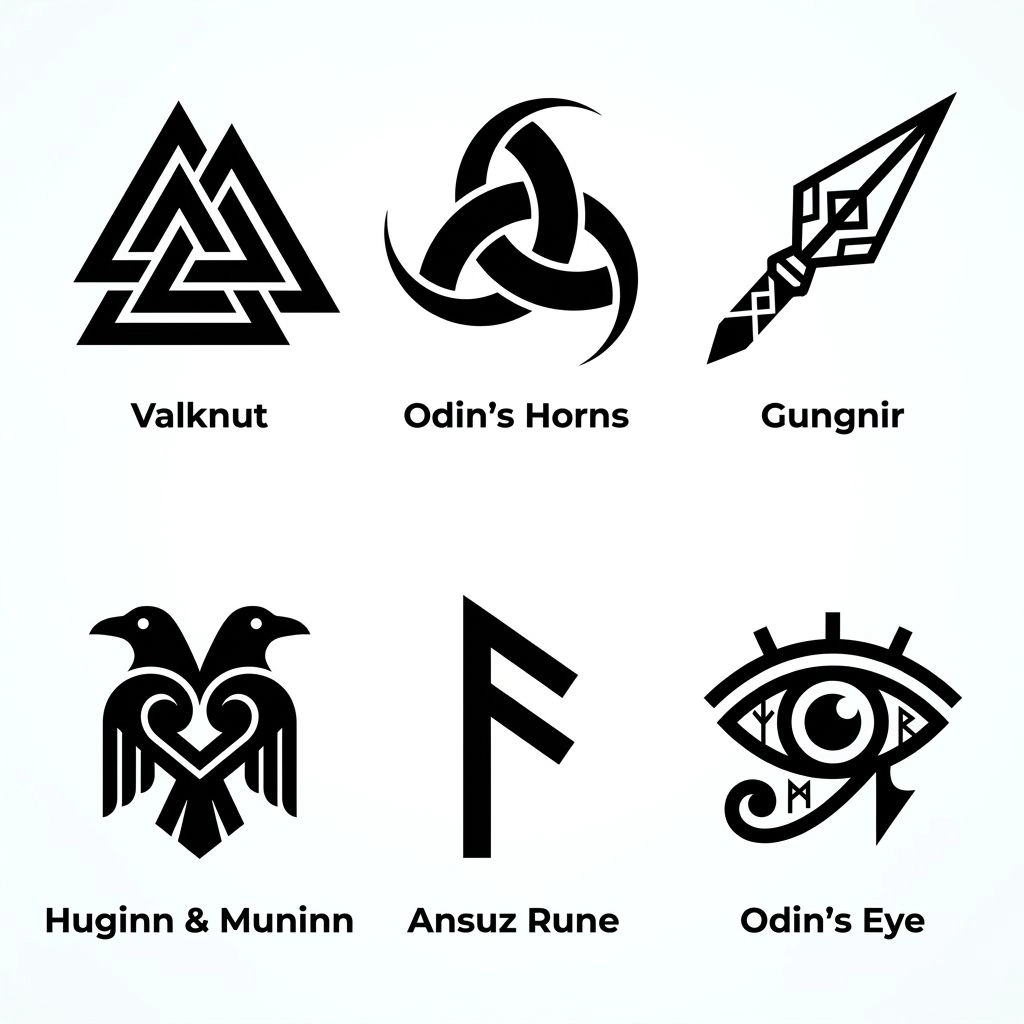
Odin is one of the most important and complex figures in Norse mythology, and the symbols connected with him reflect many different parts of his character. Odinism symbols can refer to images directly associated with Odin, such as his ravens, spear, horse, wolves, and one eye, as well as broader Norse symbols that modern Odinists or Heathens may use.
However, there is an important distinction to make at the beginning. Not every Norse symbol is an Odin symbol. Mjölnir, for example, is Thor’s hammer, while Yggdrasil belongs to the wider cosmology of Norse mythology. Some symbols commonly connected with Odin, such as the Valknut, also have interpretations that remain uncertain.
Modern use adds another layer. Some people use Norse symbols as part of modern Heathen or pagan religious practice, while certain symbols have also been appropriated by extremist groups. The meaning of a symbol therefore depends heavily on its historical background and the context in which it appears. The Anti-Defamation League specifically cautions that symbols such as the Valknut can have both non-extremist and extremist uses.
Understanding these differences makes it easier to explore Odinism symbols without confusing ancient mythology, modern spirituality, popular Viking imagery, and extremist appropriation.
What Are Odinism Symbols?
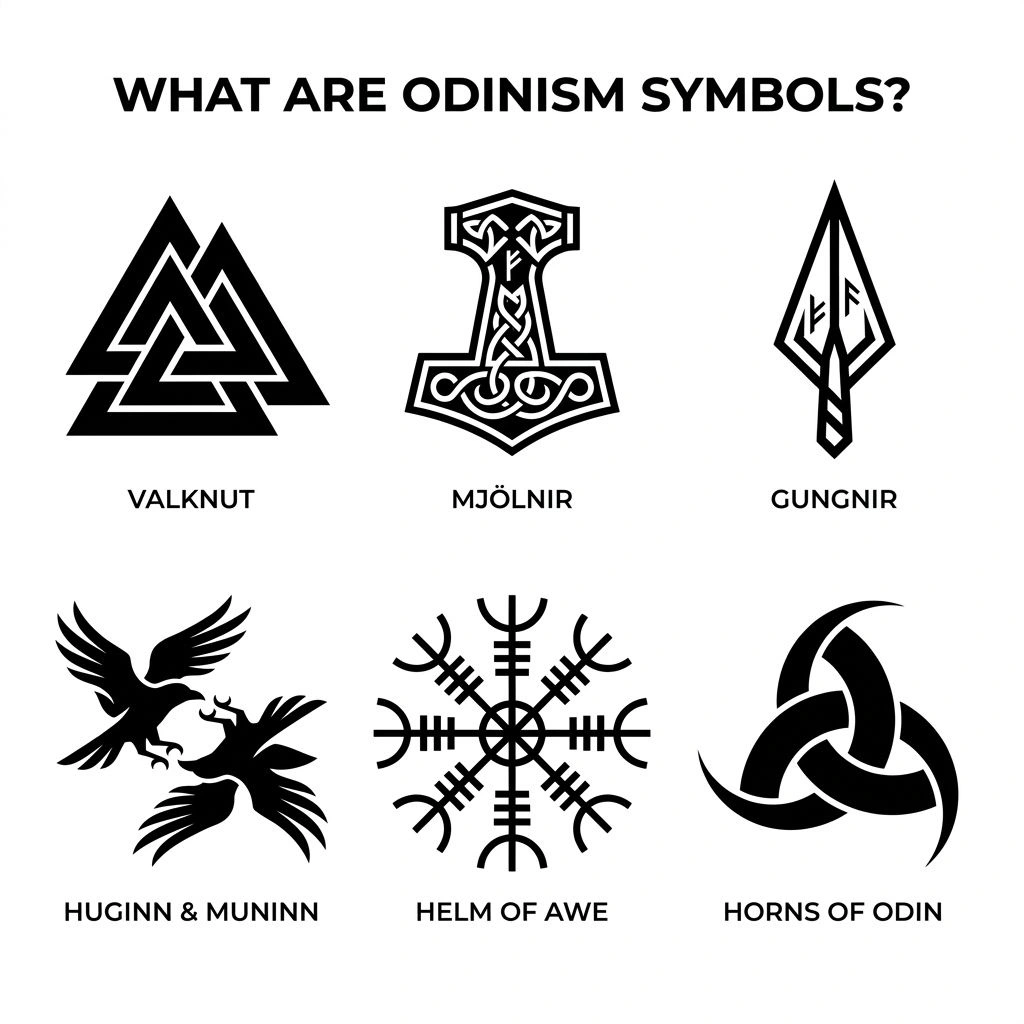
The phrase Odinism symbols can be used to describe symbols associated with Odin or with modern traditions that place particular importance on Odin.
Odin, known as Óðinn in Old Norse, is a complicated deity with associations including war, death, wisdom, poetry, magic, knowledge, kingship, and the supernatural. Surviving medieval sources portray him in many different roles rather than giving him one simple identity.
Some of his most recognizable attributes include:
- Huginn and Muninn, his two ravens
- Gungnir, his spear
- Sleipnir, his eight-legged horse
- Geri and Freki, his wolves
- His missing eye
- Draupnir, his magical ring
- The Valknut, which is strongly associated with Odin but whose original meaning is uncertain
- Runic knowledge, which is connected with Odin through Norse mythology
These symbols do not all have the same level of historical evidence. Some are explicitly described in surviving mythology, while others are archaeological motifs whose original meanings are debated.
What Are the Main Symbols of Odin? (Quick Answer)
The symbols and attributes most directly associated with Odin include Huginn and Muninn, Gungnir, Sleipnir, Geri and Freki, Odin’s missing eye, and Draupnir.
The Valknut is also frequently associated with Odin, especially because the motif appears in some archaeological contexts involving imagery that may depict Odin. However, the original Viking-Age name and exact meaning of the symbol are not known with certainty.
Here is a quick overview:
| Symbol or attribute | Connection with Odin | Common modern interpretation |
| Huginn and Muninn | Odin’s ravens | Thought, memory, knowledge |
| Gungnir | Odin’s spear | Authority, warfare, purpose |
| Sleipnir | Odin’s horse | Travel, transition, supernatural movement |
| Geri and Freki | Odin’s wolves | Strength, battle, instinct |
| One eye | Odin’s sacrifice for knowledge | Wisdom, sacrifice, insight |
| Draupnir | Odin’s magical ring | Wealth, abundance, regeneration |
| Valknut | Often associated with Odin | Death, transition, afterlife |
| Runes | Odin gains knowledge of runes in mythology | Knowledge, sacrifice, magic |
The table should be read as a guide rather than a list of fixed meanings. Ancient Norse symbolism does not always provide the neat one-symbol-one-definition system that modern websites sometimes suggest.
Odin’s Most Important Symbols and Attributes
Huginn and Muninn
Huginn and Muninn are perhaps the most recognizable animals associated directly with Odin.
They are two ravens who travel throughout the world and return to Odin with information. In surviving Norse material, they are closely connected with his ability to know what is happening beyond his immediate surroundings. World History Encyclopedia notes that representations of the two ravens are found in ornaments and runestones dating to before about 800 CE, showing that the association is not simply a modern invention.
Their names are commonly translated using concepts such as thought and memory, although translations can vary.
The ravens can therefore be interpreted through several connected ideas:
- Knowledge
- Observation
- Memory
- Thought
- Wisdom
- Information
- Connection with battle and the dead
Their symbolism is especially interesting because Odin is not simply portrayed as a physically powerful warrior. He is also a seeker of knowledge who repeatedly sacrifices comfort and safety to gain wisdom.
In modern artwork, two ravens are often used as a clear visual reference to Odin.
Gungnir
Gungnir is Odin’s famous spear.
Unlike some symbols that are only loosely associated with Odin, Gungnir is directly identified as his weapon in Norse tradition. World History Encyclopedia describes the spear as one of Odin’s main attributes and notes archaeological evidence suggesting that spear symbolism was connected with Odin in Viking-Age belief.
Gungnir can therefore represent:
- Odin
- Authority
- Warfare
- Power
- Purpose
- Sacrifice
- Divine weaponry
A generic spear, however, should not automatically be called Gungnir. Gungnir is the named spear of Odin, while spears in general had many uses in Norse society.
For someone interested in an Odin-inspired tattoo, a spear accompanied by ravens, runic imagery, or other Odin attributes can make the intended connection clearer.
Sleipnir
Sleipnir is Odin’s extraordinary eight-legged horse.
The horse is one of the clearest visual ways to identify Odin in Norse mythology. Sleipnir is associated with supernatural travel and the movement between different realms. In stories about Baldr, for example, Odin’s son Hermóðr rides Sleipnir toward the realm of the dead, illustrating the horse’s extraordinary ability to cross boundaries.
Sleipnir can therefore suggest:
- Travel
- Transition
- Movement between worlds
- Supernatural power
- Exploration
- Connection between life and death
The eight-legged horse is particularly useful as an Odin symbol because it is visually distinctive.
A normal horse does not automatically symbolize Odin. The eight-legged form of Sleipnir is the important identifying feature.
Odin’s One Eye
Odin is traditionally depicted with one eye because he sacrificed the other in his pursuit of knowledge.
This story gives the eye a meaning that goes far beyond physical appearance.
It can represent:
- Wisdom
- Knowledge
- Sacrifice
- Foresight
- Curiosity
- The price of understanding
Odin’s pursuit of knowledge is one of the most important themes in his mythology. His sacrifice is therefore often interpreted as an example of how wisdom may require giving something valuable in return.
A single eye can be used as a minimalist Odin symbol, although it should not automatically be interpreted as Norse or Odin-related without context.
Geri and Freki
Odin is also associated with two wolves named Geri and Freki.
In descriptions of Odin’s hall, the wolves are shown alongside him, while his ravens bring him information. One account describes Odin feeding his share of meat to Geri and Freki.
The wolves can be connected with:
- Odin
- Strength
- Hunting
- Battle
- Instinct
- The wild
- Companionship
A wolf by itself is not necessarily an Odin symbol because wolves have many different meanings in Norse mythology. Fenrir, for example, is a completely different mythological figure.
This distinction is important when interpreting wolf imagery.
Draupnir
Draupnir is Odin’s magical ring.
According to Norse mythology, the ring has the extraordinary ability to produce additional rings at regular intervals. It therefore has associations with abundance, reproduction, and supernatural wealth.
Draupnir is less recognizable today than Gungnir or Odin’s ravens, but it is still an important attribute when discussing Odin comprehensively.
It can symbolize:
- Abundance
- Wealth
- Repetition
- Regeneration
- Supernatural power
A ring alone is not necessarily an Odin symbol. The connection comes from the specific mythological object called Draupnir.
Valknut Meaning and Why Its History Is Uncertain
The Valknut is one of the most searched and discussed symbols associated with Odin.
It usually appears as three interlocking shapes made from triangular forms. The design appears in Viking-Age material, including imagery associated by some scholars with Odin.
However, the historical evidence requires caution.
The word Valknut is a modern name, and the exact Viking-Age name for the symbol is unknown. Its original meaning is also uncertain. Archaeological examples appear in contexts connected with death and possibly Odin, but scholars do not have a surviving Viking-Age explanation saying exactly what the symbol meant.
What the Historical Evidence Shows
The Valknut appears in several pieces of Scandinavian archaeological material.
One well-known example is found on the Stora Hammars I stone in Gotland, where the three-triangle design appears alongside imagery that may be interpreted as Odin, a raven, a spear, and a hanging figure.
This has contributed to the symbol’s association with Odin and death.
However, the evidence does not allow us to say with complete certainty:
“The Vikings believed the Valknut meant exactly this one thing.”
That level of certainty goes beyond what the surviving evidence can establish.
Modern Interpretations of the Valknut
Modern readers commonly connect the Valknut with:
- Odin
- Death
- Warriors
- Valhalla
- The afterlife
- Transition
- Fate
- Spiritual transformation
Some of these interpretations are reasonable attempts to understand the archaeological context, while others are modern spiritual interpretations.
The important distinction is to say “associated with” rather than claiming an exact original definition.
Valknut and Modern Extremist Appropriation
The Valknut also has an important modern context.
The Anti-Defamation League reports that some white supremacists, including racist Odinist groups, have appropriated the Valknut as a racist symbol. At the same time, ADL explicitly notes that non-racist pagans also use the symbol and that its meaning should be evaluated in context.
Therefore, seeing a Valknut by itself does not establish someone’s political beliefs or intentions.
Its surrounding symbols, text, group affiliation, setting, and stated purpose may provide important context.
Odin Symbols vs. Broader Norse Symbols
One of the biggest mistakes in online Norse-symbol articles is treating every Norse design as an Odin symbol.
The following comparison helps clarify the difference:
| Symbol | Connected with Odin? | Main connection |
| Huginn and Muninn | Yes | Odin’s ravens |
| Gungnir | Yes | Odin’s spear |
| Sleipnir | Yes | Odin’s horse |
| Geri and Freki | Yes | Odin’s wolves |
| One eye | Yes | Odin’s sacrifice and wisdom |
| Valknut | Strong association, but uncertain meaning | Death/Odin contexts |
| Mjölnir | No | Thor |
| Yggdrasil | No, broader mythology | World tree |
| Vegvísir | No | Later Icelandic magical tradition |
| Ægishjálmur | No | Later Icelandic magical tradition |
| Tyr rune | No | Associated with Tyr and later runic use |
This distinction prevents the common mistake of calling every popular “Viking symbol” an Odin symbol.
Mjölnir: A Norse Symbol Often Confused With Odin
Mjölnir is Thor’s hammer, not Odin’s weapon.
It is highly relevant to modern Norse paganism and broader Norse symbolism, but it should not be listed as Odin’s personal symbol.
Mjölnir has strong historical and modern associations with Thor and can represent protection, strength, religious identity, and other ideas depending on context.
Its modern use also has an important contextual dimension. ADL notes that Thor’s Hammer is used by people practicing modern Norse religions but has also been appropriated by some white supremacists. The symbol itself therefore does not automatically indicate extremist beliefs.
Yggdrasil: The Broader Norse World Tree
Yggdrasil is the great world tree of Norse cosmology.
It is deeply important to understanding the Norse mythological universe, but it is not simply an “Odin symbol.”
Yggdrasil can represent:
- The interconnected cosmos
- Different realms
- Life and death
- Continuity
- Transformation
- Cosmic order
Odin is connected with Yggdrasil through important myths, including his self-sacrifice on the tree to gain knowledge of the runes.
So Yggdrasil can appear in Odin-centered artwork, but it is more accurate to call it a broader Norse cosmological symbol.
Runes and Their Connection With Odin
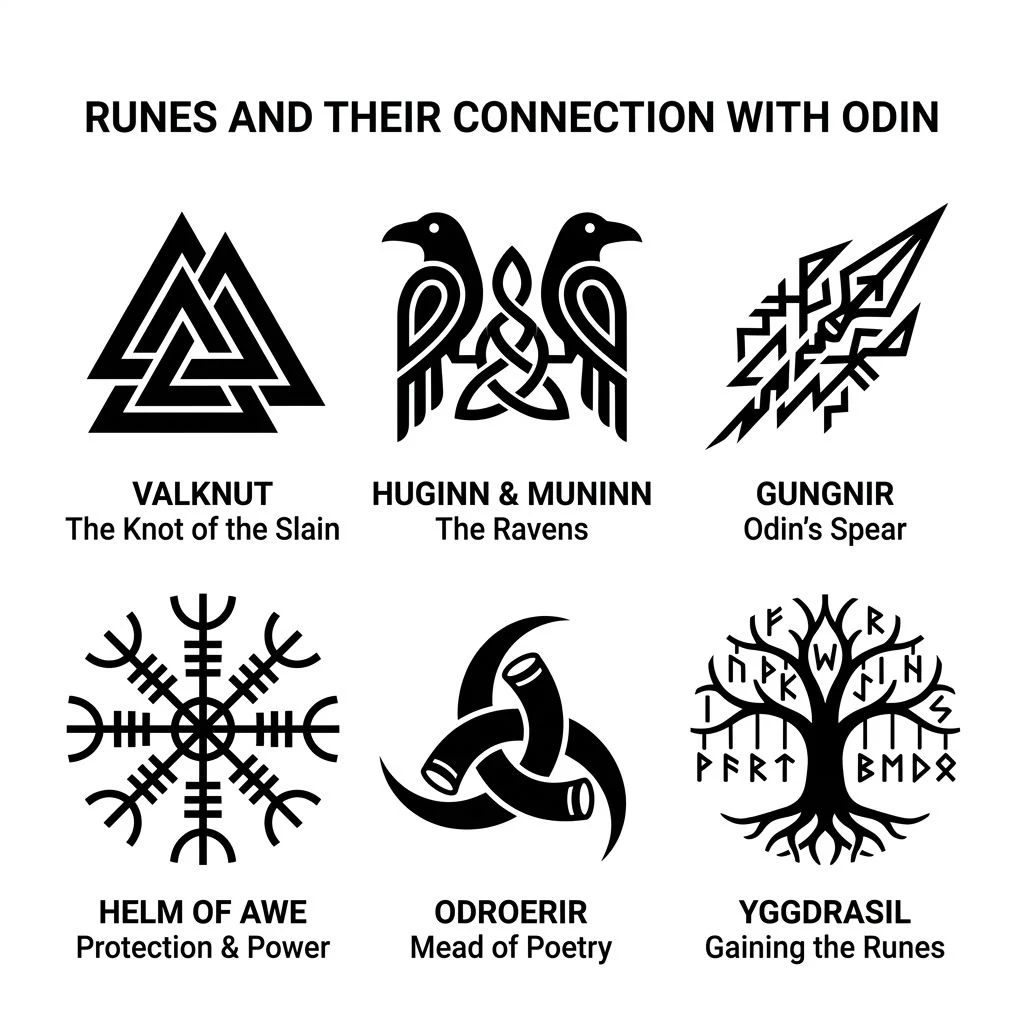
Runes are another area where modern websites often oversimplify history.
Runes were writing systems used by Germanic-speaking peoples. Different periods and regions used different runic alphabets.
Odin nevertheless has a strong mythological connection with runic knowledge.
In the Hávamál, Odin describes a dramatic self-sacrifice on a tree before gaining knowledge associated with the runes. World History Encyclopedia discusses this tradition as part of Odin’s pursuit of knowledge and magical power.
This means runes can be connected with Odin, but runes as a whole are not simply “Odin’s alphabet.”
Odin and Runic Knowledge
The myth emphasizes several recurring themes:
- Sacrifice
- Knowledge
- Wisdom
- Transformation
- Magic
- Self-discovery
This makes runes relevant to Odin’s mythology without making every individual rune an Odin symbol.
Different Runic Alphabets
The major historical runic traditions include:
- Elder Futhark
- Younger Futhark
- Anglo-Saxon Futhorc
They developed in different periods and regions.
Calling all runes “Viking symbols” therefore oversimplifies their history.
Why Not Every Rune Is an Odin Symbol
Individual runes have different histories and later interpretations.
For example, the Tyr rune is named after Tyr, another Norse deity, rather than Odin.
Likewise, the Othala/Odal rune has a complex history that includes ordinary runic use as well as later political and extremist appropriation.
ADL documents the Othala rune’s historical runic background and its later appropriation by Nazi and white supremacist movements.
This is why anyone researching runic symbolism should identify the specific rune rather than assuming all runes have the same religious meaning.
Historical Viking Symbols vs. Modern Norse Symbols
Modern popular culture often combines symbols from very different periods.
A design may look “Viking” without actually being documented in the Viking Age.
This is especially important with symbols such as Vegvísir and Ægishjálmur, which are frequently marketed online as ancient Viking symbols.
These symbols belong to later Icelandic magical traditions rather than being securely documented as Viking-Age symbols.
That does not make them meaningless. It simply means their history should be described accurately.
A useful distinction is:
| Category | Example |
| Odin’s mythological attributes | Ravens, Gungnir, Sleipnir |
| Viking-Age archaeological motifs | Valknut |
| Broader Norse mythology | Yggdrasil |
| Historical runic systems | Elder Futhark |
| Later Icelandic magical symbols | Vegvísir, Ægishjálmur |
| Modern religious use | Contemporary Heathen interpretations |
This distinction helps readers avoid confusing medieval Scandinavian religion with later folklore and modern spiritual practice.
Odinism Symbols and Modern Heathen Practice
Modern Heathen traditions are not identical to ancient Norse religion.
People today may use Norse mythology, historical sources, reconstructed practices, personal spirituality, or modern religious traditions in different ways.
The term Odinism itself has also been used differently by different groups. Some modern practitioners use Odinism as a religious or spiritual term centered on Odin and Norse traditions. Other movements using the term have been explicitly racialist.
Therefore, it is not accurate to assume that everyone who uses an Odin-related symbol belongs to the same religious or political group.
A person might wear a raven pendant because of:
- Interest in Norse mythology
- Religious devotion
- Historical interest
- Family or cultural heritage
- Literature or popular culture
- Personal symbolism
- Tattoo aesthetics
Context matters.
Norse Symbols and Extremist Appropriation
Some Norse symbols have been appropriated by extremist movements, creating confusion for people who encounter them in modern life.
The most important point is that historical Norse symbolism and modern extremist symbolism are not automatically the same thing.
Why Context Matters
The ADL’s guidance on the Valknut specifically states that symbols should be evaluated in the context in which they appear. It notes that the Valknut has genuine non-extremist uses among pagans as well as extremist appropriation.
Context may include:
- Other symbols appearing nearby
- Written slogans
- Group affiliation
- Political statements
- Historical setting
- Religious setting
- The person’s stated purpose
A single symbol usually does not provide enough information to determine someone’s ideology.
Valknut
The Valknut has genuine historical associations with Norse material culture and is used by modern pagans. It has also been appropriated by white supremacists.
Therefore, it is inaccurate to describe every Valknut as an extremist symbol.
Mjölnir
Thor’s hammer has a long history independent of modern extremist movements. Modern Heathens also use it for religious reasons.
At the same time, extremist groups have appropriated the design.
Again, context is necessary.
Othala and Other Runes
Some runes have also been appropriated by extremist movements.
The Othala rune is particularly complicated because it has an ancient runic history but was also used by Nazi organizations and later white supremacist groups.
The existence of extremist appropriation does not erase the symbol’s earlier history, nor does every modern use communicate extremist ideology.
Odinism Symbols for Tattoos
Odin-related imagery is popular in tattoo art because many of the symbols have distinctive shapes and rich mythological backgrounds.
Raven Tattoos
Two ravens can provide a recognizable reference to Huginn and Muninn.
A raven tattoo may represent:
- Thought
- Memory
- Knowledge
- Odin
- Observation
- Norse mythology
Using two ravens makes the Odin connection more specific than using one generic bird.
Valknut Tattoos
The Valknut is frequently chosen by people interested in Odin, Norse mythology, death, fate, or the afterlife.
However, its exact historical meaning is uncertain.
Anyone considering the design should also be aware that the Valknut has been appropriated by some white supremacist groups. That does not mean every Valknut tattoo has an extremist meaning, but understanding the modern context is important.
Gungnir Tattoos
A Gungnir tattoo can directly reference Odin’s spear.
It may be chosen to express:
- Odin
- Strength
- Knowledge
- Authority
- Warrior symbolism
- Norse mythology
Adding ravens or other Odin-related imagery can make the reference clearer.
Sleipnir Tattoos
Sleipnir tattoos are especially distinctive because of the horse’s eight legs.
They can represent:
- Odin
- Travel
- Transformation
- Crossing boundaries
- Norse mythology
- Movement between worlds
Rune Tattoos
Rune tattoos require extra care.
Before using a rune, identify:
- Which rune it is
- Which runic alphabet it comes from
- Its historical use
- Its later interpretations
- Whether it has modern extremist associations
This is especially important because some runes have been appropriated by extremist groups even though they have much older histories.
Odin Symbols by Meaning
Different readers may want different symbolic messages.
| Meaning | Odin-related symbol |
| Wisdom | Odin’s one eye |
| Knowledge | Huginn and Muninn |
| Observation | Huginn and Muninn |
| Authority | Gungnir |
| Supernatural travel | Sleipnir |
| Strength | Geri and Freki |
| Sacrifice | Odin’s eye and runic ordeal |
| Death and transition | Valknut, with historical uncertainty |
| Abundance | Draupnir |
| Magic and knowledge | Runes in Odin’s mythology |
| Norse cosmology | Yggdrasil, as a broader symbol |
These meanings should be treated as interpretive associations rather than universal definitions.
What Is the Difference Between Odinism Symbols and Norse Symbols?
The easiest way to understand the difference is to think of Odinism symbols as a smaller category within the much larger world of Norse symbolism.
Odin-specific imagery includes his ravens, spear, horse, wolves, eye, and ring.
Broader Norse imagery includes:
- Thor’s hammer
- Yggdrasil
- Valkyries
- Different runes
- Serpents
- Dragons
- Ships
- Other gods and mythological figures
Some symbols overlap with Odin because Odin appears in myths involving them, but that does not necessarily make them his personal symbols.
How to Choose an Odinism Symbol
If you are choosing an Odin-related symbol for a tattoo, necklace, artwork, logo, or personal spiritual practice, first decide what you want it to communicate.
For Wisdom
Consider Odin’s one eye.
It connects strongly with his pursuit and sacrifice for knowledge.
For Knowledge and Thought
Consider Huginn and Muninn.
The two ravens are among Odin’s most recognizable attributes.
For Strength and Authority
Consider Gungnir.
The spear is directly associated with Odin.
For Travel and Transformation
Consider Sleipnir.
The eight-legged horse has a strong connection with supernatural movement and crossing realms.
For Death and the Afterlife
The Valknut may be appropriate if you understand its uncertain historical interpretation and modern associations.
For Broader Norse Identity
Yggdrasil or Mjölnir may be more appropriate if your interest is Norse mythology generally rather than Odin specifically.
The most important thing is to choose a symbol based on what it actually represents rather than relying on a generic internet list.
Common Mistakes About Odinism Symbols
Mistake 1: Calling every Viking symbol an Odin symbol
Norse culture contains many gods, stories, objects, and symbols. Odin is only one part of that wider tradition.
Mistake 2: Giving the Valknut one definite meaning
The Valknut’s historical meaning is uncertain. Modern interpretations should be identified as interpretations.
Mistake 3: Calling Mjölnir Odin’s hammer
Mjölnir belongs to Thor.
Mistake 4: Calling Vegvísir a Viking-Age Odin symbol
Vegvísir comes from a later Icelandic magical tradition and should not simply be presented as an ancient Viking symbol.
Mistake 5: Treating all runes as religious symbols
Runes were writing systems. Their relationship with Odin is important in mythology, but individual runes have different histories.
Mistake 6: Assuming every Norse symbol is extremist
Some symbols have been appropriated by extremist movements, but they also have legitimate historical and modern non-extremist uses. Context matters.
Frequently Asked Questions
What is the main symbol of Odin?
There is no single universally established “main” symbol of Odin. His most recognizable attributes include Huginn and Muninn, Gungnir, Sleipnir, his one eye, and Geri and Freki. The Valknut is also strongly associated with Odin, although its original meaning remains uncertain.
What do Odin’s ravens symbolize?
Odin’s ravens, Huginn and Muninn, are associated with gathering information and returning knowledge to Odin. Their names are commonly interpreted through ideas such as thought and memory or wisdom, depending on translation.
What does the Valknut symbolize?
The Valknut is commonly associated with death, the afterlife, warriors, and Odin, but its exact original meaning is uncertain. The name itself is modern, and scholars cannot point to a surviving Viking-Age explanation that definitively defines the symbol.
Is the Valknut a symbol of Odin?
The Valknut is often considered an Odin-related symbol because it appears in some archaeological contexts involving imagery interpreted as Odin. However, the exact meaning of the motif is debated, so it is better described as strongly associated with Odin rather than as a symbol whose original meaning is completely established.
What does Gungnir symbolize?
Gungnir is Odin’s named spear in Norse mythology. It can therefore be used as a direct symbol of Odin and can carry modern associations with authority, warfare, strength, and purpose.
What does Sleipnir symbolize?
Sleipnir is Odin’s eight-legged horse. Because the horse can travel across supernatural boundaries, it is often associated with travel, transition, movement between realms, and Odin’s supernatural nature.
Is Mjölnir an Odin symbol?
No. Mjölnir is Thor’s hammer, not Odin’s weapon. It is an important Norse symbol and is used in modern Heathen contexts, but it should not be described as Odin’s personal symbol.
Are runes Odin symbols?
Runes are not simply a collection of Odin symbols. They were historical writing systems, but Norse mythology gives Odin an important relationship with runic knowledge. The Hávamál describes Odin undergoing a dramatic ordeal connected with gaining knowledge of the runes.
Is Yggdrasil an Odin symbol?
Yggdrasil is better described as a broader Norse cosmological symbol rather than Odin’s personal symbol. Odin is deeply connected with the tree through important mythology, including his ordeal to gain knowledge of the runes.
Is Vegvísir an ancient Viking symbol?
Vegvísir is often marketed as a Viking symbol today, but it comes from a later Icelandic magical tradition rather than being securely documented as a Viking-Age Odin symbol. It should therefore be distinguished from genuinely ancient Norse material.
Do Norse symbols always have extremist meanings?
No. Some Norse symbols have been appropriated by extremist movements, but many also have historical, religious, cultural, artistic, or modern pagan uses. The ADL specifically notes that the Valknut, for example, is used by non-racist pagans as well as by some white supremacists. Context is therefore important.
What is the best Odin symbol for a tattoo?
There is no single best choice. Huginn and Muninn work well for knowledge and thought, Gungnir for a direct Odin reference, Sleipnir for travel and transition, and the one-eyed image for wisdom and sacrifice. The Valknut can also be chosen, but its uncertain history and modern extremist appropriation should be understood first.
What symbol represents Odin’s wisdom?
Odin’s one eye is one of the clearest symbolic references to his pursuit of wisdom because he sacrifices an eye in the quest for knowledge. His ravens and runic knowledge also contribute to his broader association with wisdom and understanding.
Conclusion
Odinism symbols are best understood by separating Odin’s direct mythological attributes from the much larger collection of Norse symbols. His two ravens, Huginn and Muninn, his spear Gungnir, his eight-legged horse Sleipnir, his wolves Geri and Freki, his missing eye, and his magical ring Draupnir have direct connections with Odin in Norse tradition.
The Valknut deserves special attention because it is frequently associated with Odin and death, yet its original Viking-Age meaning is not certain. Modern interpretations should therefore be distinguished from what archaeological evidence can actually establish.
It is equally important not to confuse Odin symbols with broader Norse imagery. Mjölnir belongs to Thor, while Yggdrasil represents the wider Norse cosmological tradition. Runes have their own history, although Odin has an important mythological relationship with runic knowledge.
Modern use adds another layer of complexity. Some Norse symbols have been adopted by extremist groups, but those symbols can also have legitimate religious, cultural, historical, and personal uses. A symbol should therefore be interpreted in context rather than assigned a single meaning automatically.
Whether you are researching Norse mythology, exploring modern Heathen symbolism, choosing artwork, or considering an Odin-inspired tattoo, the most reliable approach is to ask where the symbol comes from, how it was used historically, what evidence supports its meaning, and how it is interpreted today.

Clara Miles
Hello! I’m Clara, a lifelong dreamer who finds magic in everyday moments. Writing has always been my way of exploring the world and understanding the people around me. I love creating stories that make readers laugh, cry, and reflect on life’s little surprises. When I’m not writing, you can usually find me sipping coffee at a cozy café or wandering through nature with a notebook in hand. My journey as an author is fueled by curiosity, imagination, and a love for connecting with my readers. Every story I write is a piece of my heart, and I hope it inspires yours too.
Books:
-
Whispers of the Heart
-
Shadows and Sunlight