
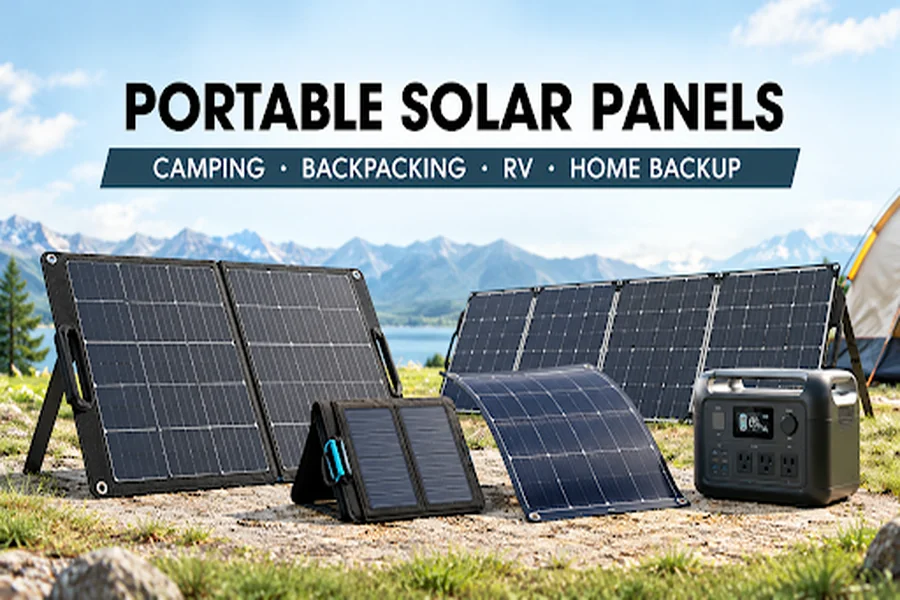
Portable solar panels serve different purposes depending on how you plan to use them. A lightweight panel for charging your phone during a hiking trip has very different requirements from a larger setup designed to power a refrigerator during an outage. Choosing the right option means looking beyond advertised wattage and considering actual output, weight, compatibility, durability, and price.
For most individuals charging a portable power station during camping trips or emergencies, a 200-watt folding panel offers a practical balance. In GearLab’s July 2026 comparison of 12 panels, the Renogy 200W Portable earned the highest overall score. The EcoFlow NextGen 220W delivered the most measured power, while smaller options such as the FlexSolar 100W are better suited to backpacking. This guide compares the best solar panels that are also portable for different applications and explains what to consider before purchasing one.
Quick Overview of the Best Portable Solar Panels
Here’s a fast way to see what the top portable solar panels can do for you, with information on each panel’s best applications, actual measured power produced, panel weight and price. This will help you find the panel(s) that will work best for your charging requirements and spending limits.
| Best For | Panel | Measured Output | Weight | List Price |
| Most people | Renogy 200W Portable | 177 W | 14.8 lb | $250 |
| Highest folding panel output | EcoFlow NextGen 220W | 193 W | 16.5 lb | $649 |
| Jackery power stations | Jackery SolarSaga 200 | 171 W | 14.2 lb | $699 |
| Van or RV roof | BougeRV Arch 200W Flexible | 166 W | 6.6 lb | $280 |
| Affordable fixed mounting | JJN Bifacial 200W | 182 W | 25 lb | $130 |
| Backpacking | FlexSolar 100W | 70 W | 4.1 lb | $89 |
Output figures and list prices are based on GearLab’s July 2026 testing. Retail prices may vary with discounts and availability.
How We Evaluated Portable Solar Panels
This guide uses independent testing from GearLab, WIRED’s multi-year reviews, SolarReviews’ 2025 roundup, and manufacturer specifications.
GearLab compared 12 panels by connecting each to an identical 1,070 Wh power station for two hours at 6,300 feet on a clear day. This provided a consistent way to compare their actual electricity generation.
Our recommendations consider measured output, portability, setup time, connector compatibility, weather resistance, warranty, and cost per measured watt.
Rated Wattage vs Actual Output
Although a 200 watt solar panel is rated to produce 200 watts of power in laboratory testing environments, it will typically not consistently produce this amount of power in the field due to variables such as; sun exposure, temperature, shading, and the orientation of the panel.
The results of GearLab’s tests illustrate this difference. Of the three models tested, the JJN Bifacial 200W produced 182 watts, achieving approximately 91% of its listed capacity. The Renogy 200W produced 177 watts while the Grecell 200W only produced 112 watts.
In terms of a realistic expectation, you should anticipate that your panels will produce roughly 70 percent to 90 percent of what they are advertised to provide when exposed to direct sunlight. You can also get a better sense of how cost-effective each panel is by comparing the cost of each panel to its actual produced wattage.
What are the Top Portable Solar Panels in 2027?
The following portable solar panels have been chosen for their size, mobility, functionality, and cost. Let’s take a deeper dive into the performance of each model and who it’s best suited for.
1. Renogy 200W Portable: Best Overall
GearLab tested the Renogy 200W Portable for 88/100 points and measured at 177W. It weighs 14.8 pounds, folds easily and can be assembled in about 35 seconds. There are also built-in USB-C and USB-A charging ports for direct device charging, with the MC4 output connecting to the compatible power stations via an adapter. Great for camping and portable solar use, and can be used on any brand.
2. EcoFlow NextGen 220W: Highest Folding Panel Output
The 220W Folding Solar Panel (EcoFlow NextGen 220W) is the highest folding panel output. 220W Folding Solar Panel would be the highest folding panel output. EcoFlow NextGen 220W produced 193W during testing, which is the top power among 12 panels. This bifacial design harnesses reflected sunlight, and it’s built with 16.5 lbs of IP68 protecting metal legs. It is a good choice for those who want to buy with the highest folding panel output at a reduced cost.
3. Jackery SolarSaga 200: Best for Jackery Power Stations
The Jackery SolarSaga 200 is the best Jackery Power Station for when you need to charge on the go. The Jackery SolarSaga 200 achieved 86% of its claimed output of 171W in our tests. It weighs 14.2 pounds, takes about 35 seconds to set up and provides IP68 protection and a three-year warranty. A panel installed WIRED reported to charge the 4,085 Wh Explorer 2000 Plus at around 20% over two sunny days. It is most importantly easy to fit into Jackery power stations. It is more suitable for those who already have a Jackery charger and are looking for a matching solar panel.
4. BougeRV Arch 200W Flexible: Best for RV and Van Roofs
BougeRV Arch 200W Flexible measures 166W and is the lightest 200W panel in the comparison, weighing just 6.6 pounds. It is flexible for use on curved roofs and is installed with industrial double-sided tape without drilling. It has a 5-year warranty with IP68 weather rating. After owning a campervan for 2 years, one GearLab reported there were no adjustments. Appropriate for RV and van owners who want solar panels as a permanent installation on their roof.
5. JJN Bifacial 200W: Best Affordable Fixed Panel
The JJN Bifacial 200W produces 182W in testing, which is about 91% of the maximum capacity with a low cost. It is also backed by a 5-year warranty, and requires approximately 10 minutes to assemble. It is sturdier than traditional camping setups and works well on camping racks, stands and semi-permanent structures. Ideal for buyers who want to save on the cost of solar power but not the portability of the system.
6. FlexSolar 100W: Best for Backpacking
The FlexSolar 100W is lightweight (just 4.1 pounds), and folds down to a size roughly the size of a laptop, making it easy to transport on hiking adventures. It had 70W in GearLab tests, and features USB-A and USB-C charging ports, as well as carabiners for easy mounting. It is compact and emphasizes portability over maximum power generation. Ideal for backpackers who need to power phones, GPS, headlamps and small power banks.
What Are the Best Solar Panels for Backpacking and Hiking?
Panels in the 10-30 watt range are more readily available for backpacking than larger foldable panels. They offer sufficient space for charging important electronics without introducing too much weight.
One of the more popular chargers is the BigBlue 28W charger, which weighs around 1.5 pounds and features both the USB-C and USB-A ports. There are also smaller options from Goal Zero (aka the Nomad 10) and FlexSolar.
A few practices improve performance:
- Charge a power bank during daylight and use it to charge devices at night.
- Position the panel toward direct sunlight rather than relying on a moving backpack.
- Expect lower output than the advertised rating.
- Consider carrying only a power bank for short weekend trips, as adding a panel increases overall weight.
Solar panels become more useful on longer trips where access to electricity is limited.
What Are the Best 400W Portable Solar Panels for High-Power Needs?
A 400W portable solar setup is useful for charging larger power stations, although these panels are considerably heavier than standard 200W models.
| Panel | Rated Capacity | Weight | Key Details |
| Renogy RSP400LSC-US | 400 W | 30.2 lb | Framed sections, five-year warranty |
| Bluetti 500W | 500 W | About 30 lb | WIRED measured around 490 W in ideal conditions |
| Bluetti 350W | 350 W | Just over 30 lb | WIRED measured approximately 290 W |
| Anker SOLIX PS400 | 400 W | About 35 lb | Compatible with suitable Anker stations |
Remember that actual output will generally be lower than rated capacity. Also, check open-circuit voltage before connecting a larger panel to your power station. Some 400W models approach 48V, which can exceed the input limits of smaller stations.
Portable Solar Panels 1000W: What Is Realistic?
Typically, a working 1,000 W mobile solar system will utilize several smaller panels instead of just one single panel. Some examples of how you can configure your mobile solar system include utilizing two 500 W panels; four 250 W panels; or two 400 W panels with an extra 200 W panel.
The weight of the system should be considered. With two thirty pound panels, you have a combined weight of sixty pounds prior to adding the weight of the cables and mounting hardware.
In bright sunlight, a 1000W rated system will likely produce about 700-850 watts of energy. This can help to greatly lower the charge times for compatible 2000Wh power stations. EcoFlow states that their DELTA 2 Max can be fully charged using a 1000W solar input in around 2.3 hours under ideal weather conditions.
In addition, some power plants may not be able to accommodate that level of input. Also, connecting solar panels in series will cause a higher voltage which could potentially exceed the limits of the charge controller. It is always best to verify what the maximum voltage and amperage are for each individual component prior to connecting them together.
Top Portable Solar Panels for Power Stations
Before you purchase a solar panel, it is best to first check the specifications of your power station. There are four specific areas that should be taken into account when looking at these specs:
- Maximum solar input: The maximum wattage the station can accept.
- Voltage range: The permitted minimum and maximum input voltage.
- Maximum current: The current the charging system supports.
- Connector type: Whether it uses MC4, XT60, DC8020, or another connection.
Open circuit voltage (Voc) is extremely important. If you exceed the maximum input voltage of the station, you could potentially destroy your charge controller. SolarReviews has found that a Renogy 200W panel with a Voc of 23.4V would be appropriate for a station that takes anywhere from 12V up to 60V.
Conclusion
When selecting the best solar panel for you, it will depend on how much electricity you require, your financial situation, and what you plan to use the solar panel for. If you are looking for an overall good solar panel, the Renogy 200W Portable would be a great choice. On the other hand, if you want a solar panel that has a higher measured output than other panels, then the EcoFlow NextGen 220W would be a better option. If you are going to be backpacking, you should look into purchasing a light-weight solar panel such as the FlexSolar 100W.
If you have an RV, you may find that using a flexible solar panel on top of the RV is more beneficial than using a rigid solar panel. For those individuals who need more power, there are 400W and 1,000W setups available which can provide additional charging capabilities, assuming that your power station can handle these higher wattage systems. When considering buying a solar panel, don’t rely solely on the wattage advertised by the manufacturer. Instead, look at several factors including but not limited to; actual output, weight, whether the connectors are compatible with your system, and the length of the warranty offered by the manufacturer.
Frequently asked questions for portable solar panel
What are the best portable solar panels in 2027?
The Renogy 200W Portable is the winner of our July 2026 tests and the best all-rounder. The most powerful unit is the EcoFlow NextGen 220W, while the BougeRV Arch 200W is ideal for a roof mount and the FlexSolar 100W is the lightweight option.
Does a 400W solar panel produce 400 watts?
Rarely. About 70-90% in good sun, which is 280-360 watts from a 400-watt panel. It is pulled down by heat, dust, and haze as well as the angle of the panel.
How long does it take to charge a 1,000 Wh power station with a 200W panel?
Based on GearLab’s testing of the best 200-watt panels with 177 to 193 watts per panel, the projects a total of approximately 6 hours of strong, direct sunlight. Cloudy days take a long long time.
Are there any portable solar panels that produce 1,000 watts?
This outcome is rarely possible with a single portable panel. A 1kW system consists of multiple panels, e.g. two 500W foldable panels or four 250W panels, connected to a power station that will take the 1kW of solar input.
Can portable solar panels run a whole house?
No. They are able to power a power station supplying power to important items such as fridge, router, phones, and a CPAP machine. When a whole house backup is required, it requires a permanent solar-plus-battery system.
Can I use portable solar panels in the rain?
Most are waterproof, typically IP65 or better, so they will not be damaged in the shower. But when it rains, output plummets, so stay away from wet ground with connectors on it.
Should I wire panels in series or parallel?
Series adds when it comes to voltage and when it comes to current – parallel adds. The first thing to check is the maximum input voltage of the station – over voltage is what kills charge controllers. If two panels are approaching that limit in series, the answer is parallel.
Are bifacial portable panels worth it?
They can be placed on bright, reflective surfaces such as sand, snow or light concrete. The gain is small on grass/dark soil. Do not judge them based on their bifacial label, but rather based on their measured output and price.
