
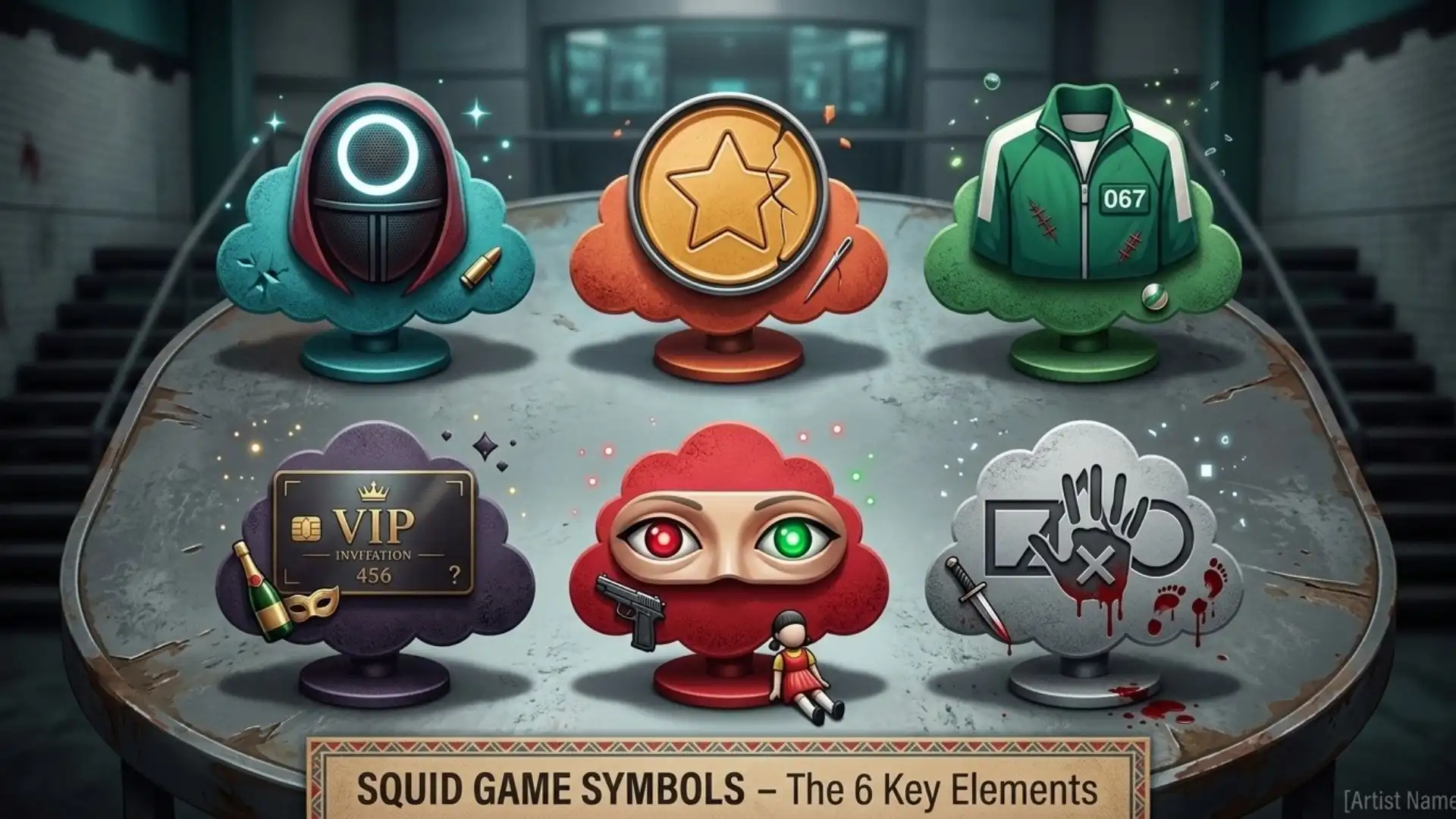
The symbols in Squid Game may look simple, but each one helps reveal the show’s hidden hierarchy, power struggles, and deeper themes. From the circle, triangle, and square on the guards’ masks to the colors of the players’ tracksuits, these visual details carry important clues about how the deadly competition works. If you’ve ever wondered what the Squid Game symbols mean, why guards wear different shapes, or what the series’ colors represent, you’re in the right place. This guide explains the meanings behind the most recognizable symbols, their roles in the show’s hierarchy, and the ideas they reveal about inequality, control, and human behavior.
Square Squid Game Symbol Meaning
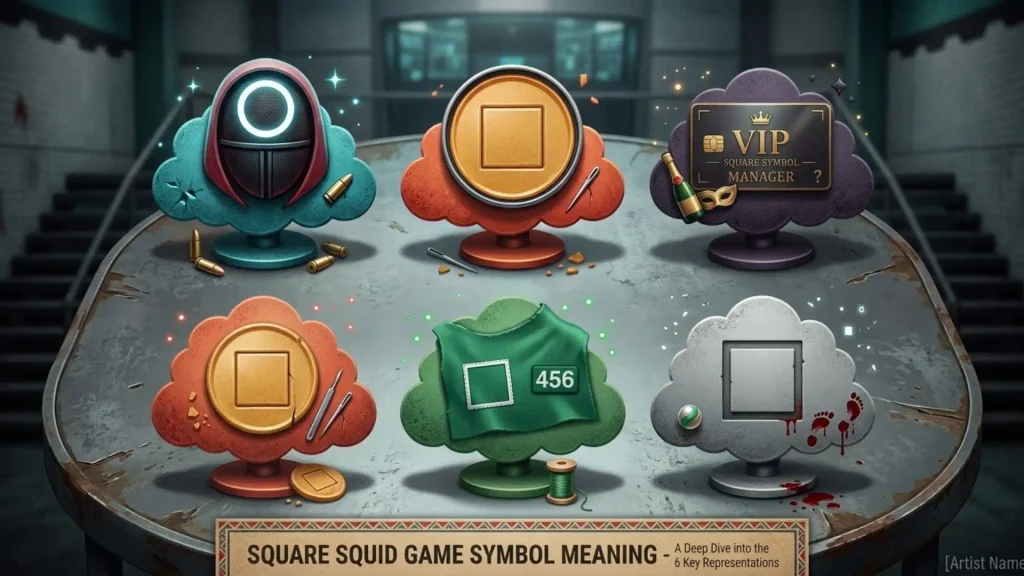
The square Squid Game symbol marks managers, the highest-ranking group among the three standard masked guard categories. Managers supervise operations and communicate instructions to other staff.
Their masks give viewers an immediate visual clue about authority. When a square-masked guard appears, viewers can distinguish that character from the workers and soldiers responsible for routine duties and enforcement.
What Does the Square Represent?
The square supports several reasonable visual interpretations.
- Organization: Its four sides create a clear, structured outline.
- Control: Square-masked managers occupy a supervisory position within the staff hierarchy.
- Order: The shape’s regular structure suits the organized appearance of the competition’s facilities.
- Decision-making: Managers communicate instructions and oversee operations rather than performing only routine tasks.
These associations help explain why viewers may connect the square with authority and structure. However, the square’s established meaning in the series is its role as a manager’s insignia.
Which Squid Game Symbol Has the Highest Rank?
The square has the highest rank among the three standard guard symbols. The triangle comes next, followed by the circle.
The production design uses a simple visual rule: the square has four vertices, the triangle has three, and the circle has none. Chae Kyoung-sun discussed this design choice in her interview with The Korea JoongAng Daily.
The hierarchy can be summarized as follows:
Circle → Triangle → Square
This sequence describes the masked staff structure. It doesn’t mean a square-masked manager outranks the Front Man, who holds a broader leadership position in the organization.
Squid Game Guard Hierarchy Explained
The guard hierarchy makes the fictional competition easier to understand. Instead of giving every staff member a name, the organization uses uniforms, masks, and geometric markings to distinguish different roles.
Circle Guards: Workers
Circle guards perform the routine work that supports the competition. They clean spaces, move materials, and help manage the facilities after each round.
Their standardized appearance makes individual workers difficult to distinguish. This creates an impression of a large, coordinated workforce in which personal identity matters less than assigned duties.
Triangle Guards: Soldiers
Triangle guards serve as armed enforcers. They supervise contestants, carry out orders, and maintain the competition’s rules.
Their weapons give them direct power over the players. Nevertheless, soldiers remain part of a larger organization and must follow instructions from higher-ranking staff.
Square Guards: Managers
Square guards occupy supervisory positions. They issue instructions, oversee operations, and help coordinate lower-ranking personnel.
Their masks make their authority visible without revealing their identities. This design also reinforces the system’s emphasis on roles rather than individual personalities.
The Front Man and the VIPs
The Front Man operates above the ordinary guard categories. He oversees the competition and represents its leadership structure.
His distinctive black mask and dark clothing separate him visually from the standard pink-uniformed guards. The difference in appearance signals that he holds a special position within the organization.
The VIPs occupy another important position. These wealthy spectators watch the games and treat the contestants’ struggles as entertainment.
Their elaborate animal masks distinguish them from the guards and conceal their identities. Their presence also introduces a broader contrast between people who risk their lives and those who watch from a position of privilege.
The guard hierarchy and the VIPs shouldn’t be treated as one simple ranking chart. They serve different functions within the story.
Squid Game Color Symbolism
The show’s colors make its characters recognizable almost immediately. Green tracksuits identify players, pink-red uniforms distinguish guards, and black masks or formal clothing help separate higher-level figures from the contestants.
These choices contribute to the series’ visual storytelling. Color communicates group identity before characters explain their roles.
Green Tracksuits: The Players
Players wear matching green tracksuits with individual numbers. Their uniforms make the contestants look like members of one group despite their different backgrounds.
The numbered clothing also creates an unsettling contrast. Viewers learn about the contestants’ personal histories, yet the competition identifies them through numbers rather than names.
Green can suggest familiarity or everyday life in some visual contexts. In Squid Game, however, its most direct function is to distinguish contestants from staff.
The tracksuits also make the players look ordinary and vulnerable. They enter a system that controls their movements, choices, and access to resources.
Pink-Red Guard Uniforms: The Staff
The guards’ bright pink-red uniforms create a sharp contrast with the players’ green tracksuits. Their coordinated clothing makes the staff easy to identify across the colorful game arenas.
The uniforms also establish a visual boundary between contestants and the people enforcing the rules. Guards appear as a unified group, while players bring different personalities, relationships, and motives into the competition.
Viewers may associate the bright color with danger or control because of how the series uses it. Still, those associations are interpretations rather than a universal meaning of red or pink.
Black Masks: Anonymity and Authority
Masks conceal the guards’ faces and make their identities difficult to read. Their geometric markings reveal their positions while hiding personal details.
This creates an interesting contradiction. The organization identifies every guard by role, yet it withholds the individual identity behind the mask.
The Front Man’s distinctive mask further separates him from ordinary staff. Meanwhile, the VIPs’ animal masks give them a different visual identity tied to their privileged spectator role.
Together, these designs reinforce the contrast between players, guards, managers, and wealthy spectators.
Squid Game Logo Shapes and Their Significance
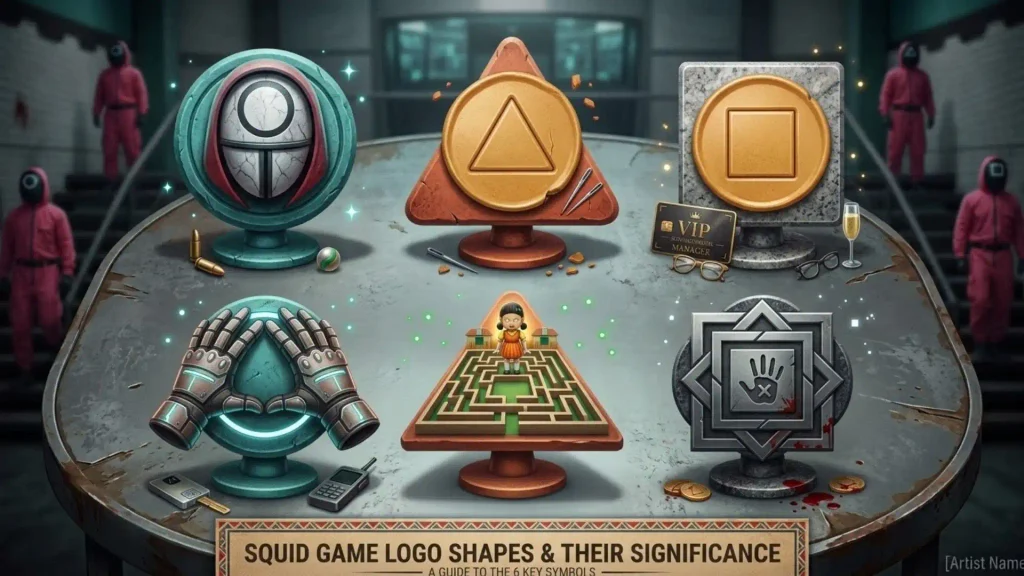
The Squid Game logo shapes are closely associated with the circle, triangle, and square used throughout the series. These simple geometric forms appear on guard masks, recruitment materials, and other visual elements.
Their connection to the traditional squid-shaped playground court gives them a practical foundation in the story. They aren’t random decorations added only to make the series look mysterious.
Production designer Chae Kyoung-sun explained that the shapes were deliberately repeated throughout the show’s design. The masks provide the most obvious example, but the visual language extends beyond them.
The shapes work well for several reasons:
- Easy recognition: Viewers can identify the three forms quickly.
- Visual consistency: Repeated shapes connect costumes, props, and game environments.
- Role identification: The masks communicate staff rank without requiring names.
- Memorable branding: Simple geometric elements remain recognizable in posters and fan graphics.
The logo and the mask symbols are related, but they aren’t identical concepts. The logo identifies the series, while the mask markings identify roles within its fictional organization.
Squid Game Symbols and Emojis: Copy and Paste
If you want Squid Game symbols copy and paste for a social media caption, message, or fan post, start with the basic geometric characters below.
These are text characters and emojis that resemble the show’s visual language. They aren’t official Netflix logo files, and their appearance may vary between devices.
Squid Game Circle, Triangle, and Square Symbols
Copy these individual characters:
| Symbol | Name | Common use |
| 〇 | Circle | Circle-themed text or designs |
| △ | Triangle | Triangle-themed text or designs |
| □ | Square | Square-themed text or designs |
| ⭕ | Outlined circle emoji | Decorative captions |
| 🔺 | Red triangle emoji | Guard-inspired graphics |
| ⬛ | Black square emoji | Simple dark geometric designs |
You can also combine the three main characters:
〇 △ □
This sequence works well in plain text, although the symbols may not match the exact proportions or appearance of the series’ graphics.
Squid Game Emoji Combinations
The following Squid Game emojis combine familiar objects with geometric characters to suggest specific games or visual themes.
| Theme | Emoji combination |
| General Squid Game theme | 🦑 〇 △ □ |
| Guard-inspired design | 🔺 ⭕ ⬛ |
| Red Light, Green Light | 🚦 🏃 🛑 |
| Dalgona challenge | 🍬 △ ⭐ ☂️ |
| Survival competition | 🎮 ⚠️ 🔺 |
| Glass Bridge | 🪟 ⚠️ 🪜 |
| Childhood-game theme | 🎲 🦑 〇 △ □ |
These combinations are illustrative rather than official emoji codes. Some emojis may look different on Apple, Android, Windows, and social media platforms.
How to Use Squid Game Symbols in Text
You can use these characters in several ways:
- Add them to Instagram captions or TikTok descriptions.
- Use them in fan discussions and messages.
- Include them in personal notes or themed invitations.
- Combine them with ordinary text for a simple graphic effect.
- Use them as placeholders when planning a design.
For professional graphics, use an image or vector asset instead of relying on text characters. A Unicode symbol is not the same thing as a transparent PNG or an official logo.
Squid Game Games and Their Symbols
The games use familiar objects, simple shapes, and recognizable childhood activities. Their visual appeal makes the challenges easy to understand, while the deadly consequences create the series’ central contrast.
Season 1 Games and Visual Motifs
Red Light, Green Light introduces Young-hee, the motion-detecting doll. The familiar playground activity becomes terrifying when movement can lead to elimination.
The doll’s childlike appearance clashes with the game’s lethal rules. This contrast helps establish the series’ unsettling visual style from its opening challenge.
Dalgona candy introduces another important use of shapes. Players must remove an outlined design from a thin sugar candy without breaking it. The available designs include a circle, triangle, star, and umbrella.
The challenge turns simple geometry into a test of patience, precision, and decision-making.
Tug of War uses a rope to emphasize teamwork and collective strength. Players must coordinate their actions because individual effort alone may not be enough.
Marbles transforms a familiar childhood activity into a test of trust. The game forces partners to confront the possibility that one person’s survival may require another person’s elimination.
Glass Stepping Stones presents players with a series of dangerous choices. Each step requires them to judge risk with incomplete information.
The final Squid Game returns to the traditional squid-shaped court. Its offense-and-defense structure connects the series’ title to its childhood-game origins.
Season 2 Games and Visual Motifs
Season 2 introduces or expands several familiar Korean games and new survival challenges.
Ddakji uses folded paper tiles. The Recruiter challenges Gi-hun to flip a tile by striking it with another folded tile. The paper game becomes the gateway to the larger competition.
Six-Legged Pentathlon combines several short challenges into a team event. The format highlights coordination, timing, and cooperation under pressure.
Mingle uses a spinning carousel and numbered groups. Players must quickly form groups of the required size and enter rooms before time runs out.
The colorful carousel creates a playful appearance, but the rules encourage panic and difficult social choices.
Season 3 Games and the Return of Geometric Shapes
Season 3 continues the show’s use of childhood activities and striking visual environments. Its challenges include Hide and Seek, Jump Rope, and the final Sky Squid Game.
The Sky Squid Game places players on three elevated structures shaped as a square, triangle, and circle. This arrangement brings the central geometric motifs back into the competition’s final stages.
The shapes now function as part of the physical environment rather than only as symbols on masks. Their return connects the series’ visual identity to the traditional playground game that inspired its title.
Across all three seasons, the games repeatedly turn familiar activities into tests of risk, trust, strategy, and survival.
What Does the Original Korean Squid Game Mean?
The title Squid Game refers to a traditional Korean children’s game known as ojingeo geim (오징어 게임). The word ojingeo means squid in Korean.
The traditional game uses a court drawn on the ground in a shape resembling a squid. Players take offensive or defensive roles and try to achieve their objective within the marked playing area.
This connection explains why the circle, triangle, and square appear so frequently in the series. They are connected to the game’s drawn court and its visual design.
Why Does Squid Game Use Children’s Games?
Children’s games provide simple rules that viewers can understand quickly. Most people can grasp the basic idea of stopping when told, flipping a tile, or choosing a safe path across a bridge.
The series changes the stakes. Contestants face severe consequences for losing, turning ordinary playground activities into frightening tests of judgment.
This contrast supports several themes:
- Childhood innocence versus brutality: Familiar games become instruments of danger.
- Nostalgia: The activities evoke memories of childhood and ordinary social play.
- Fairness: Simple rules create the appearance of a straightforward contest, even when the participants face unequal circumstances.
- Survival: Familiar skills become matters of life and death inside the competition.
The cultural context matters. These games draw from Korean childhood traditions, but the series adapts them for a fictional dystopian setting.
What Does Squid Game Symbolize in Real Life?
Beyond its masks and playgrounds, Squid Game explores social inequality, economic pressure, institutional power, and human exploitation. The story follows people whose financial problems make an extreme competition appear worth the risk.
These themes invite comparisons with real life. However, the fictional organization should not be treated as a literal map of governments, companies, or social classes.
Wealth Inequality and Financial Desperation
The contestants enter the games because many face overwhelming financial problems. Debt, unemployment, family responsibilities, and limited options influence their decisions.
The enormous cash prize gives the competition an apparent solution to those problems. Yet the contestants must risk their lives to pursue it.
This creates a troubling question: how free is a choice when someone’s circumstances leave them feeling they have few alternatives?
The series uses financial desperation to explore the difference between formally accepting a risk and having meaningful options. Its message isn’t that every person facing debt would make the same choices. Instead, it shows how extreme pressure can distort judgment.
Power, Control, and Social Hierarchy
The symbols make the organization’s power structure visible. Workers follow routines, soldiers enforce rules, and managers supervise operations. The Front Man occupies a broader leadership role, while the VIPs watch from a position of wealth.
This structure reflects the show’s interest in unequal power.
- Players face the immediate consequences of the games.
- Workers maintain the facilities.
- Soldiers enforce the rules.
- Managers coordinate staff and operations.
- The Front Man oversees the competition.
- VIPs observe the suffering as entertainment.
The arrangement emphasizes that power and responsibility are distributed unevenly. Those who control the competition do not face the same risks as the people forced to participate.
The Illusion of Fair Competition
The competition presents rules that appear consistent. Players receive instructions, take part in defined challenges, and compete for the same prize.
Yet the contestants enter with different abilities, relationships, and levels of information. Some have physical advantages, while others rely on strategy or cooperation.
The organizers control the environment and determine the consequences. That imbalance complicates the idea that the competition is truly fair.
The series therefore invites viewers to consider the difference between equal rules and equal opportunities. A contest can apply the same written rules to everyone while still placing some people at a disadvantage.
Human Behavior Under Pressure
The games expose competing instincts. Some contestants build alliances and protect vulnerable partners, while others betray friends when survival seems threatened.
The marble game offers a particularly clear example. Players who have formed relationships must confront the possibility that only one person can survive their pairing.
These situations explore:
- Trust and betrayal
- Cooperation and competition
- Fear and self-preservation
- Loyalty and moral responsibility
- The influence of desperation on decision-making
The series does not reduce every character to a single moral label. People make different choices depending on their histories, relationships, and circumstances.
Squid Game Characters and Their Symbolic Roles
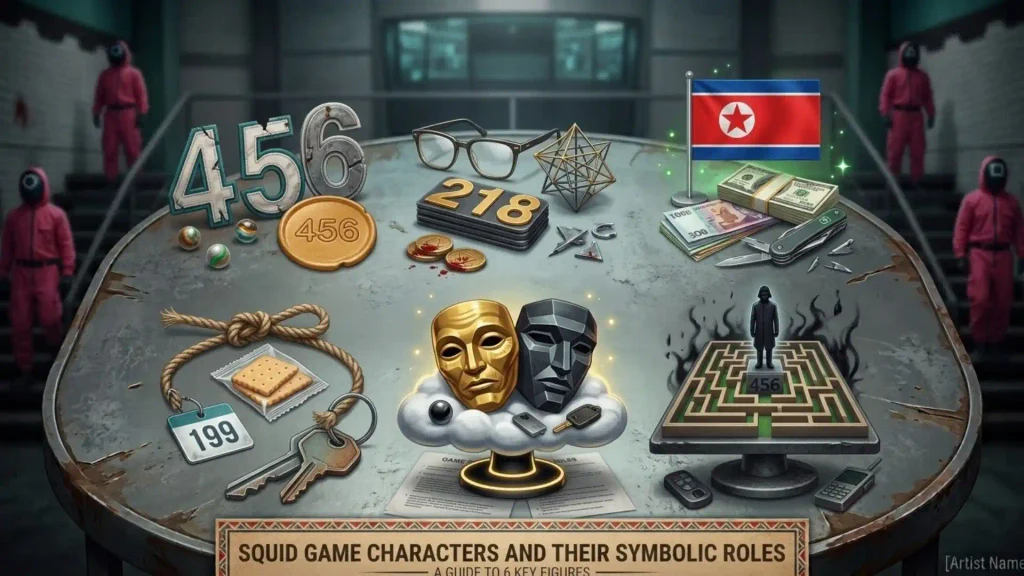
The characters give the show’s wider themes a human dimension. Their experiences show how financial pressure, personal ambition, family obligations, and moral conflict can shape behavior.
Seong Gi-hun: Player 456
Seong Gi-hun enters the competition with serious financial problems and strained family relationships. His circumstances help establish the economic desperation that drives the story.
His character also raises questions about compassion and responsibility. Even under pressure, he repeatedly struggles with choices that could harm other people.
Gi-hun’s journey connects the show’s survival premise to its moral questions. Winning money is not the only issue; the competition also challenges his understanding of what it means to remain human.
Cho Sang-woo: Player 218
Cho Sang-woo is intelligent, strategic, and deeply troubled by his financial downfall. His background creates a contrast between outward achievement and private desperation.
As the games progress, his decisions explore ambition, shame, and moral compromise. His story suggests that intelligence alone does not guarantee good judgment when fear and self-interest take control.
Sang-woo is more than a simple symbol of greed. His choices emerge from a combination of personal history, pressure, and the competition’s brutal incentives.
Kang Sae-byeok: Player 067
Kang Sae-byeok enters the games hoping to improve her family’s circumstances. Her distrust of others reflects the difficult experiences that have shaped her life.
Her character explores survival, independence, and family loyalty. She also demonstrates how a person’s private hopes can remain important even in an environment designed to strip away individuality.
The Front Man
The Front Man represents the leadership and secrecy surrounding the competition. His concealed identity and distinctive clothing separate him from the ordinary guards.
His role raises questions about obedience, authority, and the people who maintain an exploitative system. The series also explores how personal choices can become entangled with institutional power.
Young-hee and the Recruiter
Young-hee, the doll in Red Light, Green Light, transforms a familiar childhood image into a source of fear. Her fixed gaze and movement detection make an ordinary playground game feel dangerous.
The Recruiter also connects ordinary life to the competition. His ddakji challenge begins as a simple contest but becomes a doorway into the larger system.
Both figures show how the series turns familiar objects and activities into unsettling visual motifs.
Squid Game Symbols in Pop Culture and Design
The circle, triangle, and square have become recognizable parts of the show’s visual identity. Their simplicity makes them easy to reproduce in fan art, costumes, posters, and social media graphics.
The guard masks and green tracksuits are especially recognizable. Together, these visual elements allow people to reference the series without reproducing an entire scene.
Common uses include:
- Fan art: Illustrations featuring masks, geometric shapes, or game environments.
- Costumes: Green tracksuits and guard-inspired outfits.
- Posters: Geometric motifs combined with the show’s title or characters.
- Social media: Emoji combinations, captions, and fan discussions.
- Graphic design: Simple shape arrangements inspired by the series’ visual style.
A text symbol is useful for a quick caption, but it won’t reproduce the exact design of a mask or logo. A PNG or vector image is better when precise proportions and appearance matter.
When using artwork commercially, check its licensing and trademark status. Fan-made graphics are not automatically official or authorized merchandise.
Frequently Asked Questions About Squid Game Symbols
What do the circle, triangle, and square mean in Squid Game?
The circle identifies workers, the triangle identifies soldiers, and the square identifies managers. The symbols help viewers recognize the three main categories of masked guards.
Which Squid Game symbol has the highest rank?
The square represents the highest rank among the three standard guard categories. Square-masked managers supervise lower-ranking staff, while the Front Man holds a broader leadership position.
Why do Squid Game guards wear masks?
The masks conceal individual identities and display each guard’s role. Their geometric markings allow viewers to distinguish workers, soldiers, and managers without seeing their faces.
What does the Squid Game logo mean?
The logo uses the series’ recognizable geometric visual language. The circle, triangle, and square connect to the guard hierarchy and the traditional squid-shaped playground court. The logo should not be confused with the separate role markings on guard masks.
What do the colors in Squid Game represent?
Green tracksuits identify players, while pink-red uniforms distinguish guards. Black masks and distinctive clothing separate higher-level figures from ordinary contestants. Interpretations such as danger, vulnerability, and authority come from how the series presents these colors.
Can I copy and paste Squid Game symbols?
Yes. You can copy characters such as 〇 △ □ into messages, captions, and personal designs. Their appearance may vary across fonts and devices, and they are not substitutes for official logo artwork.
Conclusion
The Squid Game symbols combine simple geometry with a clear fictional hierarchy. Circles identify workers, triangles identify soldiers, and squares identify managers. Together, they make the organization’s structure visible at a glance.
The show’s colors, masks, games, and costumes build on that visual system. They distinguish players from staff while reinforcing themes of power, anonymity, and unequal control.
The symbols also connect the series to the traditional Korean children’s game that inspired its title. Familiar shapes and playground activities become part of a much darker story about financial desperation, survival, and moral choices.
Ultimately, the most important meaning of the circle, triangle, and square comes from their role in the series. Their broader geometric associations can add another layer of interpretation, but they should remain distinct from confirmed facts about the show’s design.

Ivy Reynolds
Hi, I’m Ivy Reynolds, a storyteller at heart who loves exploring the small wonders of everyday life. Writing gives me a chance to turn ordinary moments into extraordinary tales, and I’m always chasing inspiration from the world around me. I believe stories have the power to connect people, heal hearts, and spark imagination. When I’m not writing, you’ll find me wandering through nature, sipping tea, or lost in a good book. My journey as an author is all about sharing emotions, laughter, and little lessons that stay with you. Thank you for being part of this adventure with me.
Books:
-
Whispers of the Willow
-
Echoes of the Heart