
Physics symbols are a shorthand language used to describe physical quantities, mathematical relationships, constants, units, and scientific ideas. Instead of writing a full word such as “velocity,” “force,” or “electric current” every time, physicists use symbols such as v, F, and I.
If you are learning physics, you will quickly encounter Latin letters, Greek letters, mathematical signs, subscripts, superscripts, and SI unit symbols. The challenge is that one symbol does not always have one universal meaning. For example, T can represent temperature in thermodynamics or period in wave physics, while V can represent voltage or volume.
This complete guide explains the most common physics symbols and their meanings, including mechanics, electricity, magnetism, waves, optics, thermodynamics, atomic physics, quantum physics, Greek letters, mathematical symbols, and SI units.
It also explains the difference between a quantity symbol and a unit symbol, how uppercase and lowercase letters differ, and how to identify an unfamiliar symbol in a physics equation.
Quick answer: Common physics symbols include m for mass, t for time, v for velocity, a for acceleration, F for force, p for momentum, E for energy, P for power, V for voltage or volume, I for current, R for resistance, f for frequency, and λ for wavelength.
What Are Physics Symbols?
Physics symbols are letters, Greek characters, and mathematical signs used to represent physical quantities and relationships.
For example:
F = ma
means that force equals mass multiplied by acceleration.
Here:
- F = force
- m = mass
- a = acceleration
Symbols make equations shorter and allow scientists and students to communicate physical relationships efficiently.
The International System of Units (SI) also has standardized symbols for measurement units, such as m for meter, kg for kilogram, s for second, and A for ampere. NIST distinguishes quantity symbols from unit symbols and notes that quantity symbols are generally written as italic letters, while unit symbols use upright type.
Why Are Symbols Used in Physics?
Physics symbols are useful because they:
- Make equations concise
- Reduce repeated words
- Help organize calculations
- Allow formulas to work across languages
- Show relationships between physical quantities
- Make scientific communication more consistent
- Help students recognize familiar formulas quickly
For example, writing:
distance = speed × time
is perfectly understandable.
But the symbolic version:
d = vt
is faster to write and easier to use in calculations.
Physics Symbols Cheat Sheet
The following table provides a quick reference to many of the most common physics symbols.
| Symbol | Quantity | Common SI Unit | Example Formula |
| m | Mass | kg | F = ma |
| t | Time | s | v = d/t |
| d | Distance | m | d = vt |
| x | Position/displacement | m | Δx = x₂ − x₁ |
| u | Initial velocity | m/s | v = u + at |
| v | Velocity | m/s | v = u + at |
| a | Acceleration | m/s² | a = Δv/Δt |
| F | Force | N | F = ma |
| p | Momentum | kg·m/s | p = mv |
| W | Work | J | W = Fd |
| E | Energy | J | E = mc² |
| P | Power | W | P = W/t |
| g | Gravitational acceleration | m/s² | W = mg |
| r | Radius/distance | m | v = ωr |
| τ | Torque | N·m | τ = rF sinθ |
| f | Frequency | Hz | f = 1/T |
| T | Period/temperature | s or K | T = 1/f |
| λ | Wavelength | m | v = fλ |
| A | Amplitude/area | m or m² | — |
| V | Voltage/volume | V or m³ | V = IR |
| I | Electric current | A | I = Q/t |
| R | Resistance | Ω | V = IR |
| Q/q | Charge/heat | C or J | Q = It |
| C | Capacitance | F | C = Q/V |
| B | Magnetic field | T | — |
| Φ | Magnetic flux | Wb | Φ = BA cosθ |
| ρ | Density/resistivity | kg/m³ or Ω·m | ρ = m/V |
| U | Internal energy | J | ΔU = Q − W |
| S | Entropy | J/K | ΔS = Q/T |
| p/P | Pressure/power | Pa or W | p = F/A |
These are common conventions rather than a rule that applies to every textbook. Physics notation can change with the subject and context.
Physics Quantity Symbols vs. Unit Symbols
One of the easiest mistakes for beginners is confusing a physical quantity symbol with the symbol for its unit.
Consider:
F = 50 N
Here:
- F is the quantity symbol for force.
- 50 is the numerical value.
- N is the unit symbol for newton.
The same pattern appears elsewhere:
m = 5 kg
- m = mass
- 5 = numerical value
- kg = kilogram
NIST describes quantity symbols and unit symbols as different types of notation. Quantity symbols are generally italicized, while unit symbols are written upright.
Examples of Quantity Symbols and Units
| Physical Quantity | Quantity Symbol | SI Unit | Unit Symbol |
| Length | l, x, r | meter | m |
| Mass | m | kilogram | kg |
| Time | t | second | s |
| Electric current | I or i | ampere | A |
| Temperature | T | kelvin | K |
| Force | F | newton | N |
| Energy | E | joule | J |
| Power | P | watt | W |
| Pressure | p | pascal | Pa |
| Electric charge | Q or q | coulomb | C |
| Voltage | V | volt | V |
| Resistance | R | ohm | Ω |
The distinction is important because F and N do not mean the same thing. F represents force as a physical quantity, while N identifies the unit used to express force.
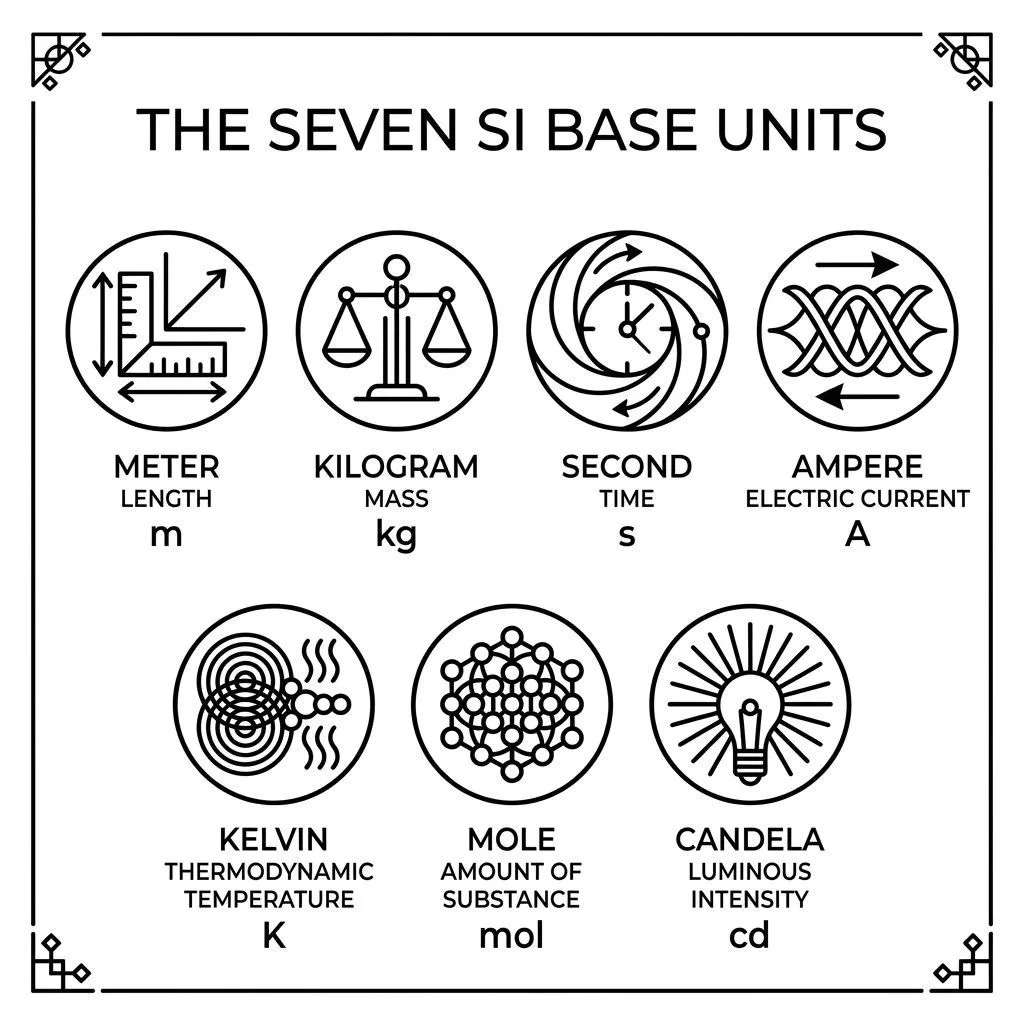
The Seven SI Base Units
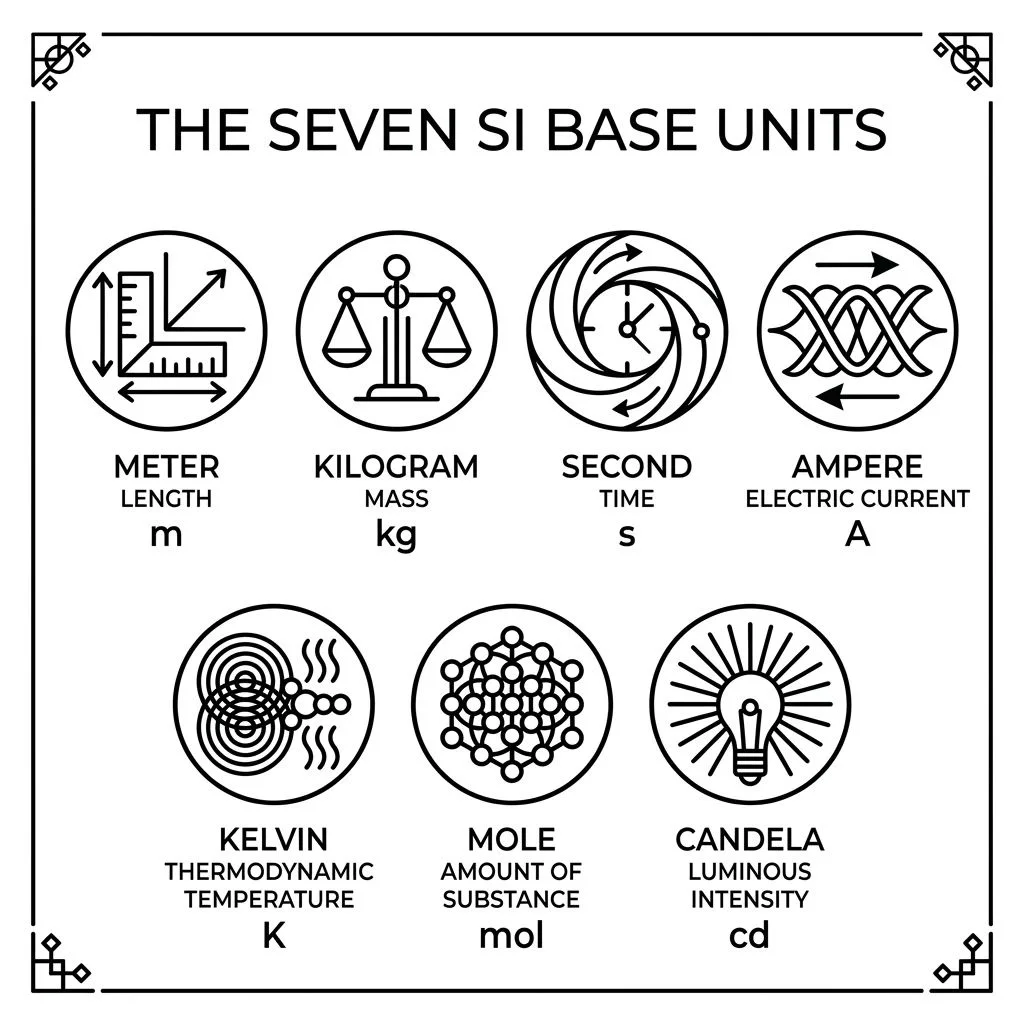
The SI system is built around seven base units. NIST identifies them as the meter, kilogram, second, ampere, kelvin, mole, and candela.
| Base Quantity | Typical Quantity Symbol | SI Unit | Unit Symbol |
| Length | l, x, r | meter | m |
| Mass | m | kilogram | kg |
| Time | t | second | s |
| Electric current | I, i | ampere | A |
| Thermodynamic temperature | T | kelvin | K |
| Amount of substance | n | mole | mol |
| Luminous intensity | Iᵥ | candela | cd |
The quantity symbols shown here are typical conventions; a particular textbook may use a different symbol depending on context. NIST’s SI guidance also distinguishes these quantity symbols from the mandatory unit symbols.
Why SI Units Matter in Physics
SI units give physics a common measurement system.
For example, a force can be described as:
20 N
rather than using an unrelated unit system.
SI derived units can then be built from the base units. For example:
1 N = 1 kg·m/s²
This means a newton can be expressed using kilograms, meters, and seconds.
NIST explains that SI contains base units and derived units, with derived units formed algebraically from base units.
Common SI Derived Units in Physics
Many important physics quantities use derived SI units with special names and symbols.
| Quantity | Unit Name | Unit Symbol | Base-Unit Relationship |
| Force | newton | N | kg·m/s² |
| Energy | joule | J | kg·m²/s² |
| Power | watt | W | kg·m²/s³ |
| Pressure | pascal | Pa | kg/(m·s²) |
| Electric charge | coulomb | C | A·s |
| Voltage | volt | V | kg·m²/(s³·A) |
| Resistance | ohm | Ω | kg·m²/(s³·A²) |
| Capacitance | farad | F | A²·s⁴/(kg·m²) |
| Magnetic flux | weber | Wb | kg·m²/(s²·A) |
| Magnetic flux density | tesla | T | kg/(s²·A) |
| Inductance | henry | H | kg·m²/(s²·A²) |
| Frequency | hertz | Hz | s⁻¹ |
NIST lists derived units and their relationships to SI base units as part of the SI system.
Common Physics Symbols A–Z
There is no single letter-to-quantity dictionary that works for every physics problem. Still, the following A–Z reference covers many symbols students commonly encounter.
A–E Physics Symbols
A / a
- A = amplitude, area, or another context-dependent quantity
- a = acceleration
B / b
- B = magnetic flux density
- b = can represent different quantities depending on the topic
C / c
- C = capacitance in many electrical contexts
- c = speed of light in vacuum
D / d
- d = distance or displacement in some contexts
- D = may represent other quantities in specialized fields
E / e
- E = energy or electric field
- e = elementary charge in some contexts
The exact interpretation should always be checked against the equation.
F–M Physics Symbols
F / f
- F = force
- f = frequency or focal length
G / g
- G = universal gravitational constant
- g = gravitational acceleration near a planetary surface
H / h
- H = magnetic field strength in electromagnetism
- h = Planck constant
I / i
- I = electric current
- i = current or imaginary-unit notation depending on context
J / j
- J can represent current density or other specialized quantities
- j can also have specialized meanings
K / k
- K = kelvin as a unit symbol
- k = spring constant, Boltzmann constant, or wave number depending on context
L / l
- L = inductance or angular momentum in some contexts
- l = length
M / m
- M = mass, molar mass, or another context-specific quantity
- m = mass in many elementary physics equations
N–Z Physics Symbols
N / n
- N = newton as a unit symbol
- n = amount of substance, refractive index, or another quantity depending on context
P / p
- P = power
- p = momentum or pressure depending on the subject
Q / q
- Q or q = electric charge
- Q can also represent heat in thermodynamics
R / r
- R = electrical resistance or gas constant
- r = radius or position vector magnitude
S / s
- S = entropy
- s can represent displacement in some kinematics conventions
T / t
- T = temperature or period
- t = time
U / u
- U = internal energy
- u = initial velocity in common kinematics notation
V / v
- V = voltage or volume
- v = velocity
W / w
- W = work or watt as a unit symbol
- w can have specialized meanings
X / x
- x = position or displacement coordinate
- X may be used for other quantities in specialized physics
Y / y
- y = position coordinate in many mechanics problems
- Y may represent other quantities depending on the field
Z / z
- z = position coordinate
- Z can represent quantities such as atomic number or impedance in specific contexts
Uppercase and Lowercase Physics Symbols
Capitalization can completely change the meaning of a symbol.
For example:
- v is commonly velocity.
- V commonly represents voltage or volume.
- p can represent pressure or momentum.
- P commonly represents power.
- c commonly represents the speed of light.
- C commonly represents capacitance.
This is why copying a formula with the wrong capitalization can create a completely different expression.
Common Uppercase vs. Lowercase Pairs
| Lowercase | Common Meaning | Uppercase | Common Meaning |
| a | Acceleration | A | Amplitude/area |
| c | Speed of light | C | Capacitance |
| f | Frequency | F | Force |
| g | Gravitational acceleration | G | Gravitational constant |
| h | Planck constant | H | Magnetic field strength |
| p | Momentum/pressure | P | Power |
| r | Radius | R | Resistance |
| t | Time | T | Temperature/period |
| v | Velocity | V | Voltage/volume |
| w | Specialized quantity | W | Work/watt |
Not every pair follows a simple opposite convention. The meaning comes from the topic and formula.
Greek Symbols in Physics
Greek letters are extremely common in physics. They are used for angles, wavelengths, coefficients, fields, constants, radiation, phase, and many other quantities.
| Symbol | Name | Common Physics Meaning |
| α | Alpha | Alpha particle, angular acceleration |
| β | Beta | Beta particle, coefficient |
| γ | Gamma | Gamma radiation, Lorentz factor |
| Δ | Delta | Change in a quantity |
| δ | Lowercase delta | Small change or variation |
| ε | Epsilon | Permittivity or other context-specific quantities |
| η | Eta | Efficiency in some contexts |
| θ | Theta | Angle |
| λ | Lambda | Wavelength |
| μ | Mu | Coefficient of friction, permeability |
| ν | Nu | Frequency in some fields |
| π | Pi | Mathematical constant |
| ρ | Rho | Density, resistivity |
| σ | Sigma | Stress, conductivity, surface density |
| τ | Tau | Torque, time constant |
| φ | Phi | Phase angle or other quantities |
| Φ | Capital Phi | Flux |
| ψ | Psi | Wavefunction in quantum mechanics |
| ω | Omega | Angular frequency |
What Does Δ Mean in Physics?
Δ means a change in a quantity in many physics contexts.
For example:
Δx = x₂ − x₁
means the change in position.
Similarly:
Δt = t₂ − t₁
means the change in time.
You may also encounter:
- Δv = change in velocity
- ΔT = change in temperature
- ΔP = change in pressure
- ΔE = change in energy
The symbol following Δ tells you what quantity has changed.
What Does λ Mean in Physics?
λ (lambda) commonly represents wavelength.
The basic wave relationship is:
v = fλ
where:
- v = wave speed
- f = frequency
- λ = wavelength
Wavelength is generally expressed in meters.
What Does θ Mean in Physics?
θ (theta) commonly represents an angle.
It appears in formulas involving:
- Force components
- Torque
- Projectile motion
- Optics
- Waves
- Rotational motion
For example:
τ = rF sinθ
uses θ as the angle between the relevant vectors.
What Does μ Mean in Physics?
μ (mu) can have several meanings.
Depending on the topic, it may represent:
- Coefficient of friction
- Magnetic permeability
- Reduced mass
- The SI prefix micro when written as µ
Always check the surrounding equation.
What Does ω Mean in Physics?
ω (omega) commonly represents angular velocity or angular frequency.
For angular frequency:
ω = 2πf
where f is frequency.
The usual unit is radians per second.
Mechanics Physics Symbols

Mechanics studies motion, forces, momentum, energy, and related physical behavior.
Motion Symbols
Common kinematics symbols include:
- d = distance
- x = position
- t = time
- u = initial velocity
- v = final velocity or velocity
- a = acceleration
Common equations include:
v = u + at
and:
s = ut + ½at²
Notation can vary between courses, so check how your textbook defines each variable.
Force Symbols
Force is usually represented by:
F
Newton’s second law is:
F = ma
where:
- F = force
- m = mass
- a = acceleration
The SI unit of force is the newton, N.
Momentum Symbols
Momentum is commonly represented by:
p
The formula is:
p = mv
where:
- p = momentum
- m = mass
- v = velocity
Momentum has the SI unit kg·m/s.
Torque Symbols
Torque is commonly represented by:
τ
A common formula is:
τ = rF sinθ
where:
- τ = torque
- r = lever-arm distance
- F = force
- θ = relevant angle
The SI unit is N·m.
Energy, Work, and Power Symbols
Energy
Energy is usually represented by:
E
Its SI unit is the joule (J).
Common forms include kinetic, potential, thermal, electrical, chemical, and nuclear energy.
Kinetic Energy
Kinetic energy is commonly written as:
KE = ½mv²
where:
- m = mass
- v = velocity
Potential Energy
Near Earth’s surface, gravitational potential energy is commonly written:
PE = mgh
where:
- m = mass
- g = gravitational acceleration
- h = height
Work
Work is commonly represented by:
W
For a constant force:
W = Fd cosθ
Work is measured in joules.
Power
Power is commonly represented by:
P
A basic formula is:
P = W/t
Power measures the rate at which work is done.
Its SI unit is the watt (W).
Notice that P is the quantity symbol for power, while W is the unit symbol for watt.
Gravity Physics Symbols
Gravity commonly involves two symbols that beginners confuse:
g and G.
What Does g Mean?
Lowercase g commonly represents gravitational acceleration.
Near Earth’s surface, it is approximately:
9.8 m/s²
The precise local value varies.
What Does G Mean?
Capital G represents the universal gravitational constant in Newton’s law of universal gravitation:
F = Gm₁m₂/r²
Here:
- F = gravitational force
- G = gravitational constant
- m₁, m₂ = masses
- r = distance between their centers
Therefore:
G ≠ g
They are different physical quantities.
Electricity Physics Symbols
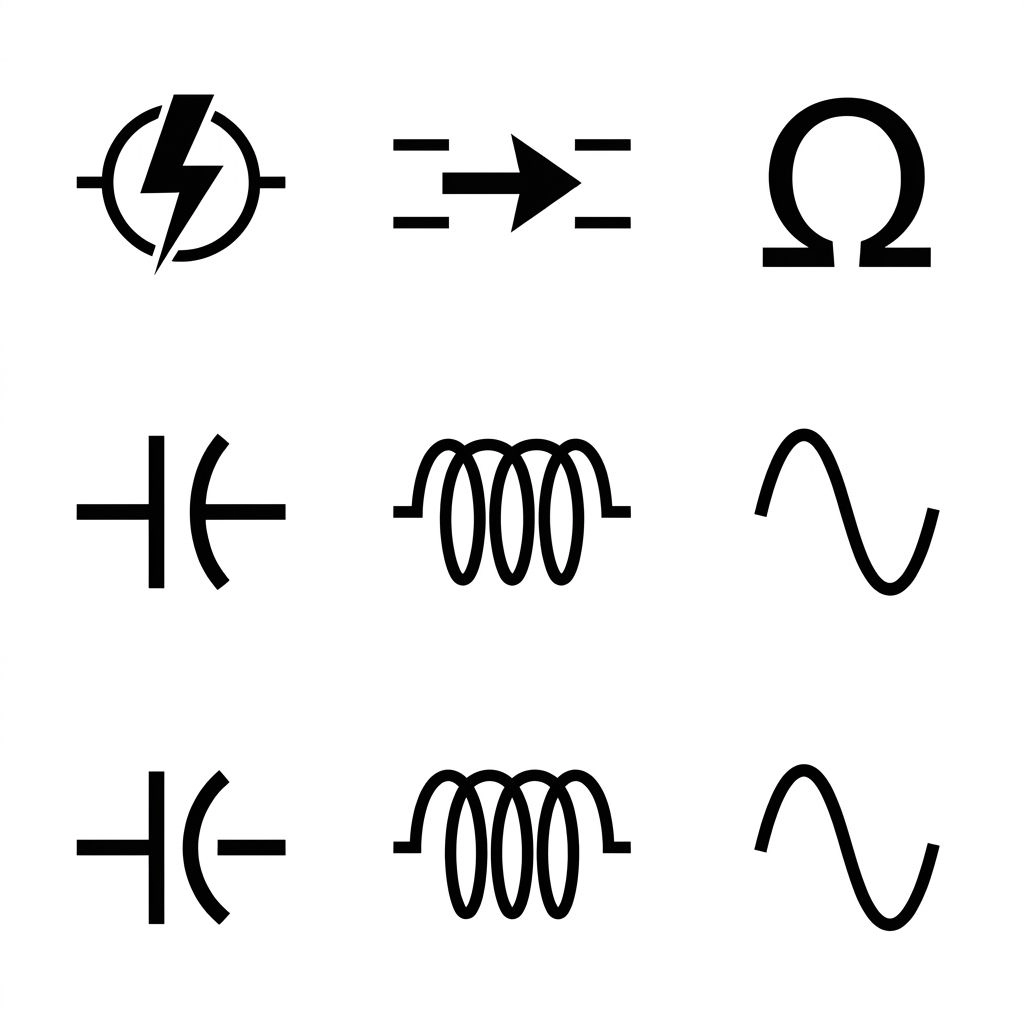
Electricity uses a set of symbols that appear repeatedly in circuit problems.
Electric Charge
Electric charge is commonly represented by:
Q or q
The SI unit is the coulomb (C).
Electric Current
Current is represented by:
I
The SI unit is the ampere (A).
A common relationship is:
I = Q/t
Voltage
Voltage or potential difference is represented by:
V
Its SI unit is the volt (V).
Resistance
Resistance is represented by:
R
Its SI unit is the ohm (Ω).
Ohm’s law is:
V = IR
Capacitance
Capacitance is represented by:
C
Its SI unit is the farad (F).
A basic relationship is:
C = Q/V
Electrical Power
Electrical power is commonly represented by:
P
Useful equations include:
P = VI
P = I²R
and:
P = V²/R
The correct equation depends on the information available.
Magnetism Physics Symbols
Magnetic Flux Density
Magnetic flux density is commonly represented by:
B
Its SI unit is the tesla (T).
Magnetic Flux
Magnetic flux is represented by:
Φ
Its SI unit is the weber (Wb).
A simple expression for magnetic flux through a flat surface is:
Φ = BA cosθ
where θ is the angle between the magnetic field and the normal to the surface.
Magnetic Field Strength
Magnetic field strength is often represented by:
H
The exact relationship between B and H depends on the material and physical situation.
Waves and Sound Physics Symbols
Waves use several symbols that appear frequently in physics.
Frequency
Frequency is represented by:
f
Its SI unit is hertz (Hz).
Frequency describes how many cycles occur per unit time.
Period
Period is represented by:
T
It is the time for one complete cycle.
The relationship is:
T = 1/f
Wavelength
Wavelength is:
λ
It is usually measured in meters.
Wave Speed
Wave speed is:
v
The basic wave equation is:
v = fλ
Amplitude
Amplitude is commonly represented by:
A
It describes the maximum displacement from equilibrium in many wave situations.
Optics Physics Symbols
Optics deals with light, mirrors, lenses, refraction, and related phenomena.
Refractive Index
Refractive index is commonly represented by:
n
A common relationship is:
n = c/v
where:
- n = refractive index
- c = speed of light in vacuum
- v = speed of light in the medium
Angles in Optics
Angles are often represented by θ.
For example:
- θᵢ = angle of incidence
- θᵣ = angle of refraction
Snell’s law is:
n₁ sinθ₁ = n₂ sinθ₂
Focal Length
Focal length is commonly represented by:
f
It is usually expressed in meters in SI calculations.
Thermodynamics Physics Symbols
Thermodynamics uses symbols for temperature, pressure, volume, heat, internal energy, and entropy.
Temperature
Temperature is:
T
The SI unit is kelvin:
K
Pressure
Pressure is generally represented by:
p
Its SI unit is the pascal:
Pa
A basic relationship is:
p = F/A
where:
- p = pressure
- F = force
- A = area
Volume
Volume is commonly represented by:
V
The SI unit is:
m³
Heat
Heat is commonly represented by:
Q
Its SI unit is the joule.
Internal Energy
Internal energy is commonly represented by:
U
Its SI unit is the joule.
Entropy
Entropy is represented by:
S
Its SI unit is:
J/K
Atomic and Nuclear Physics Symbols
Atomic and nuclear physics introduces additional notation.
| Symbol | Common Meaning |
| e⁻ | Electron |
| e⁺ | Positron |
| p | Proton |
| n | Neutron |
| α | Alpha particle |
| β | Beta particle |
| γ | Gamma radiation |
| ν | Neutrino in some contexts |
| Z | Atomic number |
| A | Mass number |
Atomic Number
Z commonly represents atomic number.
It identifies the number of protons in an atomic nucleus.
Mass Number
A commonly represents mass number.
It represents the total number of protons and neutrons in a nucleus.
Therefore:
A = Z + N
where N represents the neutron number in this context.
Quantum Physics Symbols
Quantum physics uses specialized symbols and notation.
Planck Constant
Planck’s constant is:
h
It is a fundamental constant in quantum physics.
The reduced Planck constant is:
ℏ
and is commonly called “h-bar.”
Photon Energy
A common equation is:
E = hf
where:
- E = photon energy
- h = Planck constant
- f = frequency
de Broglie Wavelength
Matter can also be associated with a wavelength:
λ = h/p
where:
- λ = wavelength
- h = Planck constant
- p = momentum
Wavefunction
The quantum wavefunction is commonly represented by:
ψ
Its interpretation depends on the formulation and context of quantum mechanics.
Relativity Physics Symbols
Relativity uses several familiar symbols in special combinations.
Speed of Light
The speed of light in vacuum is represented by:
c
Its exact value is:
299,792,458 m/s
NIST identifies the speed of light in vacuum as one of the defining constants underlying the modern SI.
Mass-Energy Equivalence
One of the most famous equations in physics is:
E = mc²
where:
- E = energy
- m = mass
- c = speed of light in vacuum
Physics Mathematical Symbols
Physics relies heavily on mathematical notation.
| Symbol | Meaning |
| = | Equal to |
| ≠ | Not equal to |
| ≈ | Approximately equal to |
| ∝ | Proportional to |
| < | Less than |
| > | Greater than |
| ≤ | Less than or equal to |
| ≥ | Greater than or equal to |
| Δ | Change in |
| Σ | Sum |
| ∫ | Integral |
| ∂ | Partial derivative |
| ∇ | Gradient or vector differential operator |
| → | Direction or vector notation |
| ∞ | Infinity |
| √ | Square root |
| π | Pi |
| θ | Angle |
| ± | Plus or minus |
What Does ∝ Mean in Physics?
The symbol ∝ means “is proportional to.”
For example:
F ∝ 1/r²
means that force varies inversely with the square of distance in that particular relationship.
A proportional relationship is different from simply saying two quantities are equal.
What Does ≈ Mean?
≈ means approximately equal to.
For example:
g ≈ 9.8 m/s²
means the value is approximately 9.8 meters per second squared.
Physics Symbols With Multiple Meanings
Some of the most confusing symbols are those that appear in multiple branches of physics.
| Symbol | Possible Meaning |
| A | Amplitude, area, mass number |
| E | Energy, electric field |
| P | Power, pressure |
| Q | Electric charge, heat |
| R | Resistance, radius, gas constant |
| T | Temperature, period, tension |
| V | Voltage, volume |
| W | Work, watt as a unit |
| p | Momentum, pressure |
| f | Frequency, focal length |
| n | Refractive index, amount of substance |
| k | Spring constant, Boltzmann constant, wave number |
This does not mean physics notation is inconsistent. The topic, formula, unit, and surrounding symbols normally make the intended meaning clear.
Physics Symbols With Subscripts and Superscripts
Subscripts and superscripts add information to a symbol.
For example:
v₀
may mean initial velocity.
v₁ and v₂
may represent velocity at two different points or states.
Other examples include:
- x₁, x₂ = two positions
- F₁, F₂ = two forces
- θ₁, θ₂ = two angles
- Eₖ = kinetic energy
- Eₚ = potential energy
- Fₙ = normal force in some notation
The exact interpretation depends on the equation.
Why Subscripts Matter
Without subscripts, you might not know which of several similar quantities a symbol refers to.
For example:
v₁ ≠ v₂
could indicate two different velocities.
Subscripts allow physics equations to describe multiple objects, positions, states, or measurements without inventing completely different letters.
How to Identify an Unknown Physics Symbol
If you see a symbol you do not recognize, don’t guess based only on the letter.
Use this process.
Check the Physics Topic
Ask what subject you are studying.
Is it:
- Mechanics?
- Electricity?
- Magnetism?
- Waves?
- Optics?
- Thermodynamics?
- Quantum physics?
- Nuclear physics?
The topic immediately narrows the possible meanings.
Check Uppercase or Lowercase
Compare:
p and P
or:
v and V
Capitalization can change the meaning.
Look at the Unit
The unit often provides a powerful clue.
For example:
- If a quantity is measured in N, it is probably force.
- If it is measured in J, it is probably energy or work.
- If it is measured in Hz, it is frequency.
- If it is measured in Ω, it is resistance.
Check the Formula
The surrounding symbols often reveal the meaning.
For example:
V = IR
makes it clear that V is voltage, I is current, and R is resistance.
Check Subscripts and Superscripts
A symbol such as v₀ carries more information than simply v.
Check Your Textbook’s Definitions
Different textbooks can use different notation.
When solving a school or university problem, follow the definitions provided by your course.
Common Physics Symbol Mistakes
Confusing Force With Its Unit
Incorrect idea:
N = force
More accurately:
F = force
and:
N = newton, the SI unit of force.
For example:
F = 10 N
means the force has a value of 10 newtons.
Confusing Mass and Weight
Mass is commonly:
m
Weight is a force and can be written:
W = mg
Mass is measured in kilograms, while weight is measured in newtons.
Confusing Speed and Velocity
Speed and velocity are related but are not identical concepts.
Speed describes how quickly something moves.
Velocity includes direction.
Confusing Power and Pressure
Both may use P in different contexts.
- Power → P, measured in watts
- Pressure → commonly p, measured in pascals
The formula and unit provide important clues.
Confusing Voltage and Volume
Both can be represented by V.
- Voltage → measured in volts
- Volume → commonly measured in cubic meters
Context matters.
Confusing G and g
G is the universal gravitational constant.
g is gravitational acceleration.
They should not be treated as the same symbol.
How to Write Physics Units Correctly
Physics notation is not only about knowing what symbols mean. Units also follow conventions.
For example:
20 kg
is correct.
The unit symbol is kg, not “kgs.”
NIST notes that unit symbols are not pluralized. It also specifies capitalization conventions for unit symbols.
Examples of Correct Unit Writing
Use:
- 5 m
- 20 kg
- 10 s
- 9.8 m/s²
- 50 N
- 12 V
- 60 Hz
- 25 Ω
Avoid informal forms such as:
- 5 ms for five meters if you actually mean 5 m
- 20 kgs
- 10 secs
- 50 Ns when you mean 50 N
Be especially careful with prefixes because capitalization changes their meaning. For example, m can mean meter or milli depending on its role, while M is the SI prefix for mega. NIST provides specific conventions for SI prefixes and unit symbols.
Quantity Symbols and Unit Symbols Have Different Formatting
In formal scientific writing, quantity symbols and unit symbols are treated differently.
NIST states that quantity symbols are generally italic, while unit symbols are upright.
For example, conceptually:
F = 25 N
Here:
- F is a quantity symbol.
- N is a unit symbol.
This distinction may be subtle in ordinary web text, but it is important in scientific typesetting.
Physics Symbols for Beginners
If you are just starting physics, don’t try to memorize every symbol at once.
Start with these groups.
Motion
Learn:
d, t, u, v, a
Then learn:
v = u + at
Force
Learn:
F, m, a
Then:
F = ma
Energy
Learn:
E, m, v, g, h
Then:
KE = ½mv²
and:
PE = mgh
Electricity
Learn:
Q, I, V, R
Then:
V = IR
Waves
Learn:
f, T, λ, v
Then:
v = fλ
This approach connects symbols to formulas instead of treating them as isolated vocabulary.
How to Memorize Physics Symbols
Group Symbols by Topic
It is easier to remember:
V, I, R
as an electricity group than as three unrelated letters.
Learn Equations Instead of Lists
Rather than memorizing “F means force,” learn:
F = ma
The equation reinforces the meaning of the symbol.
Use Units as Clues
If you see kg·m/s, you can recognize momentum.
If you see J, you can identify energy or work.
If you see Hz, you can identify frequency.
Practice With Real Problems
Symbols become much easier to remember when you use them in calculations.
Watch Uppercase and Lowercase Letters
Always copy symbols exactly.
P and p may represent different quantities.
V and v may represent different quantities.
Physics Symbols Quick Reference by Subject
| Physics Topic | Important Symbols |
| Mechanics | m, d, x, t, u, v, a, F, p |
| Gravity | F, G, g, m, r |
| Energy | E, KE, PE, W, P |
| Waves | A, f, T, λ, v, ω |
| Electricity | Q, I, V, R, C, P |
| Magnetism | B, H, Φ, μ |
| Optics | n, f, u, v, θ, λ |
| Thermodynamics | T, p, V, Q, U, S |
| Atomic physics | A, Z, α, β, γ |
| Quantum physics | h, ℏ, ψ, λ, p, E |
| Relativity | c, E, m, γ |
This table is a useful starting point, but individual textbooks may use different conventions.
What Is the Difference Between a Physics Symbol and a Physics Unit?
A physics symbol can represent a physical quantity.
A unit symbol represents the unit used to express that quantity.
For example:
m = 10 kg
Here:
- m = mass
- 10 = numerical value
- kg = unit symbol
Another example:
F = 20 N
Here:
- F = force
- 20 = numerical value
- N = newton
NIST defines a physical quantity as a property that can be used in mathematical equations of science and technology, while a unit is a quantity defined by convention for expressing values of quantities of the same kind.
Frequently Asked Questions
What are the most common symbols used in physics?
Some of the most common symbols are m for mass, t for time, v for velocity, a for acceleration, F for force, p for momentum, E for energy, P for power, I for current, V for voltage, R for resistance, f for frequency, and λ for wavelength.
What is the symbol for force in physics?
The common symbol for force is F. Force is measured in newtons, represented by the unit symbol N. Newton’s second law is F = ma.
What is the symbol for acceleration?
Acceleration is commonly represented by a. Its SI unit is meters per second squared, written m/s².
What is the symbol for velocity?
Velocity is commonly represented by v. In basic kinematics, u is often used for initial velocity and v for final velocity.
What does Δ mean in physics?
Δ (delta) commonly means a change in a quantity. For example, Δt means a change in time, while Δv means a change in velocity.
What does λ mean in physics?
λ (lambda) commonly represents wavelength. It appears in the wave equation v = fλ.
What does θ mean in physics?
θ (theta) commonly represents an angle. It appears in equations involving forces, torque, optics, waves, and rotational motion.
What does μ mean in physics?
μ (mu) can represent different quantities, including coefficient of friction and magnetic permeability. Its meaning depends on the subject and equation.
What does ω mean in physics?
ω (omega) commonly represents angular velocity or angular frequency. Angular frequency can be calculated using ω = 2πf.
What does P mean in physics?
P commonly represents power, but it can also represent pressure in some notation systems. The unit and equation help determine the intended meaning.
What does V mean in physics?
V commonly represents voltage in electricity and volume in other areas of physics. In electricity, voltage is measured in volts; volume is commonly expressed in cubic meters.
What does E mean in physics?
E commonly represents energy, but it can also represent electric field. The surrounding equation and unit determine which meaning applies.
What does Q mean in physics?
Q or q can represent electric charge. In thermodynamics, Q commonly represents heat transferred to or from a system.
What does R mean in physics?
R commonly represents electrical resistance. In other areas, it can represent radius, the gas constant, or another quantity.
What is the difference between G and g in physics?
G commonly represents the universal gravitational constant, while g represents gravitational acceleration. They are different physical quantities.
What are the seven SI base units?
The seven SI base units are the second (s), meter (m), kilogram (kg), ampere (A), kelvin (K), mole (mol), and candela (cd).
Are physics symbols the same in every textbook?
Not always. Many symbols are widely standardized, but conventions can vary by textbook, subject, country, or subfield. Always check the definitions provided with a particular equation or course.
Why does the same physics symbol have different meanings?
Physics uses a relatively small set of letters and Greek characters to represent many different quantities. The meaning is determined by context, including the topic, formula, unit, subscripts, and surrounding variables.
What is the difference between N and F in physics?
F commonly represents force as a physical quantity. N is the SI unit symbol for the newton, which is the unit used to express force.
What is the difference between P and p in physics?
P commonly represents power, while lowercase p can represent momentum or pressure depending on context. Capitalization should always be checked carefully.
How can I memorize physics symbols?
Group symbols by subject, learn them within formulas, use units as clues, practice numerical problems, and pay attention to uppercase and lowercase letters. Learning F = ma is more useful than memorizing F in isolation.
Conclusion
Physics symbols provide a compact way to describe the physical world. They appear in equations covering everything from basic motion and forces to electricity, magnetism, waves, thermodynamics, quantum mechanics, and relativity.
The most useful symbols for beginners include m for mass, t for time, v for velocity, a for acceleration, F for force, p for momentum, E for energy, P for power, I for electric current, V for voltage, R for resistance, f for frequency, and λ for wavelength.
Greek letters such as Δ, θ, λ, μ, ρ, τ, Φ, and ω are equally important because they occur frequently in formulas and specialized areas of physics.
The most important thing to remember is that a symbol does not always have one fixed meaning. The letter, capitalization, formula, unit, topic, and subscripts all provide clues. For example, V may mean voltage or volume, while T may mean temperature or period.
It is also important to distinguish physical quantities from their units. In F = 20 N, F identifies the physical quantity of force, while N identifies the unit, newton. The SI system provides a standardized framework for expressing these measurements, including seven base units from which derived units are constructed.
Once you learn symbols in groups and connect them to actual equations, physics notation becomes much easier to read, remember, and use.

Elliot Kensington
Elliot Kensington is a storyteller at heart, always fascinated by the hidden corners of human imagination. From a young age, he found comfort in books and the worlds they created, inspiring him to craft tales that blend emotion, suspense, and wonder. His writing journey began with short stories that captured fleeting moments of life, and over time, evolved into novels that explore both the extraordinary and the everyday. Elliot believes that every story holds a piece of the soul, and his mission is to connect readers to those moments that linger long after the last page. When he’s not writing, he enjoys exploring nature, capturing moments through photography, and seeking inspiration in the little things.
Books by Elliot Kensington:
-
Shadows of Tomorrow
-
The Whispering Path