Magic symbols have appeared in religious traditions, protective objects, manuscripts, alchemy, ceremonial practices, folklore, and modern popular culture for centuries. Some are simple geometric shapes, while others are letters, seals, animals, celestial signs, or carefully designed combinations of lines and numbers.
The phrase magic symbols can mean different things depending on what you are looking for. A person may be searching for ancient Egyptian symbols, witchcraft symbols, protection symbols, magical sigils, alchemical signs, planetary symbols, or symbols used in fantasy stories and games.
That is why it is important to look at a symbol in its historical and cultural context. A sign may have one meaning in an ancient tradition and a very different meaning in modern spiritual practice or popular culture.
This guide explains common magic symbols, their associations, historical contexts, differences between symbols and sigils, protective amulets, elemental and planetary signs, alchemical symbols, and ways to identify an unfamiliar symbol.
Quick answer: Magic symbols are signs, designs, letters, images, or geometric forms that have been associated with magical, religious, protective, ritual, or esoteric practices in particular cultures or traditions. Their meanings are not universal, so the historical source and context matter.
What Are Magic Symbols?
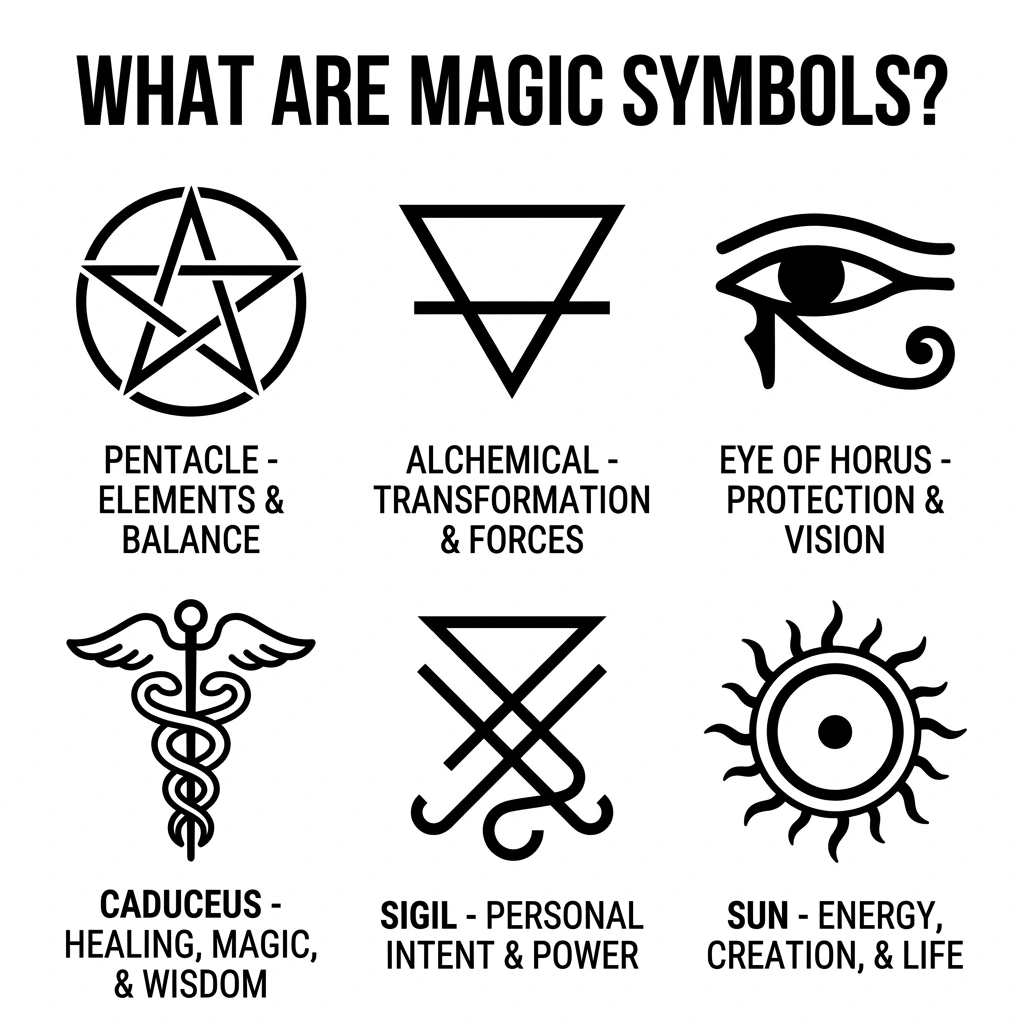
Magic symbols are visual signs that have been given special meanings within particular cultural, religious, magical, or esoteric traditions.
They can include:
- Geometric shapes
- Stars
- Circles
- Crosses
- Eyes
- Animals
- Plants
- Planetary signs
- Alchemical marks
- Letters and numbers
- Magical seals
- Sigils
- Protective amulets
- Mythological figures
Some symbols were used on physical objects such as amulets, jewelry, manuscripts, seals, or monuments. Others appeared as part of written rituals or symbolic systems.
The important point is that a symbol does not automatically have one magical meaning everywhere.
Why Do People Use Magic Symbols?
Historically, symbols could serve several purposes.
They might:
- Represent a deity or mythological story
- Express religious beliefs
- Mark an object as sacred
- Be incorporated into protective amulets
- Represent natural forces
- Identify planets or elements
- Encode names or words
- Appear in magical or ritual manuscripts
- Represent a particular person, spirit, or concept
- Serve as visual shorthand within a specialized tradition
Ancient Egyptian evidence provides a clear example. Museum collections show that amulets were associated with ideas such as protection, healing, regeneration, and life. The Metropolitan Museum of Art describes the Wedjat eye as an amulet associated with the healed eye of Horus, recovery, regeneration, and protection.
Magic Symbols and Their Meanings
There is no single universal dictionary of magical symbols. The same shape can have different interpretations in different periods and cultures.
The following table provides a useful starting point.
| Symbol | Common Association | Historical or Cultural Context |
| Ankh ☥ | Life | Ancient Egypt |
| Wedjat/Eye of Horus | Healing, restoration, protection | Ancient Egypt |
| Scarab | Rebirth, becoming | Ancient Egypt |
| Djed | Stability | Ancient Egypt |
| Shen | Protection, eternity | Ancient Egypt |
| Pentagram | Varies by tradition | Historical and modern esoteric traditions |
| Pentacle | Pentagram enclosed in a circle | Modern and historical symbolic traditions |
| Ouroboros | Cycles, renewal | Ancient and later esoteric traditions |
| ☉ | Sun | Astrology, alchemy, astronomy |
| ☽ | Moon | Astrology and related traditions |
| ☿ | Mercury | Astrology and alchemy |
| ♀ | Venus | Astrology and alchemy |
| ♂ | Mars | Astrology and alchemy |
| ♃ | Jupiter | Astrology and alchemy |
| ♄ | Saturn | Astrology and alchemy |
| 🜂 | Fire | Alchemical symbolism |
| 🜁 | Air | Alchemical symbolism |
| 🜄 | Water | Alchemical symbolism |
| 🜃 | Earth | Alchemical symbolism |
| Sigil | Specific intention, entity, or concept | Various magical traditions |
| Rune | Letter or symbolic sign | Germanic writing traditions and later esoteric uses |
These associations should be treated as contextual meanings, not universal supernatural definitions.
Ancient Magic Symbols
Ancient Egypt provides some of the clearest surviving examples because many amulets and symbolic objects have been preserved in archaeological collections.
Ankh Symbol
The ankh (☥) is one of the most recognizable symbols associated with ancient Egypt.
It is commonly translated as “life” or “to live.” The Metropolitan Museum of Art’s educational material identifies the ankh with life and notes that Egyptian deities are frequently shown holding it.
Today, the ankh may be used as a symbol of:
- Life
- Vitality
- Ancient Egyptian culture
- Spiritual ideas
- Continuity
Its modern uses can differ from its ancient Egyptian context.
Eye of Horus or Wedjat
The Wedjat, commonly called the Eye of Horus, is one of the most important Egyptian protective symbols.
According to the Metropolitan Museum of Art, the Wedjat represents the healed eye of Horus. Its symbolism includes recovery, regeneration, and protection. Ancient examples were made as amulets and were thought to transfer regenerative or protective qualities to the wearer.
This is a good example of why it is better to say:
“The symbol was historically associated with protection and regeneration.”
“This symbol magically protects anyone who wears it.”
The first statement describes historical belief and practice.
Eye of Ra
The Eye of Ra is associated with the Egyptian solar deity Ra and appears in Egyptian religious and mythological contexts.
It should not simply be treated as another name for the Eye of Horus.
Although modern discussions sometimes group the two together because both are represented as divine eyes, they belong to different mythological associations.
When researching an Egyptian eye symbol, consider:
- The deity involved
- The historical period
- The surrounding imagery
- The inscription
- The object on which it appears
Scarab Symbol
The scarab beetle was an important Egyptian symbol.
The Metropolitan Museum’s educational material explains that the scarab, or kheper, is associated with the idea of becoming or evolving and was used as an amulet in life and death, symbolizing rebirth.
The scarab therefore appears in discussions of:
- Rebirth
- Transformation
- Renewal
- Protection
- Ancient Egyptian funerary symbolism
Djed Symbol
The djed is a pillar-like Egyptian symbol commonly associated with stability.
It appears in Egyptian religious and funerary contexts and is often connected with Osiris in later interpretations.
It is useful to distinguish the djed from the ankh:
- Ankh → life
- Djed → stability
- Wedjat → healing, restoration, protection
- Scarab → becoming and rebirth
Shen Symbol
The shen is a ring-like symbol associated with ideas of eternity and protection.
The Metropolitan Museum’s educational material describes the shen sign as a rope ring representing what the sun encircles and notes that knots and ropes were used as protective amulets.
Occult and Esoteric Symbols
The word “occult” broadly refers to traditions and practices involving hidden, secret, or esoteric knowledge. Different historical traditions have used different symbolic systems.
These can include:
- Magical seals
- Planetary signs
- Alchemical symbols
- Geometric figures
- Letters
- Numbers
- Sigils
- Astrological signs
A historical manuscript may combine several of these systems rather than using one isolated symbol.
The British Library’s manuscript catalogue, for example, documents historical manuscripts containing material on alchemy, talismans, occult subjects, magic spells, magical symbols, letter and number tables, and pentagrams.
Pentagram
A pentagram is a five-pointed star drawn with five straight lines.
Its meaning has changed across different historical and cultural settings.
It can be associated with:
- Geometry
- Religious symbolism
- The five elements in some modern traditions
- Protection in some contexts
- Occult and esoteric traditions
It is inaccurate to assume that every pentagram has one universal meaning.
Pentagram vs. Pentacle
These terms are often confused.
A pentagram is a five-pointed star.
A pentacle is commonly depicted as a pentagram enclosed within a circle.
However, terminology can vary between traditions, historical sources, and modern practitioners.
Therefore, if you are identifying a symbol from an old book or artifact, look at the original source rather than relying only on a modern definition.
Ouroboros
The Ouroboros is an image of a serpent or dragon forming a circle by biting or approaching its own tail.
It is often associated with:
- Cycles
- Renewal
- Recurrence
- Transformation
- Continuity
The symbol has appeared in different historical and esoteric contexts, so its exact meaning depends on the source.
What Is a Sigil?
A sigil is a deliberately created symbolic design.
In magical and esoteric traditions, sigils may be connected with a particular name, entity, purpose, or intention.
Unlike widely recognized symbols such as the ankh, a personal sigil may have a meaning that exists only within the system or practice in which it was created.
This distinction is important.
A common symbol can have a long historical record.
A personal sigil may have been created recently.
Historical Magical Seals
Magical manuscripts sometimes contain seals associated with names, spirits, planets, or ritual systems.
Historical manuscript collections provide evidence of texts dealing with talismans, magical names, seals, and related practices. The British Library, for example, catalogs manuscripts containing treatises concerning alchemy, talismans, magical practices, and sigils.
Personal Sigils
A modern practitioner may create a personal design to represent an intention or concept.
Because such a symbol is intentionally created, it does not necessarily have an ancient meaning.
If you see an unfamiliar sigil online, avoid assuming that it is an ancient symbol simply because it looks old or complicated.
Magic Symbols vs. Sigils, Seals, Talismans, and Amulets
These words are often used as though they mean exactly the same thing, but they can describe different things.
| Term | General Description |
| Symbol | A sign or image representing an idea |
| Sigil | A deliberately created symbolic design |
| Seal | A distinctive symbolic design associated with a person, entity, name, or system |
| Amulet | An object traditionally carried or worn for protection or another intended benefit |
| Talisman | An object believed within a tradition to carry a particular influence or purpose |
These categories can overlap.
For example, an amulet can contain a symbol, while a talisman can include a written inscription or geometric design.
Ancient Egyptian evidence shows how physical objects, symbols, materials, inscriptions, and beliefs could work together in amuletic practices.
Alchemical Symbols
Alchemy developed its own symbolic vocabulary.
Historical alchemical manuscripts contain combinations of text, imagery, planetary references, metals, elements, and symbolic signs.
The British Library’s collections include manuscripts devoted to alchemy and richly illustrated alchemical works, demonstrating how extensive this symbolic tradition became.
Four Elemental Alchemical Symbols
Four commonly reproduced alchemical signs are:
| Symbol | Element |
| 🜂 | Fire |
| 🜁 | Air |
| 🜄 | Water |
| 🜃 | Earth |
These symbols are frequently encountered in modern references to alchemy.
However, historical alchemical notation was much richer than a simple four-symbol chart.
Alchemical Metal and Planet Symbols
Traditional alchemical and astrological systems connected certain metals with planets.
Common examples include:
| Symbol | Common Association |
| ☉ | Sun / Gold |
| ☽ | Moon / Silver |
| ☿ | Mercury / Mercury |
| ♀ | Venus / Copper |
| ♂ | Mars / Iron |
| ♃ | Jupiter / Tin |
| ♄ | Saturn / Lead |
These associations belong to historical symbolic systems and should not be confused with modern scientific classifications of chemical elements.
Planetary Magic Symbols
Planetary symbols appear in astronomy, astrology, alchemy, historical manuscripts, and esoteric traditions.
Common signs include:
| Symbol | Celestial Body |
| ☉ | Sun |
| ☽ | Moon |
| ☿ | Mercury |
| ♀ | Venus |
| ♂ | Mars |
| ♃ | Jupiter |
| ♄ | Saturn |
| ♅ | Uranus |
| ♆ | Neptune |
| ♇ | Pluto |
The same symbols can have different meanings depending on whether the source is astronomical, astrological, alchemical, historical, or fictional.
Sun Symbol
☉ is commonly used for the Sun.
In historical symbolism it can appear alongside ideas involving:
- Light
- Solar power
- Gold
- Divinity
- Vitality
The exact interpretation depends on the tradition.
Moon Symbol
☽ is commonly used for the Moon.
It can appear in:
- Astrology
- Alchemy
- Religious symbolism
- Esoteric diagrams
Modern interpretations may associate it with cycles, night, intuition, or femininity, but those meanings should not automatically be projected onto every historical example.
Elemental Magic Symbols
The classical elements appear frequently in magical and esoteric symbolism.
Fire
Fire is commonly associated with:
- Heat
- Transformation
- Energy
- Action
The alchemical fire symbol is often shown as an upward-pointing triangle:
🜂
Air
Air is commonly associated with:
- Breath
- Movement
- Thought
- Communication
The traditional elemental sign is often represented as:
🜁
Water
Water is commonly associated with:
- Emotion
- Flow
- Cleansing
- Change
The traditional sign is:
🜄
Earth
Earth is commonly associated with:
- Grounding
- Stability
- Material existence
- Nature
The traditional sign is:
🜃
Spirit
Some modern occult systems add spirit as a fifth element.
Its symbol and interpretation can vary considerably between traditions.
That is why there is no single universal “spirit magic symbol.”
Magic Symbols for Protection
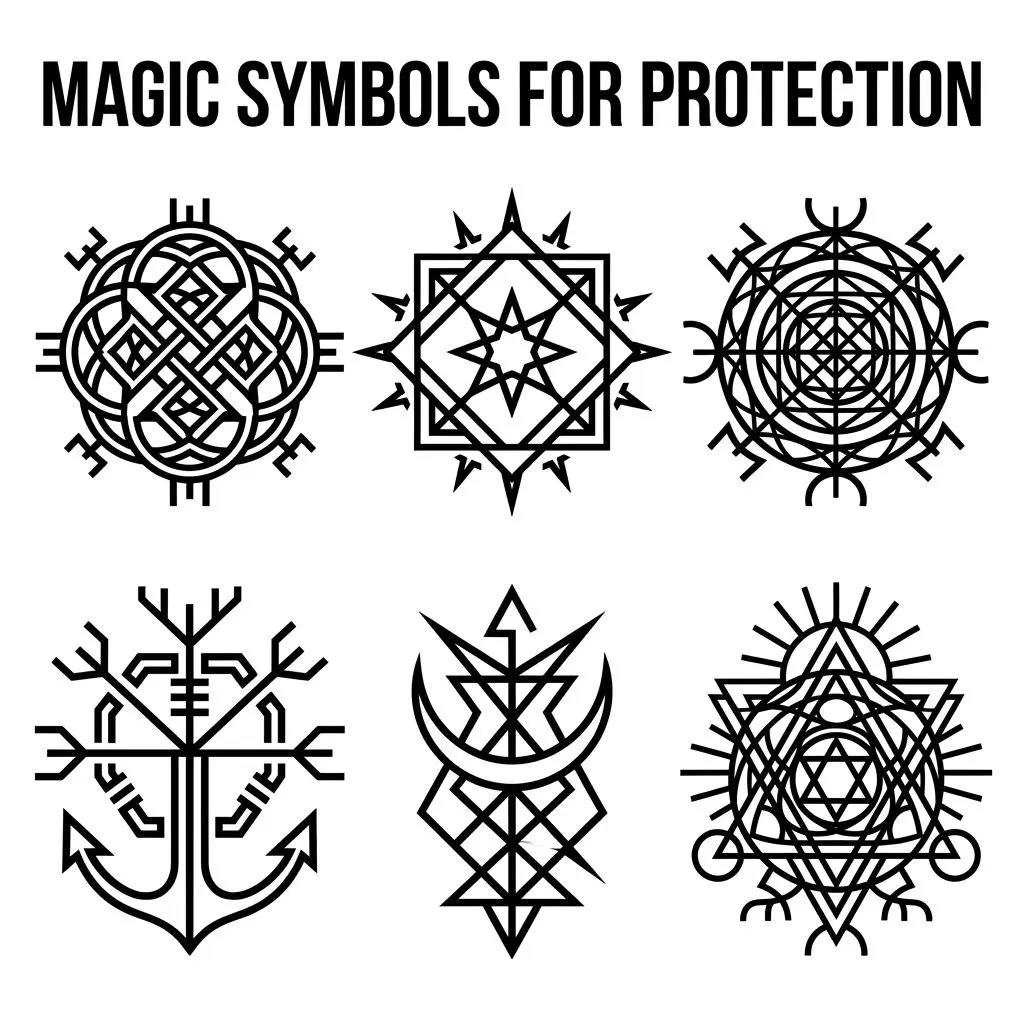
Protection is one of the most common reasons people search for magic symbols.
Historically, protective symbolism can be found in amulets, jewelry, inscriptions, religious objects, and ritual manuscripts.
Examples include:
- Wedjat/Eye of Horus
- Shen sign
- Scarab
- Protective knots
- Certain pentagram traditions
- Religious inscriptions
- Magical seals
Ancient Egyptian evidence is especially well documented. The Met records that Wedjat amulets were believed to protect their wearers and convey regenerative qualities.
Important Note About Protection Symbols
It is useful to distinguish historical belief from scientific evidence.
A museum may document that an ancient community believed an amulet protected its wearer. That does not establish that the object has a scientifically demonstrated supernatural effect.
A responsible explanation should therefore use phrases such as:
- “was believed to protect”
- “was traditionally associated with protection”
- “was used as a protective amulet”
rather than presenting supernatural effects as established scientific facts.
Magic Symbols for Love, Healing, Luck, and Prosperity
People also search for symbols connected with particular intentions.
Love Symbols
Depending on the tradition, love symbolism can include:
- Hearts
- Rose imagery
- Venus symbolism
- Certain mythological figures
- Fertility symbols
There is no universal magical symbol that objectively creates love.
Healing Symbols
The Wedjat is a historically documented example of a symbol associated with healing and restoration in ancient Egypt. The Met describes the healed eye of Horus as representing recovery and regeneration.
Luck Symbols
Luck symbols differ dramatically between cultures.
A symbol considered lucky in one culture may have little or no connection with luck in another.
Prosperity Symbols
Modern spiritual practices may associate certain signs with abundance, prosperity, or wealth. However, these meanings are often tradition-specific or modern rather than universal ancient meanings.
Runes and Magical Symbolism
Runes require special care because they were originally part of writing systems used by Germanic peoples.
They should not simply be described as “magic symbols.”
A rune can be:
- A historical letter
- Part of an inscription
- A linguistic artifact
- A modern decorative symbol
- Part of later divination or esoteric practice
Some modern systems assign symbolic or divinatory meanings to individual runes.
Therefore, when researching a rune, ask whether the source is discussing:
historical writing
or:
modern esoteric interpretation.
That distinction prevents a common misunderstanding.
Witchcraft and Pagan Symbols
Modern witchcraft and Pagan communities use a variety of symbols, but there is no single symbol system shared by everyone.
Commonly discussed examples include:
- Pentagram
- Pentacle
- Triple Moon
- Triquetra
- Elemental symbols
- Moon phases
- Herb and plant imagery
- Solar symbols
Meanings can differ among traditions and individual practitioners.
Triple Moon Symbol
The Triple Moon is often depicted as:
☾ ● ☽
or as three connected lunar forms.
In modern Pagan and Wiccan contexts, it is commonly associated with phases of the Moon and concepts such as cycles and feminine spirituality.
However, its modern use should not automatically be presented as an ancient symbol with one unchanged meaning.
Triquetra
The triquetra is a three-pointed interlaced design.
It has appeared in different historical and cultural contexts and has been given different meanings over time.
Modern associations can include:
- Threefold concepts
- Spirituality
- Interconnection
- Cycles
Its presence alone does not prove that an object is related to witchcraft.
Magic Symbols From Ancient Egypt
Ancient Egyptian symbolism deserves special attention because many objects survive in museum collections.
Some commonly recognized symbols include:
| Symbol | Common Historical Association |
| ☥ Ankh | Life |
| Wedjat | Healing, restoration, protection |
| Scarab | Becoming, rebirth |
| Djed | Stability |
| Shen | Protection, eternity |
| Was | Authority or dominion |
| Uraeus | Royal/divine imagery |
| Lotus | Renewal and religious symbolism |
The Metropolitan Museum’s educational material specifically identifies the ankh with life, the scarab with becoming and rebirth, and the shen sign with protective associations.
Magic Symbols Copy and Paste
If you are looking for symbols to use in a document, caption, profile, design, or message, some commonly recognized characters include:
☥ — Ankh
☉ — Sun
☽ — Moon
♀ — Venus
♂ — Mars
♃ — Jupiter
♄ — Saturn
☿ — Mercury
∞ — Infinity
✦ — Star
△ — Triangle
◯ — Circle
⚕ — Medical symbol
♆ — Neptune
Remember that copying a Unicode character does not automatically reproduce every historical or ritual meaning associated with a symbol. Digital representation and cultural meaning are two different things.
How to Identify an Unknown Magic Symbol
Finding an unfamiliar symbol can be frustrating, especially when several traditions use similar shapes.
Use the following process.
Look at the Basic Shape
Ask:
- Is it a circle?
- Triangle?
- Star?
- Cross?
- Eye?
- Knot?
- Animal?
- Letter?
- Geometric diagram?
Start with the simplest visual features.
Check the Number of Points
A five-pointed star, six-pointed figure, eight-pointed star, or other geometric shape may belong to very different traditions.
Do not identify a symbol solely from the number of points.
Look for Letters and Numbers
Some magical designs contain:
- Names
- Initials
- Hebrew letters
- Arabic letters
- Latin letters
- Greek letters
- Numbers
- Repeated sequences
Written material can be more informative than the outer shape.
Check the Orientation
Ask whether the design is:
- Upright
- Inverted
- Rotated
- Mirrored
- Enclosed within a circle
Orientation can matter in some traditions.
Examine the Source
Where did you find the symbol?
Was it on:
- A museum artifact?
- A historical manuscript?
- A tattoo?
- A necklace?
- A religious object?
- A video game?
- A movie?
- A fantasy book?
- A modern social-media graphic?
The source can dramatically change the likely interpretation.
Check the Historical Period
An Egyptian amulet from 1500 BCE should not automatically be interpreted using a modern occult website’s definition.
Historical period matters.
How to Tell Historical Symbols From Modern Fantasy Symbols
Modern entertainment has created thousands of fictional magical symbols.
They may appear in:
- Movies
- Television
- Video games
- Anime
- Manga
- Fantasy novels
- Tabletop games
- Graphic novels
A fictional symbol may look ancient while having been created recently by an artist or game designer.
Before calling a symbol “ancient,” look for evidence from:
- Museum collections
- Manuscripts
- Archaeological publications
- Academic sources
- Historical catalogs
A decorative symbol that appears in a fantasy game should not automatically be presented as an authentic ancient magical sign.
Are Magic Symbols Real?
The answer depends on what “real” means.
As historical objects and cultural practices, many magical symbols are certainly real. Archaeological artifacts, amulets, manuscripts, inscriptions, and museum collections provide evidence that people created and used symbolic objects within religious, protective, magical, and ritual traditions.
For example, the Metropolitan Museum has documented Egyptian amulets and explains how ancient users believed such objects could transfer protective or regenerative qualities.
As supernatural forces, however, the question is different. A historical record showing that people believed a symbol had magical power is evidence of that belief and practice, not scientific proof that the symbol produces supernatural effects.
Keeping these two ideas separate makes it easier to understand magic symbols without confusing history with modern belief.
Common Misconceptions About Magic Symbols
Every Magic Symbol Is Ancient
Not true.
Some symbols are ancient, while others are medieval, modern, or completely fictional.
Every Pentagram Means the Same Thing
No.
The pentagram has been interpreted differently across historical and modern contexts.
All Runes Are Magical
No.
Runes were writing characters before later magical and divinatory interpretations became associated with them.
Every Eye Symbol Is the Eye of Horus
No.
The Eye of Horus/Wedjat is a specific Egyptian symbol. Other eye symbols can have different identities and meanings.
A Complicated Symbol Must Be Magical
Not necessarily.
A complex design could be:
- Decorative
- Religious
- Heraldic
- Mathematical
- Astronomical
- Calligraphic
- Architectural
- Fictional
Complexity alone does not prove magical significance.
Symbols Have the Same Meaning Everywhere
They do not.
Meaning depends on:
- Culture
- Language
- Religion
- Historical period
- Geographic region
- Intended use
- Individual tradition
Why Context Matters When Interpreting Magic Symbols
A symbol should be treated like a word.
The same word can mean different things in different sentences. A symbol can work the same way.
For example, a crescent may appear in:
- Astronomy
- Astrology
- Religious art
- Historical manuscripts
- Modern jewelry
- Fantasy artwork
Its presence alone does not establish one specific meaning.
The strongest identification combines:
shape + context + historical period + source + surrounding symbols.
How to Research the Meaning of a Magic Symbol
If you want to investigate a symbol more deeply, use reliable sources first.
Start With Museum Collections
Museum databases are especially useful for historical objects because they provide:
- Object dates
- Geographic origins
- Materials
- Descriptions
- Curatorial information
- Historical context
The Metropolitan Museum’s Egyptian collection, for example, provides detailed information about Wedjat amulets and other Egyptian symbolic objects.
Check Manuscript Collections
Historical manuscripts can reveal how symbols were actually used rather than how modern websites describe them.
The British Library’s catalog contains manuscripts concerning alchemy, talismans, magical symbols, spells, and related practices.
Compare Multiple Sources
If three modern websites give three different meanings, don’t simply choose the most dramatic one.
Ask:
- Which period does each source discuss?
- Is the claim historically documented?
- Is it a modern interpretation?
- Is the source describing belief or proving an effect?
- Does the original culture support the interpretation?
Frequently Asked Questions
What are magic symbols?
Magic symbols are signs, images, letters, geometric designs, seals, or other forms that have been associated with magical, ritual, religious, protective, or esoteric practices in particular traditions.
What is the most famous magic symbol?
There is no universally accepted single “most famous” magic symbol. The pentagram, ankh, Eye of Horus, planetary signs, and various sigils are among the symbols commonly associated with magical or esoteric traditions.
What is the symbol for magic?
There is no universal symbol that simply means “magic.” Different traditions use different signs, including pentagrams, sigils, seals, elemental symbols, planetary symbols, and other designs.
What is the symbol for protection?
Protection symbols vary by culture and tradition. The ancient Egyptian Wedjat is one historically documented example of a symbol used as a protective amulet.
What does the Eye of Horus mean?
The Wedjat, or Eye of Horus, represents the healed eye of Horus in ancient Egyptian mythology. Museum evidence associates it with healing, restoration, regeneration, and protection.
What does the ankh mean?
The ankh is an ancient Egyptian hieroglyph associated with life or to live. It is commonly depicted in the hands of Egyptian deities in ancient art.
What does a pentagram mean?
A pentagram is a five-pointed star whose meanings vary by historical period and tradition. It has been used in different religious, philosophical, decorative, and esoteric contexts, so its meaning should not be assumed from the shape alone.
What is the difference between a pentagram and a pentacle?
A pentagram is a five-pointed star. A pentacle is commonly a pentagram enclosed in a circle, although terminology varies among traditions.
Are runes magic symbols?
Runes were originally writing characters used by Germanic peoples. Later traditions and modern practices have associated some runes with magical or divinatory meanings, but it is inaccurate to describe the entire historical runic writing system as purely magical.
What is a sigil?
A sigil is a deliberately designed symbolic mark. In magical or esoteric traditions, it may represent a specific name, entity, intention, or concept.
What is a magical seal?
A magical seal is a symbolic design associated with a particular name, entity, planetary system, ritual tradition, or other esoteric framework. Historical manuscripts contain examples of texts and diagrams involving seals and talismanic practices.
What are alchemical symbols?
Alchemical symbols are signs used in historical alchemical writing and illustration to represent substances, elements, planets, metals, processes, and ideas.
What are elemental magic symbols?
Elemental symbols are signs associated with classical elements such as fire, air, water, and earth. Their exact forms and interpretations depend on the particular symbolic tradition.
Can I copy and paste magic symbols?
Yes. Many symbols are available as Unicode characters and can be copied into compatible text fields. However, the digital character itself does not automatically carry a supernatural function.
Are magic symbols dangerous?
A symbol is not inherently dangerous simply because a website calls it “dark” or “forbidden.” Its cultural meaning and use should be examined in context. A historical symbol, modern religious symbol, fictional design, and ritual seal are not necessarily equivalent.
Do magic symbols really have supernatural powers?
Historical evidence can demonstrate that people believed certain symbols or amulets had magical or protective powers. It does not by itself establish that those supernatural effects are scientifically real.
How can I identify an unknown magic symbol?
Study its shape, orientation, letters, numbers, surrounding designs, source, and historical context. Museum databases and manuscript collections can be especially useful when the symbol appears on an old artifact.
Why do different websites give different meanings for the same symbol?
Symbolic meanings can change across cultures, historical periods, and modern traditions. Some websites also present modern interpretations as though they were ancient facts. Checking the original historical context helps resolve these differences.
Conclusion
Magic symbols are not one fixed collection of signs with universal meanings. They come from many different traditions, including ancient Egyptian religion, alchemy, astrology, ceremonial practices, folk traditions, modern witchcraft, esoteric systems, and fictional storytelling.
Some symbols have strong historical documentation. The ancient Egyptian ankh, for example, was associated with life, while the Wedjat or Eye of Horus was associated with healing, regeneration, and protection in Egyptian amuletic traditions.
Other symbols have meanings that developed or changed over time. The pentagram, runes, sigils, planetary signs, and elemental symbols are good examples of symbols that require context rather than a single universal definition.
The difference between a symbol, sigil, seal, talisman, and amulet is also important. These terms overlap in some traditions, but they can describe different forms of symbolic objects or designs.
When you encounter an unfamiliar magic symbol, don’t rely only on its appearance. Consider its historical period, cultural origin, surrounding symbols, written inscriptions, orientation, and source.
Most importantly, distinguish historical evidence from modern belief. A museum record can show that people believed an amulet provided protection, but that is different from scientifically demonstrating a supernatural effect.
Understanding that distinction makes the subject of magic symbols more interesting, accurate, and useful. It also helps you identify whether a symbol comes from an ancient artifact, an esoteric manuscript, a modern spiritual practice, or an entirely fictional world.
Clara Miles
Hello! I’m Clara, a lifelong dreamer who finds magic in everyday moments. Writing has always been my way of exploring the world and understanding the people around me. I love creating stories that make readers laugh, cry, and reflect on life’s little surprises. When I’m not writing, you can usually find me sipping coffee at a cozy café or wandering through nature with a notebook in hand. My journey as an author is fueled by curiosity, imagination, and a love for connecting with my readers. Every story I write is a piece of my heart, and I hope it inspires yours too.
Books:
-
Whispers of the Heart
-
Shadows and Sunlight