
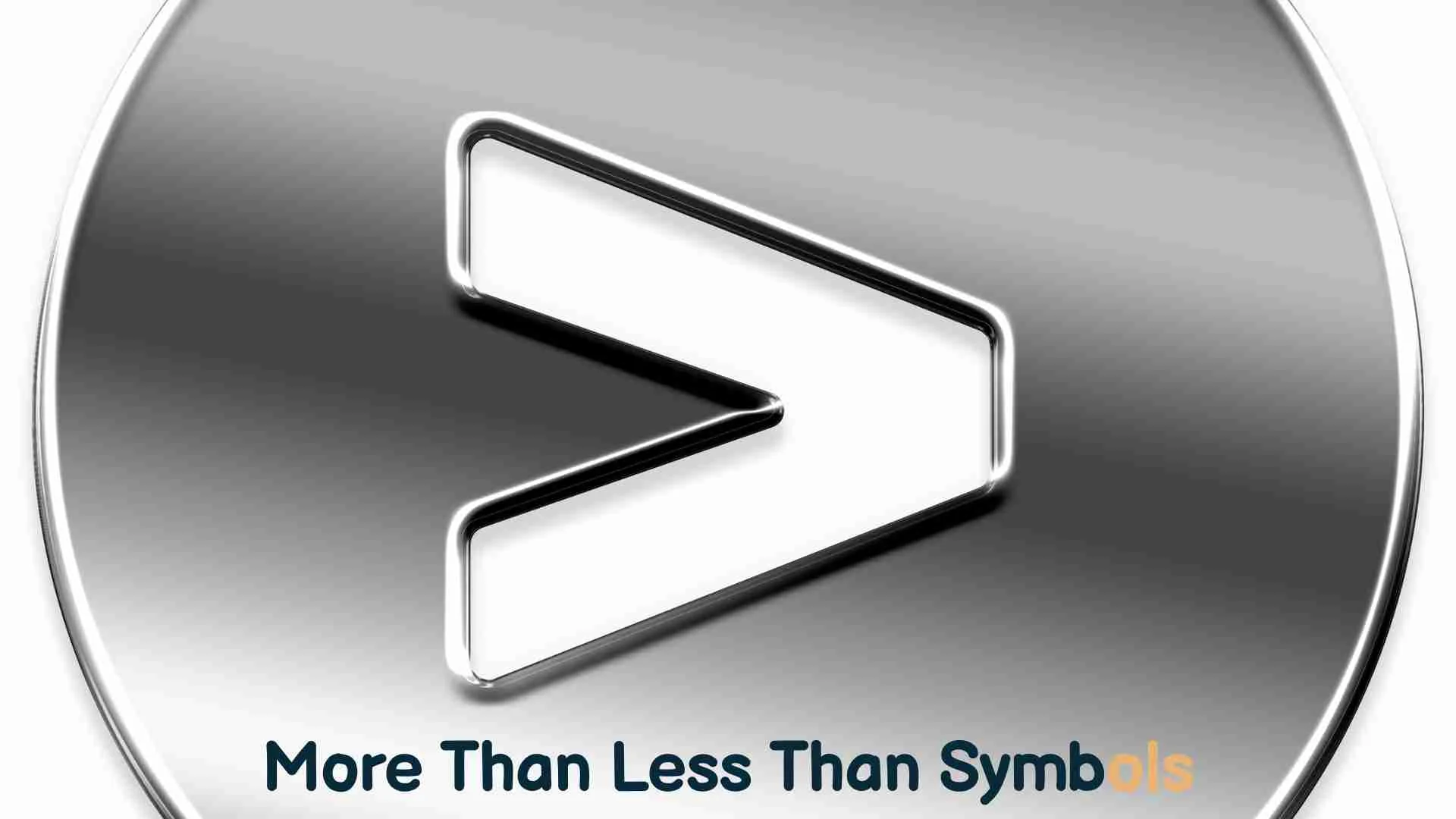
More than less than symbols are mathematical signs used to compare numbers, values, quantities, and expressions. In simple terms, these symbols help us determine whether one number is greater than, less than, or equal to another number.
The most common comparison symbols are greater than (>) and less than (<), and they are essential tools in mathematics, science, business, and everyday life.
From elementary school classrooms to advanced scientific calculations, more than less than symbols help people make comparisons quickly and accurately. Understanding these symbols is a fundamental math skill that supports learning in many subjects and practical situations.
What Are More Than Less Than Symbols?

More than less than symbols are mathematical symbols used to compare two values.
The most common comparison symbols include:
- Greater than (>)
- Less than (<)
- Equal to (=)
- Greater than or equal to (≥)
- Less than or equal to (≤)
- Not equal to (≠)
These symbols tell us how two numbers or quantities relate to one another.
For example:
- 8 > 5 means 8 is greater than 5.
- 3 < 10 means 3 is less than 10.
- 7 = 7 means both values are equal.
Comparison symbols are among the first mathematical concepts children learn because they form the basis for understanding numbers.
Why Are More Than Less Than Symbols Important?
These symbols play a vital role in mathematics and daily decision-making.
They help us:
- Compare quantities
- Solve equations
- Analyze data
- Understand graphs
- Make financial decisions
- Interpret scientific measurements
Without comparison symbols, expressing relationships between numbers would be much more difficult.
Understanding the Greater Than Symbol (>)
What Does the Greater Than Symbol Mean?
The greater than symbol (>) indicates that the number on the left is larger than the number on the right.
Examples
- 9 > 4
- 15 > 12
- 100 > 75
In each example, the value on the left is larger than the value on the right.
Easy Memory Trick
Many teachers explain that the open side of the symbol always faces the larger number.
For example:
9 > 4
The wider opening points toward 9 because 9 is greater.
Understanding the Less Than Symbol (<)
What Does the Less Than Symbol Mean?
The less than symbol (<) shows that the number on the left is smaller than the number on the right.
Examples
- 2 < 5
- 7 < 20
- 45 < 100
Each statement indicates that the left number is smaller.
Memory Trick
The smaller end points toward the smaller number.
Example:
3 < 8
The narrow side points toward 3 because it is the smaller value.
The Alligator Method

A Popular Learning Strategy
One of the most famous ways to remember more than less than symbols is the “alligator method.”
The symbol is imagined as an alligator’s mouth.
How It Works
The alligator always wants to eat the larger number.
Examples:
- 8 > 3 → The alligator eats 8.
- 4 < 9 → The alligator eats 9.
Why Children Love It
The visual image makes comparison symbols easier to remember and understand.
Equal To Symbol (=)
Meaning
The equal sign indicates that both sides have the same value.
Examples
- 5 = 5
- 12 = 12
- 8 + 2 = 10
Importance
The equal sign forms the foundation of arithmetic and algebra.
It tells us that two expressions represent the same quantity.
Greater Than or Equal To (≥)
What Does It Mean?
This symbol means one value is either greater than or exactly equal to another value.
Examples
- 10 ≥ 10
- 15 ≥ 12
- 20 ≥ 5
Practical Example
A ride at an amusement park may require riders to be:
Height ≥ 48 inches
This means riders can be exactly 48 inches or taller.
Less Than or Equal To (≤)
Meaning
This symbol means one value is either smaller than or equal to another value.
Examples
- 5 ≤ 10
- 12 ≤ 12
- 3 ≤ 8
Practical Example
A discount may apply to purchases:
Amount ≤ $100
This means purchases of $100 or less qualify.
Not Equal To Symbol (≠)
Meaning
The symbol indicates that two values are different.
Examples
- 4 ≠ 7
- 10 ≠ 12
- 25 ≠ 30
Why It’s Useful
It helps identify situations where quantities are not identical.
History of More Than Less Than Symbols
The Origins
Comparison symbols have existed for centuries.
The modern greater than and less than signs were introduced by English mathematician Thomas Harriot in the early 1600s.
Why They Were Created
Before these symbols existed, mathematicians had to write lengthy descriptions when comparing numbers.
The symbols made mathematical communication faster and more efficient.
Historical Impact
The introduction of comparison symbols helped advance:
- Algebra
- Geometry
- Science
- Engineering
They remain standard mathematical notation worldwide today.
How More Than Less Than Symbols Work
Comparing Whole Numbers
Whole numbers are the easiest to compare.
Examples:
- 20 > 15
- 3 < 7
- 100 > 99
Comparing Negative Numbers
Negative numbers can be confusing at first.
Examples:
- -2 > -5
- -1 > -10
The number closer to zero is greater.
Comparing Decimals
Examples:
- 3.5 > 3.2
- 1.25 < 1.30
Compare digits from left to right.
Comparing Fractions
Examples:
- 3/4 > 1/2
- 2/5 < 4/5
Finding common denominators often helps.
Using Number Lines to Understand Comparison Symbols
Visual Learning Tool
Number lines provide a simple way to compare values.
Basic Rule
Numbers further to the right are greater.
Example:
1 < 4
Because 4 is farther right on the number line.
Benefits
Number lines help students:
- Visualize comparisons
- Understand negative numbers
- Learn inequalities
More Than Less Than Symbols in Algebra
Comparing Variables
Comparison symbols are frequently used with variables.
Example:
x > 5
This means x can be any value greater than 5.
Solving Inequalities
Inequalities use comparison symbols instead of equal signs.
Example:
x < 10
Possible solutions include:
- 1
- 5
- 9
Real-World Importance
Inequalities help solve practical problems involving limits and conditions.
Practical Applications of More Than Less Than Symbols
Personal Finance
People use comparison symbols when evaluating:
- Expenses
- Savings
- Budgets
- Investments
Example:
Income > Expenses
This indicates positive financial health.
Shopping
Consumers compare prices regularly.
Examples:
- $15 < $20
- Discounted price < Original price
Education
Teachers use comparison symbols to:
- Teach mathematics
- Assess learning
- Explain data
Business
Businesses compare:
- Revenue > Costs
- Sales > Targets
These comparisons guide decision-making.
Healthcare
Doctors compare measurements such as:
- Blood pressure
- Cholesterol levels
- Body temperature
Comparison symbols help interpret results.
More Than Less Than Symbols in Science
Measuring Quantities
Scientists compare:
- Temperatures
- Distances
- Speeds
- Masses
Experimental Results
Researchers use comparison symbols when analyzing data.
Example:
Sample A > Sample B
This indicates one result exceeded another.
Environmental Studies
Scientists compare:
- Pollution levels
- Rainfall amounts
- Population growth
These comparisons support research and policy decisions.
More Than Less Than Symbols in Technology
Computer Programming
Programming languages use comparison operators.
Examples include:
- <
=- <=
Search Algorithms
Computers compare values constantly to:
- Sort information
- Analyze data
- Make calculations
Artificial Intelligence
AI systems rely on mathematical comparisons to process information and make decisions.
Common Mistakes When Using More Than Less Than Symbols
Reversing the Symbol
Incorrect:
5 < 3
Correct:
5 > 3
Confusing Negative Numbers
Incorrect:
-10 > -2
Correct:
-10 < -2
Ignoring Decimal Places
Incorrect comparisons often occur when decimals are not examined carefully.
Forgetting Equal Values
Remember:
10 ≥ 10
is true because the values are equal.
Fun Ways to Learn Comparison Symbols
Use the Alligator Story
Imagine the symbol as a hungry alligator.
Practice With Cards
Compare numbers using flashcards.
Interactive Games
Online learning platforms offer engaging comparison activities.
Everyday Challenges
Ask children to compare:
- Ages
- Prices
- Heights
- Scores
Practical examples strengthen understanding.
Benefits of Understanding More Than Less Than Symbols
Stronger Math Skills
Comparison symbols build foundational math knowledge.
Better Problem Solving
They help people evaluate situations logically.
Improved Financial Literacy
Understanding comparisons supports budgeting and spending decisions.
Enhanced Data Interpretation
People can better understand statistics and reports.
Greater Academic Success
Many advanced math topics depend on understanding inequalities.
Impact of Comparison Symbols on Society
Supporting Education
These symbols help millions of students learn mathematics each year.
Driving Scientific Progress
Researchers use comparisons to analyze data and test theories.
Improving Business Decisions
Organizations rely on comparisons to evaluate performance.
Enhancing Technology
Modern software depends on comparison operations.
Helping Everyday Decision-Making
People compare options constantly when making choices about money, health, and time.
Interesting Facts About More Than Less Than Symbols
- The greater than and less than symbols are over 400 years old.
- They were introduced by mathematician Thomas Harriot.
- Comparison symbols are used in nearly every branch of mathematics.
- Computer programming relies heavily on comparison operators.
- Children often learn the alligator method to remember the symbols.
- Inequalities are essential in economics, engineering, and science.
- Modern calculators and computers process millions of comparisons every second.
Frequently Asked Questions (FAQs)
1. What are more than less than symbols?
They are mathematical symbols used to compare values, including greater than (>), less than (<), greater than or equal to (≥), and less than or equal to (≤).
2. How do I remember which symbol is greater than?
The open side of the symbol always faces the larger number. Many students use the alligator method to remember this rule.
3. What is the difference between > and ≥?
The symbol > means strictly greater than, while ≥ means greater than or equal to.
4. Are comparison symbols used outside mathematics?
Yes. They are used in science, technology, finance, business, healthcare, and many everyday situations.
5. Who invented the greater than and less than symbols?
English mathematician Thomas Harriot introduced these symbols in the early seventeenth century.
Conclusion
More than less than symbols are among the most important tools in mathematics and everyday life. These simple yet powerful signs allow us to compare numbers, quantities, measurements, and relationships quickly and accurately.
From elementary classrooms and scientific laboratories to business offices and computer systems, comparison symbols play a crucial role in communication and decision-making.
By understanding how greater than, less than, equal to, and related symbols work, learners build a strong mathematical foundation that supports future success.
Whether comparing prices, solving algebra problems, analyzing scientific data, or making financial decisions, these symbols help us understand the world more clearly. Their continued importance demonstrates how a few simple mathematical signs can have a profound impact on education, technology, and society.

Elliot Kensington
Elliot Kensington is a storyteller at heart, always fascinated by the hidden corners of human imagination. From a young age, he found comfort in books and the worlds they created, inspiring him to craft tales that blend emotion, suspense, and wonder. His writing journey began with short stories that captured fleeting moments of life, and over time, evolved into novels that explore both the extraordinary and the everyday. Elliot believes that every story holds a piece of the soul, and his mission is to connect readers to those moments that linger long after the last page. When he’s not writing, he enjoys exploring nature, capturing moments through photography, and seeking inspiration in the little things.
Books by Elliot Kensington:
-
Shadows of Tomorrow
-
The Whispering Path