
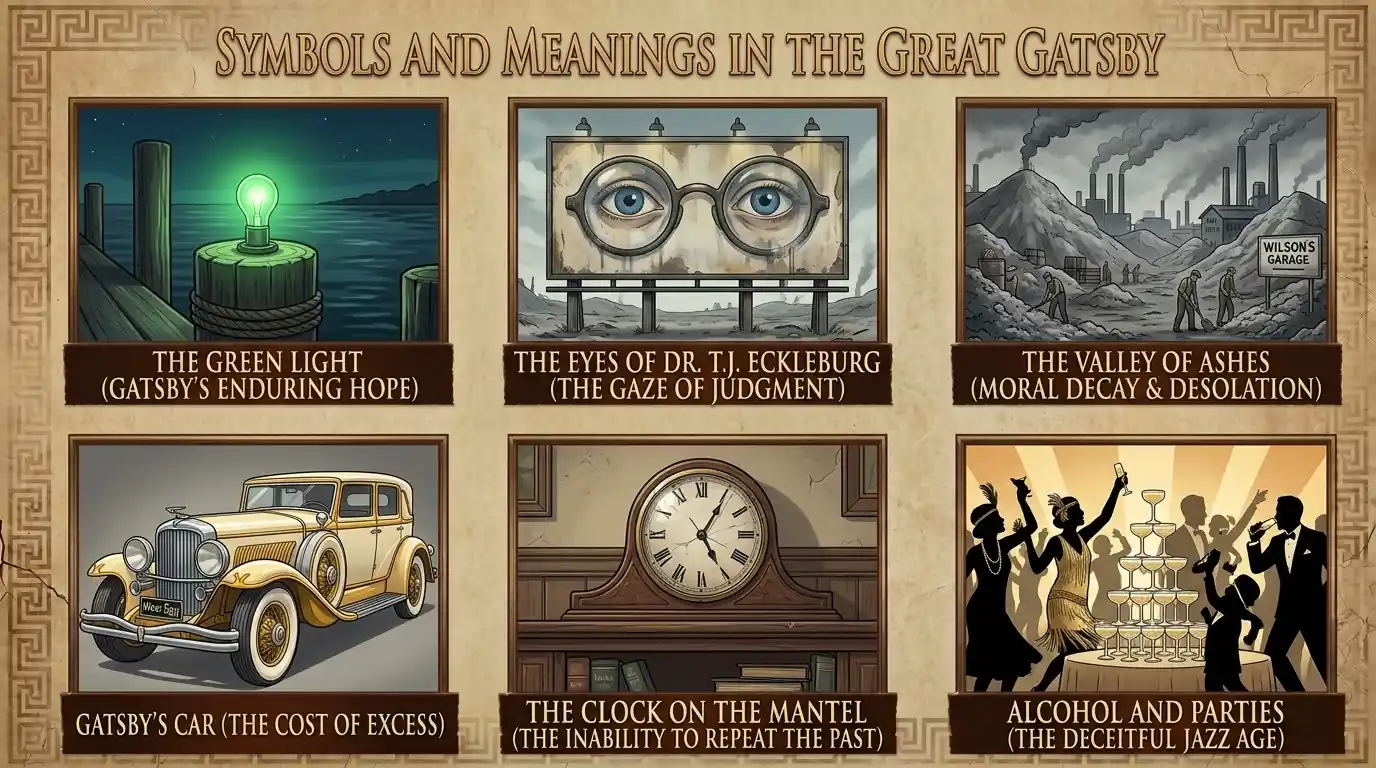
The Great Gatsby uses symbols to express ideas about dreams, love, wealth, social class, time, appearance, and the American Dream. Some of the most important symbols include the green light, the eyes of Doctor T. J.
Eckleburg, the Valley of Ashes, East Egg and West Egg, Gatsby’s mansion, cars, colors, parties, and the clock.
These details are more than background elements. Fitzgerald uses them to show what his characters want and to reveal the gap between the glamorous image of the 1920s and the problems underneath it.
Understanding the symbols in The Great Gatsby can make the novel easier to analyze for class discussions, essays, tests, and literary study.
What Are the Main Symbols in The Great Gatsby? (Quick Answer)
The major symbols in The Great Gatsby include the following:
| Symbol | Main Meaning | Related Theme |
| Green light | Hope, longing, and an unreachable dream | American Dream |
| Eyes of Doctor T. J. Eckleburg | Observation, judgment, and moral uncertainty | Morality |
| Valley of Ashes | Poverty, waste, and inequality | Social class |
| East Egg | Inherited wealth and social privilege | Class |
| West Egg | New wealth and ambition | Social mobility |
| Gatsby’s mansion | Wealth, identity, and ambition | Materialism |
| Yellow car | Wealth, status, recklessness, and danger | Carelessness |
| White | Beauty, innocence, and appearances | Appearance vs. reality |
| Gold | Wealth and luxury | Materialism |
| Yellow | Artificial glamour and decay | Corruption |
| Clock | Time and Gatsby’s desire to recover the past | Past vs. present |
| Parties | Excess, popularity, and loneliness | Wealth and emptiness |
| Daisy’s voice | Wealth, privilege, and attraction | Class and desire |
| Weather | Emotional atmosphere and change | Love and uncertainty |
These symbols do not always have only one meaning. Their significance can change depending on the scene and the character viewing them.
What Is Symbolism in The Great Gatsby?
Symbolism is the use of an object, place, color, action, or image to communicate an idea beyond its literal meaning.
In The Great Gatsby, Fitzgerald frequently gives ordinary things a deeper significance. A light is not simply a light. A car is not simply a car. A house is not simply a house.
For example, Gatsby’s mansion is literally a large home, but it also represents his enormous ambition and the identity he has constructed for himself. The green light is physically located across the water, but Gatsby’s attention to it turns it into a representation of his hopes and desires.
This makes symbolism important because it allows Fitzgerald to communicate themes indirectly.
The Green Light
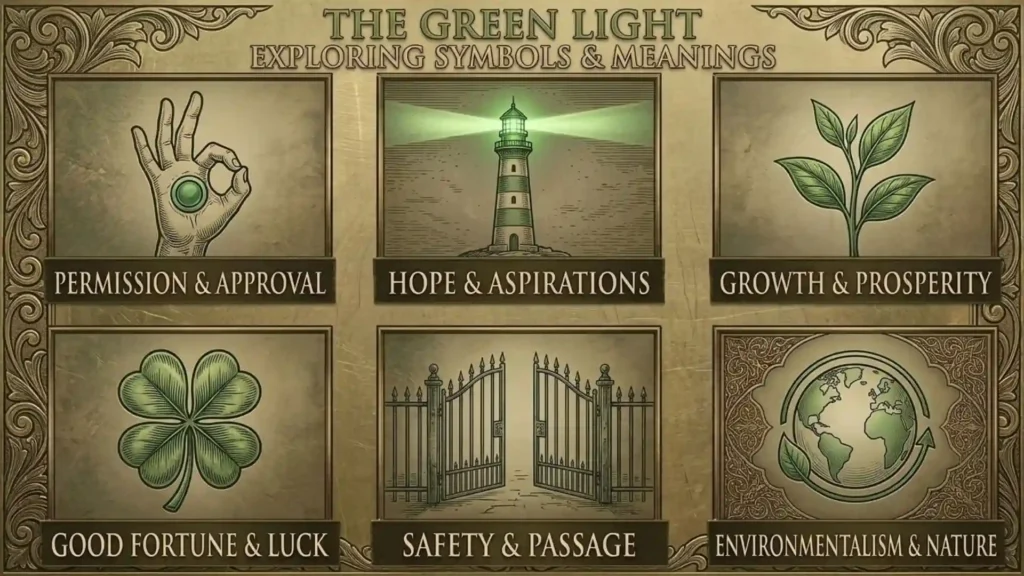
The green light is arguably the most recognizable symbol in The Great Gatsby. Gatsby notices it across the water from his mansion, where it shines near Daisy’s home.
What Does the Green Light Symbolize?
The green light symbolizes Gatsby’s longing for a future he believes he can achieve. At the personal level, it is closely connected to Daisy and his desire to reunite with her.
It can also represent:
- Hope
- Desire
- Ambition
- The future
- An idealized dream
- The American Dream
- Something that remains just out of reach
Gatsby sees the light from a distance. He can move toward it, but he cannot simply possess what it represents.
The Green Light and Daisy
Gatsby’s feelings for Daisy give the green light its personal meaning.
To Gatsby, Daisy is not merely someone he once loved. He turns her into an ideal version of the life he wants. His dream of being with Daisy becomes connected to his belief that he can recreate the happiness he imagined from the past.
The light therefore becomes a visual reminder of his desire.
The Green Light and the American Dream
The green light can also be connected to the American Dream because Gatsby believes that the future can be shaped through determination and ambition.
He moves from a poor background to an extremely wealthy lifestyle. Yet his material success does not give him the thing he wants most.
This creates an important tension. Gatsby can acquire a mansion, expensive clothing, a luxury car, and social attention, but he cannot use money to control time or another person’s choices.
Does the Meaning of the Green Light Change?
Yes. Early in the novel, the light is closely connected to Gatsby’s personal hope of reaching Daisy.
By the end, its meaning becomes broader. It can be understood as a symbol of the human tendency to pursue an ideal future even when that future remains beyond complete reach.
The symbol therefore moves from Gatsby’s individual dream toward a larger reflection on human ambition.
The Eyes of Doctor T. J. Eckleburg
The eyes of Doctor T. J. Eckleburg appear on a large, faded billboard overlooking the Valley of Ashes.
What Do the Eyes Symbolize?
The eyes can represent:
- Observation
- Judgment
- Moral uncertainty
- Spiritual emptiness
- The desire for meaning
- A society searching for moral authority
The billboard is actually an advertisement, which makes the symbol especially interesting. It looks like an all-seeing image, but its original purpose is commercial.
Do the Eyes Represent God?
Some characters and readers interpret the eyes as a God-like symbol.
George Wilson especially gives the eyes a religious meaning when he connects them with the idea of a watching God.
However, Fitzgerald does not directly state that Doctor Eckleburg’s eyes are God. The image is deliberately ambiguous.
The fact that the eyes belong to an old advertisement creates an important contrast between religious interpretation and commercial reality.
The Eyes and Moral Uncertainty
The eyes can also be viewed as a symbol of a society in which people are unsure where moral authority comes from.
The characters make selfish choices, pursue pleasure, hide the truth, and avoid responsibility. The eyes appear to watch this world, but they do not actually intervene.
That silence makes the symbol more complicated than a simple representation of punishment.
The Valley of Ashes
The Valley of Ashes is a bleak industrial area between the wealthy communities and New York City.
What Does the Valley of Ashes Represent?
The Valley of Ashes represents:
- Poverty
- Social inequality
- Industrial waste
- Neglect
- Moral emptiness
- The hidden cost of wealth
- The darker side of the American Dream
It is deliberately different from the beautiful homes and glamorous parties associated with wealthy characters.
The Valley and Social Class
The Valley of Ashes exposes the difference between people who have enormous wealth and people who struggle to survive.
George and Myrtle Wilson live and work in this environment, while wealthy characters such as Tom and Daisy can move through the world with much greater freedom.
This contrast makes the Valley an important symbol of class division.
The Valley and the American Dream
The American Dream is often associated with opportunity and upward mobility. Gatsby appears to achieve remarkable financial success, but the Valley of Ashes shows that prosperity is not equally experienced by everyone.
The contrast suggests that a society can produce extraordinary wealth while leaving other people surrounded by poverty and industrial waste.
Why Is the Valley Between the Eggs and New York?
Its location is significant.
The Valley lies between wealthy communities and the exciting urban world of New York. Characters travel through it as they move between different social environments.
This makes the Valley almost like a physical reminder of the economic and social divisions separating those worlds.
East Egg and West Egg
East Egg and West Egg are fictional communities on Long Island, but they also function as symbols of social class.
What Does East Egg Represent?
East Egg represents old money, meaning wealth that has been established and inherited across generations.
Tom and Daisy Buchanan belong to this social world.
Their position demonstrates that financial wealth is not the only factor determining social status. Family background and inherited privilege also matter.
What Does West Egg Represent?
West Egg represents new money.
Gatsby lives there because he has accumulated great wealth but does not come from the same established social background as Tom and Daisy.
Nick also lives in West Egg, although his financial and social position differs from Gatsby’s.
Old Money vs. New Money
The difference between the Eggs is important because Gatsby believes wealth can help him enter Daisy’s world.
He becomes rich and builds an impressive house close to Daisy, but his new wealth does not automatically give him the same social standing as someone born into an established wealthy family.
The Eggs therefore symbolize a class system that is more complicated than simply being rich or poor.
Color Symbols in The Great Gatsby
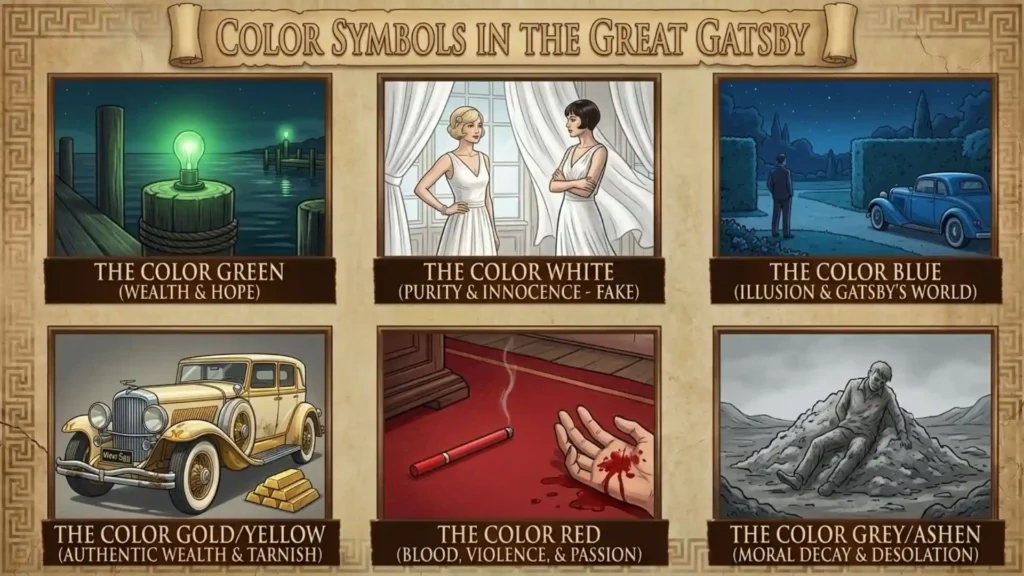
Color is used repeatedly throughout the novel. Fitzgerald does not always assign one permanent meaning to every color, but recurring colors help establish mood and reinforce themes.
What Does Green Symbolize?
Green is strongly associated with the green light.
It can suggest:
- Hope
- Desire
- Growth
- The future
- Ambition
- An ideal that has not yet been reached
Green can therefore connect Gatsby’s personal dream with the broader idea of striving for something better.
What Does White Symbolize?
White is often associated with beauty, elegance, youth, and apparent innocence.
Daisy and Jordan are frequently presented through imagery involving white.
However, Fitzgerald complicates this association. Their elegant appearance does not necessarily mean their behavior is innocent.
White therefore helps explore the difference between appearance and reality.
What Does Gold Symbolize?
Gold is strongly connected with wealth, luxury, and high social status.
It can suggest something valuable and desirable, making it appropriate for a novel filled with characters who care deeply about money and social position.
What Does Yellow Symbolize?
Yellow often has a less positive association than gold.
It can suggest artificial glamour, superficial wealth, decay, or danger.
Gatsby’s yellow car is especially important because its bright appearance becomes connected with a tragic event.
What Does Gray Symbolize?
Gray imagery fits the bleak atmosphere of the Valley of Ashes.
It can suggest:
- Emptiness
- Lifelessness
- Dullness
- Neglect
- A lack of vitality
The gray environment provides a sharp contrast to the colorful and luxurious world of Gatsby’s parties.
Gatsby’s Mansion
Gatsby’s enormous mansion is an important symbol of his ambition.
Wealth and Ambition
Gatsby’s house demonstrates how much money he has accumulated.
Its size and appearance help him create the image of a successful and sophisticated man.
But the mansion is not simply a celebration of wealth. It is also part of Gatsby’s strategy for getting closer to Daisy.
Creating a New Identity
Gatsby constructs an entirely different identity from the one he had earlier in life.
His mansion, clothing, parties, car, and social connections all contribute to this new image.
The house therefore symbolizes both material achievement and self-invention.
The Empty Mansion
There is also an important contrast between the size of Gatsby’s home and the emotional emptiness surrounding him.
He can fill the house with guests, but he cannot fill his life with the relationship he actually wants.
This makes the mansion a symbol of the limitations of material success.
Cars as Symbols
Cars are important throughout The Great Gatsby because they represent much more than transportation.
What Do Cars Symbolize?
Cars can symbolize:
- Wealth
- Freedom
- Social status
- Speed
- Modern life
- Carelessness
- Power
- Danger
In a society obsessed with appearances, an expensive car becomes a visible sign of success.
Gatsby’s Yellow Car
Gatsby’s yellow car is particularly important because it reflects his extravagant lifestyle.
Its unusual appearance makes it memorable, but the vehicle eventually becomes associated with the tragic death of Myrtle Wilson.
This creates a connection between wealth, carelessness, and destructive consequences.
Cars and Recklessness
Driving also reflects the behavior of wealthy characters.
People move quickly through different spaces, but they do not always take responsibility for the consequences of their actions.
Cars therefore become part of Fitzgerald’s larger examination of privilege and irresponsibility.
Gatsby’s Parties
Gatsby’s parties are among the most visually memorable parts of the novel.
What Do Gatsby’s Parties Symbolize?
The parties symbolize:
- Wealth
- Excess
- Entertainment
- Social status
- The desire to impress
- Superficial relationships
- Loneliness
The parties attract huge numbers of people, many of whom do not genuinely know Gatsby.
Glamour and Emptiness
From the outside, Gatsby’s parties look exciting and successful.
There is music, food, dancing, drinking, and beautiful surroundings.
Yet the parties do not give Gatsby the emotional connection he wants.
This contrast between external excitement and internal loneliness reinforces the novel’s theme of appearance versus reality.
What Happens to the Party Guests?
One of the clearest signs of the shallow nature of Gatsby’s social world comes after his death.
The people who enjoyed his hospitality largely disappear.
This shows that having many social contacts is not the same as having genuine friendships.
The Clock
The clock appears during Gatsby’s emotional reunion with Daisy at Nick’s house.
What Does the Clock Symbolize?
The clock symbolizes:
- Time
- Memory
- The past
- Gatsby’s desire to reverse time
- The difficulty of recreating an earlier life
Gatsby wants his relationship with Daisy to return to the way he remembers it.
The clock becomes an especially fitting object because time continues moving forward even when Gatsby wants to look backward.
Gatsby and the Past
Gatsby believes that he can recreate the past through determination.
His wealth, house, clothing, and lifestyle are all part of his attempt to make his dream real.
But the past cannot simply be restored because people and circumstances have changed.
The clock therefore represents one of the central conflicts in Gatsby’s story: the desire to recover something that time has already changed.
Daisy’s Voice
Daisy’s voice has a symbolic significance because Gatsby associates it strongly with wealth.
What Does Daisy’s Voice Symbolize?
Daisy’s voice can represent:
- Wealth
- Privilege
- Elegance
- Social status
- Gatsby’s attraction to Daisy’s world
Her voice is part of what makes her attractive to Gatsby, but it also reminds readers that Daisy represents more than romantic love in his imagination.
She embodies a social world Gatsby wants to enter.
Love and Wealth
Gatsby’s feelings for Daisy and his desire for wealth become intertwined.
He does not simply want Daisy as an individual. He also wants the life, status, security, and social world that she represents.
This makes Daisy an important part of the novel’s examination of class and desire.
Gatsby’s Clothes and Shirts
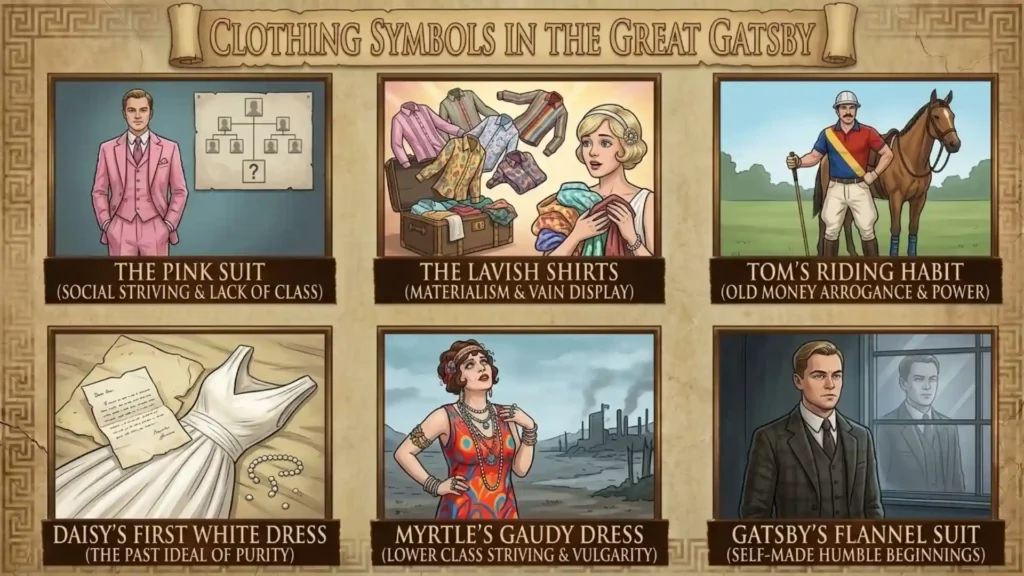
Clothing is another way Fitzgerald explores wealth and identity.
What Do Gatsby’s Clothes Symbolize?
Gatsby’s clothing represents:
- Financial success
- Social transformation
- Status
- His constructed identity
- His desire to impress Daisy
Gatsby wants Daisy to see evidence of his success.
The famous shirt scene is important because Daisy reacts emotionally to his expensive collection.
Appearance vs. Reality
The clothes demonstrate how material objects can communicate status without necessarily proving emotional happiness.
Gatsby can buy expensive clothing, but money cannot guarantee the relationship he wants.
The scene therefore reinforces the difference between possessing wealth and achieving fulfillment.
Weather and Water
Nature and weather often contribute to the emotional atmosphere of important scenes.
Rain and Emotional Uncertainty
Rain appears during Gatsby and Daisy’s reunion at Nick’s house.
The wet weather matches the nervous and uncertain atmosphere of the meeting.
Gatsby has imagined this moment for years, so the reality is emotionally complicated.
Sunshine and Happiness
Brighter weather can accompany moments of greater emotional openness or optimism.
Fitzgerald uses weather subtly rather than making every weather event a fixed symbol.
The important point is that weather can reinforce the mood of a scene and reflect changes in relationships.
Water and Distance
Water is particularly important because it physically separates Gatsby from Daisy.
What Does the Water Symbolize?
The water can represent:
- Distance
- Separation
- Longing
- Barriers
- The space between dreams and reality
Gatsby’s mansion is positioned across the water from Daisy.
He can see the world he wants, but a physical distance remains between him and his dream.
This makes the water closely connected to the green light.
The Owl-Eyed Man
The Owl-Eyed Man appears at Gatsby’s party and becomes fascinated by Gatsby’s library.
What Does the Owl-Eyed Man Symbolize?
He contributes to the novel’s theme of appearance versus reality.
The books in Gatsby’s library are real, which surprises him.
This detail matters because Gatsby’s entire identity is carefully constructed to appear authentic.
The Owl-Eyed Man recognizes something unusual about Gatsby’s world: it looks almost too perfectly designed.
His presence reminds readers that Gatsby’s image has been deliberately manufactured.
How the Major Symbols Connect to the Themes
The symbols become more meaningful when they are considered together rather than separately.
Symbols and the American Dream
The green light, Gatsby’s mansion, clothing, car, and parties all connect to Gatsby’s pursuit of an ideal life.
He believes he can transform himself through ambition and wealth.
Yet his story suggests that achieving financial success does not necessarily provide emotional satisfaction.
Symbols and Social Class
East Egg, West Egg, the Valley of Ashes, Daisy’s voice, and Gatsby’s possessions all contribute to the novel’s exploration of class.
The novel shows that wealth has different forms.
Someone can become rich without receiving the same social acceptance as someone born into an established wealthy family.
Symbols and Love
The green light, water, Daisy’s voice, and Gatsby’s mansion are all connected to his feelings for Daisy.
His romantic dream becomes connected with his broader desire for status and success.
Symbols and Appearance vs. Reality
Gatsby’s mansion, parties, clothing, library, and colors all help develop the contrast between what things look like and what they actually are.
A beautiful house does not guarantee happiness.
A crowded party does not guarantee friendship.
Expensive clothing does not guarantee love.
A wealthy identity does not erase the past.
Symbols and Time
The clock and green light are especially important to the novel’s treatment of time.
Gatsby wants the future he imagines, but he also wants to restore the past.
These desires conflict because the past cannot simply be reproduced.
Symbols and Moral Decay
The Valley of Ashes, Eckleburg’s eyes, cars, and yellow imagery help create the novel’s darker side.
Behind the wealth and entertainment is a world where selfish decisions can have serious consequences.
Symbols vs. Motifs in The Great Gatsby
Symbols and motifs are related, but they are not exactly the same.
A symbol is something that carries a deeper meaning beyond its literal function.
A motif is a recurring image, idea, pattern, or element that repeatedly supports a theme.
For example, the green light functions as a symbol because it represents Gatsby’s dream. Repeated references to color, wealth, automobiles, and parties can also function as motifs because they reinforce recurring ideas throughout the novel.
Some elements can be discussed as both symbols and motifs depending on the literary analysis.
How to Analyze a Symbol in a Gatsby Essay
If you need to write about symbolism in an essay, avoid simply saying:
“The green light symbolizes hope.”
That gives the reader the answer but not the analysis.
A stronger approach follows four steps.
Step 1: Identify the Symbol
Name the object, place, color, or image.
For example, identify the green light.
Step 2: Explain Its Literal Role
Explain what the object actually is in the story.
The green light is located across the water near Daisy’s home.
Step 3: Explain the Deeper Meaning
Discuss what it represents for Gatsby.
It becomes connected to his longing for Daisy and the future he imagines.
Step 4: Connect It to a Theme
Explain why Fitzgerald uses the symbol.
The green light can help develop the novel’s ideas about ambition, desire, the American Dream, and the difficulty of reaching an ideal future.
This approach produces analysis rather than simple plot summary.
The Great Gatsby Symbols by Chapter
The following guide can help students locate some of the most important symbolic moments.
| Symbol | Important Chapter(s) | Why It Matters |
| Green light | Chapters 1, 5, 9 | Gatsby’s dream and longing |
| Valley of Ashes | Chapters 2, 7, 8 | Poverty, class, and moral emptiness |
| Eckleburg eyes | Chapters 2, 7, 8 | Observation and uncertain morality |
| Gatsby’s parties | Chapter 3 and elsewhere | Wealth, excess, and shallow relationships |
| Gatsby’s library | Chapter 3 | Appearance and authenticity |
| Clock | Chapter 5 | Time and Gatsby’s attempt to recover the past |
| Cars | Especially Chapters 3 and 7 | Wealth, status, recklessness, and consequences |
| Gatsby’s mansion | Throughout | Wealth, ambition, and identity |
| Colors | Throughout | Appearance, desire, wealth, and decay |
The Great Gatsby Symbols: Quick Study Guide
For a quick review, remember these core meanings:
Green light: Gatsby’s dream, longing, and the future he wants to reach.
Eyes of Doctor T. J. Eckleburg: Observation, judgment, and uncertain moral or spiritual authority.
Valley of Ashes: Poverty, inequality, waste, and the darker side of wealth.
East Egg: Old money and inherited social privilege.
West Egg: New money and social ambition.
Gatsby’s mansion: Wealth, ambition, self-invention, and the desire to impress Daisy.
Cars: Wealth, freedom, status, recklessness, and danger.
White: Beauty, elegance, apparent innocence, and misleading appearances.
Gold: Luxury and wealth.
Yellow: Artificial glamour, decay, and danger.
Clock: Time, memory, and Gatsby’s desire to recover the past.
Parties: Excess, popularity, superficial relationships, and loneliness.
Daisy’s voice: Wealth, privilege, and Gatsby’s attraction to Daisy’s social world.
Frequently Asked Questions About Symbols in The Great Gatsby
What are the main symbols in The Great Gatsby?
The major symbols include the green light, the eyes of Doctor T. J. Eckleburg, the Valley of Ashes, East Egg, West Egg, Gatsby’s mansion, cars, colors, parties, Daisy’s voice, and the clock.
What does the green light symbolize in The Great Gatsby?
The green light represents Gatsby’s longing for Daisy and the ideal future he believes he can achieve. It can also represent the broader human pursuit of an unreachable dream.
What do the eyes of Doctor T. J. Eckleburg symbolize?
The eyes can symbolize observation, judgment, and moral uncertainty. Some characters interpret them in religious terms, but Fitzgerald leaves their exact meaning open to interpretation.
What does the Valley of Ashes symbolize?
The Valley of Ashes represents poverty, waste, social inequality, and the darker consequences existing beneath the wealthy characters’ glamorous lifestyle.
What do East Egg and West Egg symbolize?
East Egg represents old money and inherited privilege, while West Egg represents new money and social ambition. Their separation highlights the importance of class and family background.
What does Gatsby’s mansion symbolize?
Gatsby’s mansion represents wealth, ambition, self-invention, and his attempt to create a lifestyle that will bring him closer to Daisy.
What do cars symbolize in The Great Gatsby?
Cars can represent wealth, social status, freedom, speed, and modern life. They also become associated with recklessness and destructive consequences.
What does the clock symbolize in The Great Gatsby?
The clock symbolizes time and Gatsby’s desire to recover the past. It reflects the difficulty of recreating an earlier period of life exactly as it was.
What do colors symbolize in The Great Gatsby?
Colors contribute to different ideas throughout the novel. Green is closely associated with hope and desire, white with beauty and appearances, gold with wealth, yellow with artificial glamour and decay, and gray with emptiness and lifelessness.
Why are symbols important in The Great Gatsby?
Symbols allow Fitzgerald to communicate complex ideas through objects, places, colors, and images. They help connect the characters’ personal experiences to larger themes such as wealth, class, love, time, morality, and the American Dream.
Conclusion
The symbols in The Great Gatsby help turn Fitzgerald’s story into a deeper examination of American life, ambition, wealth, love, and social class. The green light represents Gatsby’s longing and idealized dream, while the Valley of Ashes reveals poverty and inequality behind the wealthy world’s glamour. The eyes of Doctor T. J. Eckleburg introduce questions about judgment and morality, while East Egg and West Egg expose divisions between old and new money.
Other symbols add further layers. Gatsby’s mansion and clothing show his carefully constructed identity, cars connect wealth with recklessness, parties reveal the difference between popularity and genuine friendship, and the clock reflects his struggle with the passing of time. When these symbols are studied together, they show how Fitzgerald uses small details to develop the novel’s larger themes and make The Great Gatsby more than a story about one man’s pursuit of love.

Elliot Kensington
Elliot Kensington is a storyteller at heart, always fascinated by the hidden corners of human imagination. From a young age, he found comfort in books and the worlds they created, inspiring him to craft tales that blend emotion, suspense, and wonder. His writing journey began with short stories that captured fleeting moments of life, and over time, evolved into novels that explore both the extraordinary and the everyday. Elliot believes that every story holds a piece of the soul, and his mission is to connect readers to those moments that linger long after the last page. When he’s not writing, he enjoys exploring nature, capturing moments through photography, and seeking inspiration in the little things.
Books by Elliot Kensington:
-
Shadows of Tomorrow
-
The Whispering Path