
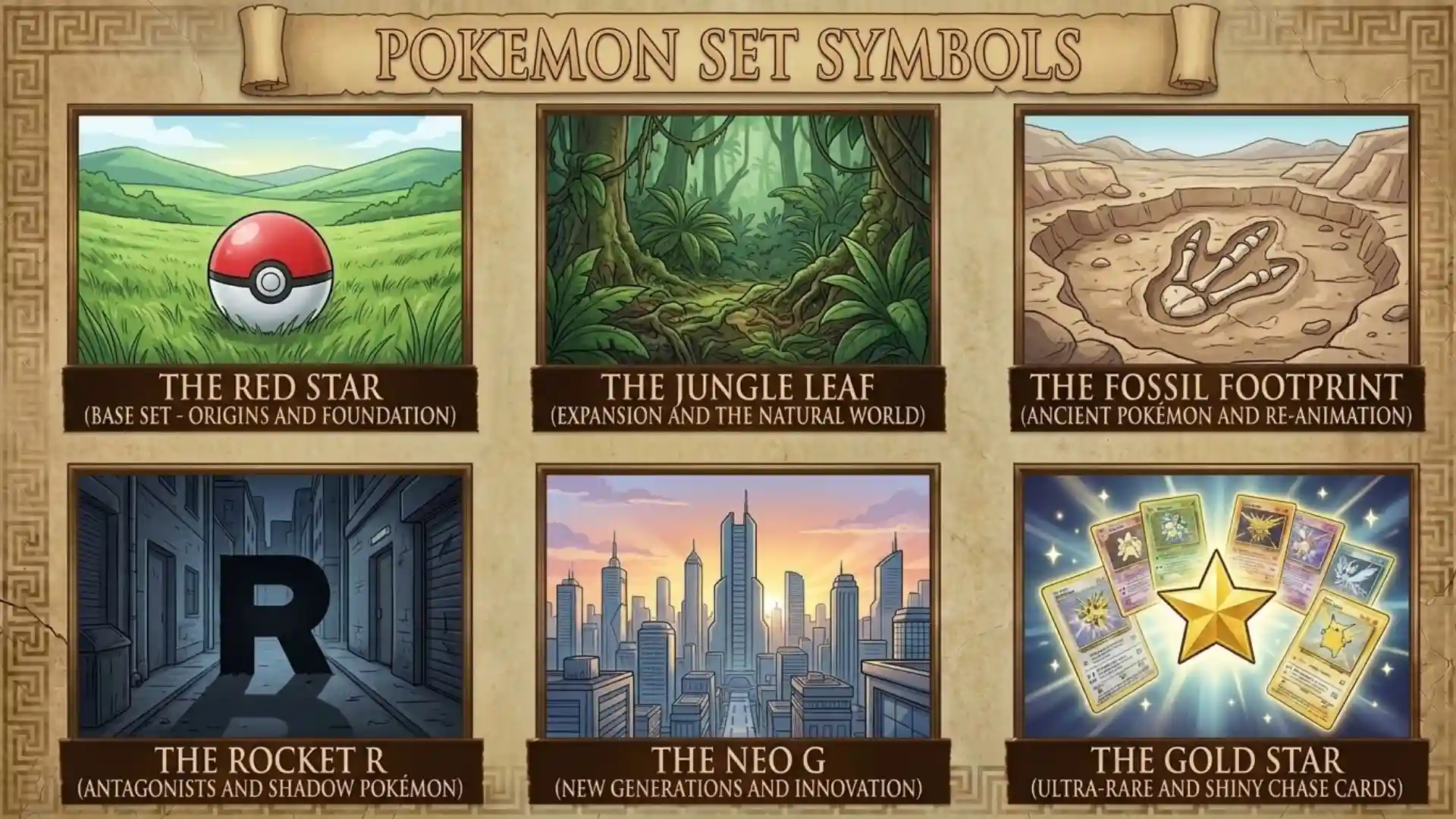
If you collect Pokémon Trading Card Game cards, you have probably noticed small symbols, letters, numbers, and codes printed on the cards. These tiny markings can tell you important information about a card, but they can also be confusing because Pokémon has changed its card identification system over the years.
Pokémon set symbols are primarily used to identify the expansion or set associated with a card. Older Pokémon cards commonly use small expansion symbols, while cards from the Scarlet & Violet Series introduced expansion codes in place of the traditional symbols. Pokémon announced this change when Scarlet & Violet launched.
Knowing how to read these markings can help you identify cards, organize a collection, distinguish cards from different expansions, and search for a particular card in the official Pokémon Trading Card Game database.
What Are Pokémon Set Symbols?
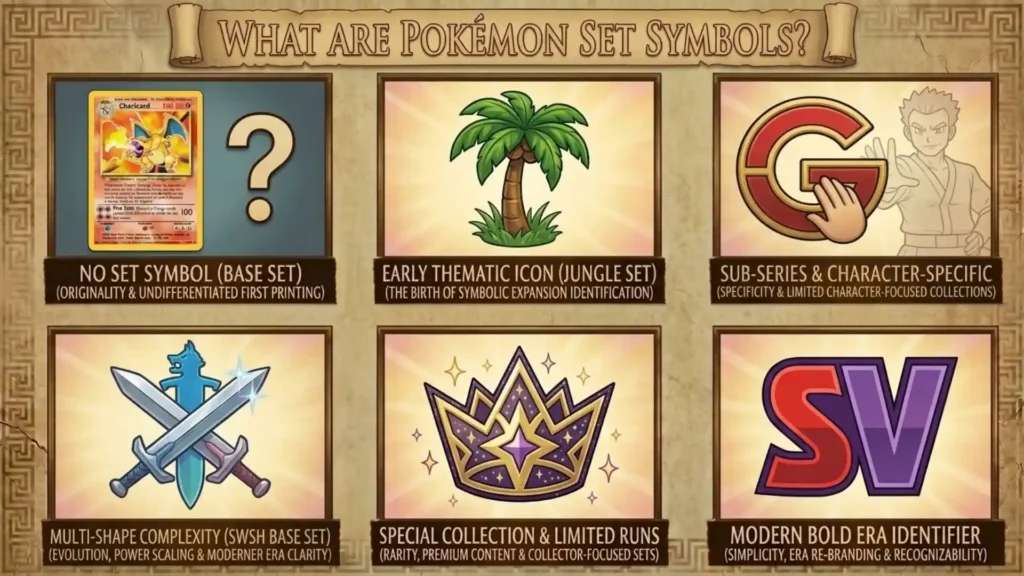
Pokémon set symbols are small identifying marks associated with Pokémon TCG expansions. They are particularly useful when the same Pokémon has appeared on cards from several different sets.
A card’s name alone does not necessarily tell you which expansion it belongs to. For example, Pikachu has appeared in numerous Pokémon TCG products and expansions. Looking at the set information, card number, artwork, and other details can help distinguish one version from another.
What Information Does a Set Symbol Provide?
A set symbol or modern expansion code can help answer a basic collector question:
“Which Pokémon TCG set is this card from?”
This is different from asking:
- How rare is the card?
- Is the card legal for tournament play?
- What is the card worth?
- Is the card a promo?
- Which printing does the card represent?
Those questions may require other markings and information.
Why Are Set Symbols Useful?
Set identification is useful for:
- Organizing collections
- Completing individual sets
- Identifying older cards
- Distinguishing different versions
- Searching card databases
- Sorting duplicates
- Researching a card’s history
- Checking cards before buying or trading
For collectors, the small marking can be the starting point for identifying a card accurately.
Where Are Pokémon Set Symbols Located?
The position and appearance of set information depend on the era of the card.
Older Pokémon Cards
Many older Pokémon cards have a small expansion symbol near the bottom of the card.
The exact design and placement vary across different generations and card layouts, so you should not expect every vintage card to have its set symbol in exactly the same location.
When identifying an older card, examine the entire lower portion carefully.
Modern Pokémon Cards
Modern cards use a different system.
Beginning with the Scarlet & Violet Series, Pokémon replaced the traditional expansion symbol with an expansion code. The code appears on the bottom-left of the card.
This change is particularly important for collectors who are used to identifying vintage cards by their small graphical symbols.
Pokémon Set Symbols vs. Set Codes
Although people often use the terms interchangeably, traditional set symbols and modern expansion codes are not exactly the same thing.
Traditional Set Symbols
Older Pokémon TCG expansions commonly used a small graphic symbol to identify the set.
These symbols can be visually distinctive, which is why collectors often use symbol charts when identifying vintage cards.
Modern Expansion Codes
Modern Pokémon cards use textual expansion codes instead.
Pokémon introduced this system with the Scarlet & Violet Series. The code appears on the bottom-left of the card.
For this reason, a search for “Pokémon set symbols” may actually involve both older symbols and modern expansion codes.
Pokémon Set Symbols vs. Rarity Symbols
This is one of the most important distinctions for new collectors.
A set symbol identifies the expansion, while a rarity symbol identifies the rarity classification.
What Is a Rarity Symbol?
Rarity is a separate piece of card information.
The official Pokémon support documentation explains that rarity is one of the searchable characteristics in the Pokémon TCG database and that the rarity symbol appears in the lower-right area of the card.
Traditional Pokémon cards commonly used symbols such as:
- Circle for common
- Diamond for uncommon
- Star for rare
However, newer Pokémon TCG sets use a much broader rarity system.
Why Is the Difference Important?
Suppose you find a small star on a card.
That does not automatically mean you have found the set symbol.
It may be the card’s rarity indicator.
The safest approach is to consider the location, era, card number, and other markings together.
Pokémon Set Symbols vs. Regulation Marks
Modern Pokémon cards can contain another type of letter or symbol called a regulation mark.
What Is a Regulation Mark?
A regulation mark is associated with competitive format legality rather than identifying the expansion itself.
This means that a regulation mark answers a different question:
“How does this card interact with current competitive format rules?”
It does not simply tell you which expansion the card came from.
Why Do Collectors Confuse Them?
Small letters can look similar when printed on a card.
If you see a letter on a modern Pokémon card, do not immediately assume that it is the expansion code.
Check the location and surrounding information.
Pokémon’s Standard-format rotation announcements specifically use regulation marks when explaining which cards remain legal for competitive Standard play.
How to Identify a Pokémon Card Using Its Set Information
You can identify most cards more accurately by combining several clues.
Step 1: Find the Set Mark or Code
Look around the lower portion of the card.
On older cards, look for a small expansion symbol.
On Scarlet & Violet-era cards, look for the expansion code at the bottom-left.
Step 2: Find the Card Number
Many Pokémon cards have a number such as:
123/198
The first number identifies the individual card in the set’s numbering sequence, while the second number indicates the size of that numbered sequence.
This information is extremely useful when several cards feature the same Pokémon.
Step 3: Check the Artwork
Compare the artwork carefully.
The same Pokémon can appear in several expansions with different artwork.
Artwork can therefore provide an additional identification clue.
Step 4: Check the Rarity
Look at the rarity information separately from the expansion identifier.
Rarity can help distinguish versions of cards that otherwise look similar.
Step 5: Confirm the Information in a Card Database
Once you have gathered the card’s name, number, and set information, compare it with a reliable database.
The official Pokémon TCG database supports searches by expansion and several other card characteristics.
Pokémon Set Symbols by Major TCG Era

Pokémon TCG has existed for decades, so its set identification system has changed alongside card designs.
Original Pokémon TCG Era
The earliest English Pokémon TCG expansions include familiar sets such as:
- Base Set
- Jungle
- Fossil
- Team Rocket
- Gym Heroes
- Gym Challenge
- Neo Genesis
- Neo Discovery
- Neo Revelation
- Neo Destiny
Collectors working with these cards often need to identify small expansion symbols to determine the set.
e-Reader Era
The e-Reader period introduced distinctive card designs and expansions including:
- Expedition
- Aquapolis
- Skyridge
Cards from this era can have visual characteristics that help separate them from earlier and later Pokémon TCG releases.
EX Series
The EX era includes expansions such as:
- EX Ruby & Sapphire
- EX Sandstorm
- EX Dragon
- EX Team Magma vs Team Aqua
- EX FireRed & LeafGreen
- EX Team Rocket Returns
- EX Deoxys
When sorting cards from this period, the set identifier can be particularly useful because many Pokémon appear across multiple expansions.
Diamond & Pearl and Platinum Era
Important expansions from this period include:
- Diamond & Pearl
- Mysterious Treasures
- Great Encounters
- Legends Awakened
- Stormfront
- Platinum
- Rising Rivals
- Supreme Victors
- Arceus
The card’s expansion information and numbering can help identify its exact set.
HeartGold & SoulSilver Era
This era includes:
- HeartGold & SoulSilver
- Unleashed
- Undaunted
- Triumphant
These sets form another recognizable section of Pokémon TCG collecting history.
Black & White Era
The Black & White era includes expansions such as:
- Black & White
- Emerging Powers
- Noble Victories
- Next Destinies
- Dark Explorers
- Dragons Exalted
- Boundaries Crossed
- Plasma Storm
- Plasma Freeze
- Plasma Blast
- Legendary Treasures
The official Pokémon card database treats expansions as separate searchable categories.
XY Era
Major XY expansions include:
- XY
- Flashfire
- Furious Fists
- Phantom Forces
- Primal Clash
- Roaring Skies
- Ancient Origins
- BREAKthrough
- BREAKpoint
- Fates Collide
- Steam Siege
- Evolutions
Set identification is useful when the same Pokémon appears in multiple XY expansions.
Sun & Moon Era
The Sun & Moon era contains many well-known expansions, including:
- Sun & Moon
- Guardians Rising
- Burning Shadows
- Shining Legends
- Crimson Invasion
- Ultra Prism
- Forbidden Light
- Celestial Storm
- Lost Thunder
- Team Up
- Unbroken Bonds
- Unified Minds
- Cosmic Eclipse
These expansions are listed separately in the official Pokémon TCG database.
Sword & Shield Era
Sword & Shield expansions include:
- Sword & Shield
- Rebel Clash
- Darkness Ablaze
- Champion’s Path
- Vivid Voltage
- Shining Fates
- Battle Styles
- Chilling Reign
- Evolving Skies
- Celebrations
- Fusion Strike
- Brilliant Stars
- Astral Radiance
- Lost Origin
- Silver Tempest
- Crown Zenith
The era also contains special sets and products with their own identifying information.
Scarlet & Violet Era
Scarlet & Violet introduced an important change in how expansions are displayed.
Pokémon announced that traditional expansion symbols would be replaced with expansion codes beginning with the Scarlet & Violet expansion. The codes are printed on the bottom-left of the card.
Important expansions from this era include:
- Scarlet & Violet
- Paldea Evolved
- Obsidian Flames
- 151
- Paradox Rift
- Paldean Fates
- Temporal Forces
- Twilight Masquerade
- Shrouded Fable
- Stellar Crown
- Surging Sparks
- Prismatic Evolutions
- Journey Together
- Destined Rivals
- Black Bolt
- White Flare
The official Pokémon card database provides expansion categories for these sets and continues to add new releases.
How to Read Modern Pokémon Expansion Codes
Modern cards can look confusing if you are accustomed to older symbols.
What Is an Expansion Code?
An expansion code is a short identifier printed on a modern Pokémon card to indicate its expansion.
It replaced the traditional expansion symbol starting with Scarlet & Violet.
Where Is the Code Printed?
For Scarlet & Violet cards, look at the bottom-left section of the card.
The code is separate from the card number and should not be confused with the regulation mark.
Why Is the Code Useful?
It provides a quick way to associate the card with its expansion.
When combined with the card number, it can make card identification much easier.
Pokémon Card Numbering Explained
Set information and card numbering work together.
What Does 25/198 Mean?
If a card says:
25/198
the 25 identifies the card’s position in the numbered set sequence, while 198 indicates the total number in that sequence.
This is not the same as a rarity rating.
Why Is Card Numbering Important?
Card numbers are useful when:
- Completing a set
- Checking a binder
- Identifying duplicates
- Comparing two versions
- Searching a card database
- Confirming a suspected card identity
What About Cards Numbered Above the Set Total?
Collectors may encounter cards with numbering that goes beyond the main numbered set.
These can be associated with special or secret cards and should be evaluated using the specific expansion’s numbering system.
This is another reason not to assume that every set follows exactly the same numbering pattern.
Why Pokémon Set Symbols Matter to Collectors
A tiny set mark can provide useful information when building a collection.
Completing a Pokémon Set
If you want to complete a particular expansion, you need to know which cards belong to it.
Set information helps separate cards from different releases.
Organizing a Binder
You can arrange your collection by:
- Set
- Card number
- Pokémon
- Rarity
- Era
- Special collection
- Language
Set-based organization is particularly useful when your collection contains many duplicate Pokémon.
Identifying Duplicate Pokémon Cards
Two cards with the same Pokémon name may not be identical.
They can have:
- Different artwork
- Different set numbers
- Different expansions
- Different rarities
- Different card layouts
- Different printings
Set information helps reveal those differences.
Pokémon Set Symbols and Card Value
A set identifier can help with card-value research, but it does not determine value by itself.
Set and Demand
Some sets attract greater collector interest than others.
However, popularity can vary over time.
Rarity
Rarity is another major factor to examine.
Modern Pokémon TCG sets include many rarity categories beyond the traditional common, uncommon, and rare classifications. The official Pokémon database lists multiple modern rarity types.
Condition
Condition can make a major difference when collectors evaluate individual cards.
Small imperfections, scratches, whitening, bends, or other damage may affect collector interest.
Printing and Variant
Different versions of a card can have different levels of collector interest.
Therefore, a set symbol is best viewed as an identification tool, not a price tag.
How to Check a Pokémon Card in the Official Database
The official Pokémon TCG database can be useful when you have identified some information but are not completely sure about the card.
Search by Pokémon Name
Start with the Pokémon’s name.
This can produce multiple results if that Pokémon appears in different expansions.
Filter by Expansion
Use the expansion filter to narrow the results.
Pokémon’s support documentation confirms that expansion is one of the searchable card characteristics.
Check Rarity
You can also compare the rarity shown in the database with the physical card.
Compare the Card Number
The final step is to make sure the card number matches.
Using several pieces of information together provides a more reliable identification than matching a symbol alone.
Common Mistakes When Identifying Pokémon Set Symbols
Mistake 1: Confusing Set and Rarity
A collector sees a star and assumes it is the set symbol.
The star may actually indicate rarity.
Mistake 2: Expecting Every Card to Have a Traditional Symbol
This is particularly problematic with modern cards.
Scarlet & Violet introduced expansion codes instead of the traditional expansion symbols.
Mistake 3: Looking Only at the Pokémon’s Name
The same Pokémon can appear in many different expansions.
The name is only one piece of identification information.
Mistake 4: Ignoring the Card Number
The card number can provide an important confirmation.
Mistake 5: Confusing an Expansion Code With a Regulation Mark
Modern cards may contain more than one type of letter or symbol.
Their locations and purposes are different.
Mistake 6: Assuming the Set Determines the Price
The expansion can influence collector interest, but condition, rarity, demand, printing, and other factors also matter.
How to Organize Pokémon Cards by Set
Set symbols become particularly useful when your collection starts growing.
Sort Cards by Era
First separate your collection into broad periods such as:
- Original era
- e-Reader era
- EX era
- Diamond & Pearl
- Platinum
- HeartGold & SoulSilver
- Black & White
- XY
- Sun & Moon
- Sword & Shield
- Scarlet & Violet
Separate Individual Expansions
After sorting by era, organize cards by expansion.
This prevents cards from different sets from becoming mixed together.
Arrange Cards by Number
Within each set, arrange cards in numerical order.
For example:
001 → 002 → 003 → 004
This is particularly useful if your goal is to complete a set.
Keep Special Cards Separate
Promo cards, special subsets, and other cards that do not fit neatly into a standard numbered expansion can be stored separately.
A Simple Pokémon Set Identification Checklist
When you find an unknown Pokémon card, use this checklist:
- Read the Pokémon’s name.
- Find the set symbol or expansion code.
- Record the card number.
- Check the artwork.
- Identify the rarity.
- Check the card’s era.
- Look for a regulation mark if it is a modern card.
- Compare the details with the official Pokémon TCG database.
Using these steps together can make identification much easier.
Why the Pokémon Set Symbol System Has Changed
The Pokémon TCG has evolved substantially since its original releases.
Card layouts, rarity systems, competitive markings, and expansion identification methods have all changed over time.
The move from traditional expansion symbols to expansion codes with Scarlet & Violet is one example of this evolution.
As a result, collectors should be careful when applying an identification rule from one era to cards from another.
A method that works perfectly for a vintage card may not work for a modern Scarlet & Violet card.
Current Pokémon Set Information
A Pokémon set-symbol guide can become outdated because new Pokémon TCG expansions continue to be released.
As of September 2026, the official Pokémon TCG card database includes newer Mega Evolution-era expansions and categories in addition to previous Scarlet & Violet and earlier releases.
Pokémon is also marking the TCG’s 30th anniversary in 2026, making the current release landscape particularly active for collectors.
For that reason, a current official database is preferable when identifying newly released cards.
Frequently Asked Questions About Pokémon Set Symbols
What are Pokémon set symbols?
Pokémon set symbols are identifying marks associated with Pokémon TCG expansions. They help collectors determine which set a card belongs to.
Where is the set symbol on a Pokémon card?
The location varies by era. Many older cards have a small expansion symbol near the bottom, while Scarlet & Violet cards use expansion codes on the bottom-left.
Are Pokémon set symbols the same as rarity symbols?
No. Set symbols identify expansions, while rarity symbols identify rarity classifications. The official Pokémon database treats expansion and rarity as separate search fields.
Did Pokémon stop using set symbols?
Pokémon changed the system rather than simply eliminating set identification. Beginning with Scarlet & Violet, traditional expansion symbols were replaced by expansion codes.
What is a Pokémon expansion code?
An expansion code is a short identifier printed on modern Pokémon cards to indicate the expansion they belong to.
Where is the Scarlet & Violet expansion code?
For Scarlet & Violet cards, the expansion code is printed on the bottom-left of the card.
What does the number on a Pokémon card mean?
A number such as 45/198 generally identifies the card’s position within the numbered sequence and the total number of cards in that sequence.
Can I identify a Pokémon card by its set symbol alone?
Sometimes a symbol can strongly narrow down the set, but it is safer to confirm it with the card number, artwork, Pokémon name, and other identifying information.
Do set symbols determine Pokémon card value?
No. Set information can help identify a card, but value can also depend on rarity, condition, demand, printing, popularity, and other factors.
How can I find out which set my Pokémon card belongs to?
Look for the expansion symbol or code, note the card number, and compare the information with the official Pokémon TCG database. Pokémon provides expansion as one of its card-search categories.
What is the difference between an expansion code and a regulation mark?
An expansion code identifies the expansion, while a regulation mark is used for competitive format legality. They serve different purposes.
Why does my modern Pokémon card not have the symbol I expected?
If it is a Scarlet & Violet-era card, it may use an expansion code instead of the traditional graphical expansion symbol. Pokémon introduced this change with Scarlet & Violet.
Conclusion
Pokémon set symbols are small but valuable pieces of information for anyone learning how to identify and organize Pokémon TCG cards. Older cards commonly use graphical expansion symbols, while Scarlet & Violet introduced expansion codes printed on the bottom-left of cards.
The best way to identify a card is to combine its set symbol or expansion code with the card number, artwork, Pokémon name, rarity, and other markings. It is also important to distinguish expansion information from rarity symbols and regulation marks because each serves a different purpose.
Whether you are sorting a vintage collection, completing a modern expansion, checking duplicate cards, or researching an unfamiliar card, understanding these markings gives you a much clearer way to navigate the Pokémon TCG. Since new expansions continue to appear, checking current official Pokémon TCG information is also important when identifying modern cards.

Elliot Kensington
Elliot Kensington is a storyteller at heart, always fascinated by the hidden corners of human imagination. From a young age, he found comfort in books and the worlds they created, inspiring him to craft tales that blend emotion, suspense, and wonder. His writing journey began with short stories that captured fleeting moments of life, and over time, evolved into novels that explore both the extraordinary and the everyday. Elliot believes that every story holds a piece of the soul, and his mission is to connect readers to those moments that linger long after the last page. When he’s not writing, he enjoys exploring nature, capturing moments through photography, and seeking inspiration in the little things.
Books by Elliot Kensington:
-
Shadows of Tomorrow
-
The Whispering Path