
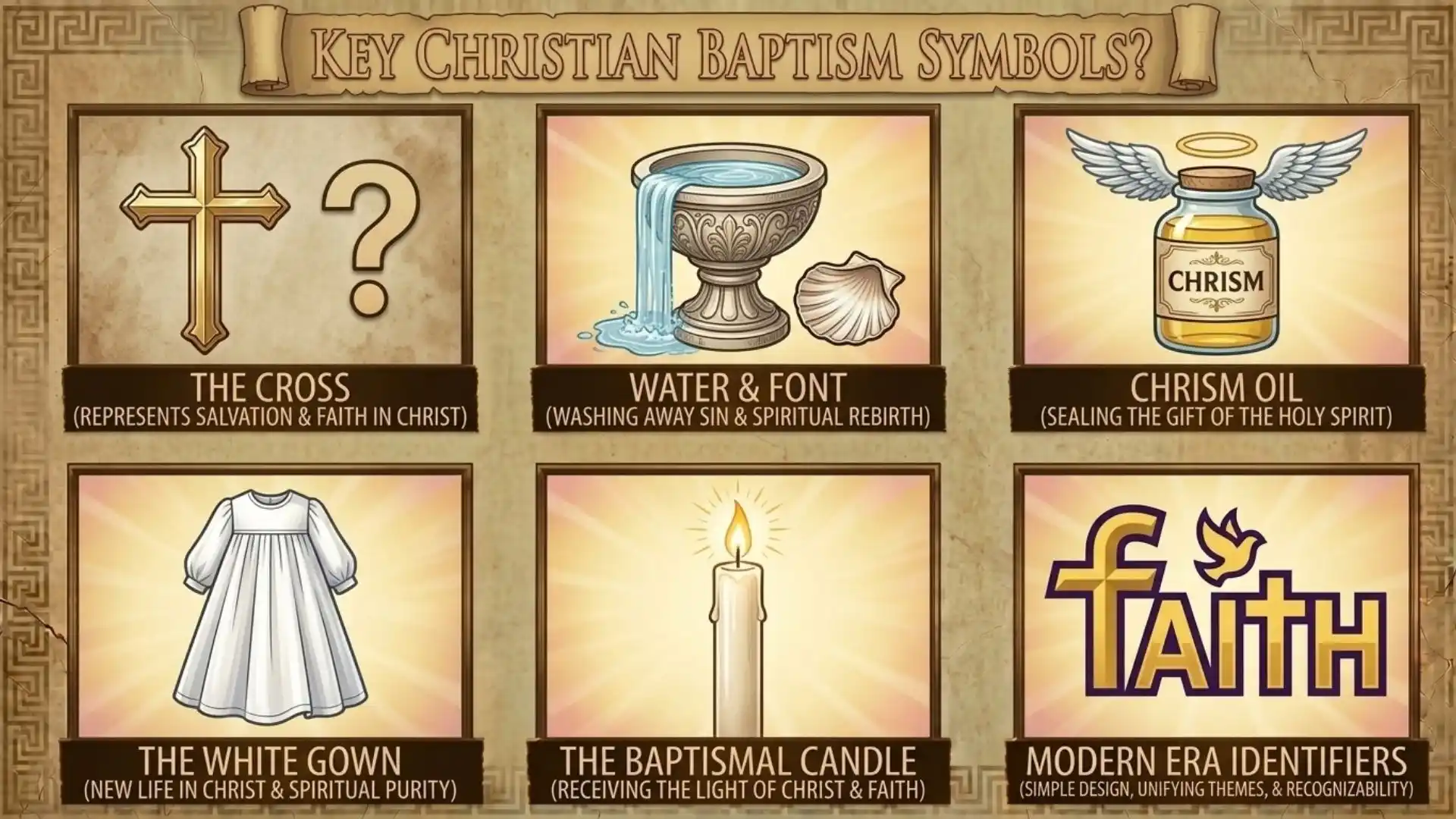
Baptism is one of the most important practices in Christianity, and baptism symbols help explain its spiritual meaning. Water, the cross, white clothing, candles, oil, and other Christian images can communicate ideas such as cleansing, new life, faith, the Holy Spirit, and belonging to the Christian community.
If you are looking for baptism symbols and meanings, it is important to understand that not every Christian church uses exactly the same symbols or performs baptism in the same way.
Water is central to Christian baptism, while other elements, such as candles, white garments, oil, and particular gestures, depend on the Christian tradition.
This guide explains the main baptism symbols, their meanings, their biblical connections, and how they are used in Catholic, Orthodox, Protestant, baby baptism, christening, invitations, gifts, and other settings.
What Are Baptism Symbols?
Baptism symbols are objects, actions, images, or elements that help communicate the religious meaning of baptism. Some are part of formal baptismal rites, while others are Christian images that have become closely associated with baptism through Scripture, church tradition, and Christian art.
The most important distinction is that not every baptism symbol is a required part of every baptism ceremony.
Water is central to baptism itself. In Catholic baptism, for example, the rite includes water along with elements such as the sign of the cross, anointing, a white garment, and a candle. Orthodox baptism has its own ritual structure, including immersion, oil, a white garment, and chrismation. Protestant practices vary widely among denominations and congregations.
Why Are Baptism Symbols Important?
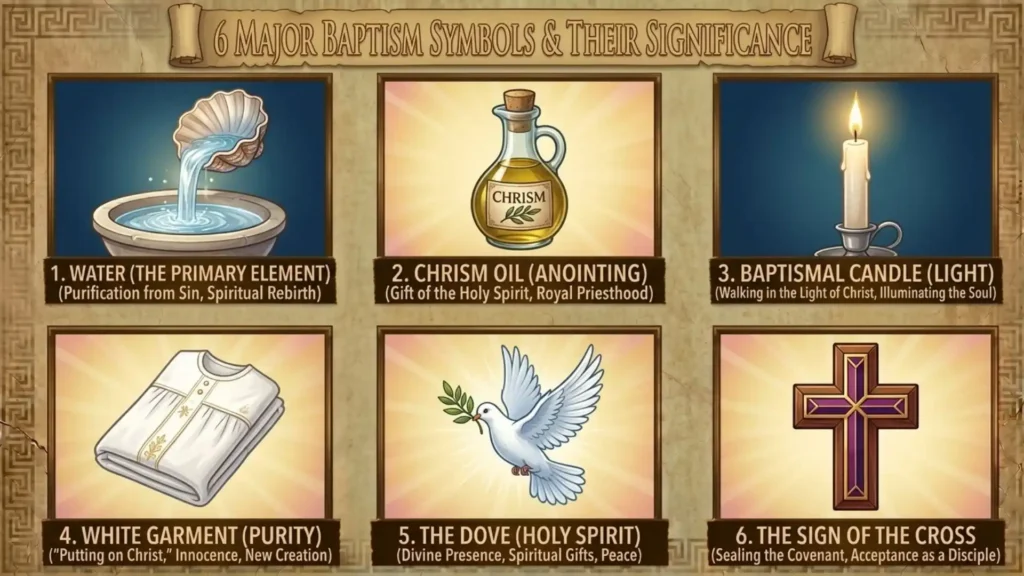
Symbols allow Christians to express spiritual ideas through visible actions and objects. A baptismal symbol may communicate:
- Cleansing from sin
- New life
- Death and resurrection
- Faith in Jesus Christ
- The presence of the Holy Spirit
- Spiritual transformation
- Belonging to the Christian community
- A commitment to Christian discipleship
The same symbol can also have more than one meaning depending on the tradition in which it is used.
Quick Guide to Baptism Symbols and Their Meanings
The following table provides a simple overview of the most common baptism symbols and their general meanings.
| Baptism Symbol | Common Meaning | How It Is Used |
| Water | Cleansing, new life, rebirth, death and resurrection | Central part of baptism |
| Cross | Christ, faith, salvation, belonging to Christ | Ritual gesture or Christian imagery |
| White garment | New life, purity, being clothed in Christ | Used in several traditions |
| Candle or light | Christ as light and Christian discipleship | Used in many liturgical traditions |
| Oil or chrism | Anointing, strength, Holy Spirit | Used in Catholic and Orthodox traditions |
| Dove | Holy Spirit and Jesus’ baptism | Mainly biblical and artistic imagery |
| Shell | Baptism and the pouring of water | Common Christian baptism imagery |
| Baptismal font | Place of baptism and entrance into Christian life | Used in many churches |
| Fish | Christian faith and identity | Broader Christian imagery |
| Fire | Holy Spirit and spiritual transformation | Biblical and Christian imagery |
These meanings are general rather than universal rules. A church may use some of these symbols and not others.
Water as the Main Symbol of Baptism
Water is the central physical element of Christian baptism. Depending on the church tradition, baptism may involve immersion, pouring, or sprinkling.
Water naturally brings ideas of washing, life, renewal, and cleansing. Christian baptism gives these ideas a deeper spiritual meaning.
The Catholic Catechism connects baptism with being born of water and the Spirit, while Orthodox teaching describes baptism as participation in Christ’s death and resurrection.
What Does Baptismal Water Represent?
Baptismal water can represent:
- Cleansing
- Repentance
- Renewal
- New birth
- Spiritual transformation
- Death to an old way of life
- Rising to new life in Christ
The meaning is therefore much deeper than simply washing with water.
Water, Cleansing, and New Life
Water is commonly associated with cleansing. In Christian baptism, this imagery points toward spiritual cleansing and a new beginning.
Catholic teaching describes baptismal water as being consecrated through prayer so that those baptized may be “born of water and the Spirit.”
Water and Death and Resurrection
Immersion can also provide a powerful image of death and resurrection.
A person goes beneath the water and rises again. In Christian theology, this can represent dying to an old life and rising to a new life in Christ.
The Orthodox Church of America explicitly describes baptism as participation in Christ’s death and resurrection and connects immersion with this symbolism.
The Cross and the Sign of the Cross
The cross is one of the most recognizable symbols of Christianity and is closely connected with baptism.
It points to the death and resurrection of Jesus Christ and can remind the baptized person of their Christian identity and relationship with Christ.
What Does the Cross Mean in Baptism?
The cross may represent:
- Faith in Jesus Christ
- Christ’s sacrifice
- Salvation
- Death and resurrection
- Christian identity
- Commitment to follow Christ
In Catholic baptism, the sign of the cross is made at the beginning of the celebration. The Catholic Catechism explains that this marks the person with the sign of Christ and points to the redemption associated with the cross.
The Sign of the Cross During Baptism
The cross and the Sign of the Cross are related but are not exactly the same thing.
The cross can be an object, image, or design. The Sign of the Cross is a ritual gesture.
This distinction is useful when discussing baptism because some readers may search for the “cross baptism symbol” while others are asking about the ritual action performed during the ceremony.
White Clothing and the Baptismal Garment
White clothing is a familiar baptism symbol in many Christian traditions.
A newly baptized person may receive or wear a white garment as part of the ceremony. The garment can symbolize a new identity and new life in Christ.
Catholic teaching describes the white garment as a sign that the baptized person has “put on Christ” and risen with Christ.
What Does the White Garment Symbolize?
The white garment can represent:
- New life
- Purity
- Renewal
- Christian identity
- Being clothed in Christ
- A new beginning in faith
The Orthodox Church also describes the white baptismal robe as the “robe of salvation” and connects it with the new humanity and life in God’s Kingdom.
Why Do Babies Often Wear White at Baptism?
White baptism gowns are especially common in infant baptism and christening traditions.
Families may choose a white gown because it fits the traditional symbolism of purity, new life, and Christian identity. The garment may also become a family keepsake and be preserved for future generations.
Not every Christian tradition requires a special white garment, so families should follow the practices of their own church.
The Baptism Candle and Light
A candle is an important baptism symbol in several Christian traditions, particularly churches with formal liturgical baptismal rites.
Light commonly represents Christ, faith, hope, guidance, and the call to live as a follower of Christ.
What Does the Baptism Candle Symbolize?
A baptism candle can represent:
- Christ as the light
- Faith
- Spiritual guidance
- New life
- Christian discipleship
- Sharing Christ’s light with others
In Catholic baptism, the newly baptized person may receive a candle lit from the Paschal Candle. The USCCB explains that this reminds the baptized to walk as children of light and to be a light in the world.
The Paschal Candle and Baptism
The Paschal Candle is strongly associated with Christ’s resurrection and light.
During the Catholic Easter Vigil, the Paschal Candle is connected with the baptismal celebration, and a candle is later given to the newly baptized.
This gives the baptism candle a connection not only with light but also with Christ’s risen life.
Oil and Chrism in Baptism
Oil is an important baptism-related symbol in some Christian traditions, especially Catholic and Orthodox Christianity.
However, readers should not assume that every Christian baptism includes the same form of anointing.
Oil of Catechumens
In the Roman Catholic rite, the Oil of Catechumens may be used before baptism.
The Catholic Catechism describes the anointing with this oil as part of the preparation for baptism and connects it with liberation from sin and the renunciation of evil.
Sacred Chrism
Sacred Chrism is a different oil used in Catholic rites.
The USCCB explains that Sacred Chrism symbolizes the gift of the Holy Spirit and the connection between Christ’s mission and the outpouring of the Spirit.
In Orthodox Christianity, chrismation follows baptism and is understood as the person’s reception of the gift of the Holy Spirit.
Why Oil Is Not Used in Every Christian Baptism
Christian traditions differ in their understanding and practice of baptism.
Some churches have detailed anointing rites, while others focus primarily on baptism with water and the profession of faith.
Therefore, oil is best described as an important baptismal or baptism-related symbol in certain traditions, rather than a universal requirement.
The Dove and the Holy Spirit
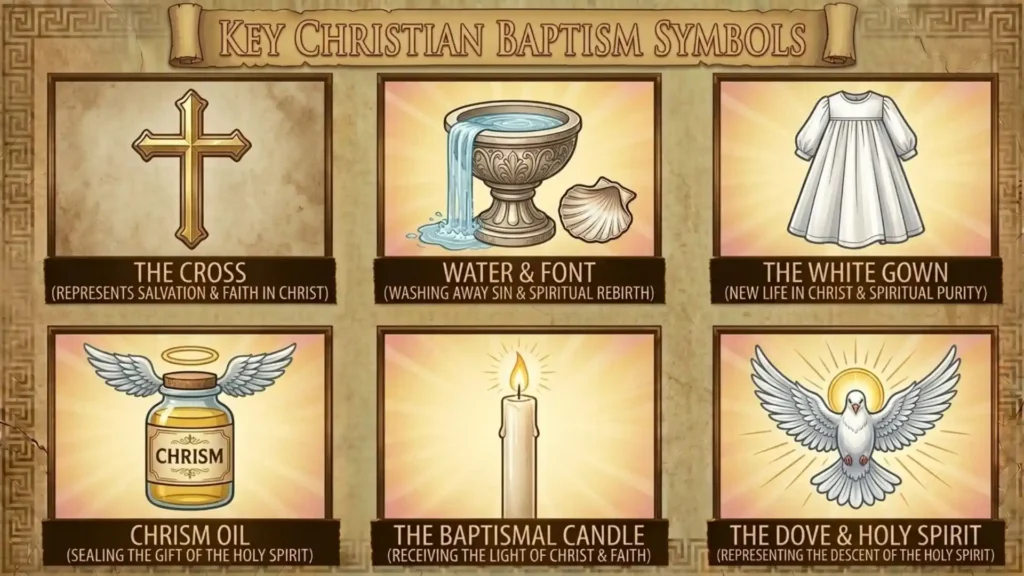
The dove is one of the most recognizable images associated with the baptism of Jesus.
The New Testament accounts of Jesus’ baptism describe the Holy Spirit descending upon him like a dove. Because of this biblical connection, the dove became a familiar Christian image associated with baptism and the Holy Spirit.
The Dove at Jesus’ Baptism
The dove can remind Christians of:
- The Holy Spirit
- Jesus’ baptism
- God’s presence
- Spiritual renewal
- Peace
The important distinction is that the dove is primarily a biblical and artistic symbol associated with baptism, rather than an object required in every baptism ceremony.
Dove as Baptism Artwork
Dove imagery frequently appears on:
- Baptism invitations
- Church decorations
- Baptism cards
- Christian artwork
- Jewelry
- Baby christening designs
- Religious tattoos
A dove can be especially suitable when the intended meaning is connected with the Holy Spirit.
The Shell as a Baptism Symbol
The shell, particularly the seashell or scallop shell, has a long association with Christian baptism imagery.
It can appear on baptismal fonts, church decorations, stained glass, baptism announcements, and Christian artwork.
Why Did the Shell Become Associated With Baptism?
One explanation is practical: shells could be used as vessels for pouring water.
The Presbyterian Mission Agency notes that seashell imagery has been associated with baptism since the early centuries of Christianity and appears in early Christian artistic representations.
Over time, the shell became a recognizable visual symbol of baptism.
Is the Shell Used in Every Baptism?
No.
The shell is best understood as a traditional baptism image, particularly in Western Christian art, rather than a universal part of the baptism ceremony.
This distinction is important because someone searching for “baptism symbols” may otherwise assume that every baptized person encounters a shell during the ceremony.
The Baptismal Font
A baptismal font is the container or structure that holds baptismal water in many churches.
Because baptism takes place at the font, it can become a powerful visual representation of the beginning of Christian life.
Why Is the Baptismal Font Important?
The font can represent:
- Baptism
- New birth
- Entry into the Christian community
- Cleansing
- New life in Christ
- The gathering of the church around baptism
Fonts can have very different designs. Some are simple basins, while others are decorated with crosses, shells, fish, biblical imagery, or other Christian symbols.
Font as a Symbol of Entry Into Christian Life
The baptismal font can be understood as a place where a person begins or publicly enters a new stage of Christian life.
This symbolism becomes especially meaningful when baptism is viewed as an entrance into the Christian community.
Other Christian Symbols Associated With Baptism
Some Christian symbols are not formal baptismal objects but are frequently connected with baptism through Scripture, theology, or Christian art.
Fish
The fish, often represented by the Christian Ichthys symbol, is a broader Christian symbol of faith and identity.
It can appear on baptism cards, jewelry, church artwork, and gifts.
However, the fish is not a required baptismal element in most Christian traditions.
Fire
Fire can symbolize the Holy Spirit, purification, divine presence, and spiritual transformation.
It is more accurately described as a broader biblical and Christian symbol than a universal baptismal object.
Olive Branches
Olive branches can suggest peace, blessing, and hope in Christian imagery.
They may be used in baptism decorations or artwork, but they are not universal baptismal symbols.
Baptism Symbols in the Bible
Understanding biblical connections can make baptism symbols much easier to understand.
The Bible contains several important themes that later Christian baptismal traditions express through symbols and rituals.
Jesus’ Baptism
Jesus was baptized by John the Baptist in the Jordan River.
The event is especially important because the Gospel accounts connect Jesus’ baptism with the Holy Spirit and the Father’s declaration concerning Jesus.
This is one reason water, the dove, and the Holy Spirit are so closely connected with Christian baptism imagery.
Water and the Jordan River
The Jordan River is strongly associated with biblical baptism because John baptized people there and Jesus was baptized in the Jordan.
The river therefore became an important part of the visual and religious imagination surrounding baptism.
The Holy Spirit and the Dove
The dove associated with Jesus’ baptism provides one of the clearest biblical reasons for using dove imagery in Christian baptism artwork.
However, the biblical event should not be confused with a requirement that every baptism ceremony contain a physical dove image.
Death, Resurrection, and New Life
Christian baptism is also closely connected with the ideas of death and resurrection.
The symbolism is especially clear in traditions where baptism is performed through immersion. Going into the water and rising from it can visually express dying to an old life and entering new life in Christ.
Baptism Symbols in Different Christian Traditions
There is no single baptism ceremony used by every Christian church.
Different traditions emphasize different actions, symbols, and theological meanings.
Catholic Baptism Symbols
Catholic baptism includes a rich set of ritual symbols.
These can include:
- Water
- Sign of the cross
- Oil of Catechumens
- Sacred Chrism
- White garment
- Candle
- Baptismal font
The Catholic Catechism explains the symbolism of the sign of the cross, baptismal water, oil, white garment, and candle as parts of the celebration.
The USCCB likewise explains the white garment, candle, and Sacred Chrism in its description of Christian initiation.
Eastern Orthodox Baptism Symbols
Eastern Orthodox baptism places strong emphasis on immersion and the symbolism of dying and rising with Christ.
The Orthodox Church in America describes the baptized person being immersed three times and then clothed in a white baptismal robe. Baptism is followed by Chrismation, which is understood as receiving the gift of the Holy Spirit.
Common Orthodox baptismal symbolism therefore includes:
- Water
- Immersion
- Oil
- White robe
- Cross
- Chrism
- Light
- Procession
Protestant Baptism Symbols
Protestant Christianity includes many denominations, so baptismal practices differ significantly.
Some churches baptize infants, while others practice believer’s baptism. Some use immersion, while others use pouring or sprinkling.
Because of this diversity, there is no single list of Protestant baptism symbols that applies to every congregation.
Water remains central, while the use of candles, white clothing, oil, and other symbols depends on the particular church tradition.
Why Baptism Practices Differ
The differences are connected to theology, church history, liturgical tradition, and different understandings of baptism.
For this reason, a good explanation of baptism symbols should avoid saying that every Christian church uses exactly the same ritual.
Baptism Symbols for Babies and Christenings
Baby baptism and christening traditions often use several meaningful symbols.
Common choices include:
- Water
- White gown
- Cross
- Candle
- Dove
- Shell
- Bible
- Baptism certificate
White Baby Baptism Gown
A white gown is often chosen because white can communicate new life, purity, and Christian identity.
For many families, the gown also has emotional value because it may become a family heirloom.
Baby Baptism Candle
A baptism candle can symbolize light and Christian faith.
In traditions where a candle is formally part of baptism, it may be connected with Christ as light and the child’s call to live in that light.
Cross for Baby Baptism
A cross can symbolize the child’s connection with Christ and the Christian faith.
It is commonly used on baptism invitations, jewelry, keepsakes, certificates, and decorations.
Baptism Symbols for Invitations, Gifts, and Decorations
Baptism symbols are often used beyond the church ceremony.
They can help families communicate the religious meaning of an event through invitations, gifts, decorations, and keepsakes.
Symbols for Baptism Invitations
Popular choices include:
- Cross
- Dove
- Water drops
- Shell
- Candle
- White flowers
- Bible imagery
For a traditional design, a cross and water combination is simple and recognizable.
For a softer baby christening design, a dove, shell, candle, or white floral imagery may be appropriate.
Symbols for Baptism Gifts
Baptism-related gifts may include:
- Cross necklaces
- Personalized Bibles
- Baptism candles
- Cross ornaments
- Engraved keepsakes
- Prayer books
- Baptism picture frames
The meaning of the gift depends on both the symbol and the relationship between the giver and the baptized person.
Symbols for Baptism Decorations
Common decorative elements include:
- Crosses
- Candles
- Water imagery
- White flowers
- Doves
- Shells
- Christian Scripture references
When decorating for a church ceremony, it is sensible to follow the church’s own guidelines.
Baptism Symbols for Tattoos and Personal Faith
Some people use baptism imagery in tattoos as a personal reminder of faith, spiritual renewal, or an important religious milestone.
Common baptism-inspired designs include:
- Cross and water
- Dove
- Baptism date
- Bible reference
- Shell
- Candle
- Fish
- Water drops
Choosing a Meaningful Baptism Tattoo
A tattoo does not have to copy the exact elements of a church ceremony.
For example, someone may choose water to represent renewal, a cross to represent faith, or a dove to represent the Holy Spirit.
Because Christian traditions differ, it is useful to understand the traditional meaning of a symbol before using it as a permanent design.
Baptism Symbols vs. General Christian Symbols
One of the easiest ways to misunderstand this topic is to treat every Christian symbol as a formal baptism symbol.
There is an important difference.
Baptism-specific or baptismal ritual elements may include:
- Water
- Baptismal font
- White garment
- Baptismal candle
- Certain anointing oils
- Sign of the cross
Broader Christian imagery associated with baptism can include:
- Dove
- Fish
- Shell
- Fire
- Olive branch
The second group may appear in baptism artwork without being required parts of the ceremony.
Why This Difference Matters
Understanding the distinction helps readers avoid inaccurate statements such as “every baptism uses a shell” or “every Christian baptism includes a candle.”
Baptism practices vary by denomination, congregation, and rite.
How to Choose a Baptism Symbol
The right symbol depends on the meaning you want to communicate and the Christian tradition involved.
For Cleansing and Renewal
Choose water when the focus is cleansing, renewal, new birth, or spiritual transformation.
For Faith in Christ
Choose the cross when the main message is faith in Jesus Christ, Christian identity, or discipleship.
For New Life
Choose water or a white garment to emphasize renewal and a new life in Christ.
For the Holy Spirit
Choose a dove when the focus is the Holy Spirit and the biblical account of Jesus’ baptism.
For Light and Guidance
Choose a candle or flame when the intended message involves Christ as light, faith, or spiritual guidance.
For Traditional Baptism Artwork
A combination of water, cross, white garment, and candle can communicate several important baptism themes, especially in traditions where these elements are part of the rite.
Frequently Asked Questions About Baptism Symbols
What are the main symbols of baptism?
The main baptism symbols commonly discussed in Christianity include water, the cross, white clothing, candle or light, and oil or chrism in traditions that use anointing. Other imagery, such as the dove and shell, is also strongly associated with baptism.
What does water symbolize in baptism?
Water can symbolize cleansing, renewal, new birth, and spiritual transformation. In Christian traditions that emphasize immersion, it can also represent dying and rising with Christ.
What does a white garment mean in baptism?
A white baptismal garment commonly represents new life, purity, and being clothed in Christ. Catholic and Orthodox traditions both give important meaning to the white baptismal garment.
What does the baptism candle symbolize?
The baptism candle commonly represents Christ as light and reminds the baptized person to live as a follower of that light. Catholic baptismal teaching specifically connects the candle with Christ’s light.
What does oil symbolize in baptism?
Oil can symbolize anointing, strength, consecration, and the work or gift of the Holy Spirit. The exact use of oil differs among Christian traditions.
What does a dove symbolize in baptism?
A dove is associated with the Holy Spirit and the biblical account of Jesus’ baptism. It is especially common in Christian baptism artwork and invitations.
Why is a shell a symbol of baptism?
The shell became associated with baptism through Christian art and traditions involving the pouring of baptismal water. It is a traditional baptism image, particularly in Western Christian contexts, but it is not required in every baptism.
Is the cross a baptism symbol?
Yes. The cross is closely connected with Christian baptism because baptism is understood in relation to Christ, his death, resurrection, and the believer’s Christian identity. Some traditions also use the Sign of the Cross as part of the baptismal rite.
What are common baptism symbols for babies?
Common baby baptism symbols include water, a white gown, cross, candle, dove, shell, and Bible imagery. Which ones are used depends on the family’s church tradition.
Are baptism symbols found in the Bible?
Some baptism imagery has direct biblical connections, especially water, Jesus’ baptism, the Holy Spirit, and the dove. Other symbols, such as the white garment, baptism candle, and shell, also developed important places in Christian ritual and tradition.
Are baptism and christening symbols the same?
The terms are used differently by different Christian traditions. In many contexts, “christening” refers to a form of infant baptism, so the symbols can overlap. The exact terminology and ceremony depend on the church.
Does every Christian church use the same baptism symbols?
No. Christian baptism practices vary. Catholic, Orthodox, Anglican, and Protestant traditions can use different rituals and symbols, so it is important to consider the specific denomination when explaining a baptism ceremony.
Conclusion
Baptism symbols help Christians express the deeper meaning of baptism through water, gestures, clothing, light, oil, and imagery. Water is central to baptism and can represent cleansing, new birth, renewal, and participation in Christ’s death and resurrection. The cross points to Christ, while a white garment can symbolize new life and Christian identity. A candle can represent Christ as light, and oil or chrism can represent anointing and the Holy Spirit in traditions that use it.
The dove and shell are also familiar baptism images, but they should not be treated as universal requirements of every Christian baptism. The same is true of candles, special garments, and particular forms of anointing because baptismal practices differ among Christian traditions.
Understanding these differences makes the meaning of baptism symbols clearer and helps readers choose appropriate symbols for ceremonies, baby christenings, invitations, gifts, artwork, or personal expressions of faith.

Isaac Wellington
I’ve always been fascinated by the hidden stories in everyday life and the power of words to change how we see the world. Writing, for me, isn’t just a profession—it’s a way to explore human emotions, mysteries, and the unexpected twists of life. Over the years, I’ve dedicated myself to creating stories that linger in your mind long after the last page. When I’m not writing, you’ll usually find me wandering through old libraries or sketching ideas in a notebook. I believe every story has a heartbeat, and I aim to capture that rhythm in my work. Join me on a journey where imagination meets reality, and the ordinary becomes extraordinary.
Books:
-
Shadows of the Forgotten
-
Whispers Through Time