
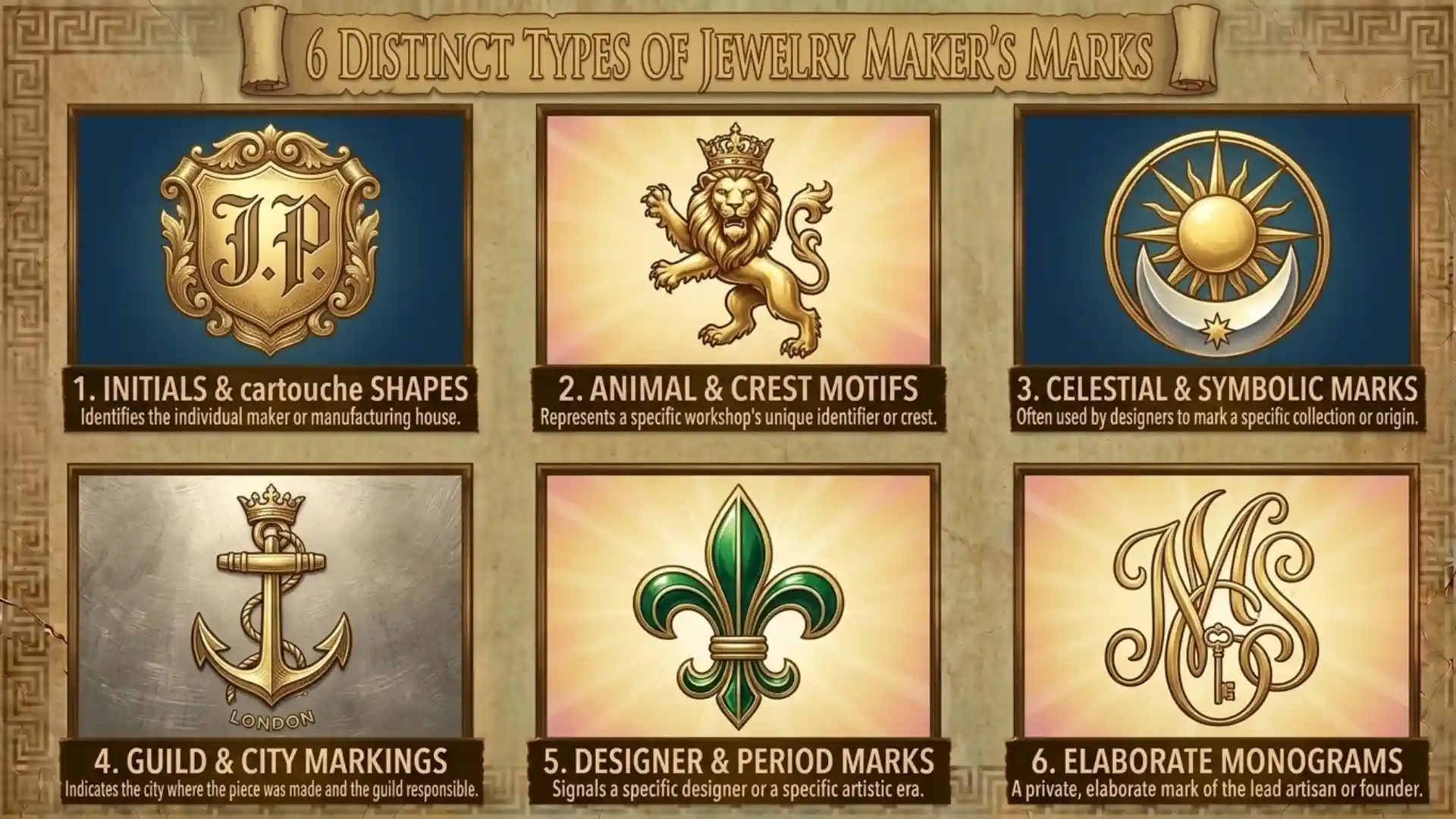
If you have ever found tiny letters, numbers, or symbols stamped inside a ring or on the back of a piece of jewelry, you may have wondered what they mean. These small marks can provide useful clues about the maker, metal, country, and sometimes the age of a piece.
A maker’s mark identification is not always as simple as matching two initials to a company name. A jewelry piece may contain several different marks, and each one can have a different purpose. One mark may identify the maker or sponsor, another may show metal purity, and another may belong to an official hallmarking system.
The good news is that you can often make a strong first identification by carefully examining the complete group of marks. The shape around the letters, the font, numbers, symbols, location, metal, and other hallmarks can all provide useful evidence.
What Is a Maker’s Mark on Jewelry?

A maker’s mark is a distinctive mark placed on jewelry to identify a maker, sponsor, manufacturer, retailer, importer, or other responsible party, depending on the marking system and period.
It may appear as initials, a logo, a pictorial symbol, or letters inside a particular surrounding shape. In some systems, the person or company represented by the mark is not necessarily the person who physically manufactured the jewelry.
This distinction is especially important with older and British jewelry. Sheffield Assay Office explains that a sponsor’s mark identifies the party who registered the mark and submitted the item for testing and hallmarking, which is not always the same as the physical manufacturer.
What a Maker’s Mark Identifies
A maker’s or sponsor’s mark can help answer questions such as:
- Who was responsible for the jewelry?
- Which company or workshop may be connected with the piece?
- Was the jewelry submitted for official hallmarking by a particular sponsor?
- Can the piece be connected to a known maker’s records?
- Does the mark help establish a particular period or country?
The answer depends on the jewelry’s marking system.
A mark made up of two letters may look simple, but thousands of makers can use similar initials. This is why the complete mark matters more than the initials alone.
Why Maker’s Marks Can Be Difficult to Identify
Jewelry marks are often extremely small. They can also become worn after years of use, polishing, resizing, repairs, or damage.
Other problems include:
- Similar initials used by different makers
- Symbols that changed meaning over time
- Different marking systems in different countries
- Marks that were partially removed
- Modern reproductions of older-looking designs
- Sponsor marks that do not identify the actual workshop
- Marks that are too small to read clearly
For this reason, a maker’s mark should normally be treated as evidence to investigate, rather than an automatic identification.
Maker’s Mark vs. Hallmark vs. Purity Mark
One of the most important steps in jewelry identification is understanding that not every stamp is a maker’s mark.
GIA distinguishes maker’s marks from hallmarks and explains that official hallmarks may provide information about precious-metal composition, assay location, country, and sometimes the period when the item was marked.
| Mark Type | What It May Tell You |
| Maker’s or sponsor’s mark | Maker, sponsor, retailer, importer, or responsible party |
| Fineness or purity mark | Metal purity |
| Assay office mark | Office or location where the metal was tested/marked in applicable systems |
| Date mark | Possible year or period of hallmarking |
| Country or convention mark | Information about a national or international hallmarking system |
| Trademark or logo | Brand or company association |
| Decorative engraving | May have personal or decorative meaning rather than metal identification |
Maker’s or Sponsor’s Mark
This is the mark most people mean when they ask about a jewelry maker’s mark.
It can consist of initials, a logo, a pictorial design, or a combination of letters and a surrounding shape.
However, the term sponsor’s mark is particularly important in British hallmarking. The sponsor may be the person or company responsible for submitting the item for hallmarking rather than the person who physically made it.
Metal Purity Mark
A purity mark gives information about the metal’s fineness.
Common examples include:
- 925 for sterling silver in many contexts
- 750 for 75% gold
- 585 for 58.5% gold
- 375 for 37.5% gold
- 10K
- 14K
- 18K
- 950 for platinum in applicable systems
The exact legal meaning and use of a mark can vary by country and period, so a number should not automatically be interpreted without considering the complete marking system.
Assay Office Mark
In a hallmarking system, an assay office mark can identify where precious metal was tested and marked.
The United Kingdom provides a clear example. Sheffield Assay Office explains that the sponsor’s mark, fineness mark, and assay office mark are compulsory components of the UK hallmarking system, while several additional marks can be voluntary.
Date Mark
Some hallmarking systems use a special mark to indicate the year or period of hallmarking.
UK date letters are a good example. Their appearance depends on the particular alphabet, typeface, case, and surrounding shield used during a given period.
A date mark can therefore be extremely useful when studying antique or vintage jewelry, but it should be interpreted within the correct national system.
Why the Difference Matters
Suppose a ring has three separate marks:
ABC | 925 | another symbol
The first may be a maker or sponsor mark, the second may indicate silver fineness, and the third could be connected to an assay or other marking system.
Calling all three marks “the maker’s mark” would make the identification less accurate.
Quick Guide to Jewelry Identification Symbols
Jewelry stamps come in many forms. Learning the basic categories can make the identification process much easier.
Letter and Initial Marks
Initials are among the most common forms of maker’s marks.
Examples might look like:
- AB
- JM
- HJ
- R&S
- ABC
But initials alone rarely provide enough evidence to identify a maker confidently.
The same two letters could belong to different businesses, designers, workshops, or sponsors.
Number Marks
Numbers often relate to metal fineness rather than the maker.
Examples include:
- 925
- 750
- 585
- 375
- 950
A number should therefore be examined alongside nearby initials and symbols.
For example, 925 AB could mean that 925 relates to silver fineness while AB may be a responsibility or maker mark. The initials cannot safely be assigned to a particular company without further evidence.
Logos and Pictorial Marks
Older and modern jewelry can contain pictorial marks such as animals, objects, letters formed into designs, or company logos.
Some historical maker’s marks were pictorial. Sheffield Assay Office notes that maker’s marks were initially often pictorial before initials combined with surrounding shapes became more common.
A picture can be useful, but it should not be assigned a universal meaning. A bird, star, crown, flower, anchor, or other symbol may mean something completely different under different systems.
Surrounding Shapes
The shape around a mark can be one of the most useful clues.
Common surrounds include:
- Oval
- Shield
- Rectangle
- Square
- Diamond
- Circle
- Cartouche-like shapes
In Sheffield’s system, the sponsor’s mark consists of initials and a surrounding shape, with the font and shape helping distinguish one mark from another.
This means that AB inside an oval is not necessarily the same mark as AB inside a shield.
Date Letters and Other Marks
A letter may look like a maker’s initial but actually belong to a date system.
This is especially important when examining British hallmarks. UK date letters use particular typefaces and shield shapes to distinguish different years or series.
Never assume that every letter stamped on jewelry represents a person’s initials.
Where to Find Maker’s Marks on Jewelry
Before trying to identify a mark, inspect the entire piece.
Rings
Look carefully at:
- Inside the ring shank
- Inside the band
- Around the shoulders
- Near the setting
- Inside vintage signet rings
The inside of the shank is a common location for jewelry marks. GIA notes that quality and maker marks are often placed in inconspicuous locations such as the inside of a ring shank.
Necklaces and Chains
Check:
- Near the clasp
- On the clasp itself
- Small connecting tags
- End pieces
- Chain links near the closure
Because these areas are small, a loupe or macro photograph may be helpful.
Bracelets
Inspect:
- Clasp
- End tabs
- Inside links
- Connecting pieces
- Small metal tags
A bracelet may have more than one stamp.
Earrings
Look at:
- Earring posts
- Backs
- Clips
- Underside of the setting
- Small connecting areas
Some marks may be hidden when the earrings are being worn.
Pendants, Brooches, and Pins
Check:
- Back of the pendant
- Bail
- Pin stem
- Clasp
- Reverse side
- Underside of decorative elements
For complicated antique pieces, examine both the visible and hidden construction.
How to Identify a Maker’s Mark Stamped on Jewelry
A systematic process is more reliable than searching random initials.
Step 1: Find Every Mark
Do not stop when you find the first stamp.
Search the entire piece for:
- Letters
- Numbers
- Logos
- Symbols
- Shapes
- Date letters
- Country marks
- Assay marks
Multiple marks can tell a much clearer story than one isolated symbol.
Step 2: Photograph the Mark
Take several photographs before searching for an identification.
Capture:
- A photograph of the entire jewelry piece
- A close-up of the mark
- A photograph from a different angle
- The area around the mark
- Any other stamps nearby
This helps prevent a tiny symbol from being interpreted without context.
Step 3: Record Letters and Numbers
Write down exactly what you see.
If the mark could be:
AB
but you are unsure whether the second character is B, 8, or R, record the alternatives.
Do not force an uncertain character into a definite reading.
Step 4: Identify the Surrounding Shape
Record whether the letters appear inside:
- Oval
- Shield
- Rectangle
- Circle
- Diamond
- Other shape
Also note whether the shape is complete or partly worn away.
Step 5: Separate Maker and Purity Marks
Now divide your observations.
For example:
AB | 925 | symbol
You might record:
- AB = possible maker/sponsor mark
- 925 = likely fineness indication
- Symbol = unidentified
This prevents a purity number from being mistaken for a maker’s identification.
Step 6: Determine the Country or Hallmark System
Ask:
- Where was the jewelry purchased?
- Was it inherited?
- Does the design appear European, American, or from another region?
- Are there recognizable hallmark components?
- Does the mark resemble a known national system?
Country is important because the same symbol or number can have different meanings in different systems.
Step 7: Compare the Complete Mark
Search for the entire combination rather than just the initials.
Instead of searching:
AB jewelry maker
try to investigate:
AB oval 925 jewelry mark
or:
AB shield sponsor mark silver
The goal is to compare the full structure of the mark.
Step 8: Confirm the Identification
Before declaring a maker, compare the proposed identification against:
- Shape
- Typeface
- Metal
- Jewelry style
- Approximate age
- Country
- Other hallmarks
- Historical records
- Known examples from the maker
For important or valuable jewelry, professional confirmation is appropriate.
Common Jewelry Stamps and What They Mean
Some marks appear frequently enough that they are worth recognizing.
925
The number 925 commonly indicates silver containing 925 parts per 1,000 silver, or 92.5% silver, in systems where that fineness designation is used.
It is generally a fineness indication, not the name of a jewelry maker.
If you see:
925 + initials
the initials may be the maker or responsibility mark while 925 describes the metal fineness.
750
750 commonly indicates 750 parts per 1,000 precious metal, or 75% gold, when used as a gold fineness mark.
A piece stamped:
750 + initials
may therefore contain both a metal-fineness indication and a separate responsibility or maker mark.
585
585 commonly corresponds to 58.5% gold.
Again, the number itself normally tells you about metal fineness rather than who made the jewelry.
375
375 commonly corresponds to 37.5% gold.
This can help distinguish a metal mark from a maker’s mark when examining older or modern jewelry.
10K, 14K, and 18K
Karat markings express gold purity using the 24-karat scale.
For example:
- 10K = 10 parts gold out of 24
- 14K = 14 parts gold out of 24
- 18K = 18 parts gold out of 24
The actual legal marking requirements can differ by jurisdiction.
A karat mark should therefore be interpreted together with any maker, responsibility, or trademark mark.
Sterling and Other Metal Marks
Words such as STERLING can indicate a silver standard in applicable marking systems.
Other marks may identify:
- Platinum
- Palladium
- Silver alloys
- Gold alloys
- Plated metals
- Manufacturer or brand
Never assume that a word, number, or symbol has exactly the same legal meaning in every country.
How the Shape and Font Help Identify a Maker
Many beginners focus only on the letters. Experienced mark identification requires looking at the complete design.
Initials
Two makers can share identical initials.
For example, “JH” might belong to several unrelated businesses or individuals.
That means the initials should be combined with:
- Shape
- Typeface
- Country
- Metal
- Time period
- Jewelry style
Surrounding Shapes
A shield, oval, rectangle, or other surround may be part of the registered identity of a maker or sponsor.
Sheffield Assay Office specifically explains that both the initials and the surrounding shape are important components of a sponsor’s mark.
Typefaces
The style of the letters can also matter.
Look for:
- Serif or plain lettering
- Thick or thin strokes
- Uppercase or lowercase letters
- Narrow or wide characters
- Unusual letter shapes
- Spacing between initials
A mark that looks like “A H” in one font may be different from “AH” in another registered design.
How to Identify Antique and Vintage Jewelry Marks
Antique and vintage jewelry can be more difficult because marks may be worn, changed, or associated with historical systems.
Worn or Partial Marks
A frequently worn ring may have a stamp that is only partly visible.
For example, you may see:
A_
instead of:
AB
or a damaged shield with only part of its outline remaining.
Do not complete the missing information based only on what you expect to see.
Historical Maker’s Marks
Older marks can be investigated through:
- Assay-office records
- Jewelry reference books
- Historical catalogs
- Museum collections
- Trade directories
- Specialist databases
- Archived maker records
Sheffield Assay Office maintains historical maker or sponsor records dating back to 1773 and offers mark-identification research for relevant Sheffield-marked pieces.
Date Letters
Date letters can be especially useful for historical jewelry.
In the UK system, different date-letter series use specific typefaces, cases, and shield shapes.
This means a letter should not be interpreted by appearance alone. The surrounding shape and applicable date-letter series are also important.
Repairs and Alterations
A jewelry piece may have been repaired many years after it was originally made.
Possible changes include:
- Resizing
- Replacing a clasp
- Replacing a stone
- Adding a new component
- Rebuilding a setting
- Polishing
- Re-plating
These changes can introduce additional marks or remove older ones.
Therefore, the newest-looking stamp may not necessarily represent the original maker of the complete piece.
Jewelry Maker’s Marks by Country
There is no single worldwide system for jewelry marks.
United States
U.S. jewelry may carry a maker’s or responsibility mark together with a quality or fineness mark.
GIA explains that U.S. precious-metal items carrying a fineness stamp have historically been subject to requirements concerning a registered maker’s or responsibility mark, although enforcement and registration practices have not always been consistent.
This is one reason why identifying American jewelry solely from initials can be difficult.
United Kingdom
The UK has a highly structured hallmarking tradition.
The hallmarking system can include:
- Sponsor’s mark
- Fineness mark
- Assay office mark
- Date letter
- Additional traditional or convention marks
Sheffield Assay Office states that sponsor’s, fineness, and assay-office marks are compulsory components of the UK system, while certain other marks are additional or voluntary.
France
French jewelry can contain its own historical and national marking conventions.
If a mark appears French, avoid applying British or American interpretations automatically. French jewelry should be compared with French hallmark references appropriate to the item’s period.
Italy
Italian jewelry may also use distinctive maker and fineness markings.
A country-specific reference is particularly important because initials, numbers, and symbols can have different meanings under different national systems.
Other International Marks
Jewelry can originate from many regions, including:
- Germany
- Austria
- Switzerland
- Spain
- Scandinavia
- Eastern Europe
- India
- Middle Eastern countries
- Other Asian countries
For international jewelry, determine the likely country before attempting to decode the mark.
GIA notes that hallmarking is not universal worldwide and that different countries use different hallmarking methodologies.
How to Read Multiple Jewelry Stamps Together
The best identification often comes from reading several marks as a group.
Example: 925 + Initials
Suppose you find:
925 AB
A reasonable first interpretation is:
- 925 = likely silver fineness
- AB = possible maker, sponsor, or responsibility mark
However, AB should not automatically be assigned to a specific maker.
You need to investigate the initials, shape, country, period, and complete mark.
Example: 750 + Maker’s Mark
Imagine a ring has:
750 + initials + symbol
The 750 may indicate 75% gold, while the other mark or marks may identify a maker, sponsor, assay system, or additional feature.
The correct interpretation depends on the country’s marking system.
Example: Maker’s Mark + Assay Marks
A British hallmark may contain several marks that work together.
For example, one mark may identify the sponsor, another may indicate fineness, another the assay office, and another may provide date information.
The combination can provide much more information than any single mark.
Why One Stamp Is Not Enough
A common mistake is to find one symbol online and immediately decide what the jewelry is.
Instead, ask:
- What other marks are present?
- Is there a purity number?
- Is there a surrounding shape?
- Does the style match the proposed maker?
- Does the country make sense?
- Does the date make sense?
- Could the piece have been repaired?
The complete evidence is more useful than one isolated character.
Does a Maker’s Mark Prove Jewelry Is Authentic?
No single stamp should automatically be treated as complete proof of authenticity.
A mark can provide valuable identification evidence, but authentication is a broader process.
Identification vs. Authentication
These terms are different.
Identification asks:
What does this mark appear to be?
Authentication asks:
Is this jewelry genuinely what it appears to be?
Valuation asks:
What is the jewelry worth?
A piece can have a genuine-looking maker’s mark and still require further examination.
When Professional Testing Is Needed
Professional examination can be appropriate when:
- The jewelry appears valuable
- The maker is historically important
- The piece contains expensive gemstones
- The mark is unusual
- The jewelry may be antique
- The metal content is uncertain
- You suspect a reproduction
- You are considering buying or selling it
Professional services can examine metal composition, markings, construction, gemstones, and other physical characteristics. GIA, for example, provides jewelry-related examination services that can include metal testing and documentation of markings.
Can a Maker’s Mark Tell You the Value?
A maker’s mark can be an important part of valuation, but it does not determine value by itself.
Maker and Brand
A recognized maker or designer may make a piece more collectible.
However, the same maker can produce pieces with very different values.
Metal and Gemstones
Value may also depend on:
- Gold content
- Silver or platinum content
- Gemstone type
- Gemstone quality
- Weight
- Craftsmanship
- Setting style
A maker’s mark cannot replace an examination of the actual materials.
Condition and Rarity
Condition is especially important for older jewelry.
Collectors may consider:
- Original condition
- Repairs
- Missing stones
- Wear
- Alterations
- Rarity
- Unusual design
Provenance and Collector Interest
A documented history can sometimes add important context.
For example, records showing previous ownership, exhibition, or connection to a known maker may help establish provenance.
However, provenance should be supported by evidence rather than assumed from an inscription.
What If Jewelry Has No Maker’s Mark?
No maker’s mark does not automatically mean that the jewelry is worthless or fake.
Where to Look Again
Check:
- Inside the ring
- Near the clasp
- Pendant bail
- Earring post
- Earring back
- Bracelet clasp
- Brooch reverse
- Underside of settings
- Small connecting tabs
Use magnification if necessary.
Why a Mark May Be Missing
Possible reasons include:
- The item was never marked
- The mark was worn down
- Polishing removed it
- A repair removed part of it
- The mark is hidden
- The jewelry uses a different marking system
- The piece is costume jewelry
- The item is handmade or from a small producer
- The stamp is too shallow to see easily
What to Do Next
If no mark can be found, examine the physical construction.
Look at:
- Metal color
- Weight
- Soldering
- Setting style
- Clasp design
- Engraving
- Stone setting
- Manufacturing techniques
These clues can help narrow down the jewelry’s origin even without a visible maker’s mark.
How to Photograph Jewelry Marks for Identification
A good photograph can make a tiny mark much easier to study.
Close-Up Photography
Use the highest practical resolution available.
Keep the camera steady and make sure the mark is in focus.
Avoid extreme digital zoom if it produces a blurry image.
Lighting and Angles
Try several angles.
Direct light can create reflections, especially on polished gold or silver. Side lighting can sometimes reveal shallow impressions more clearly.
Take several photographs rather than relying on one image.
Photographing the Entire Piece
A close-up of the mark is useful, but the entire piece provides context.
Try to capture:
- Front
- Back
- Side
- Clasp
- Setting
- Full jewelry item
- Every visible stamp
The design can help determine whether a proposed maker identification is historically plausible.
Jewelry Maker’s Mark Identification Worksheet
When researching a jewelry mark, record your observations before searching.
| What to Record | Your Observation |
| Jewelry type | Ring / necklace / bracelet / earrings |
| Mark | |
| Letters | |
| Numbers | |
| Symbol | |
| Surrounding shape | |
| Font or lettering style | |
| Metal color | |
| Other stamps | |
| Location of mark | |
| Country suspected | |
| Approximate age | |
| Stones | |
| Repairs or alterations | |
| Where it was obtained |
This simple worksheet can prevent important clues from being forgotten.
How to Compare Your Findings
After completing the worksheet, compare the complete set of observations.
For example:
Jewelry: Silver ring
Mark: AB
Number: 925
Shape: Oval
Style: Vintage
Location: Inside shank
This is much more useful than searching only for “AB jewelry.”
The more specific your evidence becomes, the easier it is to eliminate incorrect matches.
Common Mistakes When Identifying Jewelry Marks
Jewelry identification can go wrong when one clue is treated as the entire answer.
Searching Only the Initials
Searching “AB jewelry maker” may produce hundreds of unrelated results.
Always include other clues when possible.
Confusing 925 With a Maker
925 usually relates to silver fineness where that designation is used.
It is not normally the name of a maker.
Ignoring the Surrounding Shape
The same initials inside different shapes can represent different registered marks.
The shape should be recorded carefully.
Assuming One Country’s System Applies Everywhere
A symbol that has one meaning in Britain may have another meaning elsewhere.
Always establish the likely country or hallmarking system first.
Treating a Stamp as Proof of Authenticity
A stamp is evidence, not necessarily a complete authentication.
When the jewelry has significant financial or historical value, professional examination may be appropriate.
Frequently Asked Questions About Jewelry Maker’s Marks
How do I identify a maker’s mark on jewelry?
Start by photographing the complete mark and recording every letter, number, symbol, and surrounding shape. Then identify the metal mark and likely country before comparing the complete mark with reliable maker or hallmark records.
How do I identify a jewelry stamp?
First determine whether the stamp is a maker’s mark, purity mark, hallmark, date mark, or another type of inscription. Numbers such as 925 or 750 often provide metal-fineness information, while initials or logos may point toward a maker or responsible party.
What do symbols stamped inside a ring mean?
They can identify the maker, metal purity, hallmarking office, date, country, or another feature. The meaning depends on the complete marking system and the period in which the ring was made.
What does 925 mean next to initials?
In many jewelry contexts, 925 indicates silver fineness, while the initials may be a maker’s, sponsor’s, or responsibility mark. The initials need separate identification and should not automatically be assigned to a particular company.
What does 750 mean on jewelry?
750 commonly indicates 75% gold when used as a gold fineness mark. Any nearby letters or symbols should be investigated separately.
Is a maker’s mark the same as a hallmark?
No. A maker’s or sponsor’s mark identifies a responsible party, while an official hallmark can provide information about precious-metal testing and other details under a particular hallmarking system. GIA specifically distinguishes maker’s marks from official hallmarks.
Can initials identify a jewelry maker?
Sometimes, but initials alone are usually not enough. The surrounding shape, font, country, period, metal, and other marks can be necessary to distinguish between makers with similar initials.
How do I identify an unknown jewelry logo?
Photograph the logo clearly and record its shape, lettering, location, metal, and nearby marks. Then compare the complete design with reliable maker databases, historical references, or professional identification services.
How do I identify antique jewelry markings?
Start by documenting every mark. Then determine the likely country and hallmarking system, examine the shape and typeface, and compare the mark with historical records. For British pieces, assay-office resources can be especially useful because historical sponsor records exist for many marks.
Where can I look up a maker’s mark?
Useful sources include national assay offices, historical jewelry references, museum collections, specialist hallmark databases, and reputable jewelry research services. For Sheffield-marked items, Sheffield Assay Office maintains historical sponsor records and provides identification research.
What if my jewelry has no maker’s mark?
Look again in hidden areas such as the inside of a ring, clasp, pendant bail, earring back, or underside of a setting. A mark may be worn away, hidden, too small to see, or absent because of the item’s manufacturing or marking system.
Can a maker’s mark tell me the age of jewelry?
Sometimes. A documented historical maker’s mark can provide a date range, and some hallmarking systems include specific date marks. However, the mark should be considered together with design, construction, country, and other evidence.
Can a maker’s mark tell me how much my jewelry is worth?
It can contribute to valuation, especially when it identifies a collectible maker, but value also depends on materials, gemstones, condition, rarity, provenance, and market demand.
Does a maker’s mark prove jewelry is real?
No. A maker’s mark can be an important clue, but authenticity may require examination of the metal, gemstones, construction, markings, and historical consistency.
What is a sponsor’s mark?
A sponsor’s mark is a responsibility mark used in hallmarking systems such as the UK’s. It identifies the registered party responsible for submitting the item for hallmarking. That party is not necessarily the person who physically manufactured the jewelry.
Conclusion
Maker’s mark identification becomes much easier when you stop treating a jewelry stamp as one isolated symbol. Letters, numbers, logos, surrounding shapes, fonts, metal marks, assay marks, and date marks can work together to reveal the history of a piece.
Start by finding every mark and photographing it clearly. Separate maker or sponsor marks from purity marks, identify the likely country or hallmarking system, and then compare the complete mark with reliable historical records.
A stamp can provide valuable evidence about jewelry, but it should not automatically be treated as proof of authenticity or value. For rare, antique, or expensive pieces, professional examination can provide a more dependable answer.
The most useful rule is simple: read the whole marking system, not just the most noticeable symbol.

Isaac Wellington
I’ve always been fascinated by the hidden stories in everyday life and the power of words to change how we see the world. Writing, for me, isn’t just a profession—it’s a way to explore human emotions, mysteries, and the unexpected twists of life. Over the years, I’ve dedicated myself to creating stories that linger in your mind long after the last page. When I’m not writing, you’ll usually find me wandering through old libraries or sketching ideas in a notebook. I believe every story has a heartbeat, and I aim to capture that rhythm in my work. Join me on a journey where imagination meets reality, and the ordinary becomes extraordinary.
Books:
-
Shadows of the Forgotten
-
Whispers Through Time