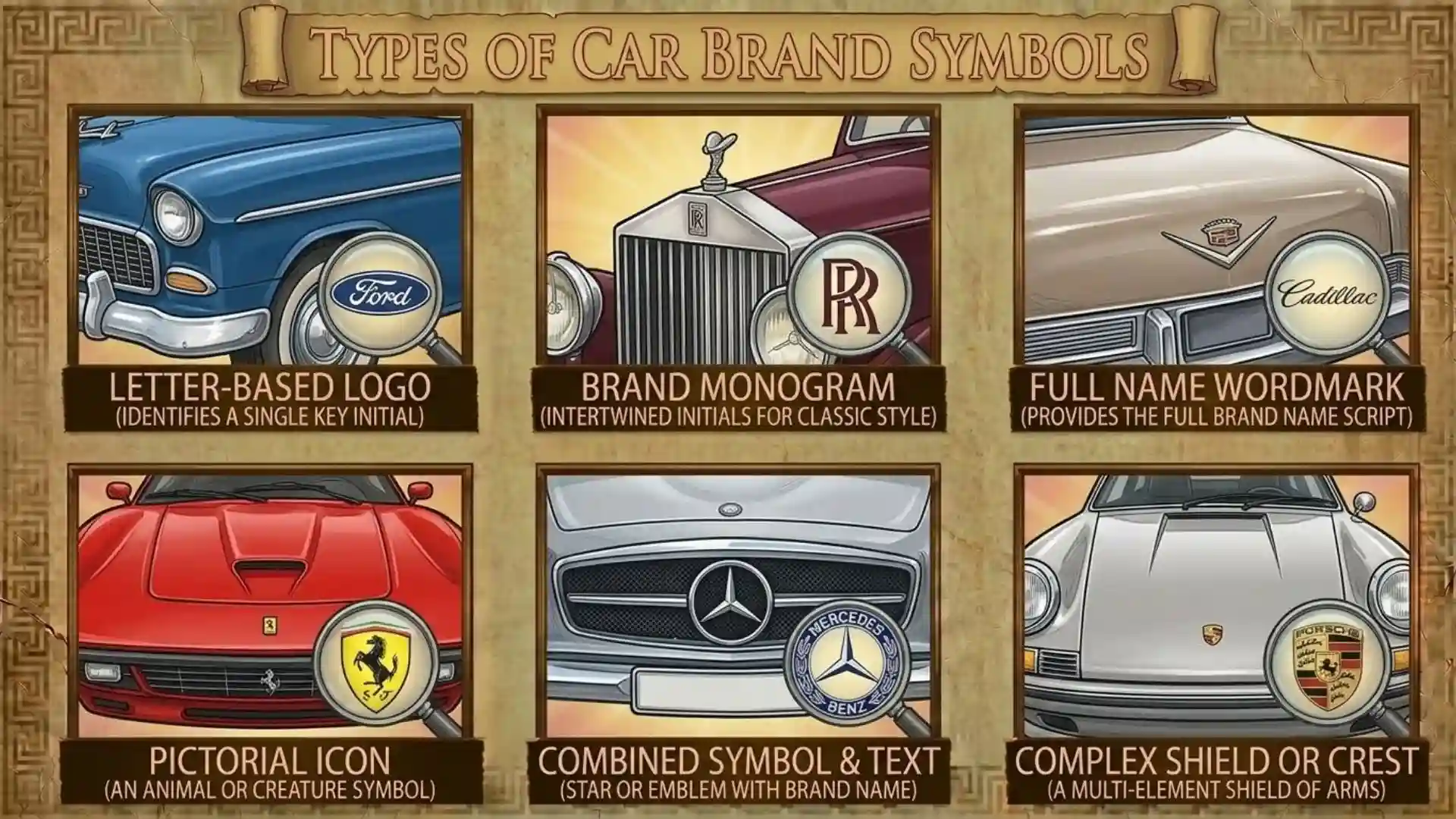
Car brand symbols are more than decorative badges placed on the front, rear, steering wheel, or wheels of a vehicle. They are visual identities that help people recognize automobile companies quickly. Some use letters or initials, while others feature stars, rings, animals, shields, wings, or abstract shapes.
If you are trying to identify an unfamiliar car logo, the shape of the symbol can often provide the first clue. A three-pointed star suggests Mercedes-Benz, four connected rings point toward Audi, a prancing horse is associated with Ferrari, and three interlocking ovals identify Toyota.
However, the meaning behind a car symbol is not always as simple as it looks. Some logos have well-documented histories, while other explanations repeated online are only popular interpretations. Toyota, Mercedes-Benz, and BMW, for example, have published information about the development of their emblems and their historical meanings.
This guide explains common car brand symbols, what they look like, how to identify an unknown emblem, what different designs can represent, and how automotive logos have changed over time.
What Are Car Brand Symbols?
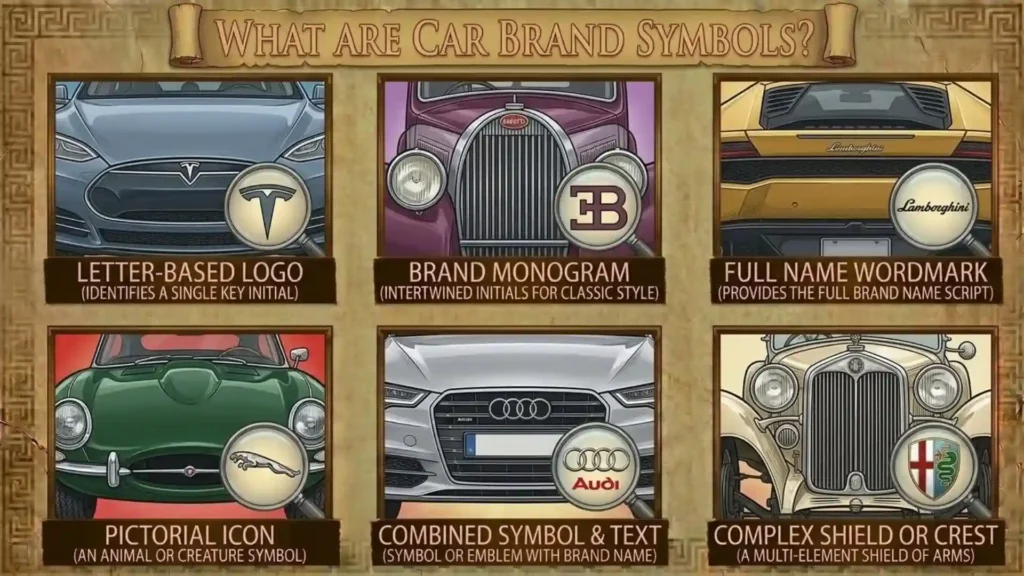
Car brand symbols are visual marks used by automobile manufacturers to identify their vehicles and communicate a recognizable brand identity.
You may see them on:
- Front grilles
- Rear trunks or tailgates
- Steering wheels
- Wheel centers
- Hood ornaments
- Key fobs
- Vehicle displays
- Dealership signs
- Advertising materials
The terms car logo, car emblem, car symbol, car badge, and automotive brand mark are often used interchangeably in everyday conversation.
Car Logos, Emblems, Badges, and Symbols
A logo is generally the visual identity associated with a company or brand.
An emblem or badge is often the physical version attached to a vehicle. It may be made from metal, plastic, glass, or another material.
A car symbol can be as simple as a letter or as detailed as a traditional coat of arms.
For example:
- Audi uses four connected rings.
- Mercedes-Benz uses a three-pointed star.
- Toyota uses three overlapping ovals.
- BMW uses a circular blue-and-white design.
- Porsche uses a detailed crest.
- Ferrari is associated with a prancing horse.
The physical badge may change slightly from one model or generation to another while still retaining the main brand identity.
Why Automakers Use Brand Symbols
A recognizable symbol allows people to identify a vehicle without reading the company’s full name.
Toyota says its current emblem was designed partly so the brand could be recognized from a distance and stand out from other automobiles. The current three-oval emblem was introduced in 1989.
This explains why many successful automotive symbols are relatively simple and recognizable.
A good car emblem needs to work in several places, from a large grille badge to a small steering-wheel mark.
Quick Guide to Identifying Car Brand Symbols
If you see an unfamiliar vehicle, start with the most noticeable features of the badge.
| Symbol or Shape | Car Brand Commonly Associated With It | Main Identification Clue |
| Three-pointed star | Mercedes-Benz | Star inside a circular design |
| Four connected rings | Audi | Four interlocking rings |
| Three overlapping ovals | Toyota | Interlocking oval structure |
| Blue-and-white roundel | BMW | Circular badge with blue and white sections |
| Prancing horse | Ferrari | Horse in a shield-like design |
| Bull | Lamborghini | Bull inside a shield |
| Horse on a crest | Porsche | Detailed shield with horse |
| Star cluster | Subaru | Several stars inside an oval |
| Lion | Peugeot | Lion-based emblem |
| Jaguar | Jaguar | Leaping or stylized jaguar |
| Winged design | Aston Martin and others | Wings surrounding central lettering |
| Large H | Honda | Stylized H |
| VW letters | Volkswagen | V and W combined |
These visual descriptions are identification clues rather than universal rules. Historical versions, regional models, special editions, and redesigned badges can look different.
Symbols With Stars
Stars are among the most recognizable elements in automobile branding.
The best-known example is the three-pointed Mercedes-Benz star. Mercedes-Benz’s official history traces the star to Daimler’s earlier trademark and explains its historical association with motorization on land, water, and in the air.
Subaru provides another recognizable example with its group of stars inside an oval.
When identifying a star-shaped car symbol, count the number of points and look at the surrounding shape rather than relying on the star alone.
Symbols With Rings and Ovals
Circular and oval designs are common in the automotive industry.
Examples include:
- Audi’s four connected rings
- Toyota’s overlapping ovals
- BMW’s circular roundel
- Volkswagen’s circular badge
The number of rings or the letters inside them can make a major difference.
Symbols With Animals
Animal imagery is particularly common among performance and luxury brands.
Examples include:
- Ferrari — horse
- Porsche — horse within a crest
- Lamborghini — bull
- Jaguar — jaguar
- Peugeot — lion
Animal symbols can come from a company’s history, location, founder, motorsport connections, heraldry, or branding tradition. The presence of an animal does not automatically tell you what it symbolizes.
Symbols With Wings
Winged emblems can be harder to identify because several automotive companies have used wings.
Examples include brands such as:
- Aston Martin
- Bentley
- Genesis
- Chrysler
- Historic automobile marques
When you see wings, check the center of the badge. Letters, a shield, a number, or a small symbol in the middle can distinguish one manufacturer from another.
Symbols With Shields and Crests
Shield-shaped symbols often have a traditional or heritage-inspired appearance.
Porsche is a well-known example, using a detailed crest containing several elements rather than one simple geometric shape.
When identifying a shield logo, examine:
- The animal
- Central letters
- Colors
- Number of sections
- Crown or other symbols
- Border design
These details are more useful than simply describing the badge as a “shield.”
Symbols Based on Letters
Some manufacturers rely heavily on letters.
Examples include:
- Honda — H
- Volkswagen — V and W
- Hyundai — H
- Ford — Ford script
- Nissan — Nissan lettering and circular design
Letter-based logos are often easier to identify when the typography is clear.
Popular Car Brand Symbols and Their Meanings
The meaning of an automotive logo should be treated carefully. If a manufacturer has officially explained its symbol, that explanation is stronger evidence than an unsupported story repeated on websites or social media.
Toyota
Toyota’s current emblem contains three overlapping ovals and was introduced in October 1989.
Toyota explains that the inner ovals represent the hearts of the customer and the company, while their combination forms a “T” and resembles a steering wheel. The outer oval represents the world surrounding Toyota.
Toyota also explains that the emblem was designed to be recognizable from a distance and visually distinctive among other automobiles.
The company says the mark evolved from earlier Toyota and Toyoda symbols, making its history useful when identifying older vehicles.
Mercedes-Benz
The Mercedes-Benz symbol is recognized by its three-pointed star.
Mercedes-Benz traces the star to Daimler’s early trademark history. The company says the three points came to symbolize motorization on land, on water, and in the air.
The modern brand identity also developed from the combination of the Daimler star and the Benz laurel wreath around the period of the 1926 merger.
This is a good example of why a logo’s present appearance can only be fully understood by looking at its history.
BMW
BMW is recognized by a circular blue-and-white emblem containing the BMW lettering.
BMW’s official history states that the logo dates to 1917 and uses the blue and white colors associated with Bavaria. The company also explains that the rotating-propeller interpretation became established through advertising in the late 1920s.
This is an important distinction because the popular “airplane propeller” explanation is often presented without the historical qualification.
Audi
Audi is commonly identified by four connected rings.
The four-ring design is one of the most recognizable German automotive symbols. When identifying an Audi emblem, the key feature is the horizontal connection of four similarly sized rings.
Older Audi vehicles can display variations in badge design, so the vehicle’s model year can provide additional context.
Volkswagen
Volkswagen is commonly recognized by the letters V and W arranged within a circle.
The compact design makes it easy to identify even when the manufacturer’s full name is not visible.
When examining an older vehicle, compare the badge style with the vehicle’s age because Volkswagen has used different treatments of the same basic VW identity over time.
Honda
Honda’s automobile emblem is based around a stylized H.
The shape is particularly useful for distinguishing Honda from other brands that also use H-shaped lettering. Look at the proportions and surrounding frame rather than relying only on the letter.
For newer vehicles, remember that automotive brand identities can change over time, so the model year can matter when comparing an emblem.
Hyundai
Hyundai uses a stylized H inside an oval.
The slanted H can make the logo look different from a simple block letter H. The oval surrounding it is another important identification clue.
Kia
Kia’s modern branding uses stylized connected lettering that can appear almost like a continuous symbol.
This is a good example of why readers should consider the entire wordmark, rather than expecting every car logo to be a separate picture.
Ford
Ford is widely recognized by its blue oval and scripted Ford lettering.
The combination of the oval shape and flowing script is more distinctive than the word alone.
Historical Ford badges may differ in shape, color, or treatment, so older vehicles should be evaluated using their production period.
Chevrolet
Chevrolet is strongly associated with its bowtie emblem.
The badge has appeared in different colors and finishes over the years, but its central bowtie shape remains an important identification feature.
Tesla
Tesla uses a stylized T as its main automotive symbol.
The logo can appear on the hood, trunk, wheels, steering wheel, and other parts of a vehicle.
Because the symbol is relatively simple, context such as the vehicle’s body design can help confirm the identification.
Nissan
Nissan has used circular and rectangular treatments around its name as its brand identity has evolved.
When identifying an unfamiliar Nissan badge, look at the lettering and surrounding geometric design.
Mazda
Mazda is recognizable by its wing-like stylized M inside an oval.
The central shape resembles an abstract pair of wings while also forming the brand’s initial.
Subaru
Subaru is associated with a blue oval containing a group of stars.
The star arrangement is one of its most useful identification features.
The number and arrangement of stars make it different from a single-star automotive emblem.
Luxury Car Brand Symbols
Luxury and performance brands often use highly distinctive symbols because their badges are closely connected with heritage and identity.
Ferrari
Ferrari is famous for its prancing horse emblem.
The horse is typically presented within a shield-shaped design accompanied by other colors and lettering.
When identifying a Ferrari symbol, look for the combination rather than the horse alone because horse imagery appears in other automotive emblems as well.
Porsche
Porsche uses a detailed crest containing a horse and several other heraldic elements.
The complexity of the badge makes it relatively easy to distinguish from a simple horse logo.
Lamborghini
Lamborghini uses a bull inside a shield.
The bull is one of the most recognizable animal symbols in the automotive world.
Jaguar
Jaguar’s branding has used the image of a jaguar as an important identity element.
Older and newer Jaguar badges can differ, so the design should be compared with the vehicle’s era.
Bentley
Bentley is known for its winged B emblem.
The central B and wing structure are important clues when distinguishing Bentley from other winged car logos.
Rolls-Royce
Rolls-Royce is associated with its double-R monogram and other distinctive luxury-car identifiers.
When identifying a Rolls-Royce, look at the combination of the lettering, badge, grille, and overall vehicle design rather than relying on a single symbol.
Aston Martin
Aston Martin is strongly associated with a winged emblem containing its name.
Because several car companies use wings, the central lettering is an important identification clue.
Maserati
Maserati is associated with a trident symbol.
The trident provides a strong visual clue and is especially useful when identifying the brand from a badge without visible vehicle lettering.
Japanese Car Brand Symbols
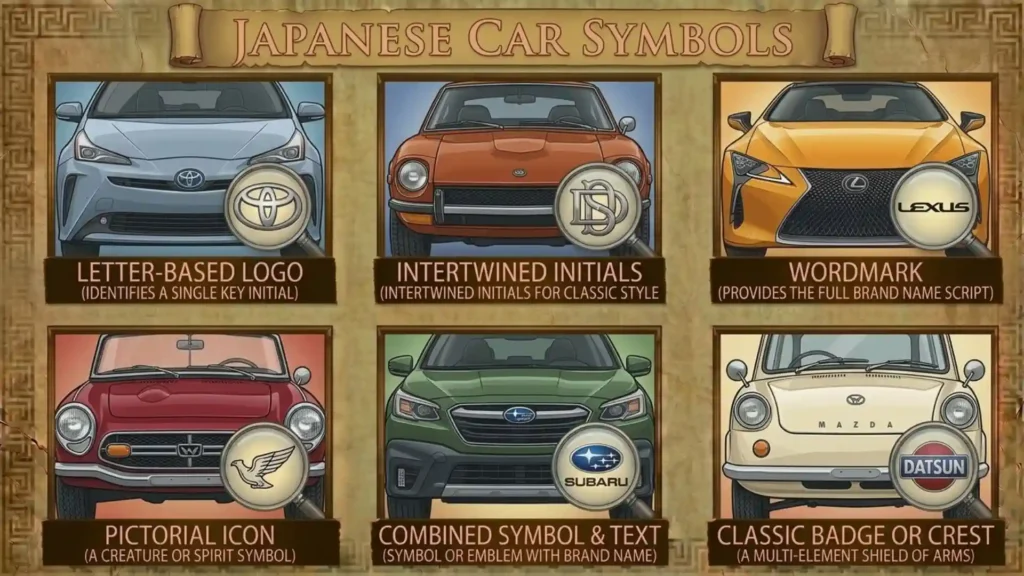
Japanese automakers use a wide variety of geometric, letter-based, and abstract symbols.
Toyota
Toyota’s three overlapping ovals are among the world’s most recognizable automotive symbols. Toyota’s official explanation gives specific meanings to the internal ovals, outer oval, and negative space.
Honda
Honda’s stylized H provides a simple identification clue.
Nissan
Nissan has used several versions of its circular and rectangular wordmark identity.
Mazda
Mazda’s wing-like M inside an oval is distinctive.
Subaru
Subaru’s group of stars inside an oval provides a useful visual clue.
Mitsubishi
Mitsubishi is recognizable by its three-diamond emblem.
The geometric simplicity makes the symbol easy to identify even at a distance.
Suzuki
Suzuki uses a stylized red S as its main automotive identity.
The angular letter shape distinguishes it from many other S-based logos.
German Car Brand Symbols
Germany has produced several of the world’s most recognizable automobile emblems.
BMW
Look for the circular badge, BMW lettering, and blue-and-white center.
BMW’s official history connects the logo to 1917 and Bavarian colors.
Mercedes-Benz
The three-pointed star is the main identification feature.
Its history reaches back to Daimler’s early 20th-century trademarks.
Audi
Four connected rings are the defining clue.
Volkswagen
The V and W inside a circle are the most recognizable elements.
Porsche
The detailed crest and horse distinguish Porsche from simpler shield-shaped badges.
American Car Brand Symbols
American automobile companies have produced many famous symbols and badges.
Ford
The blue oval and script are the primary clues.
Chevrolet
The bowtie badge is the defining visual feature.
Cadillac
Cadillac is associated with a crest-style emblem that has changed substantially over its history.
Older Cadillac badges can therefore be useful for identifying the approximate period of a vehicle.
Jeep
Jeep branding can appear as lettering or a grille-related identity rather than a complex pictorial emblem.
Tesla
Tesla’s stylized T is one of the simpler modern automotive symbols.
European Car Brand Symbols
Europe has a particularly rich tradition of automotive emblems.
Ferrari
Look for the prancing horse and shield-style composition.
Lamborghini
The bull inside the shield is the primary clue.
Volvo
Volvo is associated with a circular symbol containing its name and a diagonal arrow element.
Peugeot
Peugeot is associated with a lion emblem, with the exact design changing across different generations.
Renault
Renault has long used a diamond-shaped emblem, making the geometric form a useful identification clue.
Fiat
Fiat has used several circular and rectangular logo treatments throughout its history.
Aston Martin
The winged badge and central lettering are the most useful clues.
Car Logos With Animals
Animal symbols are among the most memorable car brand designs.
Horse Logos
The horse appears prominently in both Ferrari and Porsche branding, but the surrounding design is very different.
Ferrari is commonly identified by a prancing horse on a shield-like badge.
Porsche uses a horse within a much more elaborate crest.
This is a good example of why identifying the complete symbol is better than searching only for the animal.
Bull Logos
Lamborghini is strongly associated with a bull inside a shield.
The shield shape and lettering help separate it from other bull-related designs.
Lion Logos
Peugeot is associated with a lion emblem.
Because lion imagery can appear in many unrelated logos, the exact pose, frame, and lettering should be considered.
Jaguar Logos
Jaguar’s name and animal imagery have both played roles in its brand identity.
When identifying an older vehicle, compare the badge with the production era because Jaguar’s visual identity has changed.
Other Animal Symbols
Automotive branding can include birds, snakes, horses, bulls, lions, and other animals.
An animal should therefore be treated as the starting clue, not the complete identification.
Car Logos With Stars, Wings, and Shields
Certain visual elements appear across multiple automobile brands.
Star Logos
The Mercedes-Benz three-pointed star is perhaps the most recognizable automotive star symbol.
Subaru also uses a group of stars, creating a very different visual pattern.
When identifying a star logo, look at:
- Number of points
- Number of stars
- Circle or oval surrounding them
- Lettering
- Color
- Arrangement
Winged Logos
Winged symbols appear in several automotive brands.
Look for:
- Central letter
- Central shield
- Number of wing sections
- Shape of the feathers
- Brand name
- Badge proportions
A winged logo without its central detail may be difficult to identify accurately.
Shield and Crest Logos
Crests are especially common among luxury and heritage-oriented brands.
Porsche is a prominent example.
A crest may contain:
- Animal
- Crown
- Letters
- Stripes
- City or regional references
- Decorative borders
These details can provide stronger identification clues than the overall shield shape.
Car Brand Symbols With Letters
Letter-based logos are often designed so the letters themselves become a symbol.
Initial-Based Logos
Examples include:
- Honda — H
- Hyundai — stylized H
- Tesla — stylized T
- Volkswagen — V and W
- BMW — BMW lettering
Because several companies can use the same initial, typography and surrounding shapes are important.
Letter-and-Shape Logos
A letter placed inside an oval, circle, shield, or other frame can become a distinctive brand mark.
For example, Hyundai’s stylized H inside an oval is different from Honda’s H badge even though both rely on the letter H.
This is why the letter + shape + proportions combination is more useful than the letter alone.
What Do Car Brand Symbols Mean?
There is no single answer because different logos were created for different reasons.
Company History
Some symbols preserve part of a company’s past.
Mercedes-Benz’s current emblem developed from earlier Daimler and Benz symbols. The three-pointed star came from Daimler, while the laurel wreath came from Benz during the development of the shared Mercedes-Benz trademark.
Founders and Names
Some logos connect to:
- Founder names
- Company initials
- Family names
- Historical trademarks
- Original company identities
Toyota’s history, for example, includes the earlier Toyoda name before the company adopted Toyota branding.
Country and Heritage
National or regional identity can also influence automotive symbols.
BMW’s official history connects the blue and white colors of its emblem with Bavaria.
Performance and Luxury
Sports and luxury brands often use visual elements that communicate heritage, prestige, movement, or performance.
However, it is better to distinguish between a manufacturer’s documented explanation and a general interpretation.
Technology and Innovation
Modern automobile companies increasingly use simplified symbols that work well on:
- Digital displays
- Mobile apps
- Websites
- Electric vehicles
- Steering wheels
- Small screens
- Social media
This has encouraged many companies to simplify their visual identities.
How to Identify an Unknown Car Logo
If you see a car symbol but do not know the brand, follow a systematic process.
Step 1: Identify the Main Shape
Ask whether the emblem is:
- Circle
- Oval
- Shield
- Diamond
- Star
- Wings
- Animal
- Letter
- Abstract shape
This immediately reduces the possibilities.
Step 2: Look for Letters
Check carefully for:
- Single letters
- Initials
- Full brand name
- Multiple letters
- Numbers
If the badge is damaged, photograph it from different angles.
Step 3: Check the Colors
Colors can provide another clue.
Record whether the emblem is:
- Blue and white
- Red
- Silver
- Gold
- Black
- Green
- Yellow
- Multicolored
Do not rely on color alone because special editions and different finishes can change the appearance.
Step 4: Look for Animals or Objects
Ask:
- Is there a horse?
- Bull?
- Lion?
- Jaguar?
- Star?
- Wing?
- Crown?
- Trident?
- Diamond?
- Ring?
Then combine that clue with the badge shape.
Step 5: Compare the Complete Design
The strongest identification comes from combining several clues.
For example:
Horse + shield + yellow background + additional lettering
is more useful than simply searching:
car logo horse
The same principle applies to stars, wings, animals, and letters.
Car Brand Symbols Through History
Automotive logos are not always permanent.
Manufacturers may change them because of:
- New corporate identities
- Digital branding
- New vehicle generations
- Market changes
- Simplification
- Electric-vehicle strategies
- Anniversary celebrations
- Design modernization
Why Car Logos Change
A badge that works well as a metal grille ornament may not work equally well as a tiny smartphone icon.
Modern companies therefore often need symbols that remain recognizable at many sizes.
Current and Historical Emblems
Historical emblems can be extremely useful when identifying classic vehicles.
Toyota’s official emblem history traces the development from early Toyoda marks to the three-oval Toyota emblem introduced in 1989.
Mercedes-Benz also documents how its star developed from early Daimler trademarks into the combined Mercedes-Benz emblem.
Identifying Classic Car Logos
When dealing with an older vehicle, consider:
- Model year
- Country
- Badge material
- Font
- Shape
- Grille design
- Hood ornament
- Historical logo versions
Do not automatically reject an identification simply because the badge does not look exactly like the current company logo.
Common Myths About Car Brand Symbols
Car-logo articles often repeat explanations without checking where those stories originated.
Is the BMW Logo a Propeller?
The propeller interpretation is widely associated with BMW’s logo, but the company’s official history gives a more nuanced account.
BMW states that the blue-and-white logo dates to 1917 and that the stylized rotating-propeller interpretation appeared in advertising in the late 1920s.
Therefore, saying simply “the BMW logo is an airplane propeller” leaves out important historical context.
Hidden Meanings vs. Documented Meanings
A logo can have several interpretations online.
When possible, distinguish between:
Official explanation:
Published by the manufacturer.
Historical evidence:
Supported by company archives or reliable historical records.
Popular interpretation:
Widely repeated but not necessarily confirmed by the manufacturer.
This distinction makes car-symbol information more trustworthy.
Why Online Logo Explanations Can Be Misleading
Common problems include:
- Repeating unsourced stories
- Confusing an old logo with the current one
- Treating guesses as official meanings
- Ignoring regional variations
- Copying explanations from other websites
- Describing a logo without explaining how to identify it
A useful article should focus on evidence and practical identification rather than dramatic claims.
Frequently Asked Questions About Car Brand Symbols
What are the most common car brand symbols?
Some highly recognizable examples include the Mercedes-Benz three-pointed star, Audi’s four rings, Toyota’s three overlapping ovals, BMW’s blue-and-white roundel, Ferrari’s horse, Lamborghini’s bull, Porsche’s crest, and Subaru’s star cluster.
How can I identify a car by its logo?
Start with the logo’s main shape, then look for letters, animals, stars, rings, wings, colors, and surrounding designs. Compare several clues together instead of relying on one feature.
What car brand has a three-pointed star?
Mercedes-Benz is the brand most strongly associated with the three-pointed star. Mercedes-Benz traces the symbol to Daimler’s early trademark history.
What car brand has four rings?
Audi is recognized by four connected rings. The rings are arranged horizontally and overlap one another.
What car brand has a horse logo?
Ferrari and Porsche are two major examples. Ferrari uses a prancing horse on a shield-style emblem, while Porsche incorporates a horse into a detailed crest.
What car brand has a bull logo?
Lamborghini is famous for its bull emblem inside a shield.
What car brand has wings?
Several automobile brands have used winged designs, including Aston Martin and Bentley. The lettering and central symbol are important for telling them apart.
What does the Toyota logo mean?
Toyota explains that the three overlapping ovals represent relationships between the customer and company, while the inner shapes form a “T” and resemble a steering wheel. The outer oval represents the world surrounding Toyota.
What does the BMW logo mean?
BMW’s official history identifies the blue and white colors with Bavaria and explains that the propeller interpretation became established through advertising in the late 1920s.
What does the Mercedes-Benz logo mean?
The three-pointed star originated with Daimler’s earlier trademark. Mercedes-Benz’s historical material explains its association with motorization on land, water, and in the air. The later Mercedes-Benz emblem combined the star with the Benz laurel wreath.
Why do car companies change their logos?
Automakers may update logos to modernize their identity, improve digital visibility, mark a new corporate direction, or create a design that works better across different sizes and platforms.
Can I identify a classic car by its logo?
Often, yes. Compare the badge with historical versions of the manufacturer’s emblem and consider the vehicle’s model year, grille, body design, lettering, and other identifying features.
Are all car logos symbolic?
No. Some contain documented symbolism, while others primarily function as trademarks or recognizable brand identities. A logo should not be given a specific hidden meaning unless there is reliable evidence for that interpretation.
Why are some car logos just letters?
Letters can make a brand easy to recognize while keeping the design simple. Some manufacturers turn initials into a distinctive visual shape so the emblem can work on vehicles, advertising, digital interfaces, and merchandise.
What is the difference between a car logo and a car emblem?
A logo is the brand’s visual identity, while an emblem or badge often refers to the physical symbol attached to the vehicle. In everyday use, the terms can overlap.
Can the logo tell me the exact car model?
Usually not by itself. A brand logo can identify the manufacturer, but identifying the exact model normally requires additional information such as body shape, grille design, headlights, model lettering, or other vehicle details.
Conclusion
Car brand symbols make it possible to recognize an automobile company at a glance, but identifying them becomes much easier when you look beyond the most obvious shape. Stars, rings, animals, wings, shields, letters, colors, and typography can all provide useful clues.
Some symbols also have fascinating histories. Toyota explains the detailed meaning behind its overlapping ovals, Mercedes-Benz documents the development of its three-pointed star, and BMW provides historical context for its blue-and-white emblem and the later propeller interpretation.
If you are trying to identify an unfamiliar badge, start with its shape, examine every visible detail, compare the complete design, and consider whether the vehicle is modern or historic. Most importantly, separate documented logo history from popular interpretations.
A car symbol is often a small piece of design with a much larger story behind it.

Isaac Wellington
I’ve always been fascinated by the hidden stories in everyday life and the power of words to change how we see the world. Writing, for me, isn’t just a profession—it’s a way to explore human emotions, mysteries, and the unexpected twists of life. Over the years, I’ve dedicated myself to creating stories that linger in your mind long after the last page. When I’m not writing, you’ll usually find me wandering through old libraries or sketching ideas in a notebook. I believe every story has a heartbeat, and I aim to capture that rhythm in my work. Join me on a journey where imagination meets reality, and the ordinary becomes extraordinary.
Books:
-
Shadows of the Forgotten
-
Whispers Through Time