
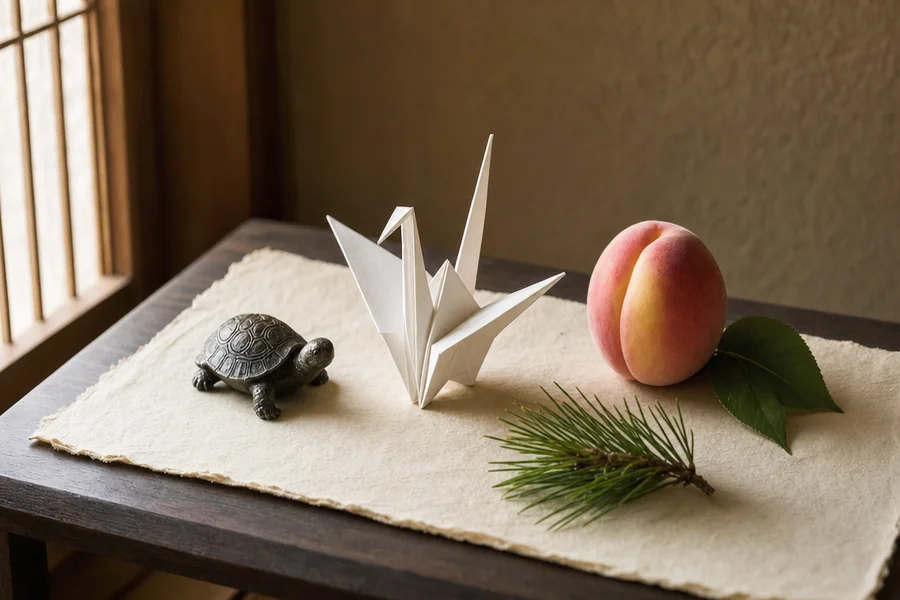
A long life is a wish that people share in many cultures. People have expressed it with written characters, animals, plants, fruit and gods. Many of these symbols of longevity still decorate gifts and celebrations today, from birthday art in China to wedding decorations in Japan.
This guide explains 10 longevity symbols from China, Japan and ancient Egypt: what each one means, where the meaning comes from, and where you can see it in art. The facts come from museum collection records and encyclopedia entries, listed at the end of the article.
1. Shou: the Chinese symbol for longevity
The simplest symbol of a long life is a word. In Chinese, the character shou (壽, or 寿 in its simplified form) means longevity. The Metropolitan Museum of Art in New York calls longevity “one of the most cherished wishes in Chinese tradition”.
The Met holds a large 18th-century tapestry panel from the Qing dynasty that shows one shou character in gold threads. The threads copy the effects of a brush, including a technique called “flying white”. According to the museum, the panel was “perfect for a birthday celebration and probably intended as a gift”. A Ming dynasty dish from the mid-16th century in the same collection shows the shou symbol in its center, with eight auspicious emblems around it, including flaming pearls, a pair of horns and a pair of books.
2. Shouxing: the Chinese god of longevity
Shou also gives its name to Shouxing, the god of longevity in Chinese mythology. Britannica describes him as one of three stellar gods known together as Fulushou, and notes that he was also called Nanji Laoren, the “Old Man of the South Pole”.
Shouxing has no temples. Instead, according to Britannica, birthday parties for elders are the time when visitors bow before his statue. Artists often show him as “a bearded old man with a high brow and a crooked staff in one hand”. In his other hand he holds the peach of immortality, and a stork or a turtle is often added as a further symbol of longevity.
Several other symbols in this list are his emblems. On a Qing dynasty porcelain saucer in the Victoria and Albert Museum (V&A) in London, the Daoist god of longevity, Shou Xing, appears “with his emblems, the deer, pine-tree, lingzhi fungus and tortoise-shell”.
3. Crane symbolism: the bird of a thousand years
Cranes are important animals in Japanese culture, and they appear in all forms of art. The Los Angeles County Museum of Art (LACMA) explains why: cranes “were traditionally believed to live for one thousand years and are therefore symbols of longevity as well as good luck”. National Geographic adds that the red-crowned crane “has been a symbol of immortality for centuries”.
The crane is also a symbol of a faithful marriage. LACMA notes that cranes mate for life, and The Met describes the red-crowned crane as “associated with marital fidelity and longevity”. With these two meanings together, the crane is a natural wish for a couple: a long life, side by side.
The paper crane is a modern form of this symbol. Cranes are a favorite subject of origami, and, as LACMA tells it, an ancient Japanese legend promises that anyone who folds one thousand paper cranes will be granted a wish. LACMA also notes that people sometimes fold 1,000 paper cranes for wedding decorations, anniversaries and other special occasions.
Japanese painters have shown cranes for centuries. In 1772, Maruyama Ōkyo painted a famous pair of folding screens with red-crowned and gray cranes, now in the LACMA collection. The museum notes that he likely based them on real birds that he observed at the Imperial Palace in Kyoto, and that the gold backgrounds of the screens highlight the birds’ auspicious meaning.
How long does a real crane live? Far less than the legend says. National Geographic gives the red-crowned crane an average life span of 30 years in the wild and 50 years in captivity. That is a long life for a bird, but it is the thousand-year crane of legend that became the symbol.
4. Turtle symbolism: the thousand-year tortoise
Turtles and tortoises are longevity symbols in both China and Japan. Britannica notes that artists often add a stork or a turtle to images of Shouxing as a further symbol of longevity, and the V&A saucer above shows a tortoise shell among his emblems.
In Japan, the long-life turtle has its own name: the minogame, or “thousand-year tortoise”. The Met describes a Japanese helmet crest from the 18th or 19th century in this form. According to the museum, the minogame is “the embodiment of longevity, as expressed by its tail of marsh grass”. It is also a companion and emblem of two of the Seven Gods of Good Fortune, Fukurokuju and Jurōjin. In Daoist (Taoist) tradition, The Met adds, it is one of four supernatural animals, together with the dragon, the phoenix and the kirin, and it symbolizes the element earth.
The same idea appears in Japanese painting. The Met holds a work attributed to the great Edo period artist Katsushika Hokusai with the title “Sea Turtle (Emblem of Longevity)”.
5. Peach symbolism: the peach of immortality
In Chinese tradition, the peach is the fruit of immortality. The legend centers on Xiwangmu, whom Britannica calls the “queen of the immortals” in Daoist mythology. Her fairyland garden was filled with rare flowers, extraordinary birds and the flat peach (pantao) of immortality.
A Daoist romance tells how Xiwangmu gave Wudi, an emperor of the Han dynasty, the famous peach of immortality. When the emperor wanted to bury the stone, she told him that Chinese soil was not suitable, and that the tree bloomed only once in 3,000 years. According to Daoist myth, the Eight Immortals (Baxian) celebrate her birthday with a grand banquet of special dishes, such as bear paws, monkey lips and dragon liver. Peaches are the last course.
The peach also links back to the god of longevity: in Chinese art, Shouxing holds the peach of immortality in his hand.
6. The pine tree
The pine is a longevity symbol in both Chinese and Japanese art. In China, it is one of Shou Xing’s emblems on the V&A saucer. In Japan, The Met describes a 1913 painting by Tomioka Tessai, “Nine Auspicious Symbols of Longevity and Prosperity”, in which a pair of rugged pine trees stand tall, “their long needles likewise symbolizing long life”.
The inscription on the same painting quotes an ancient Chinese poem, “Protecting the Heavens” (Tian bao), from the Classic of Poetry (Shijing). In the translation that The Met gives, the poem uses the lasting things of nature as a wish for long life: “Like the longevity of the Southern Mountains, Like the lushness of the pine”. The Met explains that the poem was written to congratulate the newly crowned kings of the Zhou dynasty, and that it later became a theme for painters in the Ming and Qing dynasties and in Japan.
7. The lingzhi fungus
The lingzhi fungus is another of Shou Xing’s emblems on the V&A saucer. In Tessai’s painting, red auspicious fungi grow at the base of the pines. The Met explains that people believed these fungi could extend one’s life span if they were taken as part of an elixir.
Here the fungus is a symbol of a wish from art and legend. It is not a health claim about real mushrooms.
8. The deer
The deer often walks beside the gods of longevity. On the V&A saucer, the deer is the first of Shou Xing’s emblems. In Japan, The Met holds a small Edo period case called an inrō that shows Jurōjin, the god of longevity, with a stag on one side and a long-tailed turtle (minogame) under bamboo on the other. One small object carries two longevity symbols and the god who stands for them.
9. Jurōjin: the Japanese god of longevity
In Japan, the god of longevity is Jurōjin. Britannica lists him among the Shichi-fuku-jin, the “Seven Gods of Luck”. This is a group of popular Japanese deities who are all associated with good fortune and happiness, and who have been grouped together from at least the 16th century. The seven are often shown together on their treasure ship (takara-bune).
The Met describes Jurōjin as “the Daoist deity of longevity”, and notes that viewers can identify him by his elongated forehead. In Tessai’s 1913 painting, he sits in a thatched pavilion with a red-crowned crane at his side, among pines, fungi, mountains, a red sun and a blue crescent moon. According to The Met, the signature suggests that Tessai made the painting on the second birthday of Emperor Taishō during his reign, as a wish for the emperor’s long life.
10. Ankh meaning: the Egyptian sign of life
In ancient Egypt, the sign of life was the ankh. Britannica defines it as an ancient Egyptian hieroglyph signifying “life”: a cross with a loop at the top, known in Latin as the crux ansata (the handle-shaped cross).
In Egyptian art, gods and pharaohs often hold or offer the ankh, and Britannica calls it a “vivifying talisman”, an object that gives life. The form of the symbol derives from a sandal strap. Much later, the Coptic Orthodox Church used it widely as a cross.
Strictly, the ankh means life, not long life. It belongs among the symbols of longevity because it expresses the same wish in its simplest form.
From symbols to science
All of these symbols express a wish. Today, researchers also study long life at the level of cells. One molecule in this research is NAD+ (nicotinamide adenine dinucleotide), which cells use to turn food into energy.
Studies report that NAD+ falls with age in several tissues. In blood, the picture is different: a 2026 study found that NAD+ in whole blood stays stable with age (Trętowicz and colleagues, Nature Metabolism, 2026). In mice, long-term NMN, a building block of NAD+, reduced age-related physiological decline (Mills and colleagues, Cell Metabolism, 2016). In a 60-day trial of 80 healthy middle-aged adults, NMN raised blood NAD levels (Yi and colleagues, GeroScience, 2023). These human results concern markers in the blood, not a longer life.
A crane on a scroll and a molecule in a laboratory answer different questions. For a plain-language summary of what human studies show so far, read this guide to NAD+ supplements. As with any supplement, talk to your doctor first if you take medicines or have a health condition.
Sources
- Britannica. Shouxing. Read 19 November 2026.
- Britannica. Xiwangmu. Read 19 November 2026.
- Britannica. Shichi-fuku-jin. Read 19 November 2026.
- Britannica. Ankh. Read 19 November 2026.
- The Metropolitan Museum of Art. Panel with the Chinese Character for Longevity (Shou), China, 18th century. Collection record, read 19 November 2026.
- The Metropolitan Museum of Art. Dish with character for longevity (shou), China, mid-16th century. Collection record, read 19 November 2026.
- The Metropolitan Museum of Art. Tomioka Tessai, Nine Auspicious Symbols of Longevity and Prosperity, 1913. Collection record, read 19 November 2026.
- The Metropolitan Museum of Art. Helmet Crest (Maidate), Japan, 18th to 19th century. Collection record, read 19 November 2026.
- The Metropolitan Museum of Art. Somada School, Inrō with God of Longevity (Jurōjin) and a Stag, and Long-Tailed Turtle (Minogame) under Bamboo, Edo period. Collection record, read 19 November 2026.
- The Metropolitan Museum of Art. Attributed to Katsushika Hokusai, Sea Turtle (Emblem of Longevity), Edo period. Collection record, read 19 November 2026.
- Victoria and Albert Museum. Cup and saucer with the Star god of longevity (Shou Xing) and his emblems, porcelain painted in underglaze blue, Jingdezhen, China, Qing dynasty. Collection record, read 19 November 2026.
- Los Angeles County Museum of Art. Every Living Thing: Animals in Japanese Art. Evenings for Educators, 2019 to 2020. Read 19 November 2026.
- National Geographic. Red-crowned crane, facts and photos. Read 19 November 2026.
- Mills KF, Yoshida S, Stein LR, et al. Long-term administration of nicotinamide mononucleotide mitigates age-associated physiological decline in mice. Cell Metabolism. 2016;24(6):795-806.
- Yi L, Maier AB, Tao R, et al. The efficacy and safety of β-nicotinamide mononucleotide (NMN) supplementation in healthy middle-aged adults: a randomized, multicenter, double-blind, placebo-controlled, parallel-group, dose-dependent clinical trial. GeroScience. 2023;45(1):29-43.
- Trętowicz MM, Scantlebery AML, Schomakers BV, et al. Human whole-blood NAD+ levels do not vary with age or lifestyle interventions. Nature Metabolism. 2026;8(6):1282-1290.
About the author: Nadosei Editorial writes plain-language guides on NAD+ and NMN research for Nadosei, a company that sells an NMN supplement.
