
Christianity has a rich tradition of using symbols to communicate faith, biblical ideas, and important beliefs. Some Christian symbols are immediately recognizable, such as the cross, while others, including the Ichthys fish, Chi-Rho, anchor, and Alpha and Omega, may require more explanation.
These symbols can represent ideas such as Jesus Christ, salvation, sacrifice, hope, the Holy Spirit, resurrection, eternal life, and Christian identity. Some have direct connections to biblical passages, while others became important through early Christian art and later traditions.
It is also important to remember that Christianity includes many denominations and traditions. Catholics, Eastern Orthodox Christians, and different Protestant communities may use and interpret certain symbols differently. There is therefore no single universal list in which every symbol has exactly the same meaning for every Christian.
This guide explores the major symbols of Christianity, their meanings, biblical connections, historical development, and common uses in churches, religious art, jewelry, and other forms of Christian expression.
What Are the Symbols of Christianity?
Christian symbols are visual signs, objects, letters, images, or designs used to communicate ideas connected with the Christian faith.
Some symbols are closely connected with the Bible. Others developed as Christians used visual art to express their beliefs, particularly during the early centuries of Christianity.
A symbol can communicate an idea without requiring a long explanation. For example, a cross can immediately identify a building, piece of jewelry, or work of art as Christian.
Common symbols associated with Christianity include:
| Symbol | Common Christian Association |
| Cross | Jesus Christ, crucifixion, faith, salvation |
| Crucifix | Christ’s crucifixion and sacrifice |
| Ichthys/Fish | Jesus Christ and Christian identity |
| Dove | Holy Spirit |
| Lamb | Christ, sacrifice, redemption |
| Alpha and Omega | Beginning and end, eternity |
| Chi-Rho | Christ |
| Anchor | Hope and steadfast faith |
| Shepherd | Christ’s care and guidance |
| Vine | Spiritual life and connection with Christ |
| Crown | Kingship, victory, or eternal life |
| Ship | Church and Christian community |
| Bread and wine | Communion or Eucharist |
These associations are useful starting points, but the meaning of a symbol can change depending on its biblical, historical, artistic, or denominational context.
The Cross: The Central Christian Symbol
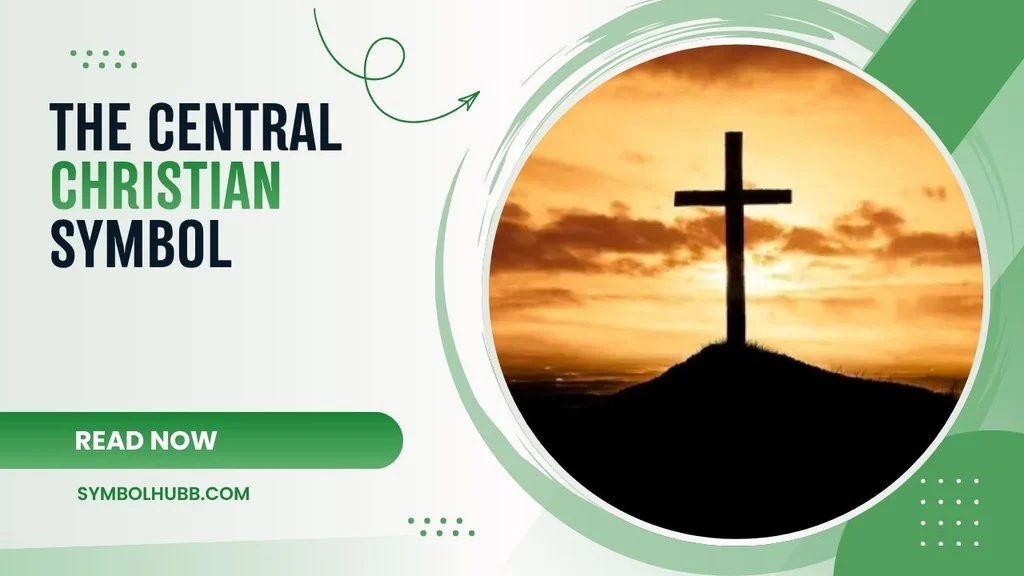
The cross is perhaps the most widely recognized symbol of Christianity. It is closely associated with the crucifixion of Jesus Christ and has become a central visual expression of Christian faith.
For Christians, the cross can point to several connected ideas:
- Jesus’ crucifixion
- Sacrifice
- Salvation
- Redemption
- Forgiveness
- Faith
- Suffering
- Hope
- Resurrection
The cross is therefore more than a simple geometric shape. Its meaning comes from the central role of Jesus’ death and resurrection in Christian belief.
What the Cross Represents
The cross can remind Christians of Jesus’ sacrifice and the belief that his death is connected with humanity’s salvation.
It can also represent the Christian understanding that suffering and death are not the final word. Because the crucifixion is closely connected with the resurrection, the cross can also carry a message of hope and new life.
A plain cross may appear in churches, homes, cemeteries, books, artwork, clothing, and jewelry.
Cross vs. Crucifix
A cross is generally a cross-shaped symbol without a representation of Jesus’ body.
A crucifix includes a figure of Jesus on the cross.
The distinction is important because different Christian traditions use these forms differently. A crucifix is especially prominent in Catholic religious art and devotion, while many Protestant churches commonly display a bare cross.
Neither should be treated as the only legitimate visual expression of Christianity. The emphasis depends on the Christian tradition and context.
The Christian Fish or Ichthys
The Ichthys, often represented by a simple fish outline, is one of the best-known Christian symbols besides the cross.
The Greek word ichthys means “fish.” Early Christians also connected the Greek letters of the word with a phrase identifying Jesus Christ as the Son of God and Savior.
The fish therefore became a compact way of expressing Christian identity.
What Ichthys Means
The fish can be associated with:
- Jesus Christ
- Christian faith
- Salvation
- Christian identity
- Baptism
- The apostles
- Eucharistic themes
Fish imagery also has biblical connections. The Gospels contain several important stories involving fish and Jesus’ disciples, including the calling of fishermen and miraculous catches.
Why the Fish Became a Christian Symbol
The Ichthys became useful as a Christian symbol because it could communicate several layers of meaning in a small and recognizable image.
Early Christians used fish imagery in various forms of art and material culture. Over time, the fish became an enduring symbol of Christianity.
Today, the Ichthys may appear on:
- Car decals
- Jewelry
- Clothing
- Church materials
- Artwork
- Websites
- Christian tattoos
The Dove
The dove is strongly associated with the Holy Spirit in Christian symbolism.
This association comes particularly from the Gospel accounts describing Jesus’ baptism, in which the Spirit is described in connection with a dove-like appearance.
For this reason, a dove may symbolize:
- The Holy Spirit
- Divine presence
- Peace
- Baptism
- Spiritual renewal
The dove can also have broader meanings in Christian art, so its exact interpretation depends on the surrounding imagery.
The Dove in Christian Art
A dove may be shown above Jesus, near a representation of God, or within scenes associated with baptism.
It is also common in Christian artwork involving themes of peace, spiritual life, and divine guidance.
When a dove appears with flames or rays of light, the image may particularly emphasize the Holy Spirit.
The Lamb of God
The lamb is another important Christian symbol. It is closely associated with Jesus through the Christian expression “Lamb of God.”
The image connects Jesus with themes of sacrifice, redemption, and salvation.
What the Lamb Represents
The lamb can symbolize:
- Jesus Christ
- Sacrifice
- Innocence
- Redemption
- Salvation
- Victory over death
The symbolism also connects Christian thought with biblical sacrificial imagery and Passover themes.
In Christian art, the lamb may appear alone, holding a cross, carrying a banner, or within other religious scenes.
The Lamb in Revelation and Christian Art
The Book of Revelation uses lamb imagery in an important theological context. Christian artists later used this imagery to communicate beliefs about Christ’s sacrifice and victory.
This makes the lamb a good example of how biblical imagery and Christian artistic tradition can work together.
Alpha and Omega

Alpha and Omega are the first and last letters of the Greek alphabet:
Α — Alpha
Ω — Omega
Together, they symbolize ideas such as the beginning and the end, eternity, completeness, and God’s sovereignty.
The expression has a direct biblical association, particularly in Revelation.
What Alpha and Omega Mean in Christianity
The symbol can communicate:
- Beginning and end
- Eternity
- God’s eternal nature
- Christ’s divine authority
- Completeness
- The fullness of creation
You may see Α and Ω on church decorations, crosses, paintings, stained glass, religious books, and other Christian artwork.
Why Alpha and Omega Are Used Together
Because Alpha is the first Greek letter and Omega is the last, placing them together creates a visual expression of completeness.
In Christian symbolism, this can communicate the idea that God is present at the beginning and the end and transcends the limits of time.
The Chi-Rho
The Chi-Rho (☧) is an ancient Christian monogram associated with Christ.
It combines two Greek letters:
- Chi (Χ)
- Rho (Ρ)
These are the first two letters of Christos, the Greek word for Christ.
What the Chi-Rho Represents
The Chi-Rho therefore functions as a visual abbreviation for Christ.
It can appear in:
- Churches
- Manuscripts
- Religious artwork
- Crosses
- Christian jewelry
- Historical Christian objects
- Decorative designs
The symbol became particularly important in early Christian visual culture.
Why the Chi-Rho Is Important
The Chi-Rho is useful for understanding how early Christians developed compact visual ways to identify Christ.
Unlike the cross, someone unfamiliar with Christian history might not immediately recognize it. Learning its meaning therefore adds historical depth to the study of Christian symbols.
The Anchor
The anchor is a less obvious but important Christian symbol.
It is commonly associated with hope, stability, and steadfast faith.
The association with hope has a biblical foundation, particularly in the New Testament’s imagery of hope as an anchor for the soul.
What the Anchor Represents
The anchor can symbolize:
- Hope
- Stability
- Faith
- Perseverance
- Security
- Steadfastness
Early Christian communities also used anchor imagery, sometimes incorporating a cross into the design.
The Anchor in Christian Art
An anchor may appear on:
- Tombs
- Jewelry
- Religious artwork
- Church decorations
- Memorial designs
Its meaning can be especially appropriate when Christian symbolism focuses on remaining faithful during difficult circumstances.
The Good Shepherd
The Good Shepherd is a major Christian image associated with Jesus’ care for his followers.
In the Gospel of John, Jesus describes himself as the Good Shepherd.
The image of a shepherd caring for sheep communicates ideas of:
- Guidance
- Protection
- Care
- Sacrifice
- Leadership
- Relationship between Christ and believers
The Shepherd and the Sheep
Sheep can represent believers, while the shepherd represents Christ.
This imagery is also connected with the biblical tradition of shepherding, particularly Psalm 23 and the teachings of Jesus.
Christian art has used shepherd imagery for centuries, making it one of the important visual themes of Christian tradition.
The Vine
The vine is another biblical image with an important place in Christian symbolism.
Jesus uses the image of the vine and branches to describe the relationship between himself and his followers.
What the Vine Represents
The vine can symbolize:
- Spiritual life
- Connection with Christ
- Growth
- Fruitfulness
- Dependence
- Christian community
The branches depend on the vine for life, making the image useful for expressing the idea that believers remain spiritually connected to Christ.
Vine Imagery in Christian Art
Vines and grapes may appear in:
- Church decorations
- Mosaics
- Stained glass
- Communion-related artwork
- Religious manuscripts
- Cross designs
The grapevine can also connect naturally with Christian themes surrounding wine and the Eucharist.
Bread and Wine
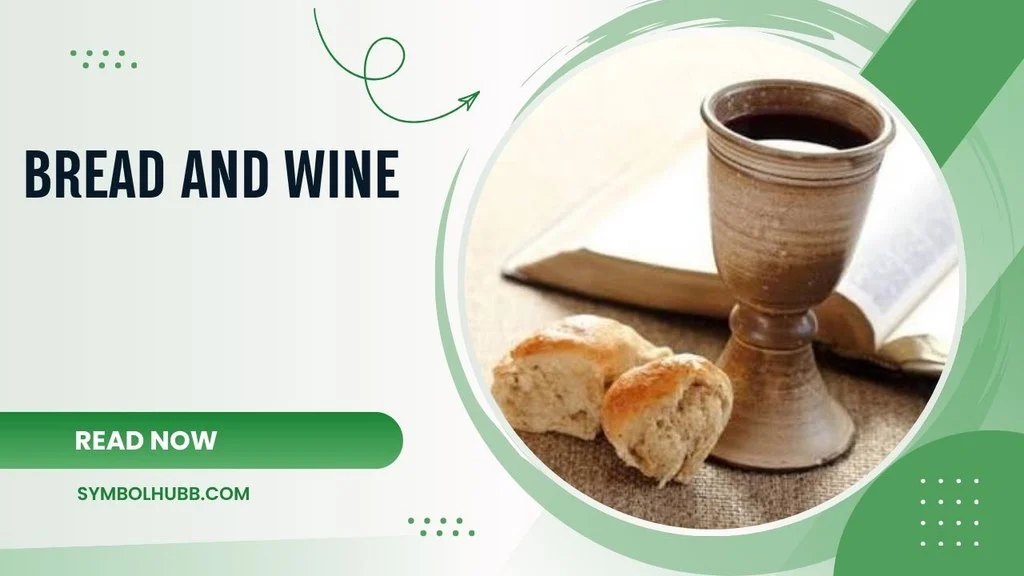
Bread and wine are important Christian symbols associated with Communion or the Eucharist.
The symbolism comes from Jesus’ Last Supper with his disciples.
Different Christian denominations understand Communion differently, so the article should not suggest that every Christian tradition interprets the bread and wine in precisely the same theological way.
What Bread Can Represent
Bread may be associated with:
- Jesus
- Spiritual nourishment
- Communion
- God’s provision
- Christian fellowship
What Wine Can Represent
Wine may be associated with:
- Jesus’ blood
- The New Covenant
- Communion
- Sacrifice
- Christian worship
Together, bread and wine are among the most important objects used in Christian worship.
The Crown
The crown can carry several meanings in Christian symbolism.
Depending on context, it can represent:
- Christ’s kingship
- Victory
- Eternal life
- Glory
- Martyrdom
- Reward
The crown is particularly useful when Christian art focuses on Christ as King or on the promise of eternal life.
The Crown of Life
The New Testament uses the imagery of a crown of life, which has contributed to the crown’s association with faithfulness, perseverance, and eternal reward.
A crown in Christian artwork should therefore be interpreted according to its surrounding imagery rather than assigned only one meaning.
The Ship
The ship is an older Christian symbol that can represent the Church and the Christian community traveling through the difficulties of life.
It can also evoke biblical stories involving boats, storms, fishermen, and Noah’s Ark.
What the Ship Represents
A Christian ship may symbolize:
- The Church
- Christian community
- Faith
- Journey
- Safety
- Hope
- Perseverance
Church interiors have sometimes been designed in ways that reinforce the connection between a worshiping community and a ship traveling toward safety.
Holy Trinity Symbols
The Holy Trinity refers to the Christian doctrine of one God in three persons: Father, Son, and Holy Spirit.
Christian artists and traditions have used different visual designs to communicate this idea.
Examples include:
- Three interlocking circles
- Triquetra or Trinity knot designs
- Threefold geometric patterns
- Artistic representations of Father, Son, and Holy Spirit
Why There Is No Single Universal Trinity Symbol
There is no one visual design that every Christian denomination must use to represent the Trinity.
Different communities and periods of Christian art have used different approaches.
This is an important distinction because an article about Christian symbols should avoid suggesting that one particular Trinity design is universally official.
Christian Symbols by Meaning
Looking at symbols according to their meaning can make Christian symbolism easier to understand.
Symbols Associated With Jesus
Several symbols are particularly connected with Jesus Christ:
- Cross
- Crucifix
- Ichthys
- Chi-Rho
- Lamb
- Good Shepherd
- Alpha and Omega
The cross emphasizes the crucifixion, while the Ichthys and Chi-Rho can identify Christ more directly through imagery and language.
Symbols Associated With the Holy Spirit
The dove is the most familiar Christian symbol associated with the Holy Spirit.
Fire or flames can also be used to represent the Holy Spirit, particularly in connection with Pentecost.
These symbols often emphasize spiritual presence, transformation, and divine action.
Symbols of Hope and Salvation
Christian symbols associated with hope and salvation include:
- Cross
- Anchor
- Lamb
- Light
- Resurrection imagery
The anchor is especially connected with hope, while the cross brings together themes of sacrifice and salvation.
Symbols of Eternal Life
Symbols associated with eternal life can include:
- Alpha and Omega
- Crown
- Cross
- Resurrection imagery
The exact meaning depends on the artwork and Christian tradition in which the symbol appears.
Christian Symbols in Churches and Religious Art
Christian symbols can be found throughout churches and religious artwork.
You may see them in:
- Stained-glass windows
- Mosaics
- Paintings
- Statues
- Altars
- Church doors
- Pulpits
- Baptismal areas
- Religious books
- Vestments
- Crosses and crucifixes
Stained Glass
Stained-glass windows often use Christian symbols to communicate biblical stories or theological themes.
A window might contain a cross, dove, lamb, fish, vine, crown, or Alpha and Omega.
The colors, surrounding figures, and biblical scene can help determine the intended meaning.
Christian Paintings and Mosaics
Christian artists have used symbols to make theological ideas visible.
A lamb can point toward Christ. A dove can suggest the Holy Spirit. A shepherd can represent Jesus’ care for believers.
This symbolic language allowed religious art to communicate ideas even to people who could not read.
Christian Symbols in Jewelry and Tattoos
Christian symbols are also commonly used in modern jewelry and personal artwork.
The cross is perhaps the most recognizable choice, but people may also encounter:
- Ichthys fish
- Chi-Rho
- Dove
- Anchor
- Alpha and Omega
- Trinity designs
- Lamb imagery
- Scripture-inspired symbols
Choosing a Christian Symbol for Jewelry
A symbol can be selected because of the meaning it communicates.
For example:
- Cross: faith, Christ, sacrifice, salvation
- Fish: Christian identity and Christ
- Dove: Holy Spirit and peace
- Anchor: hope and steadfastness
- Alpha and Omega: eternity and completeness
- Chi-Rho: Christ
The meaning can also be personal, and interpretations may differ between Christian traditions.
Christian Tattoos
Christian symbols may also appear in tattoos.
People may choose a cross, fish, Bible verse imagery, dove, anchor, or other Christian design to express faith or commemorate an important spiritual experience.
Because symbolism varies by tradition, it is worth understanding the historical and religious meaning of a design before using it.
Biblical Symbols vs. Traditional Christian Symbols
Not every Christian symbol has exactly the same origin.
Some have strong and direct biblical associations, while others became established through early Christian art and tradition.
| Symbol | Biblical Connection | Traditional Christian Development |
| Cross | Jesus’ crucifixion | Central Christian emblem |
| Alpha & Omega | Revelation | Christian art and decoration |
| Lamb | Biblical sacrificial imagery and Christ | Extensive Christian art tradition |
| Dove | Holy Spirit and Jesus’ baptism | Christian artistic symbol |
| Fish | Biblical fish imagery | Ichthys as a Christian identity symbol |
| Chi-Rho | Greek name/title of Christ | Early Christian monogram |
| Anchor | Hope imagery | Early Christian symbol |
| Shepherd | Biblical shepherd imagery and Jesus’ teaching | Major Christian art theme |
| Vine | Jesus’ vine-and-branches teaching | Christian art and worship imagery |
This distinction helps prevent a common misunderstanding: a symbol can be strongly Christian without being a symbol that appears in exactly that visual form in the Bible.
Christian Symbols Across Different Traditions
Christianity includes many traditions, and symbolic practices can differ between them.
Catholic Christianity
Catholic churches commonly use crosses, crucifixes, statues, saints’ imagery, the Eucharistic symbolism of bread and wine, and other forms of religious art.
The crucifix is especially important in Catholic visual tradition.
Eastern Orthodox Christianity
Eastern Orthodox Christianity has a rich tradition of icons, crosses, liturgical imagery, and symbolic religious art.
Icons are not simply decorative pictures. They occupy an important place within Orthodox worship and theology.
Protestant Christianity
Protestant communities vary considerably.
Many Protestant churches use a simple cross, Bible imagery, baptismal symbolism, communion imagery, or other Christian designs. Some traditions make extensive use of visual art, while others maintain relatively simple worship spaces.
Why These Differences Matter
It is better to say “many Christian traditions” than to assume every Christian uses every symbol in exactly the same way.
The cross may be nearly universal as a Christian reference point, but its artistic form, placement, and theological emphasis can differ.
Common Christian Symbols at a Glance
For a quick review, here are some of the most important symbols discussed in this article:
- Cross: Jesus’ crucifixion, sacrifice, salvation, and Christian faith
- Crucifix: Jesus depicted on the cross
- Ichthys: Christ and Christian identity
- Dove: Holy Spirit
- Lamb: Christ, sacrifice, and redemption
- Alpha and Omega: beginning and end, eternity
- Chi-Rho: Christ
- Anchor: hope and steadfast faith
- Good Shepherd: Christ’s care and guidance
- Vine: spiritual connection with Christ
- Bread and wine: Communion or Eucharist
- Crown: kingship, victory, or eternal life
- Ship: Church, community, and spiritual journey
Frequently Asked Questions
What is the most important symbol of Christianity?
The cross is the most widely recognized symbol associated with Christianity. It is closely connected with Jesus’ crucifixion and can represent sacrifice, salvation, redemption, faith, and Christian hope.
What are the five main symbols of Christianity?
There is no universally fixed official list of exactly five Christian symbols. However, five widely recognized examples are the cross, Ichthys fish, dove, lamb, and Alpha and Omega. Different Christian traditions may emphasize additional symbols.
What does the fish symbolize in Christianity?
The Christian fish, or Ichthys, is associated with Jesus Christ and Christian identity. The Greek word ichthys means fish, and early Christians connected its letters with a phrase identifying Jesus as Christ, Son of God, and Savior.
What does the dove symbolize in Christianity?
The dove is strongly associated with the Holy Spirit, particularly through the accounts of Jesus’ baptism. Depending on the artistic context, it can also suggest peace or spiritual renewal.
What does Alpha and Omega mean in Christianity?
Alpha is the first letter of the Greek alphabet, while Omega is the last. Together, they can represent the beginning and the end, eternity, and God’s sovereignty. The imagery has a direct biblical connection, particularly in Revelation.
What does the Chi-Rho symbol mean?
The Chi-Rho combines the Greek letters Chi and Rho, which begin the Greek word Christos, meaning Christ. It therefore serves as a Christian monogram representing Jesus Christ.
What Christian symbol represents hope?
The anchor is strongly associated with Christian hope and steadfastness. The cross can also communicate hope through its connection with Jesus’ death and resurrection.
Are all Christian symbols found in the Bible?
No. Some symbols have direct biblical connections, while others developed through early Christian art, tradition, and historical usage. The Chi-Rho, for example, is a Christian monogram based on Greek letters rather than a visual symbol presented in the Bible.
What is the difference between a cross and a crucifix?
A cross is generally shown without a figure of Jesus, while a crucifix includes Jesus’ body on the cross. Different Christian traditions use these forms differently.
What symbol represents the Holy Trinity?
There is no single universally required Trinity symbol. The triquetra, threefold designs, and interlocking-circle patterns are among the visual forms used to express the Trinity in Christian art and tradition.
Why do Christians use symbols?
Christian symbols can communicate biblical teachings and theological ideas visually. They can also help identify churches, express faith, support worship, and preserve religious traditions through art and objects.
Conclusion
The symbols of Christianity provide a visual language through which Christians have expressed faith, biblical teachings, and theological ideas across many centuries. The cross remains the most recognizable symbol, while the crucifix, Ichthys, dove, lamb, Alpha and Omega, Chi-Rho, anchor, shepherd, vine, crown, ship, bread, and wine add other layers of meaning.
Some symbols have direct biblical connections, while others developed through early Christian history and religious art. Their meanings can also vary between Catholic, Orthodox, Protestant, and other Christian traditions.
Understanding the context behind each symbol is therefore more useful than memorizing a simple list. Whether you encounter a Christian symbol in a church, painting, stained-glass window, piece of jewelry, or personal artwork, its surrounding imagery and tradition can help reveal what it is intended to communicate.

Clara Miles
Hello! I’m Clara, a lifelong dreamer who finds magic in everyday moments. Writing has always been my way of exploring the world and understanding the people around me. I love creating stories that make readers laugh, cry, and reflect on life’s little surprises. When I’m not writing, you can usually find me sipping coffee at a cozy café or wandering through nature with a notebook in hand. My journey as an author is fueled by curiosity, imagination, and a love for connecting with my readers. Every story I write is a piece of my heart, and I hope it inspires yours too.
Books:
-
Whispers of the Heart
-
Shadows and Sunlight