Taíno symbols are powerful cultural and spiritual signs used by the Taíno people to express beliefs, nature, and daily life.
In short, Taíno symbols represent the connection between humans, nature, and the spiritual world.
These symbols are found in carvings, pottery, jewelry, and sacred objects, and they continue to inspire art and identity today.
What Are Taíno Symbols?
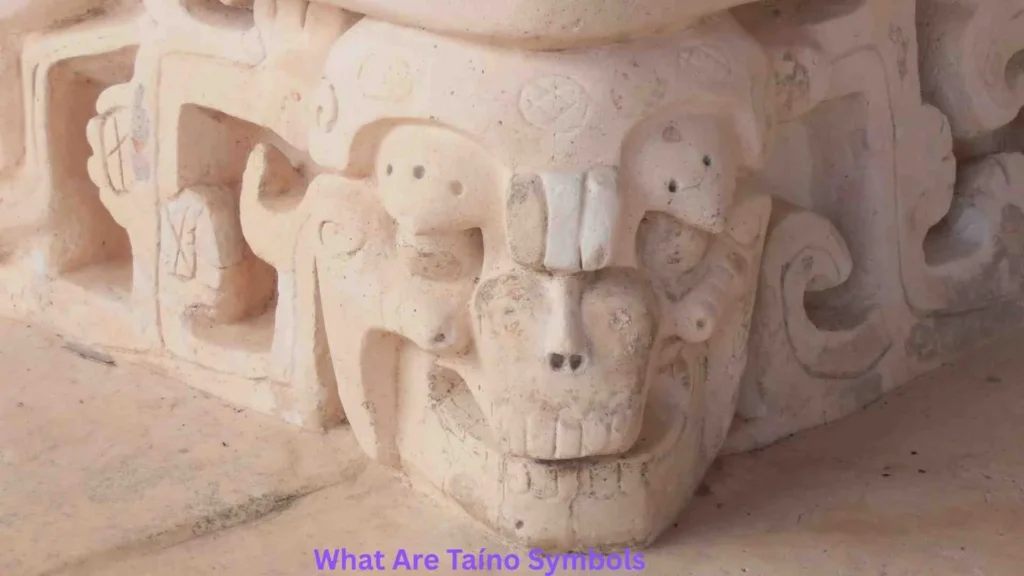
Taíno symbols are visual designs and carvings created by the indigenous Taíno people of the Caribbean. These symbols were used to:
- Represent gods and spirits
- Communicate ideas and traditions
- Decorate objects and tools
- Express cultural identity
They are deeply connected to nature, spirituality, and community life.
Taíno Symbols and Meanings
Taíno symbols are an important part of the artistic and spiritual traditions of the Taíno people, the Indigenous people of the Caribbean. Taíno art can be found in ancient petroglyphs, pottery, tools, ceremonial objects, and rock carvings. Many of these designs feature animals, celestial objects, human figures, and geometric shapes connected with nature and spiritual beliefs.
One of the most recognizable Taíno symbols is the sun, which is often associated with light, life, warmth, and the natural world. Other common images include frogs, turtles, birds, fish, and human-like figures. However, the exact meaning of an individual petroglyph is not always known. Some interpretations come from archaeological evidence, Indigenous traditions, and comparisons with Taíno mythology.
The zemí is another important concept in Taíno culture. Zemí refers to a spiritual being or sacred object, and representations of zemí could take many forms. Some were connected with ancestors, natural forces, fertility, protection, or other spiritual aspects of life.
Taíno symbols were not simply decorative designs. They were often connected to the community’s relationship with nature, ancestors, spirituality, and the world around them. Today, these symbols are also used by people of Caribbean and Taíno heritage as expressions of identity and cultural connection.
Because many ancient Taíno symbols were created before written records were available, it is important to distinguish between documented interpretations and modern symbolic meanings.
Taíno Symbols Tattoos

Taíno symbols are popular tattoo designs for people who feel connected to Caribbean history, Indigenous heritage, nature, or ancestral identity. Traditional Taíno-inspired tattoos often feature animals, celestial imagery, faces, geometric patterns, and petroglyph-style figures.
A turtle is a popular choice because turtles are strongly associated with the Caribbean environment and appear in Taíno artistic traditions. A sun-inspired design may represent life, energy, warmth, or a connection with nature. Animal figures can also be chosen because of their connection to the natural world and Taíno mythology.
Before getting a Taíno-inspired tattoo, it is worth researching the specific design rather than assuming that every ancient-looking symbol has one fixed meaning. Many designs shared online are modern interpretations, and some symbols are incorrectly labeled as “Taíno” even when their historical origin is uncertain.
For a more meaningful tattoo, consider choosing an image based on documented Taíno art or archaeological examples. You can also combine a traditional-inspired motif with a personal element, such as a family connection, Caribbean heritage, or appreciation for Indigenous history.
A Taíno tattoo can therefore be more than an attractive design. For many people, it can serve as a reminder of ancestry, resilience, cultural identity, and the enduring history of the Caribbean’s Indigenous peoples.
Taíno Sun Symbol Meaning
The Taíno sun symbol is commonly interpreted through the importance of the sun in nature and Taíno spiritual traditions. The sun provided light and warmth and played an essential role in the natural environment on which communities depended.
Taíno art includes sun-like and radiating designs, although not every circular or radiating petroglyph should automatically be identified as a sun symbol. Archaeologists study the surrounding imagery, location, style, and cultural context when interpreting ancient rock art.
In modern use, a Taíno-inspired sun design may represent life, light, strength, warmth, energy, and renewal. These meanings make the sun an especially popular choice for artwork and tattoos.
The sun can also symbolize the connection between people and the natural world. Its daily appearance and movement across the sky can be viewed as a reminder of continuity and the cycles of nature.
It is important to remember that a modern interpretation is not necessarily the same as a historically proven Taíno meaning. Ancient Taíno beliefs were complex, and surviving archaeological evidence does not provide a complete dictionary of symbols and their meanings.
Taíno Symbols in English

When people search for “Taíno symbols in English,” they are often looking for simple explanations of Indigenous Caribbean symbols and what different designs represent.
Some commonly discussed Taíno-inspired images include:
| Taíno-inspired symbol | Common modern interpretation |
| Sun | Light, life, warmth, energy |
| Turtle | Nature, endurance, connection to the sea |
| Frog | Water, fertility, transformation |
| Bird | Nature, sky, spiritual associations |
| Fish | Water and the Caribbean environment |
| Zemí figure | Spiritual power or sacred presence |
| Human face | Ancestral or spiritual imagery |
| Geometric patterns | Artistic and ceremonial decoration |
These interpretations should be treated carefully because there is no complete surviving Taíno symbol dictionary that gives a universally accepted English translation for every petroglyph.
The Taíno language itself was part of the Arawakan language family, and many Taíno words survived in Caribbean Spanish and English. Words such as hammock, canoe, tobacco, barbecue, and hurricane are commonly associated with Taíno or related Indigenous Caribbean languages.
Understanding Taíno symbols in English is therefore not simply a matter of translating pictures into words. It requires looking at archaeology, mythology, art, language, and the historical context of the Taíno people.
Taíno Symbols and Meanings PDF
People searching for a Taíno symbols and meanings PDF are usually looking for a convenient reference containing images of Taíno designs and explanations of their possible meanings.
A useful PDF should ideally distinguish between documented archaeological evidence, scholarly interpretation, and modern symbolism. This is especially important because many websites share symbol charts that present uncertain meanings as established historical facts.
A good reference guide may include images or descriptions of Taíno petroglyphs, zemí representations, animal figures, celestial designs, and other forms of Indigenous Caribbean artwork. It can also provide information about where particular examples were discovered and how archaeologists interpret them.
If you are creating a PDF about Taíno symbols, consider organizing it into sections such as:
- Introduction to Taíno culture
- Ancient Taíno rock art and petroglyphs
- Important animal imagery
- Sun and celestial imagery
- Zemí figures and spirituality
- Modern Taíno-inspired symbols
- Symbol meanings and interpretation notes
A responsible reference should avoid claiming that every symbol has one definite meaning. Ancient symbols can have multiple interpretations depending on their archaeological and cultural context.
Taíno Symbol for Love
There is no universally accepted ancient Taíno symbol that can be confidently described as the official Taíno symbol for love.
You may find modern websites or tattoo collections that label particular Taíno designs as symbols of love, passion, family, or affection. However, these descriptions are often modern interpretations rather than meanings that have been conclusively established through historical Taíno sources.
For someone looking for a Taíno-inspired representation of love, a heart-like or paired design may be used creatively, but it should not automatically be presented as an authentic ancient Taíno “love symbol.”
Another approach is to choose imagery connected with relationships, family, nature, or spiritual connection and explain its meaning as a modern personal interpretation.
This distinction matters because Taíno culture should be represented respectfully. Rather than saying that an uncertain symbol definitely meant “love,” it is more accurate to say that a contemporary artist or tattoo wearer may use the design to express love, family, connection, or devotion.
Taíno Turtle Symbol Meaning
The turtle is one of the most recognizable animals associated with Taíno-inspired art. Turtles were part of the Caribbean environment and appear in Indigenous Caribbean artistic traditions.
In modern symbolic interpretations, the Taíno turtle is often associated with endurance, protection, nature, patience, longevity, and a connection to the sea. These meanings also make turtle designs popular for tattoos and jewelry.
The turtle’s natural characteristics provide an easy reason for some of these modern associations. Its shell can suggest protection, while its slow and steady movement can represent patience and persistence. Its relationship with the ocean can also make it meaningful to people with Caribbean connections.
However, the exact spiritual meaning of every turtle image in ancient Taíno art cannot be assumed. A turtle petroglyph or carved figure should be understood within its archaeological and cultural context.
Today, a Taíno-inspired turtle can serve as a meaningful symbol of Caribbean heritage, connection to nature, resilience, and respect for Indigenous history. For a tattoo or artwork, researching the original archaeological source of the design can make the symbol much more meaningful and culturally respectful.
Who Were the Taíno People?
The Taíno were indigenous people who lived in:
- The Caribbean islands (Cuba, Hispaniola, Puerto Rico, Jamaica)
- Parts of the Bahamas
Key Features of Taíno Culture
- Skilled farmers and fishermen
- Strong spiritual beliefs
- Rich artistic traditions
- Deep respect for nature
Importance of Taíno Symbols in Their Culture
Taíno symbols played a central role in everyday life.
Why They Were Important
- Represented spiritual beliefs
- Connected people to nature and ancestors
- Used in ceremonies and rituals
- Helped preserve stories and traditions
Common Taíno Symbols and Their Meanings
1. Coquí Frog – Life and Voice of Nature 🐸
The coquí frog is a famous symbol in Taíno culture.
Meaning
- Represents life, fertility, and nature
- Symbol of the Caribbean environment
Interesting Fact
The coquí’s sound is associated with island identity and spirit.
2. Sun Symbol – Energy and Life ☀️
The sun was a powerful symbol.
Meaning
- Represents life, growth, and warmth
- Seen as a source of energy
Use
- Carved in stones and artifacts
3. Moon Symbol – Balance and Cycles 🌙
The moon symbol reflects natural cycles.
Meaning
- Represents time, change, and balance
- Linked to feminine energy
4. Cemí (Zemi) – Spiritual Spirits
Cemí are sacred figures or symbols representing gods.
Meaning
- Represent ancestral spirits and deities
- Used in rituals and ceremonies
Use
- Carved into stones, wood, and bone
5. Spiral Symbol – Continuity and Life Cycle 🔄
The spiral is a common Taíno design.
Meaning
- Represents growth, life cycles, and eternity
6. Turtle Symbol – Longevity and Protection 🐢
The turtle symbolizes strength and endurance.
Meaning
- Represents long life and protection
- Connection to water and land
7. Bird Symbol – Freedom and Spiritual Connection 🐦
Birds were important in Taíno culture.
Meaning
- Represent freedom and communication with the spirit world
Historical Origins of Taíno Symbols
Taíno symbols date back thousands of years.
Sources of Inspiration
- Nature (animals, sun, water)
- Spiritual beliefs
- Daily life experiences
Archaeological Discoveries
Symbols have been found in:
- Cave carvings
- Pottery
- Tools and jewelry
Spiritual Meaning Behind Taíno Symbols
Taíno symbols are deeply spiritual.
1. Connection to Nature
- Nature was sacred
- Symbols reflect animals, plants, and elements
2. Respect for Ancestors
- Cemí represent ancestors and spirits
3. Balance and Harmony
- Symbols promote living in harmony with nature
Practical Applications of Taíno Symbols
1. Art and Craft
- Used in pottery, carvings, and paintings
2. Jewelry
- Symbols are worn as necklaces and bracelets
3. Tattoos
- Represent identity and heritage
4. Education
- Used to teach history and culture
Impact of Taíno Symbols on Society
1. Cultural Preservation
- Help keep Taíno traditions alive
2. Identity and Pride
- Strengthen cultural identity
3. Inspiration for Art
- Influence modern designs and creativity
Interesting Facts About Taíno Symbols
- Many symbols are inspired by animals
- Cemí figures were believed to hold spiritual power
- Symbols were often carved by hand
- Spiral designs appear in many artifacts
- Taíno art is still studied today
Taíno Symbols in Modern Life
Cultural Revival
- Indigenous communities are reviving traditions
Fashion and Design
- Symbols appear in clothing and accessories
Tourism and Education
- Used in museums and cultural centers
Benefits of Understanding Taíno Symbols
- Promotes cultural awareness
- Encourages respect for indigenous history
- Inspires creativity
- Builds knowledge of ancient traditions
- Supports cultural preservation
Real-Life Examples
Example 1: Cultural Identity
People of Caribbean heritage use Taíno symbols to connect with their roots.
Example 2: Art and Design
Artists create modern designs inspired by ancient symbols.
Example 3: Education
Schools teach Taíno symbols to preserve history.
Frequently Asked Questions (FAQs)
1. What are Taíno symbols?
Taíno symbols are cultural and spiritual designs used by the indigenous Taíno people.
2. What does the coquí frog symbolize?
It represents life, nature, and Caribbean identity.
3. What are Cemí figures?
They are symbols representing gods and ancestral spirits.
4. Are Taíno symbols still used today?
Yes, they are used in art, jewelry, and cultural practices.
5. Why are Taíno symbols important?
They preserve history, culture, and spiritual beliefs.
Conclusion
Taíno symbols are powerful expressions of culture, spirituality, and connection to nature.
They tell stories of a rich and vibrant civilization that valued harmony, respect, and creativity.
By understanding these symbols, we not only learn about the Taíno people but also appreciate the importance of preserving cultural heritage in today’s world.

Isaac Wellington
I’ve always been fascinated by the hidden stories in everyday life and the power of words to change how we see the world. Writing, for me, isn’t just a profession—it’s a way to explore human emotions, mysteries, and the unexpected twists of life. Over the years, I’ve dedicated myself to creating stories that linger in your mind long after the last page. When I’m not writing, you’ll usually find me wandering through old libraries or sketching ideas in a notebook. I believe every story has a heartbeat, and I aim to capture that rhythm in my work. Join me on a journey where imagination meets reality, and the ordinary becomes extraordinary.
Books:
-
Shadows of the Forgotten
-
Whispers Through Time
