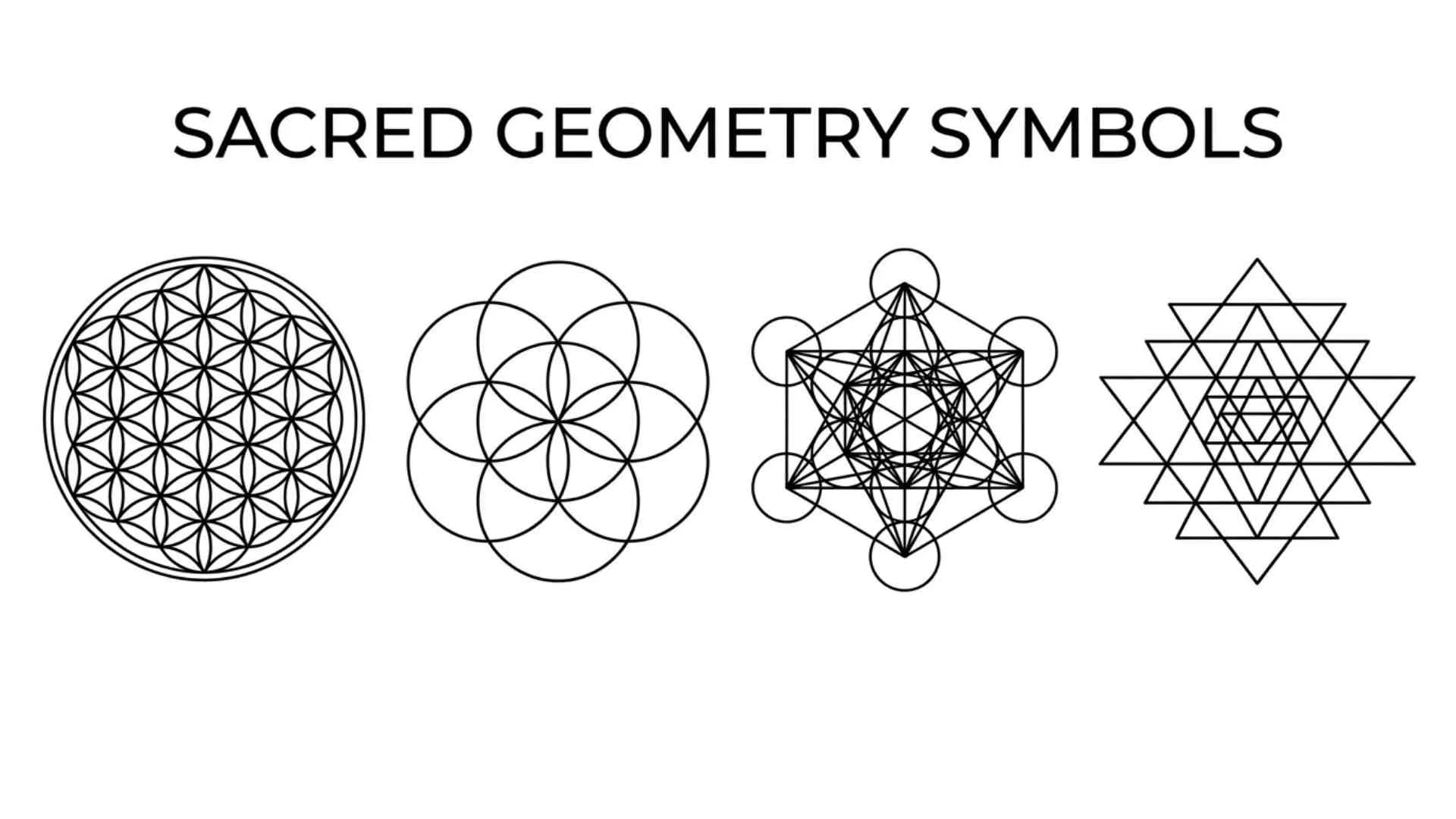
Sacred geometry symbols are ancient geometric shapes believed to hold spiritual meaning and represent the patterns of creation found in nature and the universe.
In simple terms, these symbols combine mathematics, art, and spirituality to show how everything in the world is connected from flowers and snowflakes to galaxies in space.
Many people first notice sacred geometry symbols in art, tattoos, architecture, or meditation designs.
At first glance, they look like beautiful patterns. But the more you learn about them, the more fascinating they become. These symbols have been used for thousands of years in temples, religious art, and even modern design.
What Are Sacred Geometry Symbols?
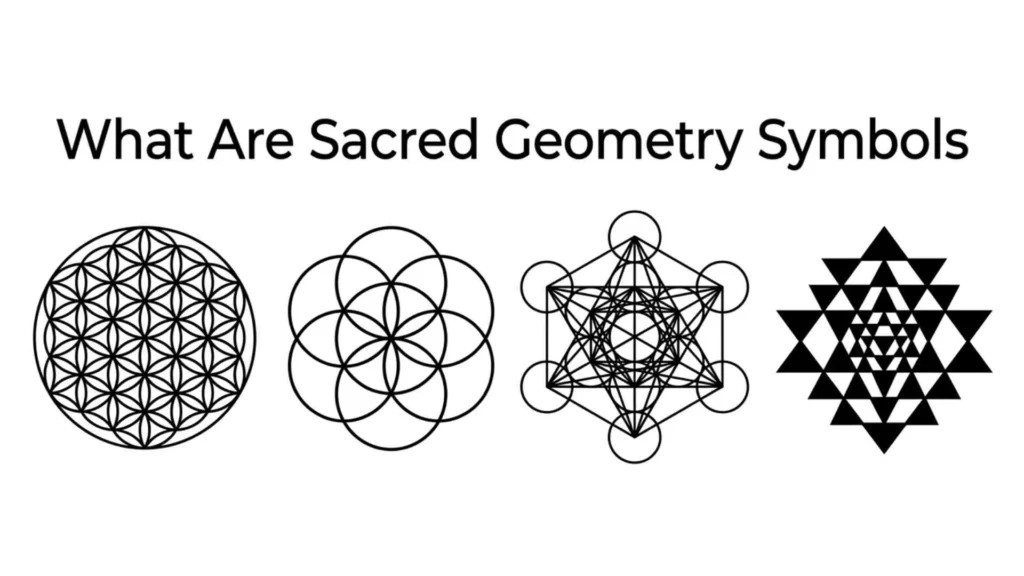
Sacred geometry symbols are shapes and patterns that people believe represent the basic structure of the universe. They are called “sacred” because many cultures connect them to spiritual meaning, divine order, or cosmic balance.
These symbols often appear in:
- Nature (flowers, shells, crystals)
- Architecture (temples, churches, mosques)
- Art and design
- Meditation and spiritual practices
- Modern tattoos and logos
The idea behind sacred geometry is simple: nature follows patterns, and these patterns can be understood using geometry.
Sacred Geometry Symbols for Manifestation
Sacred geometry is widely used in manifestation practices because it is believed to align the mind with universal energy.
Some commonly used symbols for manifestation include:
- Flower of Life: Represents creation and infinite potential. Used to attract abundance and clarity.
- Metatron’s Cube: Symbol of protection and energetic alignment, helping focus intentions.
- Seed of Life: Represents new beginnings and the power of creation.
- Sri Yantra: Known for manifesting wealth, prosperity, and spiritual growth.
To use these symbols for manifestation, people often meditate on them, draw them in journals, or place them in living spaces as visual reminders of their intentions.
Sacred Geometry Symbols Tattoos
Sacred geometry tattoos are popular for their deep spiritual meanings and aesthetic appeal. People choose these designs not only for beauty but also for personal symbolism.
Popular tattoo choices include:
- Flower of Life tattoo – symbolizes unity and universal connection
- Metatron’s Cube tattoo – represents balance and protection
- Seed of Life tattoo – reflects personal growth and transformation
- Platonic solids tattoos – represent the elements of nature (earth, water, fire, air, ether)
These tattoos are often placed on forearms, back, chest, or wrists, depending on how visible or personal the wearer wants them to be.
Sacred Geometry symbols and meanings PDF
Many people search for Sacred Geometry resources in PDF format for easy learning and offline reference. A typical sacred geometry symbols PDF includes:
- Visual diagrams of symbols
- Explanations of meanings
- Spiritual interpretations
- Mathematical breakdown of patterns
- Meditation and usage guides
If you are creating a blog PDF resource, you can compile high-quality images, definitions, and practical uses of each symbol to provide value to readers interested in spirituality and geometry.
Sacred Geometry symbols PDF
A sacred geometry PDF guide is often used as a quick reference for students, designers, and spiritual practitioners. It usually contains structured information such as:
- Basic introduction to sacred geometry
- Symbol charts and diagrams
- Meaning and significance of each symbol
- Applications in meditation, art, and healing
- Color-coded or categorized sections for easy learning
Such PDFs are highly shareable and often used as lead magnets in spiritual or wellness blogs.
Sacred geometry symbols list
Here is a commonly used list of sacred geometry symbols:
- Flower of Life
- Seed of Life
- Tree of Life
- Metatron’s Cube
- Sri Yantra
- Torus
- Merkaba
- Vesica Piscis
- Platonic Solids
- Golden Spiral (Fibonacci Spiral)
Each of these symbols represents a different aspect of creation, energy flow, and universal harmony.
Sacred geometry symbols for wealth
Certain sacred geometry symbols are believed to attract financial abundance and prosperity when used with intention.
Key symbols include:
- Sri Yantra: Strongest symbol for wealth, prosperity, and success
- Flower of Life: Expands opportunities and abundance consciousness
- Torus energy field: Represents continuous flow of energy and resources
- Golden Spiral: Symbol of natural growth and expansion
People often place these symbols in offices, wallets, or use them during meditation focused on financial goals.
Sacred geometry symbols for healing
Sacred geometry is also associated with energetic healing and emotional balance.
Common healing symbols include:
- Flower of Life: Restores harmony and energetic balance
- Metatron’s Cube: Clears negative energy and strengthens protection
- Torus: Supports energy flow in the body and environment
- Vesica Piscis: Symbol of balance and unity between dual energies
These symbols are often used in Reiki, meditation, yoga spaces, and holistic healing practices to promote peace and alignment.
The Basic Idea Behind Sacred Geometry
Sacred geometry combines three powerful ideas:
- Mathematics – Numbers and shapes explain patterns.
- Nature – Natural forms repeat similar designs.
- Spiritual Meaning – Many believe these patterns show the order of life.
For example:
- A sunflower grows in spiral patterns.
- Snowflakes form perfect hexagon shapes.
- Honeycombs are built using hexagons.
These repeating shapes make scientists and spiritual thinkers believe geometry is a universal language.
History of Sacred Geometry Symbols
Sacred geometry is not new. It has been used by ancient civilizations across the world.
Ancient Egypt
The Egyptians used sacred geometry in:
- Pyramids
- Temple designs
- Artwork
The Great Pyramid of Giza is believed to contain geometric proportions linked to the Earth and stars.
Ancient Greece
Greek mathematicians studied geometry deeply.
One famous thinker, Pythagoras, believed numbers and shapes explained the universe.
Greek temples were built using perfect ratios and symmetry.
India
In India, sacred geometry appears in:
- Mandalas
- Yantras
- Temple architecture
These patterns were used for meditation and spiritual focus.
Islamic Civilization
Islamic art often uses complex geometric patterns instead of human images.
You can see sacred geometry in:
- Mosque decorations
- Tile patterns
- Carpets
These designs represent unity and infinity.
Medieval Europe
During medieval times, sacred geometry influenced:
- Church architecture
- Cathedral stained glass
- Religious artwork
Many cathedrals were designed using geometric proportions believed to create harmony.
Most Popular Sacred Geometry Symbols and Their Meanings
Let’s explore the most well-known sacred geometry symbols.
The Flower of Life
The Flower of Life is one of the most famous sacred geometry symbols.
What It Looks Like
It is made of:
- Multiple overlapping circles
- Arranged in a flower-like pattern
Meaning
The Flower of Life represents:
- Creation
- Unity
- The connection between all life
Many believe it contains the blueprint of the universe.
Where It Appears
- Ancient temples
- Spiritual artwork
- Jewelry and tattoos
The Seed of Life
The Seed of Life is part of the Flower of Life.
What It Looks Like
Seven circles arranged in a pattern.
Meaning
Represents:
- New beginnings
- Creation
- Growth
Some traditions connect it to the seven days of creation.
The Tree of Life
The Tree of Life symbol appears in many cultures.
Meaning
Represents:
- Growth
- Strength
- Connection between heaven and Earth
Where Found
- Religious art
- Mythology stories
- Spiritual teachings
Metatron’s Cube
Metatron’s Cube is a complex geometric design.
Meaning
Represents:
- Balance
- Protection
- Universal structure
Some believe it contains all basic geometric shapes of the universe.
The Sri Yantra
The Sri Yantra is a sacred symbol used in Indian traditions.
Meaning
Represents:
- Cosmic energy
- Spiritual growth
- Meditation focus
It consists of:
- Interlocking triangles
- Symmetrical patterns
The Vesica Piscis
This symbol forms when two circles overlap.
Meaning
Represents:
- Creation
- Birth
- Balance between opposites
It is often found in Christian art.
The Golden Ratio
The Golden Ratio is not a symbol but a mathematical proportion.
Meaning
Represents:
- Beauty
- Balance
- Natural harmony
It appears in:
- Human body proportions
- Architecture
- Artworks
Sacred Geometry Symbols in Nature
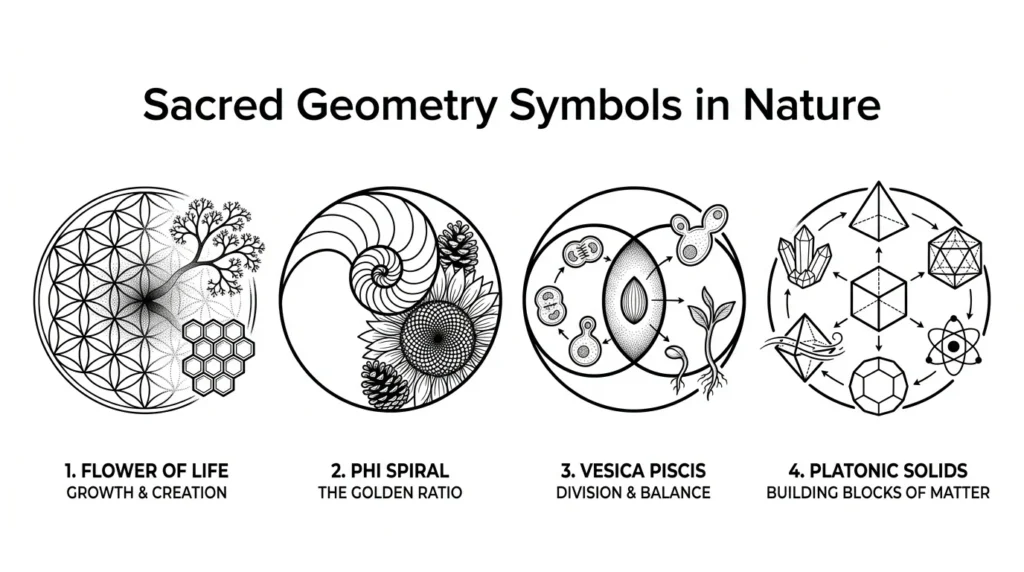
Nature is full of sacred geometry patterns.
Examples in Nature
You can find sacred geometry in:
- Flowers
- Seashells
- Pinecones
- Honeycombs
- Snowflakes
For example:
A sunflower’s seeds grow in spiral patterns that follow mathematical rules.
Why Nature Uses These Patterns
These patterns:
- Save space
- Use energy efficiently
- Provide strength
Nature often chooses the most efficient design.
Sacred Geometry in Architecture
Many famous buildings use sacred geometry.
Examples
Sacred geometry has been used in:
- Pyramids
- Temples
- Churches
- Mosques
These buildings feel peaceful and balanced because of their symmetry.
Why Architects Use Sacred Geometry
Architects use geometry to:
- Create balance
- Improve strength
- Make designs visually pleasing
Even modern architects use similar principles today.
Sacred Geometry in Art and Design
Artists use sacred geometry to create beautiful patterns.
Where You See It
- Mandalas
- Paintings
- Logos
- Decorative patterns
These designs feel calming because the brain enjoys symmetry.
Modern Uses
Sacred geometry appears in:
- Tattoo art
- Graphic design
- Digital artwork
- Branding
Many brands use geometric shapes to create memorable logos.
Sacred Geometry Symbols in Spiritual Practices
Many spiritual traditions use sacred geometry.
Meditation
People focus on geometric shapes to:
- Improve concentration
- Relax the mind
- Feel connected to nature
Healing Practices
Some believe sacred geometry helps:
- Reduce stress
- Improve emotional balance
- Support mindfulness
While scientific proof is limited, many people find it helpful.
Practical Applications of Sacred Geometry Symbols
Sacred geometry is not just spiritual—it has real-world uses.
Interior Design
Designers use geometry to create:
- Balanced rooms
- Relaxing spaces
- Beautiful patterns
For example:
Geometric tiles make rooms look modern and stylish.
Technology and Engineering
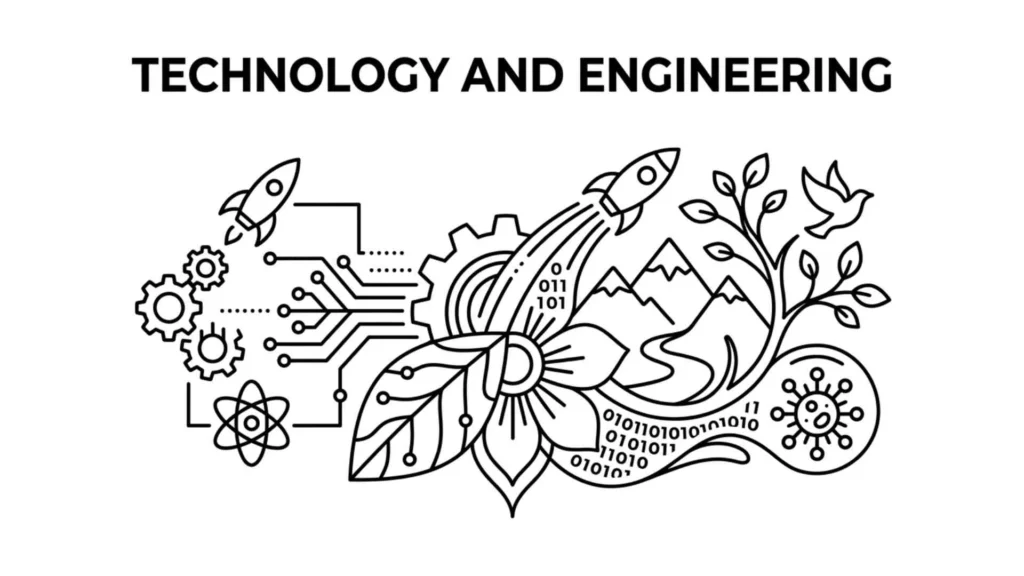
Engineers use geometric patterns to:
- Build strong structures
- Create efficient designs
- Improve safety
Examples:
- Bridges
- Towers
- Computer designs
Education
Students learn geometry to:
- Understand patterns
- Solve problems
- Improve logical thinking
Sacred geometry can make math feel more interesting.
Impact and Benefits of Sacred Geometry for Society
Sacred geometry has influenced many areas of life.
1. Encourages Creativity
Artists and designers use geometric patterns to create unique works.
2. Improves Architecture
Balanced designs lead to stronger buildings.
3. Supports Cultural Heritage
Sacred geometry preserves traditions across generations.
4. Inspires Scientific Discovery
Studying patterns helps scientists understand nature better.
5. Promotes Mindfulness
Meditating on patterns helps people relax.
Interesting Facts About Sacred Geometry Symbols
Here are some fun facts:
- Honeybees use hexagons because they store the most honey with the least wax.
- Snowflakes always form six-sided shapes.
- The human face follows geometric proportions.
- Many ancient temples were built using precise mathematical ratios.
Legends and Stories About Sacred Geometry
Many cultures created stories around geometric patterns.
The Creation Pattern Legend
Some traditions believe the Flower of Life represents the pattern used by the universe to create everything.
According to legend:
- The universe began with simple shapes
- These shapes combined into complex forms
- Life developed from these patterns
Whether symbolic or real, these stories show how deeply geometry influenced early beliefs.
Sacred Geometry Symbols in Modern Culture
Today, sacred geometry is more popular than ever.
Modern Examples
You can see sacred geometry in:
- Tattoo designs
- Yoga studios
- Meditation apps
- Jewelry
- Clothing patterns
Social media has also helped spread interest in geometric art.
How to Use Sacred Geometry Symbols in Daily Life
You don’t need to be a mathematician to enjoy sacred geometry.
Simple Ways to Use It
You can:
- Draw mandalas
- Decorate rooms with geometric art
- Wear symbolic jewelry
- Use meditation patterns
These small steps bring beauty into daily life.
Safety and Misunderstandings About Sacred Geometry
Some myths exist about sacred geometry.
Common Misunderstandings
- Believing shapes have magical powers
- Assuming geometry guarantees spiritual results
- Thinking all patterns have hidden meanings
In reality:
Sacred geometry is mostly about patterns and symbolism, not magic.
Frequently Asked Questions (FAQs)
1. What are sacred geometry symbols used for?
Sacred geometry symbols are used in art, architecture, meditation, and design. They represent patterns found in nature and are often linked to balance and harmony.
2. Are sacred geometry symbols scientific?
Some aspects are scientific, like geometric patterns in nature. However, spiritual meanings connected to them depend on cultural beliefs.
3. What is the most famous sacred geometry symbol?
The Flower of Life is widely considered the most famous sacred geometry symbol because of its complex pattern and symbolic meaning.
4. Can sacred geometry help with meditation?
Many people use geometric patterns during meditation to improve focus and relaxation.
5. Where can sacred geometry be found in everyday life?
You can find sacred geometry in flowers, shells, buildings, artwork, and even technology designs.
Conclusion
Sacred geometry symbols are more than beautiful shapes—they are powerful reminders of the patterns that exist all around us. From ancient temples to modern logos, these symbols have shaped art, architecture, science, and spiritual traditions for thousands of years.
Whether you see them in nature, design, or meditation, sacred geometry helps us appreciate the hidden order of the universe. By understanding these patterns, we gain a deeper respect for both mathematics and the beauty of the world around us.
