
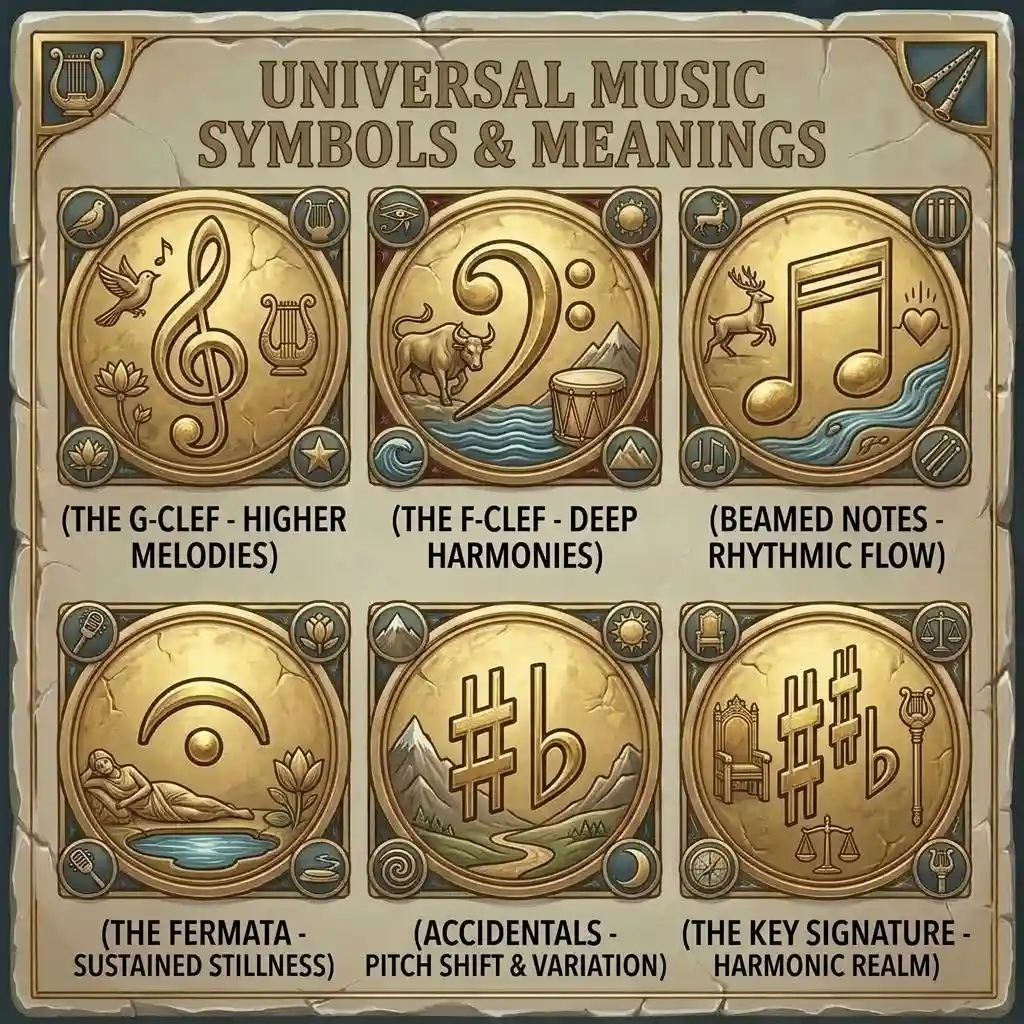
Music symbols are the written signs musicians use to understand how a piece should sound and be performed. They can show pitch, rhythm, silence, tempo, volume, articulation, expression, repetition, and other instructions.
If you are learning to read sheet music, understanding these symbols is one of the first steps toward becoming comfortable with musical notation.
Some symbols are easy to recognize, such as a treble clef, quarter note, sharp, or flat. Others can be confusing at first, especially when two markings look similar but have different jobs. A dot, for example, can change the duration of a note, indicate staccato articulation, or appear as part of another notation convention depending on where it is placed.
This guide explains common music symbols and meanings in simple language. It covers notes, rests, clefs, accidentals, time signatures, dynamics, articulation, tempo, ornaments, repeat markings, and other signs found in written music. It also explains how to read these symbols together instead of memorizing each one separately.
What Are Music Symbols?
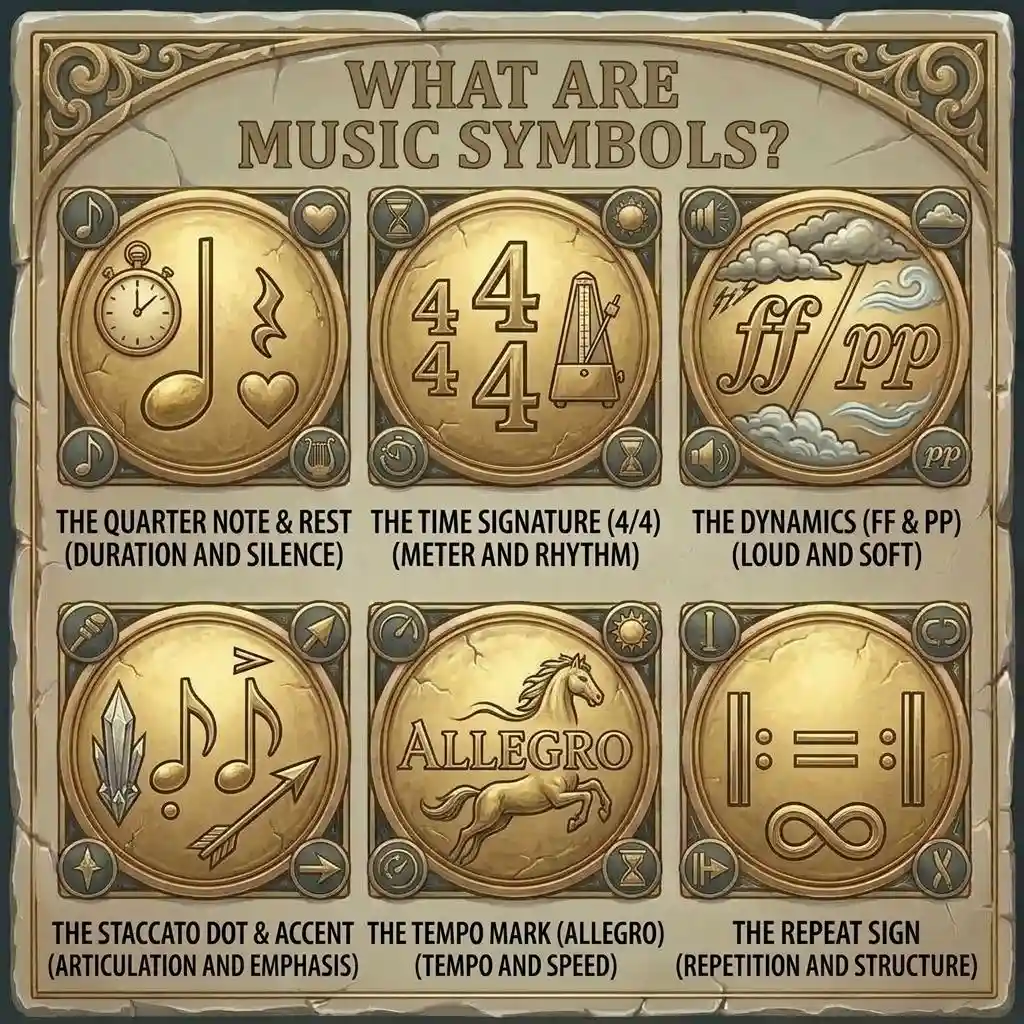
Music symbols are visual marks used to communicate musical information in written form. Instead of explaining every performance instruction with words, composers and arrangers can use standardized notation to show musicians what notes to play, how long to hold them, how loudly to perform them, and how a passage should be shaped.
A piece of sheet music can contain several types of symbols at the same time. A musician may need to read a clef for pitch, a key signature for recurring pitch alterations, a time signature for meter, notes and rests for rhythm, and dynamic or articulation markings for expression.
Why Music Uses Symbols
Music happens over time, so written music needs a practical way to record events in the correct order.
Symbols make it possible to communicate information such as:
- Which pitch to play
- How long to play it
- When to remain silent
- How quickly the music should move
- How loudly or softly to perform
- Whether a note should be smooth, short, accented, or sustained
- When a section should repeat
- Where a musical passage should end or continue
This system allows musicians to interpret the same written score without needing the composer to describe every detail in ordinary language.
Music Symbols vs. Musical Notation
The terms are related but not identical.
Music symbols are individual signs or markings, such as a sharp, clef, note, rest, accent, or fermata.
Musical notation is the broader system that uses those symbols together to represent music.
For example, a quarter note is one symbol, while a complete measure containing quarter notes, rests, a time signature, and articulation marks is part of a larger notation system.
Main Categories of Music Symbols
Music symbols can be grouped according to their function:
| Category | What it tells the musician |
| Notes | Which pitches and rhythmic values to perform |
| Rests | When to remain silent |
| Clefs | How pitches are positioned on the staff |
| Accidentals | How written pitches are altered |
| Key signatures | Which pitches are regularly sharpened or flattened |
| Time signatures | How beats are organized |
| Dynamics | How loud or soft music should be |
| Articulation | How individual notes should be performed |
| Tempo | How fast or slowly the music should move |
| Ornaments | Decorative or embellished ways of performing notes |
| Repetition marks | Where sections repeat or navigation changes |
| Expression markings | Additional performance guidance |
Music Symbols and Meanings: Quick Reference Chart
The following chart provides a quick starting point for common music symbols.
| Symbol | Name | Basic meaning | Category |
| 𝄞 | Treble clef | Establishes the pitch reference for the staff | Clef |
| 𝄢 | Bass clef | Establishes a lower pitch reference | Clef |
| ♯ | Sharp | Raises a pitch by a semitone in standard Western notation | Pitch |
| ♭ | Flat | Lowers a pitch by a semitone | Pitch |
| ♮ | Natural | Cancels a sharp or flat effect according to context | Pitch |
| 𝅝 | Whole note | Four quarter-note values | Rhythm |
| 𝅗𝅥 | Half note | Two quarter-note values | Rhythm |
| ♩ | Quarter note | One quarter-note value | Rhythm |
| ♪ | Eighth note | Half of a quarter-note value | Rhythm |
| 𝅘𝅥𝅯 | Sixteenth note | Half of an eighth-note value | Rhythm |
| 𝄽 | Quarter rest | Silence corresponding to a quarter-note value | Rest |
| p | Piano | Soft | Dynamics |
| f | Forte | Loud | Dynamics |
| > | Accent | Emphasize the note | Articulation |
| • | Staccato | Short or detached articulation | Articulation |
| 𝄐 | Fermata | Hold longer than the ordinary written value | Expression |
| ∼ | Trill indication | Rapid alternation between neighboring pitches | Ornament |
The exact appearance of some musical characters can vary according to the notation font and software used.
Common Music Symbols
The most useful symbols to learn first are the ones that appear frequently in ordinary sheet music.
For beginners, these include:
- Treble clef
- Bass clef
- Whole, half, quarter, and eighth notes
- Common rests
- Sharp
- Flat
- Natural
- Time signatures
- Key signatures
- Basic dynamic markings
- Staccato
- Legato
- Accent
- Fermata
- Repeat sign
Learning these first creates a foundation for more advanced notation.
Notes and Rests
Notes tell the performer when musical sound occurs, while rests indicate periods of silence.
Both are important parts of rhythm. A rest is not an empty space with no musical purpose. It has a written rhythmic value and must be counted just as carefully as a note.
Clefs
Clefs establish the pitch reference used by the staff.
The treble and bass clefs are especially common, while alto and tenor clefs are used in particular vocal and instrumental ranges.
Pitch Symbols
Sharp, flat, natural, double-sharp, and double-flat markings affect pitch according to the notation context.
These are often called accidentals when they are used to alter notes within a passage.
Dynamics and Expression
Dynamic markings communicate changes in loudness or softness. Expression markings can give additional information about how a passage should be shaped.
Examples include:
- p
- pp
- mp
- mf
- f
- ff
- crescendo
- diminuendo
- accent
- fermata
Tempo and Rhythm
Tempo markings indicate speed, while rhythm symbols organize the timing and duration of musical events.
These should not be confused with dynamics. A piece can become faster without becoming louder, or louder without becoming faster.
Musical Note Symbols and Their Meanings
Notes are among the most recognizable music symbols. Their shapes help communicate rhythmic duration, while their vertical position on a staff helps identify pitch.
Whole Note
A whole note is written as an open oval without a stem.
In a common simple-meter explanation, it has the duration of four quarter-note values. Its actual time in seconds depends on the tempo.
The important point is that note value and clock time are not the same thing. A whole note lasts longer at a slower tempo than at a faster tempo.
Half Note
A half note has an open notehead with a stem.
Its basic rhythmic value is two quarter-note values.
Two half notes can therefore fill the same basic rhythmic space as four quarter-note values.
Quarter Note
A quarter note has a filled notehead and a stem.
Its basic value is one quarter-note value.
Quarter notes are particularly common when teaching rhythm because they provide a useful reference for comparing other note values.
Eighth Note
An eighth note has a filled notehead and a stem with a flag. When several eighth notes appear together, their flags are often connected by a beam.
An eighth note has half the basic duration of a quarter note.
Sixteenth Note
A sixteenth note has a filled notehead, a stem, and two flags when written individually.
Its basic rhythmic value is half that of an eighth note and one-quarter of a quarter-note value.
Dotted Notes
A dot placed after a note generally increases that note’s duration by half of its original value.
For example, a dotted quarter note lasts for a quarter-note value plus half of a quarter-note value.
The dot therefore does not simply mean “play longer.” It has a specific mathematical function in standard notation.
Beamed Notes
Beams connect certain shorter-value notes, such as eighth or sixteenth notes.
They make rhythmic groupings easier to read and can visually show how notes relate within a beat or musical phrase.
Music Rest Symbols and Their Meanings
Rests represent silence. Like notes, they have different rhythmic values.
Whole Rest
A whole rest represents a whole-rest duration according to the meter and notation context.
It is traditionally shown as a small rectangle hanging below a staff line.
Half Rest
A half rest is shown as a small rectangle sitting above a staff line.
It has the basic rhythmic value associated with a half note.
Quarter Rest
A quarter rest has a distinctive curved shape and represents a quarter-note rhythmic value.
It is one of the most frequently encountered rest symbols.
Eighth Rest
An eighth rest represents an eighth-note rhythmic value.
Its shape resembles the flag-like element associated with an eighth note.
Sixteenth Rest
A sixteenth rest represents a sixteenth-note rhythmic value and has additional curved elements compared with an eighth rest.
Why Rests Matter
Rests help create rhythm, phrasing, contrast, and space.
A musician should count a rest with the same attention given to a note. Ignoring a written rest can change the rhythm of an entire passage.
Clef Symbols in Music
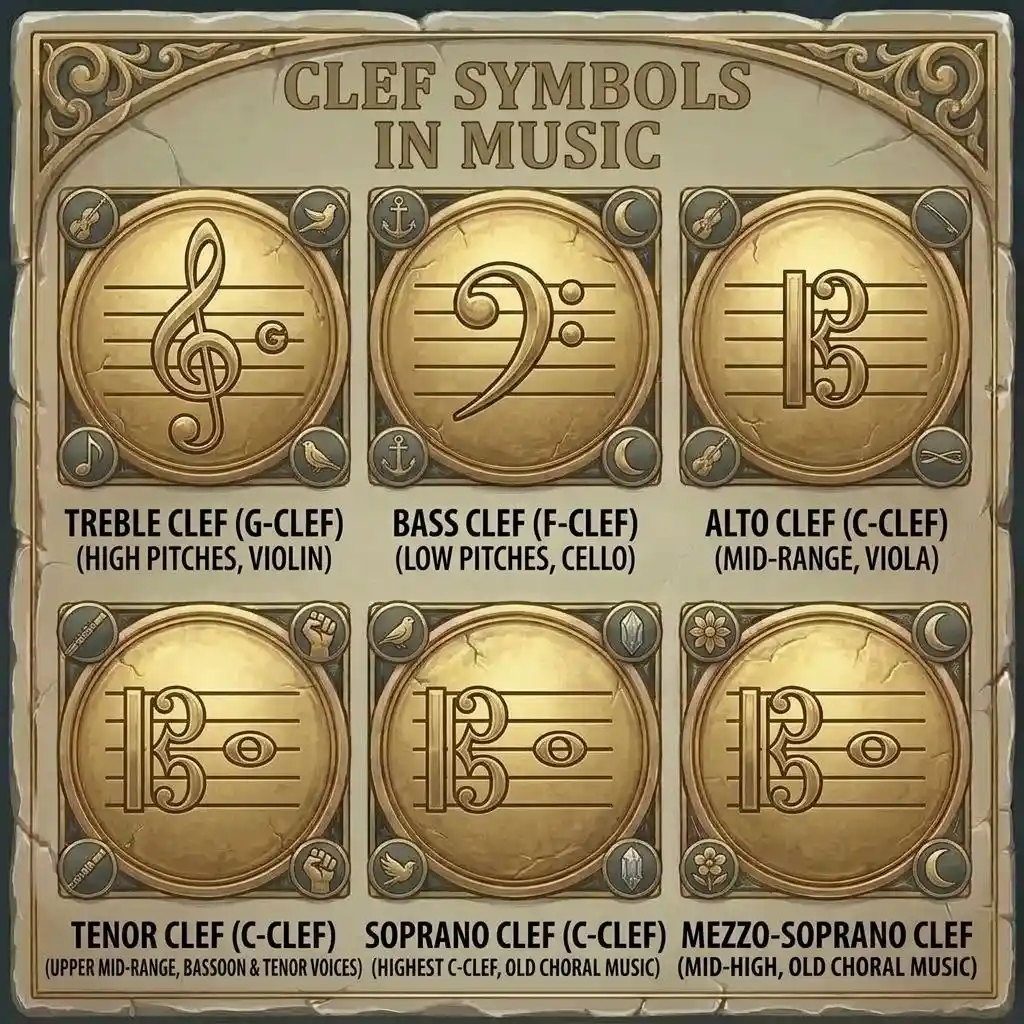
A clef appears at the beginning of a staff and establishes how the lines and spaces correspond to pitches.
Treble Clef
The treble clef is also called the G clef because its design identifies the position of G above middle C in the standard notation system.
It is commonly used for higher vocal and instrumental ranges.
You may encounter it in:
- Piano music
- Violin music
- Flute music
- Trumpet music
- Many vocal parts
Bass Clef
The bass clef is also called the F clef because its markings identify the position of F below middle C.
It is commonly used for lower ranges.
You may encounter it in:
- Left-hand piano notation
- Bass guitar notation
- Cello music
- Bass vocal parts
- Low brass music
Alto Clef
The alto clef is a type of C clef.
It is particularly associated with the viola.
The clef positions middle C on the center line of the staff.
Tenor Clef
The tenor clef is another C clef.
It is used in certain higher passages for instruments that normally use lower clefs, including some cello, bassoon, and trombone writing.
Sharp, Flat, and Natural Symbols
Accidentals are essential for understanding pitch.
Sharp Symbol
The sharp symbol is ♯.
In standard Western notation, a sharp raises the pitch of a note by a semitone according to the notation context.
For example, C with a sharp becomes C-sharp.
The sharp sign can appear in a key signature or directly before a note as an accidental.
Flat Symbol
The flat symbol is ♭.
It lowers a pitch by a semitone in standard Western notation.
For example, B with a flat becomes B-flat.
Like sharps, flats can appear in key signatures or as individual accidentals.
Natural Symbol
The natural symbol is ♮.
It cancels a sharp or flat effect according to the applicable notation rules.
For example, if a note has been altered by a sharp in a relevant context, a natural marking can indicate that the pitch should return to its natural form.
Double Sharp and Double Flat
A double sharp raises a pitch by two semitones, while a double flat lowers it by two semitones.
These markings can look unusual to beginners, but they are useful in music where correct theoretical spelling matters.
Time Signature and Rhythm Symbols
Time signatures help organize music into measures and indicate the meter.
What Is a Time Signature?
A time signature normally appears after the clef and key signature.
It provides information about how rhythmic values are organized within measures.
The upper and lower numbers work together rather than functioning as two unrelated numbers.
4/4 Time
4/4 is commonly called common time.
In basic terms, it organizes each measure around four quarter-note beats.
It is extremely common in many styles of music.
3/4 Time
3/4 contains three quarter-note beats in each measure in a basic simple-meter interpretation.
It is strongly associated with many waltz-like musical patterns.
6/8 Time
6/8 contains six eighth-note units in each measure.
In many musical contexts, these are grouped into two larger beats, making 6/8 a common example of compound meter.
This is why simply saying “6/8 has six beats” can be confusing. The written eighth-note units and the felt metric grouping are related but not always identical.
Dots, Ties, and Beams
These markings help organize rhythm.
A dot can extend a note’s duration.
A tie connects two notes of the same pitch and combines their durations.
A beam visually connects shorter notes into rhythmic groups.
Triplets and Tuplets
A triplet divides a rhythmic space into three equal parts where the normal subdivision would differ.
More generally, tuplets are groupings that create a rhythmic division different from the regular subdivision.
They are useful for creating rhythmic patterns that do not fit neatly into the ordinary beat subdivision.
Music Dynamics Symbols and Meanings
Dynamics tell performers about volume and changes in intensity.
Piano
p means piano, which indicates soft playing.
It does not refer to the piano instrument when used as a dynamic marking.
Pianissimo
pp means pianissimo, indicating very soft playing.
Additional repeated letters can indicate an even softer dynamic in traditional notation.
Mezzo-Piano
mp means mezzo-piano and indicates moderately soft playing.
Mezzo-Forte
mf means mezzo-forte and indicates moderately loud playing.
Forte
f means forte, indicating loud playing.
Fortissimo
ff means fortissimo, indicating very loud playing.
As with softer markings, additional repeated letters can indicate stronger dynamic levels.
Crescendo
A crescendo indicates a gradual increase in volume.
It is often shown with a widening hairpin:
<
The performer gradually becomes louder through the marked passage.
Diminuendo
A diminuendo indicates a gradual decrease in volume.
It is commonly shown with a closing hairpin:
>
The terms decrescendo and diminuendo can both be encountered for a gradual reduction in loudness.
Music Articulation Symbols and Meanings
Articulation markings describe how individual notes should be shaped or connected.
Staccato
A staccato dot indicates a detached style of articulation.
It generally makes the note shorter and more separated from neighboring notes, although the exact performance depends on musical context.
Legato
Legato indicates that notes should be performed smoothly and connected.
A curved slur is often used to show legato phrasing.
Tenuto
Tenuto is commonly shown by a horizontal line above or below a note.
It generally indicates that the note should receive its full written duration, often with a degree of emphasis.
Accent
An accent marking tells the performer to give a note additional emphasis.
Its exact effect can depend on the musical style and context.
Marcato
Marcato indicates a strongly marked or emphasized articulation.
It is often represented by a wedge-like symbol above or below the note.
Fermata
A fermata looks like a curved arch with a dot underneath.
It indicates that a note, rest, or other musical event should be held longer than its written value.
The exact length is normally determined by the performer, conductor, or musical context.
Tempo Symbols and Meanings
Tempo tells musicians how quickly the music should move.
Largo
Largo generally indicates a broad, slow tempo.
Adagio
Adagio indicates a slow tempo, though exact speed can vary according to context and performance tradition.
Andante
Andante is commonly associated with a moderate, walking-like pace.
Moderato
Moderato indicates a moderate tempo.
Allegro
Allegro generally indicates a fast or lively tempo.
It is important to remember that allegro does not simply mean “happy.” In modern notation, it primarily functions as a tempo indication, although historical meanings and expressive associations can vary.
Presto
Presto indicates a very fast tempo.
Ritardando and Accelerando
Ritardando, often abbreviated as rit., indicates a gradual slowing down.
Accelerando, often abbreviated as accel., indicates a gradual speeding up.
These are different from suddenly changing the tempo.
Repeat and Navigation Symbols
Long pieces often use navigation markings so performers do not need to see every repeated measure written again.
Repeat Sign
The repeat sign uses double bar lines and dots to indicate that a section should be repeated.
The exact repeat path depends on the surrounding notation.
Coda
A coda marking identifies a passage used for a concluding section or a later navigation point.
The word means “tail” in Italian and is commonly represented by a distinctive circle-with-cross symbol.
Segno
The segno is a navigation symbol that tells the performer where to return when a Dal Segno instruction appears.
Da Capo
D.C., short for Da Capo, means “from the beginning.”
It tells the performer to return to the start of the piece or designated section.
Dal Segno
D.S., short for Dal Segno, means “from the sign.”
It directs the performer back to the location marked by the segno.
Fine
Fine indicates the ending point.
It can be used with repeat/navigation instructions to tell the performer where the piece should finish.
First and Second Endings
First and second endings provide different endings when a repeated section is played multiple times.
The first ending is used during one pass, while the second ending is used during a later pass.
Music Ornament Symbols
Ornaments decorate or embellish musical notes.
Their exact performance can vary depending on historical period, style, instrument, and musical context.
Trill
A trill involves rapid alternation between a written note and a neighboring pitch.
Its exact execution can depend on the musical period and surrounding notation.
Turn
A turn is an ornament that moves around the main note using neighboring pitches.
It creates a short decorative figure rather than simply sustaining the written note.
Mordent
A mordent is a brief ornament involving the main pitch and a neighboring pitch.
There are different forms of mordent, so the surrounding notation matters.
Grace Note
A grace note is a small note placed before a main note.
It indicates a decorative pitch or pitches that are performed in relation to the main note.
Arpeggio
An arpeggio marking indicates that the notes of a chord should be played or sung in succession rather than simultaneously.
It is particularly noticeable in piano and other chordal instruments.
Tremolo
Tremolo markings indicate rapid repetition or rapid alternation, depending on the instrument and notation context.
The exact interpretation should therefore be considered alongside the instrument being played.
Commonly Confused Music Symbols
Some notation marks cause more confusion than others because they look similar or have related functions.
Tie vs. Slur
A tie connects notes of the same pitch and combines their durations.
A slur connects a group of notes to indicate smooth phrasing or connected articulation.
This distinction is extremely important for beginners.
Staccato Dot vs. Augmentation Dot
A dot above or below a note can indicate staccato when placed as an articulation mark.
A dot directly after a notehead can indicate augmentation, extending the note’s duration.
The location of the dot helps determine its function.
Sharp vs. Number Sign
The musical sharp symbol ♯ resembles the keyboard number sign #, but they are not exactly the same character.
In professional music notation, the proper sharp glyph is used by notation software and music fonts.
Repeat Sign vs. Double Bar Line
A double bar line simply marks a structural boundary in a piece.
A repeat sign includes dots and gives specific information about returning to another section.
Tempo vs. Dynamics
Tempo answers:
How fast should the music move?
Dynamics answer:
How loud or soft should the music be?
These two concepts can change independently.
How to Read Music Symbols on Sheet Music
Learning individual symbols is useful, but the real skill is understanding how they work together.
Step 1: Identify the Clef
Start by identifying the clef.
This tells you how to interpret the pitches represented by the staff lines and spaces.
Step 2: Check the Key Signature
Look immediately after the clef for sharps or flats that form the key signature.
This establishes recurring pitch alterations for the passage.
Step 3: Read the Time Signature
Look for the time signature.
It helps you understand the meter and rhythmic organization of each measure.
Step 4: Read Notes and Rests
Now identify the pitches and rhythmic values.
Count rests as carefully as you count notes.
Step 5: Look for Dynamics
Check for markings such as:
- p
- mp
- mf
- f
- crescendo
- diminuendo
These tell you about volume and changes in intensity.
Step 6: Check Articulation
Look for dots, accents, slurs, tenuto marks, and other articulation symbols.
These affect how notes should be shaped.
Step 7: Follow Tempo and Repeat Markings
Finally, check tempo instructions and navigation markings such as D.C., D.S., coda, fine, and repeat signs.
Following all of these layers together gives you a much more complete interpretation of the score.
Music Symbols for Different Instruments
Music notation shares many basic principles across instruments, but certain instruments use additional symbols and conventions.
Piano Music Symbols
Piano music commonly uses a grand staff consisting of treble and bass clefs.
Pianists may also encounter:
- Pedal markings
- Chord symbols
- Octave indications
- Arpeggio markings
- Dynamic changes
- Hand or voice indications
The grand staff is particularly useful because the right and left hands can be represented in related but different pitch ranges.
Guitar Music Symbols
Guitarists may read standard notation, tablature, chord diagrams, or a combination of these.
Guitar notation can include specialized markings for:
- Bends
- Slides
- Hammer-ons
- Pull-offs
- Harmonics
- Muting
- Vibrato
These symbols cannot always be interpreted in exactly the same way as general orchestral notation.
Vocal Music Symbols
Vocal scores can combine musical notation with lyrics.
Singers may encounter:
- Breath marks
- Slurs
- Phrase markings
- Dynamics
- Tempo instructions
- Text-based expression directions
Words and musical symbols work together to communicate both the melody and the performance.
Percussion Symbols
Percussion notation can use different noteheads and staff conventions to distinguish instruments.
The meaning of a percussion note can therefore depend on the instrument assignment and notation key provided with the score.
String Instrument Symbols
String players may encounter markings related to bowing, articulation, position, pizzicato, tremolo, and other techniques.
These symbols provide information beyond basic pitch and rhythm.
Music Symbols by Genre
Music notation is not identical across every genre.
Classical Music
Classical scores often contain detailed information about:
- Pitch
- Rhythm
- Dynamics
- Articulation
- Tempo
- Expression
- Ornaments
- Repetition
- Instrument-specific techniques
A fully notated orchestral score can therefore contain many layers of information.
Jazz
Jazz charts may combine standard notation with:
- Chord symbols
- Lead-sheet notation
- Rhythmic figures
- Improvisation indications
- Rehearsal markings
The performer may be expected to interpret or improvise certain parts rather than play every detail exactly as written.
Pop Music
Pop arrangements can use a mixture of:
- Chord charts
- Lyrics
- Standard notation
- Rhythm notation
- Rehearsal markings
The amount of notation varies according to the arrangement.
Contemporary Music
Contemporary composers sometimes use extended or graphic notation to communicate sounds and techniques that traditional notation cannot easily represent.
In such music, a composer may provide a legend explaining unfamiliar symbols.
This is why a symbol should always be interpreted in the context of its score rather than assumed to have exactly one meaning everywhere.
Music Symbols for Beginners
Beginners do not need to memorize every musical symbol at once.
A gradual approach is easier and more practical.
Symbols to Learn First
Start with:
- Treble clef
- Bass clef
- Whole note
- Half note
- Quarter note
- Eighth note
- Common rests
- Sharp
- Flat
- Natural
- Time signatures
- Basic dynamics
- Staccato
- Legato
- Repeat sign
Once these are familiar, move to more advanced markings such as ornaments, alternate clefs, tuplets, and instrument-specific symbols.
Easy Way to Remember Music Symbols
Instead of memorizing a large list, connect each symbol to its function.
For example:
- Clef → pitch
- Note → sound and duration
- Rest → silence
- Sharp/flat → pitch change
- Time signature → meter
- Dynamic → volume
- Articulation → note shape
- Tempo → speed
- Repeat sign → navigation
This creates a mental map of music notation.
How to Practice Reading Notation
Practice one category at a time.
Start by identifying notes and rests. Then add clefs and key signatures. After that, introduce dynamics and articulation.
When reading a complete score, avoid trying to understand every marking simultaneously. Work from the basic structure toward the expressive details.
Music Symbols You Can Copy and Paste
Some common musical symbols can be represented using Unicode characters.
Examples include:
♩ ♪ ♫ ♬ ♯ ♭ ♮
These can be useful in educational content, messages, documents, or social posts.
However, Unicode is not a complete replacement for professional music notation. Many detailed notation symbols depend on specialist music fonts, notation software, or a complete musical score.
Common Musical Unicode Symbols
| Symbol | Common name |
| ♩ | Quarter note |
| ♪ | Eighth note |
| ♫ | Beamed eighth notes |
| ♬ | Beamed notes |
| ♯ | Sharp |
| ♭ | Flat |
| ♮ | Natural |
When using these characters online, check how they render on phones, computers, and different browsers.
Why Not Every Music Symbol Can Be Copied Easily
Professional notation contains many markings whose meaning depends on placement, staff position, note attachment, spacing, and surrounding symbols.
For example, a staccato dot is meaningful partly because of where it appears in relation to a note. Copying the dot by itself does not preserve all of that information.
That is why sheet-music notation software is generally more suitable for complete scores than plain text.
Frequently Asked Questions About Music Symbols
What are the most common music symbols?
Common music symbols include notes, rests, treble and bass clefs, sharps, flats, naturals, time signatures, dynamics, articulation marks, tempo instructions, and repeat signs.
What are the symbols on sheet music?
Sheet music can contain symbols for pitch, rhythm, silence, meter, dynamics, articulation, tempo, expression, ornaments, and navigation. The exact markings depend on the music and instrument.
What does the sharp symbol mean?
The sharp symbol ♯ raises a written pitch by a semitone in standard Western notation, subject to the surrounding key and notation context.
What does the flat symbol mean?
The flat symbol ♭ lowers a written pitch by a semitone in standard Western notation.
What does the natural symbol mean?
The natural symbol ♮ cancels a sharp or flat effect according to the applicable notation rules.
What does P mean in music?
A lowercase p is the dynamic marking piano, meaning soft. It describes volume, not the piano instrument.
What does F mean in music?
A lowercase f is the dynamic marking forte, meaning loud.
What does a dot mean in music?
A dot can have different meanings depending on its location. After a notehead, it can extend the note’s duration. Above or below a note, it can indicate staccato articulation.
What is the difference between a tie and a slur?
A tie joins two notes of the same pitch to combine their durations. A slur generally indicates smooth, connected phrasing across a group of notes.
What does a fermata mean?
A fermata indicates that a note, rest, or other musical event should be held longer than its normal written duration. The precise length depends on musical context and performance.
What does a coda mean?
A coda is a concluding section or navigation point in a piece. The coda symbol helps performers locate that section when following repeat instructions.
What is the difference between tempo and dynamics?
Tempo describes how quickly or slowly music moves, while dynamics describe how loud or soft it should be performed.
How can beginners learn music symbols?
Beginners can start with clefs, basic notes and rests, time signatures, accidentals, dynamics, and simple articulation marks. Practicing these symbols in real sheet music is generally more useful than memorizing a long list without context.
Conclusion
Understanding music symbols and meanings becomes much easier when each symbol is connected to its musical job. Notes and rests organize sound and silence, clefs establish pitch references, accidentals change pitches, time signatures organize meter, dynamics control volume, articulation shapes individual notes, and tempo markings guide musical speed.
You do not need to learn every symbol at once. Start with the common signs used in basic sheet music and gradually add more advanced markings such as ornaments, navigation symbols, alternate clefs, and instrument-specific notation. The most useful goal is not simply to recognize a symbol but to understand what it asks the performer to do.
Music notation can also vary according to instrument, genre, historical period, and composer. When a less familiar symbol appears, always consider its position and the surrounding notation rather than assuming that every mark has one universal meaning.

Clara Miles
Hello! I’m Clara, a lifelong dreamer who finds magic in everyday moments. Writing has always been my way of exploring the world and understanding the people around me. I love creating stories that make readers laugh, cry, and reflect on life’s little surprises. When I’m not writing, you can usually find me sipping coffee at a cozy café or wandering through nature with a notebook in hand. My journey as an author is fueled by curiosity, imagination, and a love for connecting with my readers. Every story I write is a piece of my heart, and I hope it inspires yours too.
Books:
-
Whispers of the Heart
-
Shadows and Sunlight