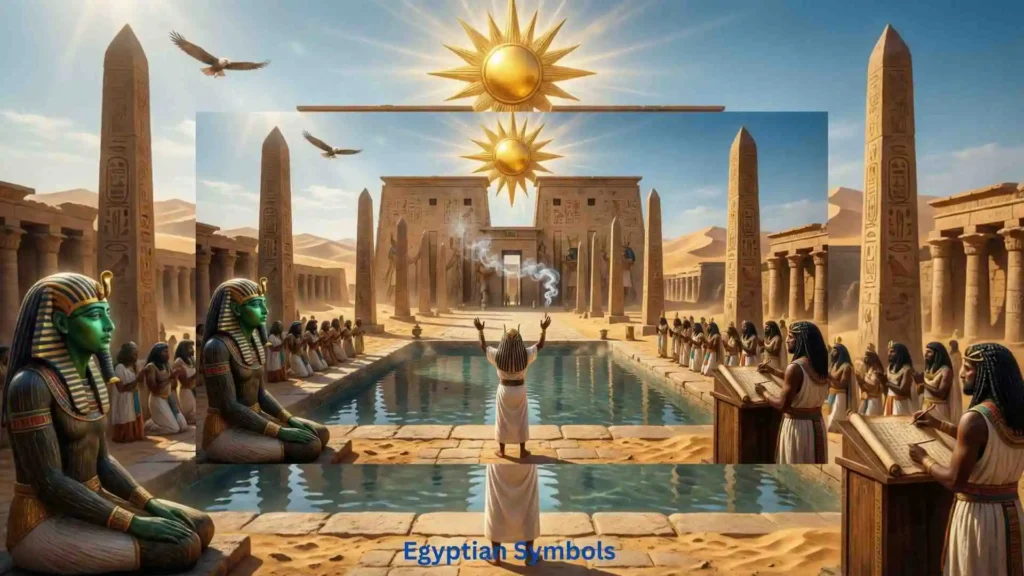
Egyptian symbols are ancient signs used by the people of Ancient Egypt to represent life, power, protection, and spirituality.
Short answer: these symbols helped Egyptians explain the world, their gods, and the afterlife through pictures instead of words.
Even today, Egyptian symbols are popular in jewelry, tattoos, art, and design because their meanings feel mysterious and timeless.
Learning about them helps us connect with one of the world’s oldest and most fascinating civilizations.
What Are Egyptian Symbols?
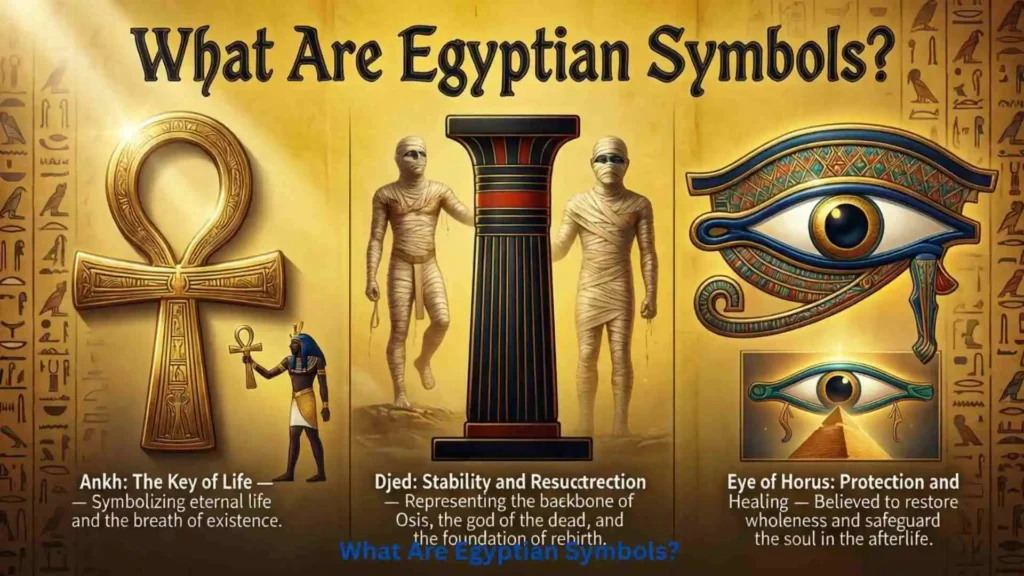
Egyptian symbols are visual representations used to convey ideas, beliefs, and information. Unlike modern alphabets, many Egyptian symbols carried both literal and spiritual meanings.
They were mainly used in:
- Hieroglyphic writing
- Religious ceremonies
- Art and architecture
- Amulets and jewelry
Each symbol often had more than one meaning depending on context.
Why Egyptian Symbols Were So Important
Symbols played a central role in ancient Egyptian society because they:
- Preserved religious beliefs
- Connected humans with gods
- Explained life after death
- Protected people from evil
- Recorded history and knowledge
To Egyptians, symbols were not just drawings—they were powerful tools filled with spiritual energy.
Egyptian Symbols and Hieroglyphs
What Are Hieroglyphs?
Hieroglyphs are the writing system of ancient Egypt. They combine:
- Pictures (symbols)
- Sounds (phonetics)
- Ideas (concepts)
More than 700 hieroglyphic symbols were used over thousands of years.
How Symbols Functioned in Writing
- Some symbols represented sounds
- Some represented whole words
- Some added meaning or emphasis
This made Egyptian writing both artistic and meaningful.
The Ankh: Symbol of Life
Meaning of the Ankh
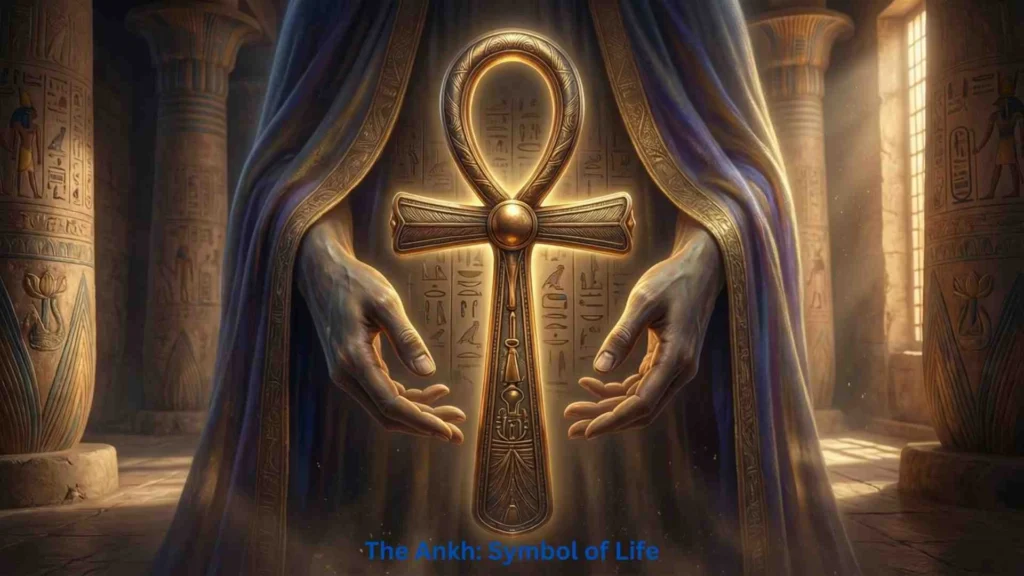
The ankh is one of the most famous Egyptian symbols. It looks like a cross with a loop at the top.
It represents:
- Life
- Eternal life
- Divine protection
Use in Ancient Egypt
- Held by gods in carvings
- Placed in tombs
- Worn as amulets
The ankh symbolized the connection between the physical and spiritual worlds.
The Eye of Horus | Protection and Healing
Origin Story
The Eye of Horus comes from the myth of Horus and Set. Horus lost his eye in battle, and it was magically restored.
Symbolic Meanings
- Protection
- Health and healing
- Wholeness
- Royal power
Practical Uses
- Used on amulets
- Painted on boats for protection
- Associated with medical practices
Even today, the Eye of Horus is a popular protective symbol.
The Scarab Beetle | Rebirth and Transformation
Why a Beetle?
Ancient Egyptians observed scarabs rolling dung balls and believed they symbolized the sun’s movement.
Meanings of the Scarab
- Rebirth
- Renewal
- Creation
- Protection in the afterlife
Scarab amulets were often placed on mummies to ensure safe passage to the next world.
The Was Scepter | Power and Authority
The was scepter is a long staff with a forked base and animal head.
Symbolism
- Power
- Dominion
- Control
Who Used It?
- Gods
- Pharaohs
- High priests
It represented the authority of rulers and divine control over chaos.
The Djed Pillar | Stability and Strength
The Djed pillar looks like a column with horizontal lines.
Meaning
- Stability
- Strength
- Resurrection
It was closely linked to Osiris, the god of the afterlife.
Cultural Role
- Used in religious festivals
- Symbolized the backbone of Osiris
- Represented the stability of the universe
The Feather of Ma’at | Truth and Justice
Who Was Ma’at?
Ma’at was the goddess of truth, balance, and order.
Symbol Meaning
- Truth
- Justice
- Moral balance
In the afterlife, a person’s heart was weighed against Ma’at’s feather. A lighter heart meant a righteous life.
Animal Symbols in Ancient Egypt
Animals played a major role in Egyptian symbolism.
Cat (Bastet)
- Protection
- Fertility
- Home and family
Falcon (Horus)
- Kingship
- Sky and power
- Divine vision
Crocodile (Sobek)
- Strength
- Protection
- Fertility of the Nile
Animals were seen as sacred representations of gods.
Snake Symbols | Protection and Danger
Uraeus (Cobra)
- Worn on pharaohs’ crowns
- Symbolized royal authority
- Protected against enemies
Snakes represented both danger and divine protection.
Sun Symbols in Egyptian Culture
The Sun Disk
- Represented Ra, the sun god
- Symbol of creation and life
Scarab and Sun
- Scarab pushing the sun across the sky
- Daily rebirth of the sun
The sun was central to Egyptian religious belief.
Practical Uses of Egyptian Symbols
In Daily Life
- Jewelry for protection
- Amulets for luck and health
- Symbols carved into homes
In Religion
- Temple decorations
- Ritual objects
- Burial items
In Governance
- Royal insignia
- Monument carvings
- Official seals
Symbols guided every aspect of life.
Egyptian Symbols and the Afterlife
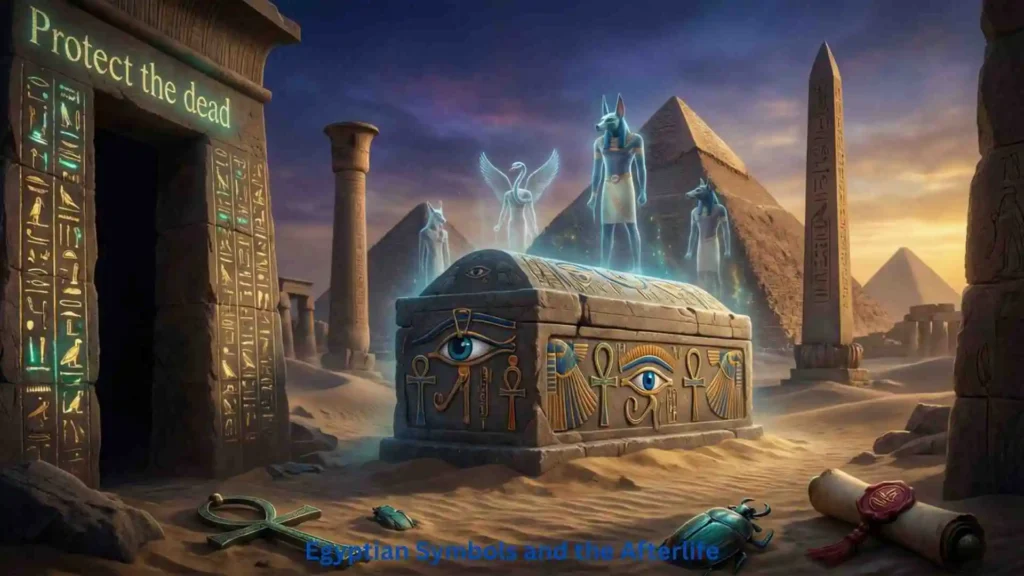
Ancient Egyptians believed strongly in life after death.
Symbols helped:
- Guide the soul
- Protect the dead
- Ensure resurrection
Tombs were filled with symbolic images to prepare the soul for eternity.
Impact of Egyptian Symbols on Society
Cultural Influence
- Inspired Greek and Roman cultures
- Influenced art and architecture
Educational Value
- Help historians understand ancient beliefs
- Teach symbolism and storytelling
Spiritual Impact
- Encourage reflection on life and morality
- Inspire modern spiritual practices
Egyptian symbols still shape human thought today.
Egyptian Symbols in Modern Times
Fashion and Jewelry
- Ankhs and scarabs
- Eye of Horus pendants
Tattoos
- Represent strength, protection, rebirth
Movies and Media
- Used to create mystery and ancient atmosphere
Modern use often blends history with personal meaning.
Interesting Facts About Egyptian Symbols
- Some symbols are over 5,000 years old
- Colors also carried symbolic meaning
- Symbols were believed to hold magical power
- Many meanings changed over time
- Some symbols are still not fully understood
Myths and Legends Behind Egyptian Symbols
Stories of gods like Osiris, Isis, and Horus explain the origins of many symbols. These legends helped people understand natural events like flooding, death, and rebirth.
Learning Egyptian Symbols Today
Students learn Egyptian symbols through:
- History classes
- Museums
- Documentaries
- Digital reconstructions
They remain an important part of world heritage.
Egyptian Symbols vs. Modern Symbols
Unlike modern logos:
- Egyptian symbols were spiritual
- Carried layered meanings
- Connected humans to gods
They were not decorative only—they were sacred.
Frequently Asked Questions (FAQs)
1. What are Egyptian symbols used for?
They were used to express religious beliefs, record history, and provide protection.
2. Are Egyptian symbols religious?
Yes, most are deeply connected to religion and spirituality.
3. Why did Egyptians use so many symbols?
They believed symbols carried power and meaning beyond words.
4. Are Egyptian symbols still used today?
Yes, in art, jewelry, tattoos, and modern spiritual practices.
5. What is the most famous Egyptian symbol?
The ankh and the Eye of Horus are the most well-known.
Conclusion
Egyptian symbols are a window into one of the greatest civilizations in history.
They reveal how ancient Egyptians understood life, death, nature, and the divine.
Far more than simple images, these symbols carried spiritual power, guided daily life, and shaped beliefs that still influence the modern world.
By learning about Egyptian symbols, we gain a deeper appreciation for human creativity, faith, and the timeless search for meaning.

Elliot Kensington
Elliot Kensington is a storyteller at heart, always fascinated by the hidden corners of human imagination. From a young age, he found comfort in books and the worlds they created, inspiring him to craft tales that blend emotion, suspense, and wonder. His writing journey began with short stories that captured fleeting moments of life, and over time, evolved into novels that explore both the extraordinary and the everyday. Elliot believes that every story holds a piece of the soul, and his mission is to connect readers to those moments that linger long after the last page. When he’s not writing, he enjoys exploring nature, capturing moments through photography, and seeking inspiration in the little things.
Books by Elliot Kensington:
-
Shadows of Tomorrow
-
The Whispering Path