Egyptian symbols have fascinated people for centuries. From the familiar ankh and Eye of Horus to scarabs, djed pillars, royal crowns, and mysterious hieroglyphic signs, these images appear throughout ancient Egyptian temples, tombs, jewelry, amulets, statues, and inscriptions.
But Egyptian symbols are more than attractive designs. Many were connected with ideas such as life, protection, renewal, kingship, stability, truth, the gods, and the afterlife. Some symbols could also have different associations depending on the period, object, deity, or setting in which they appeared.
This guide explains the most important Egyptian symbols in simple language. It also explains the difference between Egyptian symbols and hieroglyphs, the symbols connected with major Egyptian gods, Egyptian royal and animal symbols, common symbols used in tattoos and jewelry, and how to identify some of the most recognizable ancient Egyptian signs.
Egyptian Symbols at a Glance
What Do Egyptian Symbols Mean? (Quick Answer)
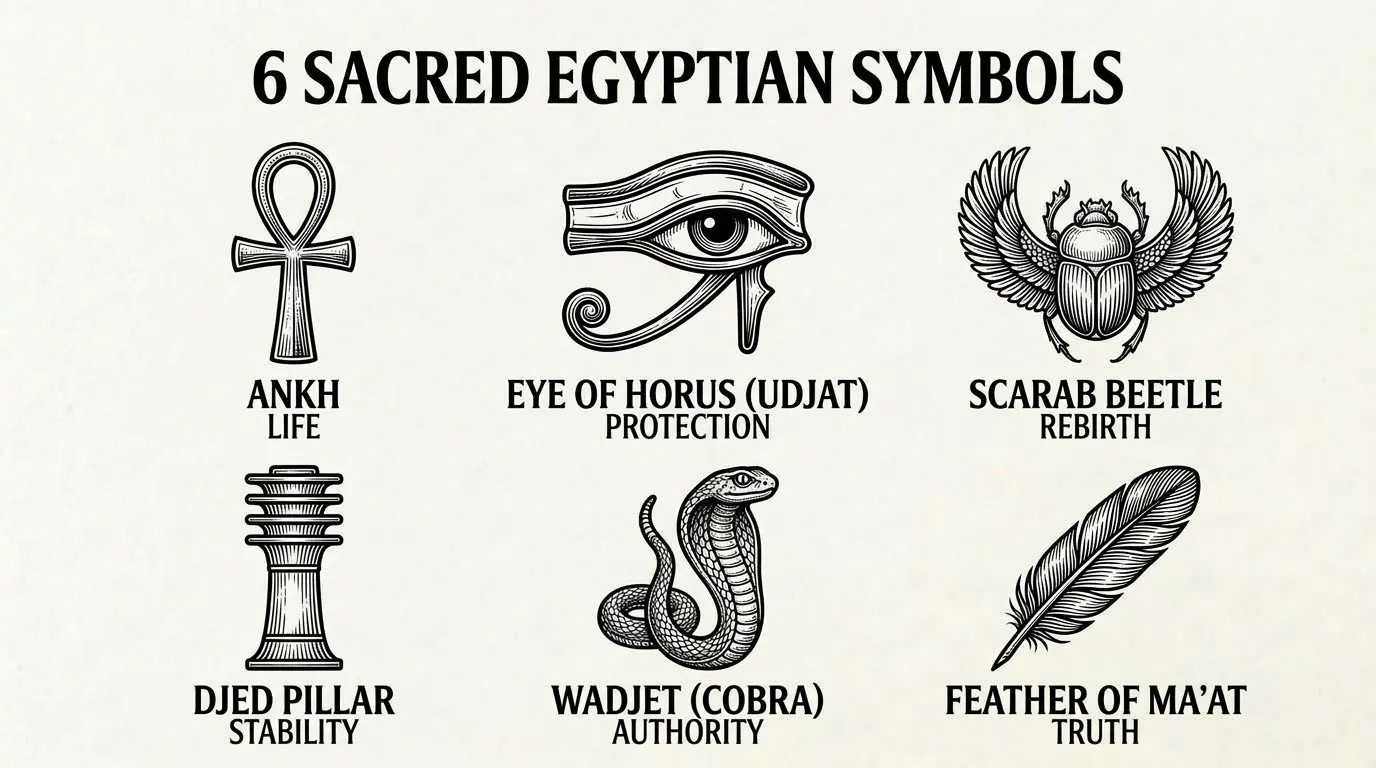
Egyptian symbols were visual signs used to communicate religious, royal, funerary, cultural, and everyday ideas. Some of the best-known include the ankh for life, Eye of Horus for healing and protection, scarab for renewal and becoming, djed for stability, was scepter for dominion, and feather of Ma’at for truth and order.
The table below provides a quick reference before exploring each symbol in detail.
| Egyptian Symbol | Common Name | Main Association |
| 𓋹 | Ankh | Life and eternal life |
| 𓂀 | Eye of Horus / Wedjat | Healing, protection, restoration |
| 𓆣 | Scarab | Renewal and becoming |
| 𓊽 | Djed | Stability and endurance |
| 𓌀 | Was Scepter | Power and dominion |
| 𓂀 | Wedjat Eye | Health and regeneration |
| 𓏏 | Tyet / Knot of Isis | Isis and protection |
| 🪶 | Feather of Ma’at | Truth, balance, and order |
| 𓆓 | Uraeus/Cobra | Royal protection |
| 𓇳 | Sun Disk | Solar power and divinity |
| 𓆰 | Lotus/Sesen | Creation and renewal |
| Cartouche | Royal name enclosure | Royal identity |
| Shen Ring | Eternal enclosure | Protection and eternity |
| Crook and Flail | Royal insignia | Kingship and authority |
| Double Crown | Pschent | Unified Egypt |
The meanings in this table are simplified for quick reference. Ancient Egyptian symbolism was not always fixed to one definition, and the same sign could have several related associations.
What Are Egyptian Symbols?
Egyptian Symbols in Ancient Egypt
Ancient Egyptians used visual imagery extensively in religious art, architecture, funerary objects, royal monuments, jewelry, and writing. A symbol could communicate an idea even when it was not being used as ordinary written language.
The ankh, djed, and was are a useful example. Museum evidence shows these signs appearing together, combining ideas associated with life, stability, and dominion. Such combinations demonstrate why it can be misleading to assume that every Egyptian symbol had only one simple meaning.
Symbols could appear on temple walls, coffins, statues, amulets, scarabs, crowns, furniture, and other objects. Their meaning often became clearer from the surrounding imagery and the purpose of the object.
Egyptian Symbols vs. Hieroglyphs
Egyptian symbols and hieroglyphs are related, but they are not exactly the same thing.
Hieroglyphs were part of an ancient Egyptian writing system. They could represent sounds, words, concepts, or grammatical elements. Some recognizable symbols were also hieroglyphic signs.
The ankh is a good example. It could represent the concept of life while also functioning as a hieroglyphic sign.
However, not every Egyptian image should automatically be called a hieroglyph. A royal crown, deity, animal figure, or complex temple scene may have symbolic meaning without being a single writing sign.
This distinction is important because modern websites sometimes use “Egyptian symbols” and “Egyptian hieroglyphs” as if they mean exactly the same thing.
Why Context Matters
Ancient Egyptian civilization lasted for thousands of years. Religious beliefs, artistic styles, royal traditions, and symbolism developed and changed over time.
Therefore, it is better to say that a symbol was associated with an idea rather than claiming that it always meant exactly one thing.
For example, a scarab can be associated with renewal and the rising sun, but its meaning can become more specific when it appears with a particular deity, inscription, or funerary object.
This approach gives a more accurate picture of ancient Egyptian culture.
Most Famous Egyptian Symbols
Ankh
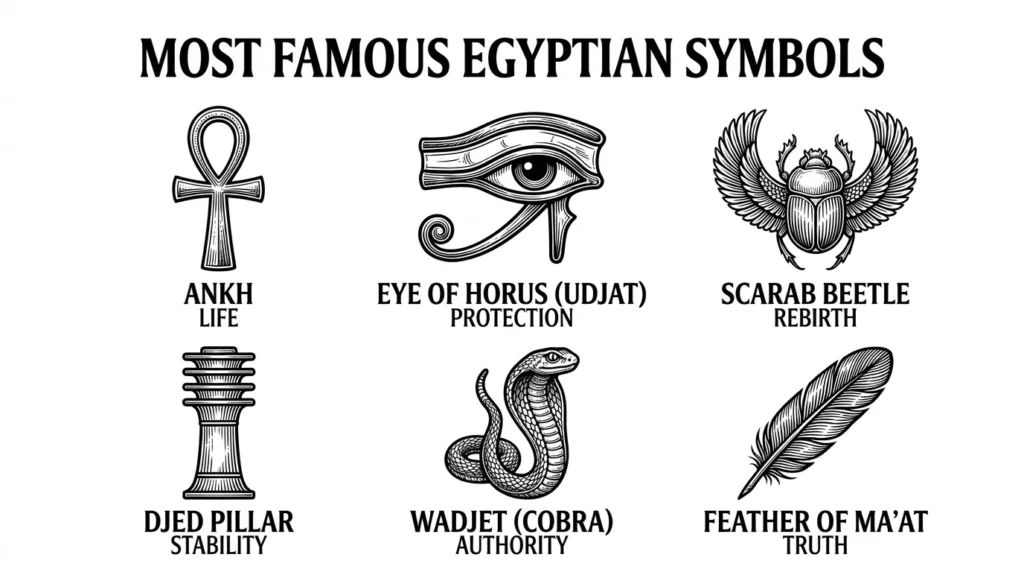
The ankh is probably the most recognizable Egyptian symbol. It has a cross-like shape with a loop at the top and is commonly associated with life.
The symbol appears frequently in Egyptian art, particularly in scenes involving gods and royalty. Gods may be shown holding an ankh or presenting one to a king.
Its association with life also connects it with continued existence and the idea of life beyond death.
The ankh is still widely used today in jewelry, artwork, tattoos, fashion, and decorative designs. However, its ancient religious context is much broader than the modern idea of simply calling it a “symbol of life.”
Main meaning: Life, continued existence, and eternal life.
Eye of Horus
The Eye of Horus, also called the Wedjat, is one of the most recognizable Egyptian symbols.
Its meaning is connected with the mythological injury and restoration of the eye of Horus. Because the eye was restored, the symbol became associated with healing, regeneration, health, and protection.
Ancient Egyptian amulets shaped like the wedjat were used for protective purposes. Museum examples show the wedjat appearing on scarabs and other amulets.
The symbol is often confused with the Eye of Ra, but they should not simply be treated as identical.
Main meaning: Healing, restoration, health, and protection.
Eye of Ra
The Eye of Ra belongs to a different mythological tradition from the Eye of Horus, although modern designs sometimes make the two look interchangeable.
The Eye of Ra is associated with the solar power of the god Ra and with divine forces that could protect order and punish threats.
It is often connected with powerful female deities in Egyptian mythology, depending on the particular story and period.
Main meaning: Solar power, divine authority, protection, and destructive force in certain myths.
Scarab
The scarab beetle became one of the most important images in ancient Egyptian symbolism.
Its association with the sun god Khepri connects it with becoming, renewal, and the daily rising of the sun. Scarab amulets were especially popular and could carry additional hieroglyphic signs.
Some ancient scarabs combined signs such as the ankh, djed, wedjat, and other positive symbols. This shows that Egyptians could intentionally combine several signs to create a protective or favorable message.
Main meaning: Renewal, becoming, regeneration, and solar rebirth.
Djed
The djed is a pillar-like symbol traditionally associated with stability and endurance.
It became closely connected with Osiris and funerary beliefs. The djed was also used in religious and protective imagery.
The exact origin of its form has been interpreted in different ways, so it is better not to present one modern explanation as certain. What is clear is that stability and endurance are major associations of the sign.
The djed was sometimes combined with the ankh and was scepter, creating a powerful group of related concepts.
Main meaning: Stability, endurance, and associated Osirian ideas.
Was Scepter
The was scepter is a long staff topped by a stylized animal head and ending in a forked form.
It is strongly associated with power, dominion, and authority. Gods and kings are frequently shown holding it.
The was was not merely a decorative staff. Its presence in religious and royal imagery helped communicate authority and divine or royal power.
Main meaning: Power, dominion, authority, and control.
Tyet or Knot of Isis
The tyet is often called the Knot of Isis.
Its shape resembles a tied loop or knot and it became closely associated with the goddess Isis. It is commonly interpreted in connection with protection, security, and Isis’s protective power.
The tyet is sometimes compared visually with the ankh, but the two are distinct symbols.
Main meaning: Protection, security, and association with Isis.
Feather of Ma’at
The feather of Ma’at is associated with the goddess Ma’at and the important Egyptian concepts of truth, balance, justice, and cosmic order.
Ma’at represented an ideal of proper order that applied to society, kingship, religion, and the universe.
The feather is especially famous because of its connection with Egyptian funerary beliefs. In representations of the judgment of the dead, the heart of the deceased is weighed against the feather of Ma’at.
Main meaning: Truth, balance, justice, and order.
Uraeus Cobra
The uraeus is the raised cobra associated with Egyptian royalty and divine protection.
The cobra was particularly connected with Wadjet, a protective goddess associated with Lower Egypt. The image became an important part of royal regalia.
A cobra on a king’s headdress could communicate protection and royal authority.
Main meaning: Royal protection, sovereignty, and divine authority.
Lotus or Sesen
The lotus is commonly associated with creation, renewal, and the emergence of life.
Lotus imagery appears throughout Egyptian art, including temple decoration, columns, paintings, and objects.
Its association with the daily cycle of opening and closing helped make it an important image of renewal.
Main meaning: Creation, renewal, rebirth, and beauty.
Cartouche
A cartouche is an elongated oval enclosure surrounding the name of a king or queen in Egyptian writing.
It is not simply a decorative symbol. Its purpose was closely connected with royal identity.
The cartouche is particularly useful for readers interested in Egyptian names because it helps identify royal names in inscriptions.
Main meaning: Royal identity, name, and protection of the royal name.
Shen Ring
The shen ring is a circular symbol associated with the idea of eternity and protection.
Its circular form suggests something enclosed or without an obvious beginning or end.
The shen motif appears in Egyptian art and can also be connected visually with other protective symbols.
Main meaning: Protection, eternity, and enclosure.
Egyptian Symbols by Meaning
Symbols of Life
The ankh is the clearest symbol associated with life, but it is not the only Egyptian image connected with continued existence.
The scarab, solar imagery, lotus, and certain funerary signs could also participate in ideas of renewal and continuation.
Ancient Egyptian culture did not always separate “life” and “afterlife” as sharply as modern readers might. Objects placed in tombs could be intended to support the deceased in the next stage of existence.
Symbols of Protection
The most recognizable include:
- Eye of Horus
- Uraeus
- Tyet
- Shen ring
- Protective scarab imagery
The wedjat is especially well documented as an amulet. Museum examples show wedjat amulets placed with the dead and explain their connection with healing and regeneration.
Symbols of Rebirth and Renewal
The scarab, lotus, djed, and solar imagery can all be associated with renewal.
The scarab is particularly connected with Khepri and the daily solar cycle. The lotus became associated with creation and renewal, while the djed carried associations with stability and Osirian traditions.
Rather than treating these symbols as identical, it is better to understand them as different images participating in a broader Egyptian interest in regeneration and continued existence.
Symbols of Power
The was scepter is strongly associated with dominion.
Other symbols connected with royal power include:
- Crook and flail
- Uraeus
- Crowns
- Cartouches
- Solar imagery
- Royal staffs
These images often appear in scenes of kingship and divine authority.
Symbols of Truth and Balance
The feather of Ma’at is the best-known symbol in this category.
Ma’at represented a principle of truth, balance, justice, and proper order. Her symbolism was particularly important in ideas surrounding kingship and the judgment of the dead.
The feather therefore represents more than “truth” in a modern everyday sense. It belongs to a much larger Egyptian concept of maintaining proper order.
Symbols of Royalty
Egyptian kingship had a rich visual language.
Royal symbols include:
- Uraeus
- Double Crown
- Red Crown
- White Crown
- Crook and flail
- Cartouche
- Khepresh or blue crown
- Was scepter
These symbols helped communicate the king’s identity, authority, territory, and relationship with the gods.
Symbols of the Afterlife
Egyptian funerary symbolism includes many of the same signs seen in temples and royal art.
Important examples include:
- Ankh
- Djed
- Scarab
- Wedjat
- Anubis and jackal imagery
- Osirian symbols
- Feather of Ma’at
- Ka and Ba imagery
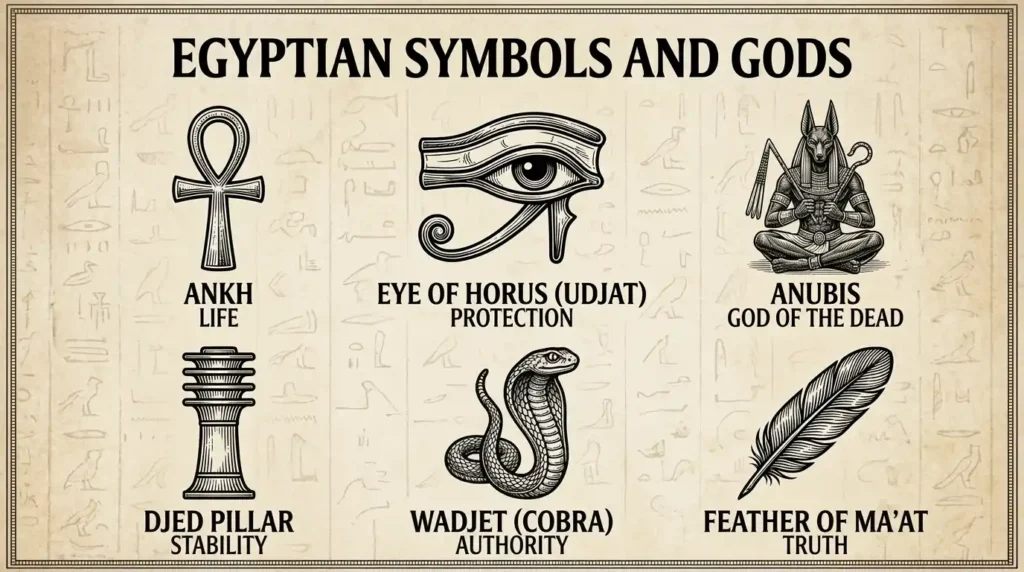
Egyptian Symbols and Gods
Horus
The Eye of Horus became particularly important because of the story of its injury and restoration. This is why the wedjat came to be associated with healing and regeneration.
Ra
Ra is one of the best-known Egyptian solar gods.
The sun disk is central to his imagery, and the Eye of Ra represents an aspect of his solar power in Egyptian mythology.
Ra’s symbolism is therefore closely connected with the sun, kingship, divine authority, and cosmic order.
Osiris
Osiris is strongly connected with death, resurrection, and the afterlife.
The djed pillar is closely associated with Osirian traditions, while the crook and flail are also important in representations of Osiris.
His imagery became especially important in Egyptian funerary traditions.
Isis
Isis is one of the most important goddesses in Egyptian religion.
The tyet, or Knot of Isis, is associated with her protective power. Isis is also frequently represented as a protective mother and a powerful magical and divine figure.
Anubis
Anubis is traditionally represented with a jackal or jackal-headed human form.
He is strongly associated with funerary practices, protection of the dead, and the transition to the afterlife.
Because of this, jackal imagery can be an important clue when identifying Egyptian funerary scenes.
Thoth
Thoth is commonly represented with an ibis head or as an ibis.
He is associated with writing, knowledge, measurement, and intellectual activities.
The ibis therefore became an important animal image connected with Thoth.
Bastet
Bastet is commonly represented as a cat or a woman with a cat’s head.
Cats had an important place in Egyptian religious culture, and Bastet became associated with protection, the home, motherhood, and other aspects of Egyptian life.
Hathor
Hathor is frequently represented with cow imagery, horns surrounding a sun disk, or other distinctive forms.
She was associated with motherhood, femininity, music, joy, and other important aspects of Egyptian religious life.
Khepri
Khepri is closely associated with the scarab beetle.
The scarab’s connection with Khepri helps explain why the beetle became an image of becoming, renewal, and the daily solar cycle.
Ma’at
Ma’at is represented by the ostrich feather.
Her name and symbolism are associated with truth, balance, justice, and cosmic order.
The feather is especially important in funerary scenes involving the judgment of the deceased.
Egyptian Animal Symbols
Falcon
The falcon is strongly associated with Horus and royal or divine imagery.
Its ability to fly high in the sky made it a particularly appropriate image for a deity connected with the heavens.
Scarab Beetle
The scarab is associated with Khepri and renewal.
Scarab amulets became widespread and could contain additional signs, names, or inscriptions.
Jackal
Jackal imagery is closely associated with Anubis and funerary traditions.
The animal’s connection with desert and burial areas likely contributed to its religious associations.
Ibis
The ibis is associated with Thoth.
Its image can therefore help identify scenes connected with writing, knowledge, and the god’s religious role.
Cat
Cats are strongly associated with Bastet and can represent protective and domestic aspects of Egyptian religious culture.
Not every cat image should automatically be interpreted as Bastet, however. The surrounding context matters.
Cobra
The cobra is closely associated with protection and royalty, especially through the uraeus.
The raised cobra on royal regalia is one of the most recognizable images in Egyptian art.
Cow
Cow imagery is strongly associated with Hathor and can communicate maternal and divine associations.
Egyptian animal symbolism was complex, so an animal could be connected with more than one deity or concept depending on the context.
Egyptian Royal Symbols
Uraeus
The uraeus was worn as part of royal headdresses and represented protective authority.
Its raised cobra form created a visual statement that the king was protected by divine power.
Red Crown of Lower Egypt
The Red Crown, commonly called the Deshret, represented Lower Egypt.
Its distinctive form makes it useful for identifying royal imagery associated with the northern part of the country.
White Crown of Upper Egypt
The White Crown, or Hedjet, represented Upper Egypt.
It is often shown as a tall white crown.
Double Crown
The Double Crown, often called the Pschent, combines the symbols of Upper and Lower Egypt.
It therefore became an important representation of a unified Egyptian kingdom.
Crook and Flail
The crook and flail are among the most famous royal objects.
Cartouche
The cartouche surrounds the name of a king or queen.
It provides a useful visual clue when identifying royal names in hieroglyphic inscriptions.
Egyptian Symbols in Tombs, Temples, and Amulets
Temple Symbols
Temples contained enormous amounts of symbolic imagery.
Gods, kings, crowns, animals, staffs, solar disks, and hieroglyphic signs could appear together in carefully designed scenes.
These were not simply decorations. Their placement and combination helped communicate religious and royal ideas.
Tomb and Afterlife Symbols
Tombs contain some of the richest examples of Egyptian symbolic imagery.
Amulets and Jewelry
Amulets are particularly important for understanding Egyptian symbols.
The wedjat eye, for example, appears on ancient amulets associated with health, regeneration, and protection.
Scarab amulets could also carry combinations of signs. Museum examples demonstrate that Egyptians sometimes selected hieroglyphic signs for their positive or protective associations.
Royal Inscriptions
Royal inscriptions often combine names, titles, gods, crowns, animals, and symbols.
A single monument may therefore contain several layers of meaning rather than one isolated symbol.
Egyptian Symbols You Can Copy and Paste
Common Egyptian Unicode Symbols
Examples include:
- Ankh: 𓋹
- Eye of Horus/Wedjat: 𓂀
- Scarab: 𓆣
- Djed: 𓊽
- Was: 𓌀
- Papyrus: 𓇑
- Lotus-related signs: 𓆸
- Sun disk: 𓇳
These characters are useful for digital posts, educational pages, usernames, notes, and decorative text.
Important Note About Hieroglyphic Characters
A Unicode hieroglyph is not necessarily a complete representation of everything an ancient Egyptian symbol meant.
Ancient inscriptions depended on combinations of signs, orientation, artistic style, language, grammar, and historical context.
Therefore, copying one hieroglyph and assigning it a modern English word does not always reproduce the full meaning of an ancient inscription.
Egyptian Symbols for Tattoos and Jewelry
Ankh Tattoos
Because the ankh has a well-established ancient association with life, it is one of the easier symbols to understand historically.
Eye of Horus Tattoos
The Eye of Horus is popular in tattoos because of its association with healing, restoration, and protection.
If choosing this design, it is useful to understand that the ancient symbol was connected with the mythological restored eye of Horus rather than simply being a generic “good luck eye.”
Scarab Tattoos
A scarab can represent renewal, becoming, regeneration, or a connection with Khepri and Egyptian solar traditions.
Its historical background makes it especially meaningful for people interested in transformation and new beginnings.
Djed Tattoos
A djed tattoo can be connected with stability and endurance.
It is less immediately recognizable to modern audiences than the ankh or Eye of Horus, which can make it an interesting choice for someone who wants a less common Egyptian design.
Lotus Tattoos
A lotus design can represent renewal and creation within an Egyptian context.
However, lotus imagery appears in many cultures, so someone wanting specifically Egyptian symbolism may wish to combine it with clearly Egyptian artistic elements.
Ancient Egyptian Symbols vs. Modern Meanings
What Has Stayed the Same?
Some modern interpretations are reasonably close to ancient associations.
For example:
- Ankh → life
- Wedjat → healing/protection
- Djed → stability
- Scarab → renewal
- Feather of Ma’at → truth/order
- Uraeus → royal protection
These associations are supported by surviving objects, inscriptions, art, and museum collections.
What Has Changed?
Modern popular culture often simplifies Egyptian symbolism.
A symbol may be reduced to one word even though ancient Egyptians used it within a much larger religious system.
Tattoos, jewelry, movies, games, fashion, and social media may also give symbols new meanings that did not exist in ancient Egypt.
That does not necessarily make modern interpretations wrong, but they should be identified as modern interpretations rather than presented as unquestionable ancient facts.
Which Egyptian Symbol Is This?
Quick Identification Guide
If you see a looped cross, you are probably looking at an ankh.
If you see a stylized eye with distinctive markings, it may be the Eye of Horus or wedjat.
If you see a beetle, it is likely a scarab.
If you see a pillar with horizontal sections at the top, it may be a djed.
If you see a long staff topped by an animal-like head, it may be a was scepter.
If you see a raised cobra on a royal crown, it is likely a uraeus.
If you see an oval surrounding a royal name, it is a cartouche.
If you see a feather associated with judgment or Ma’at, it refers to the feather of Ma’at.
If you see a falcon, look for connections to Horus or other sky and solar imagery.
If you see a jackal or jackal-headed figure, Anubis is a likely association.
Commonly Confused Egyptian Symbols
Eye of Horus vs. Eye of Ra: These have different mythological associations even though modern designs can make them look similar.
Ankh vs. Tyet: Both can look somewhat similar, but the tyet is associated particularly with Isis, while the ankh is associated with life.
Djed vs. Was: The djed is a pillar-like symbol associated with stability, while the was is a staff associated with dominion and authority.
Scarab vs. beetle decoration: A scarab in Egyptian art can carry religious and symbolic associations, especially when used as an amulet.
Hieroglyph vs. symbol: Some symbols can function as hieroglyphic signs, but not every symbolic image is simply a hieroglyph.
Frequently Asked Questions About Egyptian Symbols
What is the most famous Egyptian symbol?
The ankh is one of the most recognizable Egyptian symbols. Its looped-cross shape is strongly associated with life and continued existence.
What is the Egyptian symbol for life?
The ankh is the best-known Egyptian symbol associated with life. It appears frequently in ancient Egyptian religious and royal imagery.
What is the Egyptian symbol for protection?
The Eye of Horus or wedjat is one of the best-known Egyptian protective symbols. Uraeus, tyet, and shen imagery can also have protective associations.
What is the difference between the Eye of Horus and Eye of Ra?
The Eye of Horus is connected with the restored eye of Horus and associations such as healing and regeneration. The Eye of Ra is connected with the solar power of Ra and different mythological traditions.
Are Egyptian symbols the same as hieroglyphs?
No. Hieroglyphs were part of an Egyptian writing system, while “Egyptian symbols” is a much broader category that can include religious, royal, funerary, artistic, and writing-related imagery.
What symbolizes rebirth in ancient Egypt?
Several symbols can be associated with renewal or rebirth, including the scarab, lotus, djed, and solar imagery. Their exact meaning depends on context.
What are the symbols of Egyptian gods?
Different gods had different associated symbols. Horus is connected with the falcon and Eye of Horus, Ra with solar imagery, Osiris with the djed and crook and flail, Isis with the tyet, Anubis with the jackal, Thoth with the ibis, and Khepri with the scarab.
What is the Egyptian symbol for truth?
The feather of Ma’at is strongly associated with truth, justice, balance, and proper order.
What is the Egyptian symbol of royalty?
Egyptian royalty was represented through several symbols rather than one single sign. The uraeus, crowns, crook and flail, cartouche, and was scepter are among the most recognizable.
Can Egyptian symbols be used as tattoos?
Yes. Ankh, Eye of Horus, scarab, djed, lotus, and cartouche designs are commonly used in modern tattoos. Anyone choosing one should research its historical context rather than relying only on simplified modern meanings.
Conclusion
Egyptian symbols form a rich visual language connected with life, protection, renewal, kingship, truth, the gods, and the afterlife. The ankh, Eye of Horus, scarab, djed, was scepter, feather of Ma’at, uraeus, lotus, and cartouche are among the best-known examples.
The most important thing to remember is that an ancient Egyptian symbol rarely existed in isolation. Its meaning could depend on the object, inscription, deity, historical period, and setting in which it appeared.
If you are studying Egyptian history, choosing a tattoo, researching a hieroglyph, or simply trying to identify an ancient Egyptian sign, looking at both the symbol and its context will give you a much more accurate understanding.

Isaac Wellington
I’ve always been fascinated by the hidden stories in everyday life and the power of words to change how we see the world. Writing, for me, isn’t just a profession—it’s a way to explore human emotions, mysteries, and the unexpected twists of life. Over the years, I’ve dedicated myself to creating stories that linger in your mind long after the last page. When I’m not writing, you’ll usually find me wandering through old libraries or sketching ideas in a notebook. I believe every story has a heartbeat, and I aim to capture that rhythm in my work. Join me on a journey where imagination meets reality, and the ordinary becomes extraordinary.
Books:
-
Shadows of the Forgotten
-
Whispers Through Time