Music symbols are special signs used in written music to show how a song should be played or sung.
In simple words, they help turn sounds into something we can see and understand on paper.
Whether you are a student, a beginner, or just curious about music, learning music symbols makes reading and enjoying music much easier.
These symbols act like a universal language that connects musicians all around the world.
What Are Music Symbols?
Music symbols are standardized marks written on a musical staff or sheet music to explain how music should be played or sung. Each symbol has a specific meaning related to:
- Pitch (how high or low a sound is)
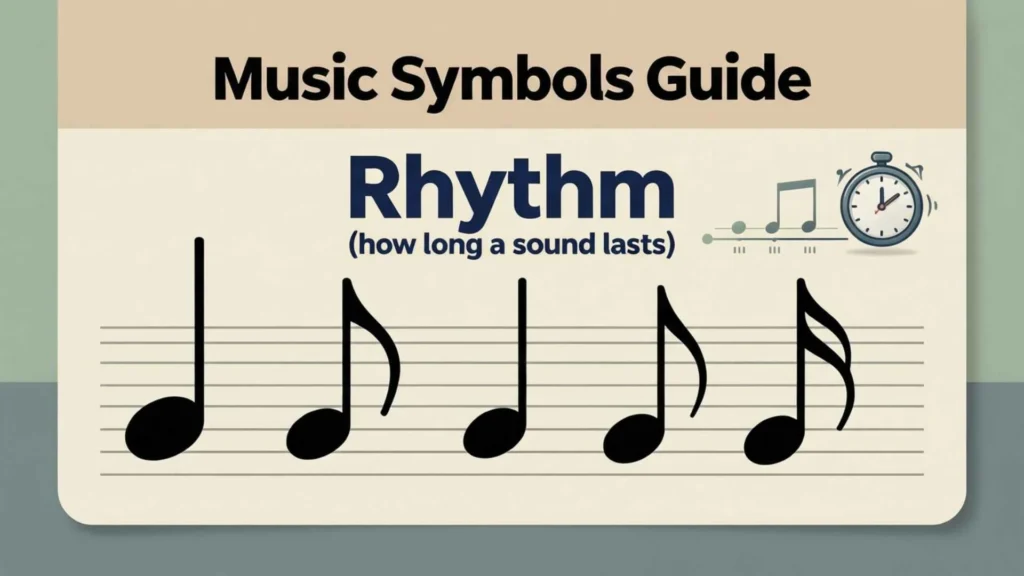
- Rhythm (how long a sound lasts)
- Expression (how the music feels)
- Technique (how notes are performed)
Together, these symbols create a complete musical instruction system.
The History of Music Symbols
Early Music Notation
In ancient times, music was passed down orally. However, as music became more complex, symbols became necessary.
- Ancient Greeks used letter-based symbols
- Medieval monks developed neumes, early pitch indicators
- These neumes evolved into the modern staff system
The Birth of the Musical Staff
Around the 11th century, Guido of Arezzo introduced:
- A four-line staff
- Clefs to show pitch
- A system that allowed musicians to read music more precisely
This was a turning point in music education and composition.
The Musical Staff | The Foundation of Music Symbols
The musical staff consists of five horizontal lines and four spaces. Each line and space represents a different pitch.
Why the Staff Matters
- Organizes pitch visually
- Works with clefs to define note names
- Used universally in Western music
Without the staff, most modern music symbols would have no reference point.
Clefs | Defining Pitch Range
Clefs tell musicians which notes belong to which lines and spaces.
Treble Clef
- Used for high-pitched instruments and voices
- Common for piano (right hand), violin, flute, soprano voice
Bass Clef
- Used for low-pitched instruments
- Common for piano (left hand), cello, bass guitar
Alto and Tenor Clefs
- Used for viola and some orchestral instruments
- Help avoid excessive ledger lines
Clefs make music readable for different instruments.
Notes and Rests | The Core Music Symbols
Musical Notes
Notes show pitch and duration.
Common note types include:
- Whole note
- Half note
- Quarter note
- Eighth note
- Sixteenth note
Each note shape tells the performer how long to hold the sound.
Rests
Rests represent silence in music.
- Whole rest
- Half rest
- Quarter rest
- Eighth rest
Silence is just as important as sound in creating musical balance.
Time Signatures | Organizing Rhythm
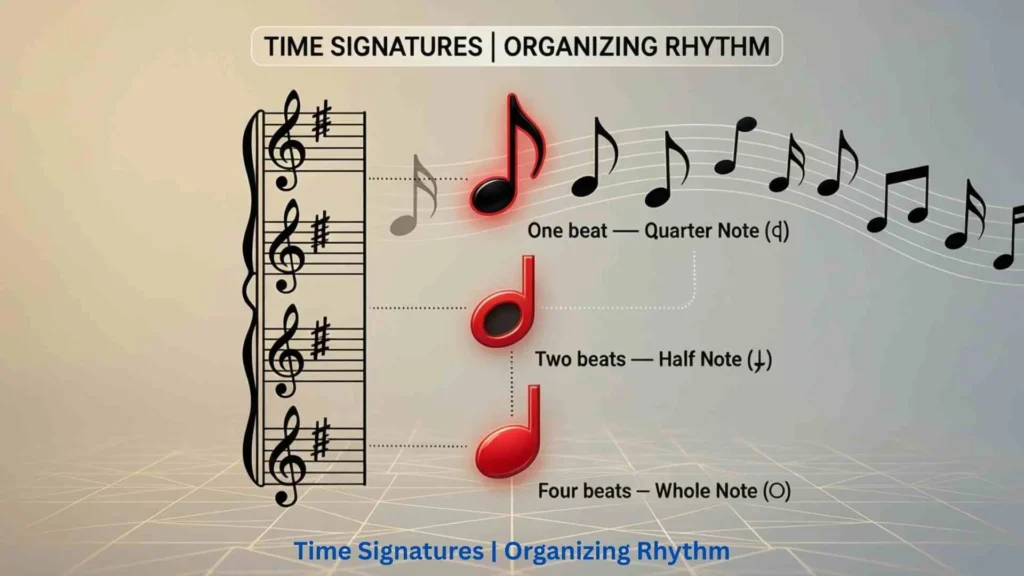
Time signatures appear at the beginning of a piece.
Common Examples
- 4/4 (common time)
- 3/4 (waltz time)
- 6/8 (compound rhythm)
They tell musicians:
- How many beats are in each measure
- What type of note gets one beat
This helps performers stay in rhythm together.
Key Signatures | Establishing Tonality
Key signatures show which notes are sharp or flat throughout a piece.
Why Key Signatures Matter
- Define the musical scale
- Create mood (happy, sad, dramatic)
- Reduce the need for repeated accidentals
For example:
- C major has no sharps or flats
- G major has one sharp
- F major has one flat
Accidentals | Temporary Pitch Changes
Accidentals alter notes temporarily.
- Sharp (♯): raises pitch
- Flat (♭): lowers pitch
- Natural (♮): cancels sharp or flat
These symbols allow composers to add color and tension to music.
Dynamics | Expressing Volume and Emotion
Dynamics show how loud or soft music should be played.
Common Dynamic Symbols
- p (piano): soft
- f (forte): loud
- mf (mezzo-forte): moderately loud
- crescendo: gradually louder
- decrescendo: gradually softer
Dynamics bring emotion and contrast to music.
Articulation Symbols | Shaping Sound
Articulation symbols describe how notes are played.
Examples
- Staccato: short and detached
- Legato: smooth and connected
- Accent: emphasized note
- Tenuto: held for full value
These symbols add personality to musical phrases.
Tempo Marks | Controlling Speed
Tempo symbols guide the speed of music.
Traditional Italian Terms
- Largo: very slow
- Andante: walking pace
- Allegro: fast and lively
- Presto: very fast
Modern Tempo Markings
- Metronome numbers (e.g., ♩ = 120)
- Descriptive words like “slowly” or “energetically”
Tempo affects the overall mood of a piece.
Expression and Style Symbols
These music symbols communicate the character of music.
- Dolce: sweetly
- Cantabile: in a singing style
- Marcato: strongly marked
- Rubato: flexible tempo
They help performers interpret music beyond the notes.
Ornamentation Symbols | Musical Decoration
Ornaments add elegance and flair.
Common Ornaments
- Trill
- Mordent
- Grace notes
- Turn
These symbols are especially common in classical and baroque music.
Repeat and Structural Symbols
These symbols organize music structure.
- Repeat signs
- First and second endings
- Da capo (D.C.)
- Dal segno (D.S.)
- Coda
They prevent unnecessary repetition of written music.
Music Symbols in Different Genres
Classical Music
- Heavy use of traditional notation
- Detailed symbols for expression and technique
Jazz Music
- Chord symbols
- Improvisation markings
- Swing rhythm indicators
Popular Music
- Lead sheets
- Lyrics with chord symbols
- Simplified notation
Music symbols adapt to fit different musical styles.
Music Symbols in Digital Music
Software and Apps
- Play, pause, record icons
- MIDI notation symbols
- Loop and tempo markers
Modern Composition
- Digital notation tools
- Music symbols used globally online
- Easy sharing and editing
Technology has expanded how music symbols are used and taught.
Practical Applications of Music Symbols
In Education
- Teaching students to read music
- Developing rhythm and pitch accuracy
- Improving memory and coordination
In Performance
- Guiding ensemble coordination
- Ensuring consistent interpretation
- Preserving composer’s intentions
In Composition
- Writing original music
- Experimenting with harmony and rhythm
- Communicating ideas clearly
Music symbols make musical collaboration possible.
Impact and Benefits of Music Symbols on Society
Cultural Preservation
- Safeguard musical heritage
- Preserve traditional and classical works
Global Communication
- Musicians from different countries can play together
- One universal system for music education
Cognitive and Emotional Benefits
- Improve brain development
- Enhance emotional expression
- Support therapy and mental health
Music symbols indirectly improve human connection and creativity.
Interesting Facts About Music Symbols
- The treble clef was once shaped differently
- Italian terms dominate music notation due to history
- Some symbols are over 500 years old
- Music notation varies slightly across cultures
- Emojis are sometimes called modern music symbols 🎵
Music Symbols in Other Cultures
Eastern Music
- Uses numeric or letter-based systems
- Different symbols for pitch and rhythm
Folk Traditions
- Often rely on oral teaching
- Some use simplified notation
Despite differences, the goal remains the same: preserving sound.
Learning Music Symbols Today
Best Ways to Learn
- Practice reading sheet music
- Use flashcards and apps
- Play instruments regularly
- Listen while following scores
With practice, music symbols become second nature.
Frequently Asked Questions (FAQs)
1. Why are music symbols important?
They allow musicians to read, write, and perform music accurately and consistently.
2. Are music symbols the same worldwide?
Most Western music symbols are universal, though some cultures use different systems.
3. How long does it take to learn music symbols?
Basic symbols can be learned in weeks, while mastery takes ongoing practice.
4. Can you make music without symbols?
Yes, but symbols help preserve and share music more effectively.
5. Are music symbols still relevant today?
Absolutely. They are essential in education, performance, and digital music creation.
Conclusion
Music symbols are the written language of sound. They transform invisible melodies into visible instructions that anyone can learn and interpret.
From ancient monks to modern musicians, these symbols have shaped how music is taught, shared, and preserved. By understanding music symbols, we unlock a deeper connection to music itself its structure, emotion, and timeless beauty.

Elliot Kensington
Elliot Kensington is a storyteller at heart, always fascinated by the hidden corners of human imagination. From a young age, he found comfort in books and the worlds they created, inspiring him to craft tales that blend emotion, suspense, and wonder. His writing journey began with short stories that captured fleeting moments of life, and over time, evolved into novels that explore both the extraordinary and the everyday. Elliot believes that every story holds a piece of the soul, and his mission is to connect readers to those moments that linger long after the last page. When he’s not writing, he enjoys exploring nature, capturing moments through photography, and seeking inspiration in the little things.
Books by Elliot Kensington:
-
Shadows of Tomorrow
-
The Whispering Path